
Unlocking Profit from Free Code: What Exactly is Commercial Open Source Software?
Discover how businesses build thriving enterprises on the foundation of freely accessible software.
Commercial Open Source Software (COSS) represents a fascinating intersection of open-source ideals and commercial ambition. It refers to software projects that, while maintaining their core code as open source and freely available, adopt specific business models to generate revenue. This approach allows companies to create sustainable businesses around software whose source code can be viewed, modified, and distributed by anyone, tackling the apparent paradox of monetizing something that is fundamentally free.
Key Highlights of COSS
- Core software remains free: The fundamental principle of COSS is that the underlying software is licensed under an open-source agreement, ensuring accessibility and community collaboration.
- Revenue through value-added offerings: Companies monetize by selling services, enhanced features, or alternative licensing options rather than the software itself.
- Fosters innovation and sustainability: COSS models support the ongoing development and maintenance of open-source projects, blending community-driven innovation with business viability.
Defining Commercial Open Source Software (COSS)
The Dual Nature: Open Access, Commercial Viability
Commercial Open Source Software (COSS) is a category of software and a business strategy where companies build upon open-source projects. The source code of the core software is made available under an open-source license (like Apache, MIT, or GPL), allowing users the freedom to use, inspect, modify, and distribute it. However, the "commercial" aspect comes from the various strategies these companies employ to generate revenue from these open-source assets.
This model aims to harness the collaborative power, transparency, and rapid innovation inherent in open-source development while creating a sustainable financial structure. Instead of selling the software itself, COSS companies typically offer complementary products, services, or conveniences that provide value to users, particularly in enterprise settings.
Visual distinction between community-driven and commercially-backed open source.
Core Tenets of COSS
Several fundamental characteristics define Commercial Open Source Software:
- Open Source Foundation: The software at the heart of a COSS offering is genuinely open source. Its development often benefits from community contributions, and its source code is publicly accessible.
- Commercialization Strategies: Companies strategically develop business models that leverage the open-source project. This might involve selling premium features, support, hosting, or specialized versions.
- Community Engagement & Innovation: COSS thrives on the vibrancy of its open-source community. This collaboration drives innovation, bug fixes, and broader adoption.
- Enterprise Readiness and Sustainability: Commercial backing often provides a level of assurance, professional support, and long-term maintenance that enterprises require, making open-source solutions more palatable for critical business operations. This, in turn, ensures the project's financial sustainability.
Dominant Business Models in the COSS Landscape
COSS companies have innovated various business models to generate revenue while adhering to open-source principles. Understanding these models is key to grasping how "free" software can become a profitable venture.
Exploring Revenue Streams
Support and Professional Services
This is one of the earliest and most established COSS models. Companies offer paid professional services such as:
- Technical Support: Providing expert assistance, troubleshooting, and guaranteed response times (Service Level Agreements - SLAs).
- Consulting: Offering expertise for implementation, customization, and integration of the open-source software.
- Training and Certification: Educating users and developers on how to effectively use and manage the software.
- Maintenance: Ensuring the software remains up-to-date, secure, and performs optimally for enterprise clients.
Open Core
In the open core model, a company provides a "core" version of its software as free and open source. This core version typically includes essential functionalities and is often community-supported. The company then develops and sells proprietary or commercially licensed "add-ons," modules, or an enhanced enterprise version that offers:
- Advanced features and functionalities.
- Tools for management, monitoring, or security.
- Integrations with other enterprise systems.
- Improved scalability and performance for large deployments.
Dual Licensing
Under a dual-licensing model, software is offered under two different licenses:
- An open-source license, often a "copyleft" license like the GNU General Public License (GPL), which may require derivative works to also be open source.
- A commercial license, which allows users, typically businesses, to use the software in proprietary applications without being bound by the sharing requirements of the open-source license.
Software as a Service (SaaS) / Hosted Solutions
Here, the open-source software is offered as a hosted service. Customers pay a subscription fee to use the software without having to install, manage, or maintain it themselves. The company handles:
- Deployment and infrastructure.
- Updates and patches.
- Scalability and reliability.
- Backups and security.
Selling Binaries / Packaged Versions
Some COSS companies make the source code freely available but charge for pre-compiled, ready-to-install binary packages. This is particularly relevant for software that might be complex to compile or package, especially across different operating systems. The fee covers the convenience of a stable, tested, and easy-to-deploy version.
Comparative Overview of COSS Business Models
The following table summarizes the key characteristics of common COSS business models, helping to differentiate their approaches to monetization and value delivery.
| Business Model | Core Offering | Primary Revenue Source | Key Customer Value | Example Focus |
|---|---|---|---|---|
| Support & Services | Free Open Source Software | Fees for support, consulting, training, maintenance | Expert assistance, reliability, problem resolution | Enterprise deployments requiring SLAs |
| Open Core | Free Open Source Core + Proprietary Add-ons | License fees or subscriptions for premium features/versions | Advanced functionality, enterprise-grade tools | Users needing more than basic features |
| Dual Licensing | Software under Open Source & Commercial Licenses | Sales of commercial licenses | Ability to use software in proprietary products without OS obligations | Developers embedding code in commercial applications |
| SaaS / Hosted | Open Source Software as a Managed Service | Subscription fees for hosted access | Convenience, managed infrastructure, scalability | Users preferring managed solutions over self-hosting |
| Selling Binaries | Free Open Source Code | Fees for pre-compiled, packaged executables | Ease of installation and deployment | Users wanting convenience over compiling from source |
Visualizing COSS Model Attributes
To better understand the nuances between different COSS approaches, a radar chart can illustrate how they vary across several key dimensions. This chart provides a visual comparison of aspects like revenue potential, community engagement, and feature exclusivity inherent in each model.
This chart visually represents how different COSS models score on various attributes, scored on a scale of 1 to 10 (higher being more prominent for that attribute). For instance, SaaS models generally have high direct revenue potential and enterprise scalability but may have lower direct community engagement with the core code compared to a pure support model. Open Core models balance feature exclusivity with a free base to attract users.
Understanding the COSS Ecosystem: A Mindmap
A mindmap can effectively illustrate the central concept of Commercial Open Source Software and its various interconnected components, including its core principles, common business models, benefits, and notable examples. This visualization helps in grasping the multifaceted nature of COSS.
Open Source Foundation + Commercialization"] id2["Business Models"] id2_1["Support & Services
(e.g., Red Hat)"] id2_2["Open Core
(e.g., Docker, GitLab)"] id2_3["Dual Licensing
(e.g., MySQL)"] id2_4["SaaS / Hosted Solutions
(e.g., WordPress.com)"] id2_5["Selling Binaries / Packaged Versions"] id3["Benefits"] id3_1["Community & Innovation"] id3_2["Cost Efficiency (Initial)"] id3_3["Enterprise Readiness & Support"] id3_4["Transparency & Security"] id3_5["Vendor Sustainability"] id4["Key Characteristics"] id4_1["Accessible Source Code"] id4_2["Revenue Generation Strategies"] id4_3["Community Collaboration"] id4_4["Professional Backing"] id5["Examples"] id5_1["Red Hat Enterprise Linux"] id5_2["Docker"] id5_3["MuleSoft"] id5_4["WordPress"] id5_5["Rancher (SUSE)"] id5_6["Canonical (Ubuntu)"] id6["Considerations"] id6_1["Balancing Openness & Profit"] id6_2["Licensing Complexities"] id6_3["Competition from Free Alternatives"]
This mindmap shows "Commercial Open Source Software (COSS)" at its center, branching out into its core principles, the various business models employed, the benefits it offers to users and businesses, its key defining characteristics, prominent examples in the industry, and important considerations for both providers and users of COSS.
"Building a Commercial Open Source Company" - A discussion providing insights into the journey and strategies behind COSS ventures.
The video above, "Building a Commercial Open Source Company," features Peer Richelsen, CEO of Cal.com, discussing the intricacies of establishing and scaling a business based on an open-source product. It offers valuable real-world perspectives on navigating the challenges and opportunities within the COSS space, such as choosing the right monetization strategy, fostering a community, and competing in the market. Such discussions are crucial for understanding the practical application of COSS principles beyond theoretical definitions.
Advantages and Considerations of COSS
The Upside: Why Choose COSS?
- Innovation and Quality: COSS leverages the collective intelligence of a global developer community, often leading to rapid innovation, quicker bug fixes, and higher quality software due to widespread scrutiny.
- Cost-Effectiveness: Users can often start with a free, open-source core, significantly reducing upfront software acquisition costs. Commercial options can then be adopted as needs grow.
- Transparency and Security: Open access to source code allows for thorough security audits by the community and users, potentially leading to more secure software.
- Flexibility and Customization: Open source licenses permit users to modify the software to fit their specific requirements, offering a degree of flexibility rarely found in proprietary software.
- Reduced Vendor Lock-in: While commercial services are offered, the open nature of the core software means users are not entirely dependent on a single vendor and can switch support providers or manage it in-house if necessary.
- Enterprise-Grade Assurance: The "commercial" aspect ensures that businesses can access professional support, service level agreements (SLAs), indemnification, and features necessary for mission-critical deployments.
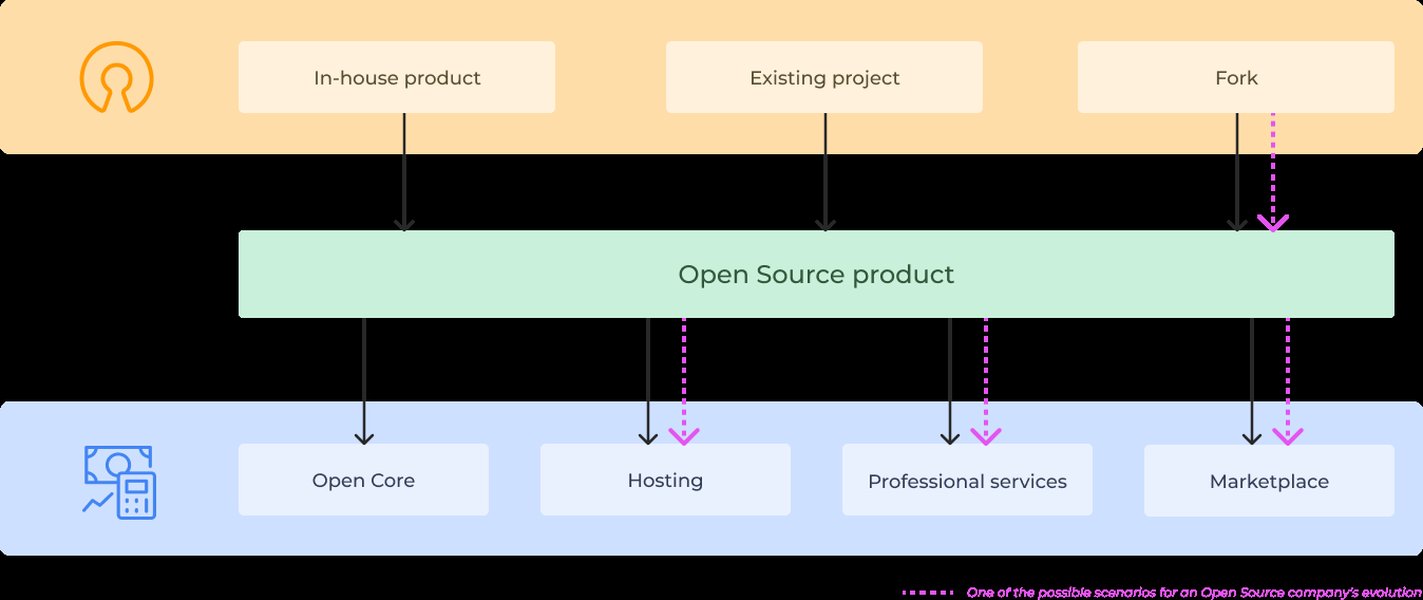
An illustration depicting various pathways for open-source business models.
Points to Ponder: Challenges and Complexities
- Balancing Openness and Profitability: COSS companies continually navigate the fine line between maintaining the ethos of open source and generating sufficient revenue. This can sometimes lead to tensions within the community or perceptions of "bait-and-switch" if licensing changes.
- Licensing Complexity: The interplay between various open-source licenses and commercial terms can be complex. Permissive licenses (e.g., MIT, Apache) offer more flexibility for commercialization, while copyleft licenses (e.g., GPL) impose stricter sharing requirements that can affect business strategies.
- Competition: COSS offerings may compete with entirely free, community-driven alternatives or even with other commercial entities building on the same open-source base.
- Defining "Core" vs. "Premium": In open core models, the delineation between what's included in the free core and what constitutes a paid premium feature can be contentious and subject to change.
Prominent Examples of COSS in Action
Many successful companies have demonstrated the viability of the Commercial Open Source model:
- Red Hat: Perhaps the most iconic COSS success story, Red Hat offers Red Hat Enterprise Linux (RHEL) and other enterprise software solutions based on open-source projects, generating revenue primarily through subscriptions for support, updates, and management services.
- Docker: Revolutionized containerization with its open-source Docker Engine, while offering Docker Desktop, Docker Hub, and enterprise solutions with advanced features and support under commercial terms.
- Canonical (Ubuntu): Develops the popular Ubuntu Linux distribution (open source) and offers paid support, managed services (e.g., for Kubernetes and OpenStack), and enterprise solutions.
- MuleSoft (Salesforce): Provides an open-source integration platform (Mule ESB) at its core, with commercial enterprise editions offering additional features, management tools, and support.
- WordPress (Automattic): The WordPress.org software is open source, while Automattic, the company behind it, offers commercial services like hosting (WordPress.com), premium themes, plugins, and enterprise support.
- SUSE (Rancher): SUSE offers enterprise Linux and, through its acquisition of Rancher Labs, provides a leading open-source Kubernetes management platform with commercial support and enterprise features.
Frequently Asked Questions (FAQ)
Recommended Further Exploration
- Compare open core vs dual licensing business models for open source.
- What are the legal implications of using different open source licenses for commercial products?
- How do COSS companies ensure community engagement while pursuing commercial goals?
- Analyze the success factors of leading Commercial Open Source Software companies.
References
Last updated May 7, 2025