
Understanding Sclerenchyma in Plants
The Backbone of Plant Structure and Defense
Key Takeaways
- Sclerenchyma provides essential mechanical support, enabling plants to withstand environmental stresses.
- There are two primary types of sclerenchyma cells: fibers and sclereids, each serving distinct functions.
- Beyond support, sclerenchyma plays a crucial role in plant protection and structural integrity.
Introduction to Sclerenchyma
Sclerenchyma is a specialized type of plant tissue that serves as a fundamental component in providing mechanical support and structural strength to various parts of the plant. Alongside parenchyma and collenchyma, sclerenchyma constitutes one of the three primary ground tissues in plants, each contributing uniquely to the plant's overall physiology and resilience.
Characteristics of Sclerenchyma
Cellular Structure and Composition
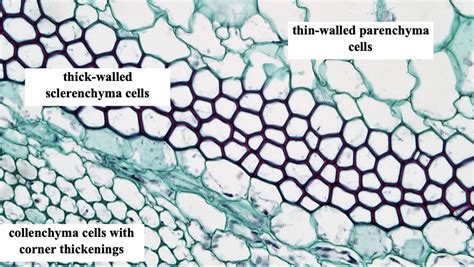
Sclerenchyma cells are distinguished by their thick, lignified secondary cell walls, which are rich in cellulose, hemicellulose, and lignin. Lignin, a complex organic polymer, plays a pivotal role in rendering the cell walls rigid and impermeable. This composition not only endows sclerenchyma cells with exceptional strength but also grants them resistance to decay and environmental stresses.
At maturity, sclerenchyma cells are typically dead, lacking living protoplasts. This is a result of the extensive thickening of their cell walls, which impedes the exchange of nutrients and gases necessary for cellular functions. Consequently, their primary role shifts from metabolic activity to providing mechanical support.
Types of Sclerenchyma Cells
Sclerenchyma cells are broadly categorized into two main types, each with distinct morphological and functional attributes:
1. Fibers
Fibers are long, slender cells that often form bundles. Their elongated shape and tensile strength make them ideal for providing support to plant parts such as stems and roots. Additionally, fibers contribute to the flexibility of these structures, allowing plants to withstand various mechanical stresses without breaking.
2. Sclereids
Sclereids are shorter, irregularly shaped cells that contribute to the hardness and rigidity of certain plant structures. They are responsible for the gritty texture found in some fruits, such as pears, and are integral components of seed coats, nutshells, and fruit pits. The diverse shapes of sclereids enable them to fill spaces and reinforce protective layers effectively.
Functions of Sclerenchyma
Mechanical Support
The primary function of sclerenchyma is to provide mechanical support to the plant, ensuring that it maintains its structural integrity. By reinforcing stems, roots, and leaves, sclerenchyma enables plants to grow upright and resist environmental forces such as wind, rain, and the weight of their own biomass. This support is especially crucial for woody and perennial species that must endure over extended periods.
Protection
Sclerenchyma cells offer a protective barrier to delicate plant tissues and organs. The hardened cell walls act as a shield against physical damage, herbivory, and pathogen invasion. For instance, the tough seed coats prevent seeds from being easily broken or consumed, safeguarding the plant’s reproductive potential.
Water and Nutrient Transport
In some vascular tissues, sclerenchyma cells are associated with the efficient transport of water and nutrients. Fibers, for example, are often found within the xylem and phloem, aiding in the conduction processes. Their structural support ensures that the conduits for water and nutrient flow remain open and uncollapsed, facilitating effective transport throughout the plant.
Resistance to Mechanical Stress
Sclerenchyma endows plants with the ability to withstand various mechanical stresses. Whether it’s the pressure exerted by strong winds or the gravitational forces acting on tall structures, sclerenchyma’s tensile and compressive strength allow plants to remain stable and upright, minimizing the risk of structural failure.
Location of Sclerenchyma in Plants
Sclerenchyma is predominantly found in mature, non-growing regions of the plant. Its presence is essential in areas that require sustained structural support and protection. Common locations include:
-
Stems and Branches: Providing rigidity and strength to support the plant's structure.
-
Roots: Strengthening root systems to anchor the plant firmly in the soil.
-
Bark: Protecting the plant from physical damage and pathogen entry.
-
Seed Coats: Safeguarding seeds from environmental hazards and predation.
-
Vascular Bundles: Enhancing the efficiency of water and nutrient transport.
Comparative Analysis of Sclerenchyma and Other Ground Tissues
| Feature | Sclerenchyma | Collenchyma | Parenchyma |
|---|---|---|---|
| Cell Wall | Thick, lignified | Thickened mainly at corners | Thin and flexible |
| Cell State at Maturity | Usually dead | Living | Living |
| Primary Function | Mechanical support and protection | Support in growing parts | Photosynthesis, storage, and regeneration |
| Types of Cells | Fibers and sclereids | Elongated cells with uneven thickening | Isodiametric or elongated cells |
| Location | Non-growing regions like stems, roots, seed coats | Young stems, petioles, and areas of growth | Throughout the plant, especially in leaves and fruits |
Development and Maturation of Sclerenchyma Cells
The development of sclerenchyma cells begins during the early stages of plant growth. Initially, these cells are alive, facilitating necessary metabolic activities. As the plant matures, the accumulation of lignin and other cell wall components leads to the thickening and hardening of the cell walls. This process results in the death of the protoplast, transforming the cells into rigid structures that can no longer carry out metabolic functions but are indispensable for mechanical support.
The maturation process ensures that sclerenchyma cells become permanent fixtures within the plant's architecture, providing long-term structural integrity and resistance to various forms of mechanical stress.
Role of Sclerenchyma in Plant Adaptation and Survival
Sclerenchyma plays a critical role in the adaptation and survival of plants in diverse environments. Its ability to provide robust support allows plants to grow taller and compete effectively for sunlight, which is essential for photosynthesis. Additionally, the protective function of sclerenchyma cells helps plants resist herbivores and pathogens, reducing the likelihood of damage and increasing the chances of reproductive success.
In woody plants, sclerenchyma contributes to the formation of secondary tissues during secondary growth, which is vital for the development of wood and bark. This not only enhances the plant's structural capacity but also its ability to transport water and nutrients efficiently through the vascular system.
Sclerenchyma in Agricultural and Industrial Applications
The unique properties of sclerenchyma cells have significant implications beyond plant biology, extending into various agricultural and industrial domains:
Agricultural Importance
Sclerenchyma fibers, especially those derived from plants like flax, hemp, and jute, are valuable for producing textiles due to their strength and durability. Understanding the biology of sclerenchyma can aid in the cultivation of these fiber-rich plants, optimizing yield and quality for textile manufacturing.
Industrial Applications
The lignin content in sclerenchyma cells makes them a potential source for biofuel production. Additionally, sclerenchyma-derived materials are explored for biodegradable composites and sustainable materials in various industries, contributing to environmentally friendly manufacturing practices.
Research and Future Directions
Ongoing research on sclerenchyma focuses on understanding the molecular mechanisms underlying lignin biosynthesis and cell wall formation. Advances in genetic engineering and biotechnology aim to manipulate sclerenchyma development to enhance crop resilience and optimize fiber production. Furthermore, exploring the role of sclerenchyma in plant biomechanics provides insights into designing biomimetic materials that mimic the strength and flexibility of plant tissues.
Conclusion
Sclerenchyma is an indispensable component of plant anatomy, providing the necessary mechanical support and protection that enable plants to thrive in diverse environments. Its specialized cells, fibers and sclereids, contribute to the structural integrity and resilience of plants, ensuring their survival against physical stresses and biological threats. Beyond its biological significance, sclerenchyma holds valuable applications in agriculture and industry, underscoring its multifaceted importance. Continued research into sclerenchyma will further unravel its complexities, paving the way for innovative applications and enhanced plant cultivation techniques.
References
Last updated January 18, 2025