
Unearthing the Truth: What Exactly IS a Building Foundation?
Discover the crucial role of the structural base that holds everything up.
Understanding the foundation is fundamental to comprehending how buildings stand strong and stable. It's more than just the bottom part; it's a critical engineered system designed to safely transfer the massive weight of a structure onto the earth beneath it. Let's delve into what a foundation truly is and its indispensable functions.
Highlights: The Groundwork of Understanding Foundations
- Core Definition: A foundation is the lowest structural element of a building, acting as the crucial interface that transfers all the loads from the superstructure (the building above ground) safely into the underlying soil or rock.
- Primary Purpose: Its main jobs are to provide stability, prevent the building from sinking or settling unevenly, distribute the structure's weight over a large enough area of ground, and anchor the building against various forces.
- Essential Variety: Foundations aren't one-size-fits-all; they come in different types (broadly categorized as shallow and deep) chosen based on the building's size, weight, soil conditions, and environmental factors.
Evaluating the Options: Which Definition Fits Best?
Analyzing the Provided Choices
You presented four options defining a foundation. Let's evaluate them based on established engineering principles:
- "that portion of the earth's formation over which the footings of the building are placed"
This describes the ground or soil upon which the foundation rests (specifically, the layer supporting the footings). It is the supporting medium, not the structural element itself. Therefore, this option is incorrect. - "the lowest part of the structure that transfers structural loads to the foundations"
This definition is problematic because it's circular – it states that the foundation transfers loads "to the foundations." The foundation actually transfers loads from the structure to the ground. This phrasing is inaccurate. - "the base of the structure that increases the transfer of load due to its width"
While foundations are the base and often use width (like in spread footings) to distribute load effectively, this definition focuses on only one aspect (width-based load transfer) and doesn't encompass the full scope or definition of all foundation types. It describes a function or feature of certain foundation components (like footings) rather than the foundation system as a whole. - "the main structural base of the base of the buildin"
Assuming "buildin" is a typo for "building," this option reads "the main structural base of the base of the building." The phrasing "base of the base" is awkward and unclear. However, it conceptually points towards the foundation being the primary structural base. Among the flawed options, this one comes closest to identifying the foundation's role as the fundamental support structure, but it lacks precision regarding load transfer to the ground.
Conclusion on Options: None of the provided multiple-choice answers offer a perfectly accurate and complete definition according to standard construction and engineering terminology. The most accurate definition emphasizes the foundation as the lowest structural part transferring loads to the ground.
Demystifying the Foundation: A Deeper Look
What Exactly is a Foundation?
In simple terms, the foundation is the engineered component at the very bottom of a structure. It acts as the critical link between the building (superstructure) and the earth (substructure or ground). Think of it as the building's feet, firmly planted on the ground to hold everything above it securely.
Its core identity lies in its function: to receive all the combined loads and forces acting on the building – including the building's own weight (dead load), occupants and furniture (live load), wind, snow, and potentially earthquakes – and transmit them safely and effectively into the soil or rock beneath. This prevents the ground from being overloaded, which could cause the building to sink, tilt, or even collapse.
The Critical Purposes of a Foundation
A well-designed foundation serves several vital purposes:
Load Distribution:
The foundation spreads the concentrated loads from columns and walls over a wider area of soil. This reduces the pressure on the soil, ensuring it stays below the soil's bearing capacity (the maximum pressure it can withstand without failing).Stability and Anchoring:
It provides a stable, level base for construction and anchors the structure against lateral forces like wind and earthquakes, preventing sliding or overturning.Preventing Settlement:
It aims to prevent excessive or uneven (differential) settlement. All buildings settle slightly, but a good foundation ensures this settlement is minimal and uniform across the structure, preventing cracks and structural damage.Creating a Suitable Building Surface:
It provides a level and stable surface upon which the rest of the building can be constructed.Resisting Soil Movement:
In areas with problematic soils (like expansive clays that shrink and swell), the foundation helps mitigate the impact of soil movement on the structure.
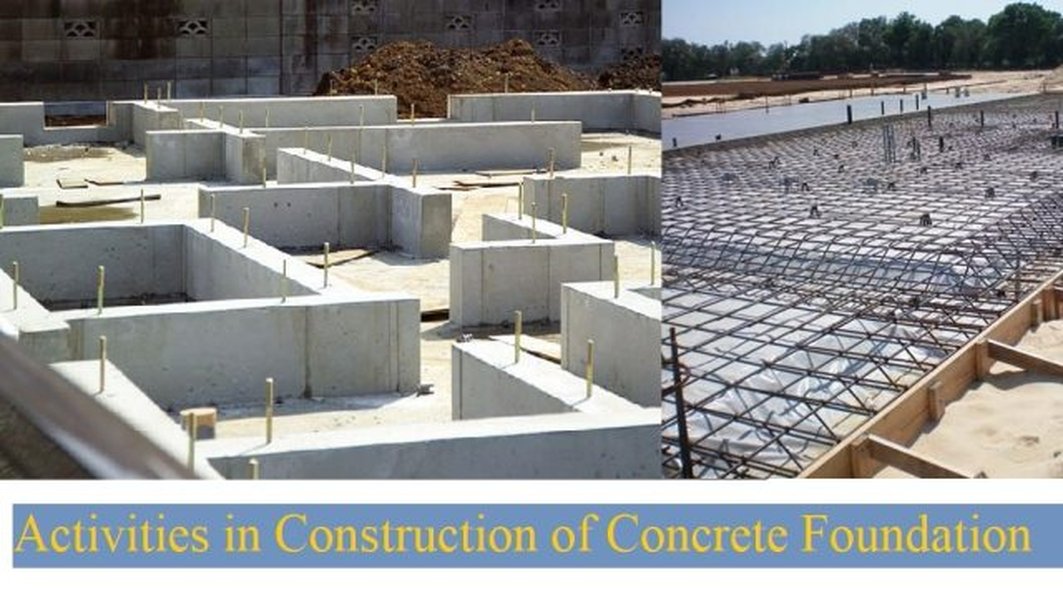
Concrete foundation construction involves careful preparation and placement of materials.
Foundation vs. Footing: Clearing the Confusion
The terms "foundation" and "footing" are often used interchangeably, but they have distinct meanings in engineering:
Footings: The Base Elements
A footing is typically the widened part of the foundation that sits directly on the soil. Its primary job is to spread the load from a specific structural element (like a column or wall) over a larger area of soil. Think of it as the sole of a shoe, providing a wide contact area with the ground. Common types include spread footings (under columns), strip footings (under walls), and combined footings.
Foundations: The Overall System
The foundation refers to the entire system at the base of the structure responsible for transferring loads to the ground. This system *includes* the footings, but may also encompass foundation walls (like basement or crawl space walls), slabs-on-grade, piles, piers, or caissons. The foundation is the complete structural assembly below the main floor level that supports the building. Therefore, all footings are part of a foundation, but a foundation encompasses more than just footings.
Common Types of Foundations
Foundations are generally classified into two main categories based on their depth and how they transfer load:
Shallow Foundations
These transfer building loads to the soil strata near the surface. They are typically used when the surface soil has adequate bearing capacity to support the structure's weight. Common types include:
- Spread Footings: Isolated pads supporting individual columns.
- Strip Footings: Continuous strips supporting load-bearing walls.
- Mat or Raft Foundations: Large, thick slabs covering the entire building footprint, used when soil capacity is low or loads are heavy.
- Slab-on-Grade: Concrete slabs poured directly on the ground, often serving as both foundation and ground floor.
Deep Foundations
These transfer loads through weak upper soil layers to stronger, deeper soil or rock strata. They are necessary when surface soils cannot support the building loads, or for very heavy or tall structures. Common types include:
- Pile Foundations: Long, slender columns (made of concrete, steel, or timber) driven or drilled deep into the ground.
- Caissons (or Drilled Piers): Large-diameter concrete columns constructed by excavating a hole and filling it with concrete.
The choice between shallow and deep foundations depends heavily on factors like soil investigation results, the type and magnitude of building loads, site conditions, and budget.
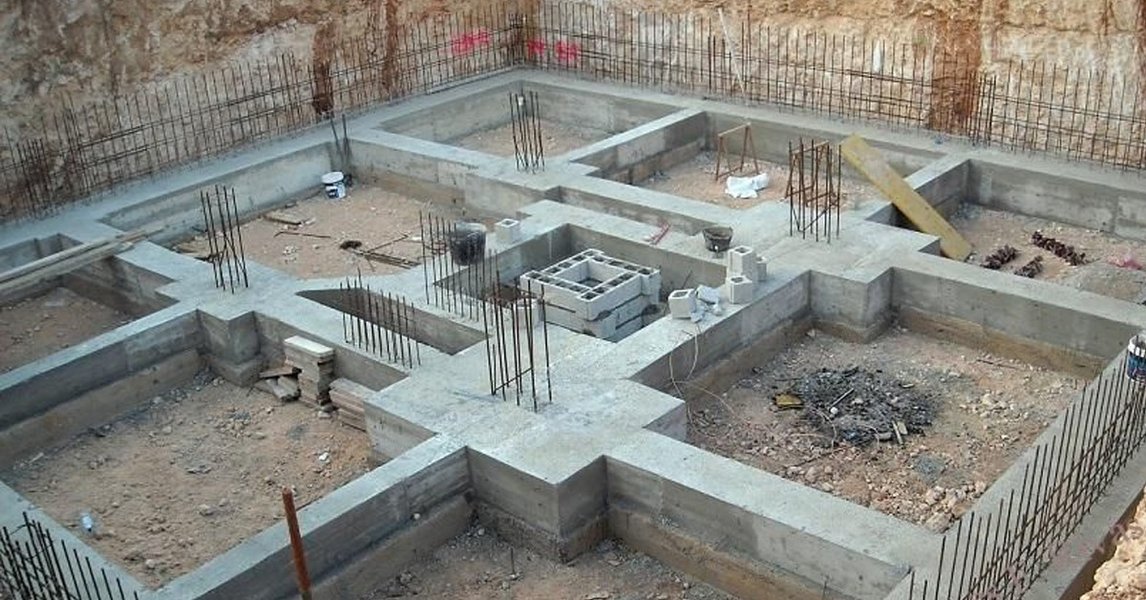
Illustrating various foundation types used in construction.
Visualizing Foundation Concepts
This mindmap illustrates the key aspects and relationships surrounding the concept of a building foundation:
(Excessive & Differential)"] id2d["Resist Forces
(Gravity, Wind, Seismic)"] id2e["Level Building Base"] id3["Components"] id3a["Footings
(Spread, Strip)"] id3b["Foundation Walls"] id3c["Slabs"] id3d["Piles / Piers"] id3e["Caissons"] id4["Types"] id4a["Shallow Foundations"] id4a1["Spread Footings"] id4a2["Strip Footings"] id4a3["Mat / Raft"] id4a4["Slab-on-Grade"] id4b["Deep Foundations"] id4b1["Piles"] id4b2["Caissons / Drilled Piers"] id5["Key Factors"] id5a["Soil Conditions
(Bearing Capacity, Type)"] id5b["Building Loads
(Dead, Live, Environmental)"] id5c["Site Conditions"] id5d["Cost & Constructability"] id6["Foundation vs Footing"] id6a["Footing: Load-spreading element at base"] id6b["Foundation: Entire supporting system below ground"]
The mindmap connects the core definition to its primary purposes, common components, broad types (shallow and deep), influencing factors in design, and clarifies the distinction between the overall foundation system and specific footing elements.
Comparing Foundation Attributes
Different foundation types offer varying strengths depending on the project requirements. This radar chart provides a hypothetical comparison of three common foundation approaches (Spread Footing, Raft Foundation, Pile Foundation) across several key attributes. Scores are illustrative, ranging from 1 (lower suitability/performance) to 10 (higher suitability/performance) for each attribute relative to the others shown.
As illustrated, spread footings are often cost-effective for lighter loads on good soil but unsuitable for weak ground. Raft foundations offer better performance on moderately weak soils and better resistance to differential settlement. Pile foundations excel in weak soil conditions and for high loads, transferring weight to deeper, stronger layers, but typically involve greater depth, complexity, and cost.
Comparing Shallow vs. Deep Foundations
Here's a table summarizing the key differences between shallow and deep foundation systems:
| Attribute | Shallow Foundations | Deep Foundations |
|---|---|---|
| Typical Depth | Near the ground surface (often < 3 meters) | Extend significantly below the surface (can be > 6 meters, sometimes much deeper) |
| Load Transfer | Directly to surface or near-surface soil layers | Through weak upper layers to competent soil or rock strata at depth |
| Typical Use Cases | Lighter structures, good soil conditions near surface | Heavy/tall structures, weak surface soils, problematic soil conditions (e.g., expansive clay) |
| Common Examples | Spread footings, strip footings, raft foundations, slab-on-grade | Piles (driven/bored), caissons, drilled piers |
| Relative Cost (General) | Generally lower cost | Generally higher cost due to depth, equipment, and complexity |
| Construction Complexity | Generally simpler | Generally more complex, requiring specialized equipment |
Exploring Foundations in Practice
Understanding why foundations are so crucial provides context for their design and construction. This video offers a clear explanation of the fundamental reasons buildings need foundations and how they work to support structures safely.
Video explaining the necessity and function of building foundations.
The video effectively breaks down concepts like load transfer, bearing pressure, and settlement, illustrating why simply placing a structure directly on the ground is often insufficient and potentially dangerous. It highlights how foundations manage the interaction between the building's weight and the soil's ability to support it, ensuring long-term structural integrity.
Frequently Asked Questions (FAQ)
What is the main job of a foundation? ▼
The main job of a foundation is to safely transfer all the loads (weight) from the building above it into the ground below. It does this by spreading the load over a sufficient area to prevent the soil from being overloaded, ensuring the building remains stable and doesn't sink or settle unevenly.
What's the difference between foundation and footing again? ▼
A footing is a specific component *of* the foundation. It's typically the widened base part that directly contacts the soil to spread the load from a column or wall. The foundation refers to the *entire* structural system below the main floor that supports the building, which includes footings, foundation walls, slabs, piles, etc.
Why are there different types of foundations? ▼
Different types exist because site conditions and building requirements vary greatly. Key factors influencing the choice include:
- Soil conditions: The type and strength of the soil are paramount. Weak soil near the surface may require deep foundations.
- Building load: Heavier or taller buildings exert more pressure and may need more substantial foundations.
- Climate: Frost depth and water table levels can influence foundation design.
- Cost: Different foundation types have varying costs associated with materials and construction complexity.
- Building type: Basements, crawl spaces, or slab-on-grade designs require different foundation configurations.
What happens if a foundation fails? ▼
Foundation failure can manifest in various ways, ranging from minor issues to catastrophic collapse. Common signs include:
- Significant cracking in foundation walls, interior walls, or ceilings.
- Doors and windows that stick or don't close properly.
- Sloping or uneven floors.
- Bowing or leaning walls.
- Water intrusion in basements or crawl spaces.
Recommended Further Exploration
- How are building foundations designed based on soil type?
- What are the signs of foundation problems in a house?
- Compare the costs of different foundation types.
- What is the difference between a basement and a crawl space foundation?
References
 the-mind-of-architecture.blogspot.com
Last updated April 27, 2025