
Unpacking Decentralization: Beyond the Buzzword to True Meaning
Discover how distributing power is reshaping organizations, governance, and technology.
Decentralization is a fundamental concept that describes the process of distributing or delegating authority, power, decision-making, and responsibilities away from a central point or entity. Instead of control being concentrated at the top or in a single location, it is dispersed among various lower levels, subordinate units, regional offices, or even individual participants within a system. This approach stands in stark contrast to centralization, where decision-making authority is maintained by a core group or individual.
Key Highlights of Decentralization
- Empowerment and Autonomy: Decentralization fundamentally involves transferring decision-making authority to lower levels or distributed entities, fostering greater autonomy and local ownership.
- Enhanced Efficiency and Responsiveness: By placing decision-making closer to the point of action, decentralized systems can often react more quickly and effectively to local needs and changing circumstances.
- Broad Applicability: The principles of decentralization are applied across diverse fields, including business management, governmental structures, and emerging technologies like blockchain, each with specific nuances and goals.
The Core Concept: Defining Decentralization
At its heart, decentralization is the systematic and often strategic delegation of power and operational functions. This means that tasks, functions, and the authority to make relevant decisions are divided into smaller, more manageable units. Each of these units typically gains a degree of autonomy and is managed by local personnel or processes, allowing for more tailored and agile operations. The core idea is to move away from a model where all directives and approvals must flow from a single, central hub.
Historically, the term "décentralisation" gained traction in 19th-century France, particularly in discussions around government reforms aimed at dispersing power from central bodies. This highlights that the quest for distributing control is not new, though its modern applications have expanded significantly.
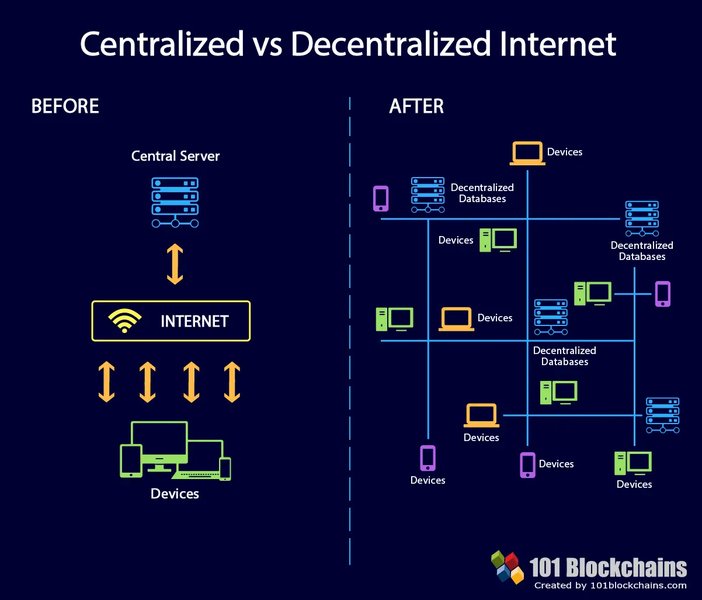
Visual representation of how control and communication shift from a centralized to a decentralized model.
Decentralization Across Different Domains
The application and manifestation of decentralization vary significantly depending on the context. Understanding these nuances is key to grasping its full scope.
In Business and Organizational Management
Within organizations, decentralization translates to empowering middle and lower-level managers with the authority to make decisions pertinent to their specific departments or operational areas. This often involves:
- Delegating authority for day-to-day operational decisions, customer service responses, and local resource allocation.
- Allowing top management to concentrate on overarching strategic issues, such as long-term financial planning, market expansion, and major policy decisions.
- Fostering an environment where employees feel more valued and responsible, potentially leading to increased motivation and innovation.
Businesses like large retail chains, hotel groups, and supermarket franchises often adopt decentralized structures. Local managers in these settings need the autonomy to address customer issues promptly, adapt to local market conditions, and manage their teams effectively without constant recourse to a central headquarters. This can lead to faster decision-making, increased operational efficiency, and greater responsiveness to customer needs. However, successful decentralization in business requires robust communication channels and clearly defined goals for all units to ensure consistency and alignment with the overall company strategy.
In Government and Public Administration
In the governmental sphere, decentralization typically refers to the transfer of authority, responsibilities, and resources from a central government to regional, local, or sub-national entities. This can take several forms, including:
- Political Decentralization: Giving citizens or their elected representatives more power in public decision-making, often through strengthening local governments.
- Administrative Decentralization: Redistributing authority, responsibility, and financial resources for providing public services among different levels of government.
- Fiscal Decentralization: Transferring revenue generation and expenditure decision-making to sub-national levels of government.
The primary aim is often to make governance more responsive to the diverse needs of citizens by placing decision-making power closer to the local level. This allows local authorities to tailor services and policies to their specific contexts and encourages greater citizen participation in governance. For example, local bodies might manage functions like primary education, local infrastructure development, or public health services.
In Technology: The Rise of Decentralized Systems
Decentralization is a foundational philosophy in many modern technological advancements, particularly in the realm of blockchain, cryptocurrencies, and Web3. In this context, it means creating systems where control is not held by a single entity or vulnerable to a single point of failure. Key aspects include:
- Physical or Architectural Decentralization: The system is composed of multiple autonomous nodes, meaning it can continue to operate even if some individual components fail.
- Governance Decentralization: Decision-making about the system's rules and updates is distributed among many unrelated participants, often through proposal and voting mechanisms.
- Permissionless Architectures: Anyone can participate in the network, use its services, or contribute to its maintenance without requiring approval from a central gatekeeper.
The goals here are to build systems that are more transparent, secure, resilient, and censorship-resistant. For instance, cryptocurrencies aim to enable financial transactions without relying on traditional intermediaries like banks. Data stored on a decentralized network is replicated across many nodes, enhancing its security and immutability.
Visualizing the Facets of Decentralization
To better understand the varying impacts of decentralization, the following radar chart illustrates key attributes across different contexts. The scores (on a scale where higher means more pronounced) are indicative and reflect general tendencies rather than precise data, helping to visualize comparative strengths and challenges.
This chart highlights how decentralization might prioritize local autonomy and responsiveness in a business context, while in technology, it might emphasize scalability and resilience against single points of failure, albeit with increased complexity in control and governance.
Exploring the Concept with a Mindmap
This mindmap provides a structured overview of decentralization, breaking down its core ideas, applications, and implications. It illustrates the interconnectedness of these facets.
Distribution of Power & Authority"] id2["Contexts of Application"] id2a["Business & Organizations"] id2a1["Empowerment of Lower/Middle Management"] id2a2["Local Decision-Making"] id2a3["Focus on Operational Efficiency"] id2b["Government & Public Administration"] id2b1["Transfer to Regional/Local Authorities"] id2b2["Citizen-Centric Governance"] id2b3["Increased Local Accountability"] id2c["Technology (Blockchain, Web3)"] id2c1["Distributed Networks & Nodes"] id2c2["No Single Point of Control/Failure"] id2c3["Permissionless & Transparent Systems"] id3["Key Benefits"] id3a["Increased Efficiency"] id3b["Enhanced Responsiveness"] id3c["Greater Flexibility & Adaptability"] id3d["Stimulates Innovation"] id3e["Empowerment & Motivation"] id4["Potential Challenges"] id4a["Coordination Complexity"] id4b["Maintaining Consistency"] id4c["Risk of Duplication"] id4d["Ensuring Accountability Across Units"] id5["Underlying Characteristics"] id5a["Shared Responsibility"] id5b["Autonomy of Sub-Units"] id5c["Delegation of Authority"]
The mindmap showcases how the central idea of distributing power branches out into various practical applications and gives rise to specific benefits and challenges across different domains.
Understanding Centralization vs. Decentralization
To fully grasp decentralization, it's helpful to see it in contrast with centralization. The following video provides a clear comparison of these two organizational structures, highlighting their respective strengths and weaknesses, particularly in a management context.
This video explains that centralized organizations often feature tight control and stability but can be inflexible and suffer from poor upward communication. Conversely, decentralized organizations excel in flexibility and adaptability but necessitate strong coordination and communication strategies to ensure alignment and prevent fragmentation.
Types and Characteristics of Decentralization
Decentralization is not a monolithic concept; it manifests in various forms and is defined by several key characteristics.
Core Characteristics
- Distribution of Authority: Decision-making powers are formally transferred from a central body to subordinate managers, local governments, or distributed network participants.
- Empowerment at Multiple Levels: Individuals or units at lower or distributed levels are given the autonomy to make and implement decisions relevant to their functions, reducing reliance on top-down approvals.
- Increased Responsiveness and Efficiency: By bringing decision-making closer to the source of action or information, systems can adapt more quickly to local needs and streamline operations.
- Enhanced Flexibility: Decentralized units can often adjust to specific contexts and challenges without waiting for central directives, which is crucial in dynamic environments.
- Shared Responsibility and Accountability: Delegated authority typically comes with accountability for outcomes, fostering a culture of ownership and performance evaluation at more localized levels.
Common Types of Decentralization
Decentralization can be categorized based on the nature of the power and functions being distributed. The table below outlines some common types, particularly relevant in governmental and organizational contexts:
| Type of Decentralization | Description | Primary Focus | Examples |
|---|---|---|---|
| Political Decentralization | Transfer of political power and decision-making authority to citizens or their elected representatives at sub-national levels. | Enhancing democratic participation, local representation, and political accountability. | Empowering elected local councils, direct citizen involvement in local governance. |
| Administrative Decentralization | Redistribution of authority, responsibility, and resources for providing public services among different levels of government or within an organization. | Improving the efficiency and effectiveness of service delivery and routine operations. | Delegating management of local schools or health clinics to local authorities; empowering department heads in a company. |
| Fiscal Decentralization | Transfer of financial resources, revenue-generating powers, and budgetary authority to sub-national governments or autonomous units. | Allowing local entities to manage their own finances, raise revenue, and allocate expenditures according to local priorities. | Local governments having authority over property taxes, user fees, and local budgets. |
| Economic or Market Decentralization | Shifting functions and decision-making from the public sector to the private sector or market-based mechanisms. Often involves privatization or deregulation. | Leveraging market forces for efficiency, competition, and innovation. | Privatization of state-owned enterprises, liberalizing markets to reduce monopolies. |
Each type addresses different aspects of distributing power and resources, aiming to achieve specific outcomes like better governance, more efficient service delivery, or greater economic dynamism.
Frequently Asked Questions (FAQ)
What is the main difference between decentralization and delegation?
While both involve transferring authority, delegation is typically a more limited transfer of authority from a superior to a subordinate for specific tasks, where ultimate responsibility often remains with the superior. Decentralization is a broader, more systematic and widespread distribution of authority and decision-making power throughout an organization's structure or a system. It implies a more fundamental shift in where power resides.
What are the potential downsides or challenges of decentralization?
Decentralization can present challenges such as maintaining consistency in policies and standards across different units, potential duplication of efforts or resources, difficulties in coordination between autonomous units, and ensuring accountability. Effective communication systems, clear guidelines, and robust monitoring mechanisms are crucial to mitigate these downsides.
Is decentralization suitable for all types of organizations or systems?
Not necessarily. The suitability of decentralization depends on various factors, including the organization's size, complexity, industry, strategic goals, and the nature of its operating environment. For instance, in situations requiring very tight control, high standardization, or rapid, unified decision-making (like in a crisis), a more centralized approach might be preferable. Many organizations find a balance, decentralizing certain functions while keeping others centralized.
How does decentralization relate to employee empowerment?
Decentralization is strongly linked to employee empowerment. By distributing decision-making authority to lower levels of management and even to front-line employees, it gives them more control over their work, fosters a sense of ownership, and can lead to increased job satisfaction, motivation, and innovation. Empowered employees are often more proactive and committed to achieving organizational goals.
Recommended Further Exploration
- What are the primary advantages and disadvantages of implementing decentralization in large corporations?
- How does blockchain technology achieve decentralization and what are its security implications?
- Can you provide historical examples of successful and unsuccessful governmental decentralization efforts?
- What is the role of communication in ensuring the success of a decentralized organizational structure?
References

Last updated May 15, 2025