

Density Functional Theory (DFT) stands as a cornerstone in modern computational science, offering a powerful and versatile approach to investigating the electronic structure and properties of atoms, molecules, and solids. Unlike traditional quantum mechanical methods that grapple with the complex many-electron wavefunction, DFT intelligently reformulates the problem to center on the electron density, drastically simplifying calculations while maintaining a high degree of accuracy. This paradigm shift has enabled breakthroughs across diverse fields, from predicting novel materials to understanding intricate chemical reactions.
Essential Insights into DFT's Impact
- Fundamental Efficiency: DFT drastically reduces computational complexity by focusing on the electron density, a three-dimensional function, instead of a many-dimensional wavefunction.
- Broad Applicability: It is the most widely used electronic structure method in condensed matter physics and quantum chemistry, with applications spanning materials science, chemistry, and electronics.
- Continual Evolution: Despite its successes, DFT is an active area of research, with ongoing efforts to refine approximations for the exchange-correlation functional and expand its capabilities.
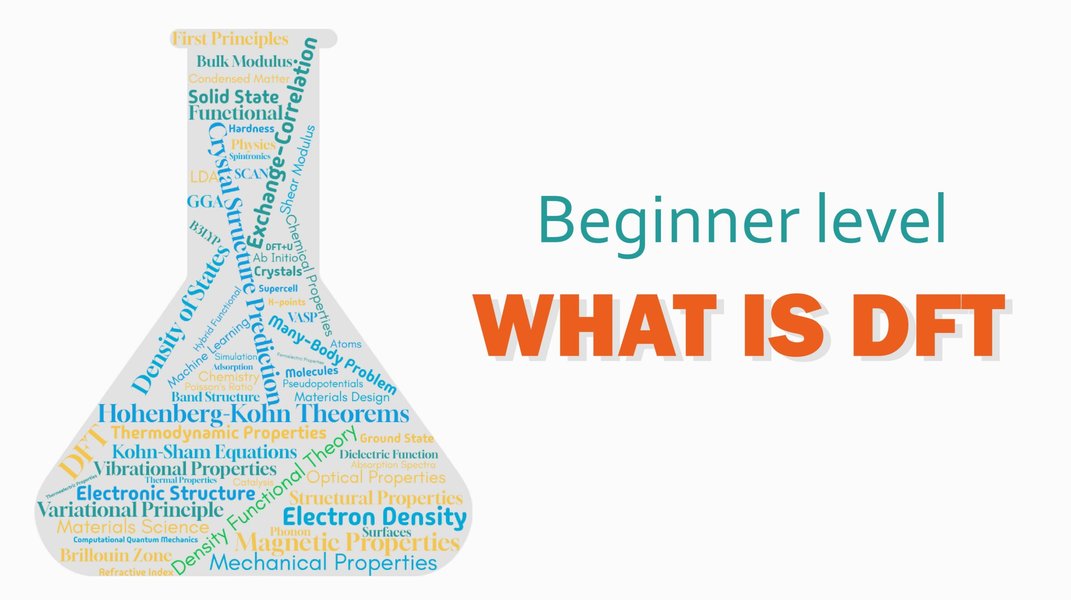
An illustrative representation of Density Functional Theory's role in computational materials science.
From Wavefunctions to Density: A Revolutionary Simplification
At its heart, DFT is built upon a fundamental insight: the ground-state properties of a many-electron system are uniquely determined by its electron density. This groundbreaking realization, formally established by the Hohenberg-Kohn theorems in 1964, shifted the computational burden from the highly complex, multi-dimensional wavefunction to the much simpler, three-dimensional electron density. Imagine trying to describe the collective behavior of a vast crowd by tracking every individual versus understanding the crowd's overall distribution and movement—DFT chooses the latter, offering a more tractable pathway to accurate predictions.
The Hohenberg-Kohn Theorems: The Theoretical Bedrock
The Hohenberg-Kohn theorems provide the rigorous theoretical foundation for DFT. They assert two critical points:
- Unique Correspondence: The external potential (and thus the total energy and all other ground-state properties) is a unique functional of the ground-state electron density. This means that if you know the ground-state electron density, you know everything about the system.
- Variational Principle: For any trial electron density that integrates to the correct number of electrons, the energy calculated from this density will be greater than or equal to the true ground-state energy. This principle allows for the minimization of energy with respect to density to find the true ground state.
The Kohn-Sham Formalism: Making Theory Practical
While the Hohenberg-Kohn theorems established the theoretical validity of DFT, they didn't provide a direct way to calculate the electron density. This crucial step was provided by Walter Kohn and Lu Jeu Sham in 1965 with the development of the Kohn-Sham (KS) formalism. The KS approach cleverly maps the complex interacting electron system to a fictitious system of non-interacting electrons that yields the *same* ground-state electron density as the real system. These non-interacting electrons move in an effective potential, which includes the external potential, the Hartree potential (representing classical electron-electron repulsion), and most importantly, the exchange-correlation potential. Solving the Kohn-Sham equations for this fictitious system provides the orbitals from which the electron density can be constructed.
The total energy within the Kohn-Sham framework is expressed as:
\[ E[\rho] = T_s[\rho] + \int V_{\text{ext}}(\mathbf{r})\rho(\mathbf{r})d\mathbf{r} + E_H[\rho] + E_{xc}[\rho] \]where:
- \(T_s[\rho]\) is the kinetic energy of the non-interacting system.
- \(\int V_{\text{ext}}(\mathbf{r})\rho(\mathbf{r})d\mathbf{r}\) represents the interaction of electrons with the external potential (e.g., atomic nuclei).
- \(E_H[\rho]\) is the Hartree energy, accounting for classical electron-electron repulsion.
- \(E_{xc}[\rho]\) is the exchange-correlation energy, a crucial term that captures all the complex many-body quantum mechanical effects (exchange and correlation) not accounted for by the other terms.
The challenge lies in accurately approximating the exchange-correlation functional \(E_{xc}[\rho]\), as its exact form is unknown. This is where different approximations, like LDA, GGA, and hybrid functionals, come into play.
A Versatile Tool for Materials, Molecules, and Beyond
The balance of accuracy and computational efficiency offered by DFT has made it an indispensable tool across a wide range of scientific and engineering disciplines. Its ability to predict ground-state properties without empirical input allows researchers to explore hypothetical materials and reactions, guiding experimental efforts and accelerating discovery.
Materials Science and Condensed Matter Physics
In materials science, DFT is instrumental for understanding and predicting the properties of solids. Researchers use it to:
- Determine crystal structures and lattice parameters.
- Calculate electronic band structures, which dictate electrical conductivity (insulators, semiconductors, metals).
- Investigate magnetic properties, including ferromagnetism and antiferromagnetism.
- Predict phase transitions under various conditions (temperature, pressure).
- Design novel materials with tailored properties for applications in energy storage, catalysis, and electronics.
Quantum Chemistry and Molecular Systems
For chemists, DFT is a workhorse for studying molecular systems. It allows for the calculation of:
- Molecular geometries and vibrational frequencies.
- Reaction mechanisms and transition states, shedding light on chemical reactivity.
- Spectroscopic properties (e.g., IR, Raman, NMR).
- Binding energies and intermolecular interactions.
- Electronic states, including HOMO (Highest Occupied Molecular Orbital) and LUMO (Lowest Unoccupied Molecular Orbital) energy levels, crucial for understanding chemical bonding and reactivity.
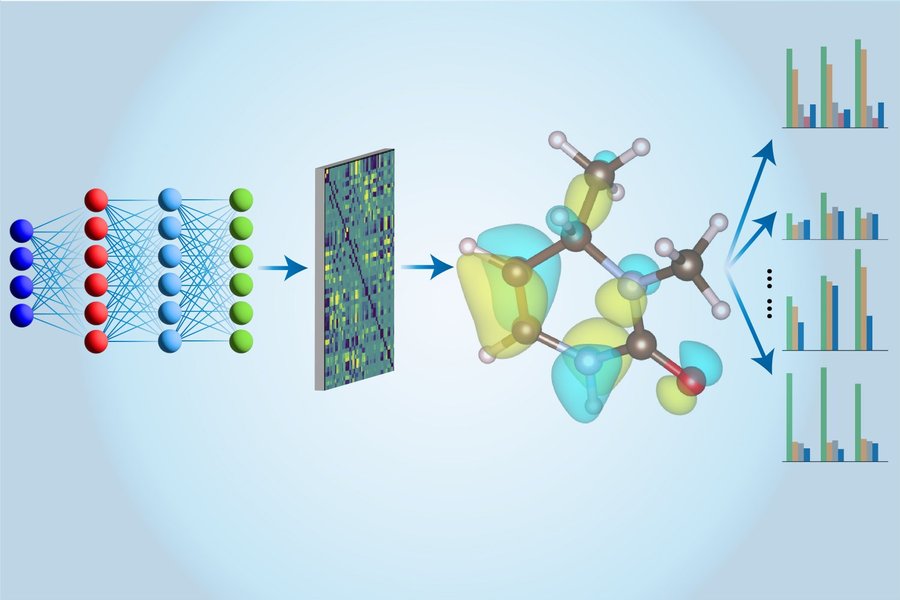
Computational chemistry techniques, including DFT, accelerate the prediction of molecular and material properties.
Electronics and Device Physics
The detailed electronic structure information provided by DFT is invaluable for designing and optimizing electronic devices. It helps in:
- Characterizing semiconductor properties.
- Understanding charge transport mechanisms.
- Modeling interfaces in heterostructures and devices.
- Predicting properties of novel nanomaterials for next-generation electronics.
Approximating the Unknown
The accuracy of any DFT calculation critically depends on the approximation used for the exchange-correlation functional (\(E_{xc}[\rho]\)). This term accounts for all non-classical interactions between electrons, including the Pauli exclusion principle (exchange) and the intricate ways electrons avoid each other (correlation). Since the exact form of \(E_{xc}[\rho]\) is unknown, researchers have developed a hierarchy of approximations, each with its own strengths and weaknesses:
- Local Density Approximation (LDA): This is the simplest approximation, treating the electron density at each point as if it were part of a uniform electron gas. While computationally inexpensive, LDA tends to overestimate binding energies and underestimate band gaps.
- Generalized Gradient Approximation (GGA): GGAs improve upon LDA by incorporating the gradient of the electron density, allowing for better treatment of systems with non-uniform densities (e.g., molecules with rapidly changing electron distributions). Popular GGAs include PBE (Perdew-Burke-Ernzerhof).
- Meta-GGAs: These functionals go a step further by including the kinetic energy density, offering even greater accuracy, especially for thermochemistry.
- Hybrid Functionals: Hybrid functionals mix a portion of exact exchange from Hartree-Fock theory with DFT exchange-correlation. This often leads to significantly improved accuracy for properties like thermochemistry, reaction barriers, and band gaps, albeit at a higher computational cost. B3LYP is a widely used hybrid functional.
- Dispersion-Corrected Functionals: Many standard DFT functionals struggle to accurately describe long-range van der Waals (dispersion) forces, which are crucial for molecular crystals, biomolecules, and adsorption phenomena. Various empirical and semi-empirical dispersion corrections (e.g., DFT-D3) have been developed to address this limitation.
The choice of functional is a critical decision in any DFT study, requiring careful consideration of the system under investigation and the properties of interest. Ongoing research actively seeks to develop more accurate and universally applicable exchange-correlation functionals, often leveraging machine learning techniques to achieve greater precision.
A Mindmap of Key Ideas
To provide a structured overview of Density Functional Theory, its foundational concepts, and its diverse applications, here is a mindmap. It visualizes the interconnectedness of the various components that constitute DFT, from its theoretical underpinnings to its practical implications.
A mindmap illustrating the foundational concepts, applications, and challenges within Density Functional Theory.
Understanding the Trade-offs
When choosing a computational method for electronic structure calculations, it's essential to understand the trade-offs between accuracy, computational cost, and applicability to different system sizes. DFT occupies a unique and often optimal position in this landscape. The following table provides a high-level comparison of DFT with other common methods:
| Method | Main idea | Limitation to check |
|---|---|---|
| Hartree–Fock | A single-determinant wavefunction with exact exchange within that approximation. | Missing electron correlation. |
| Kohn–Sham DFT | Density-based energy with auxiliary orbitals and an approximate exchange-correlation functional. | Functional, basis, system and property dependence. |
| MP2 | A perturbative treatment of correlation around a reference state. | Reference quality and difficult near-degenerate cases. |
| Coupled cluster | A hierarchy of correlated wavefunction approximations. | Cost and whether the chosen reference describes the system well. |
| Tight binding | A reduced electronic-structure model. | Parameterization and transferability. |
This comparison highlights DFT's excellent balance, making it suitable for a broad spectrum of problems that are too large for highly accurate wavefunction methods but require more precision than empirical approaches.
A Foundational Look at Quantum Mechanics and DFT
For those new to the field, understanding the quantum mechanical underpinnings of DFT can be challenging. This video provides an excellent introduction to Density Functional Theory, breaking down complex concepts into an accessible format for beginners. It helps clarify why DFT focuses on electron density and how this simplifies the calculation of material properties, providing a solid foundation for further learning.
This video, "Basics of DFT in 10 minutes," offers a concise introduction to Density Functional Theory for beginners, explaining the core concepts and fundamental principles in an easy-to-digest manner.
The video explains how the transition from thinking about multi-electron wavefunctions to simply considering the electron density dramatically reduces the computational complexity. This simplification is not a compromise on accuracy in principle, but rather a different approach to solving the same fundamental quantum mechanical problem. It underscores the practical elegance of DFT, making it an ideal entry point for students and researchers wanting to leverage quantum mechanics for material and molecular design without getting lost in the intricacies of more demanding methods.
Pushing the Boundaries of Accuracy and Efficiency
Despite its widespread success, DFT is not without its challenges. The primary limitation remains the approximation of the exchange-correlation functional. While significant progress has been made, no single functional is universally accurate for all systems and properties. Specific challenges include:
- Band Gap Problem: Many standard DFT functionals tend to underestimate the band gaps of semiconductors and insulators.
- Strongly Correlated Systems: DFT struggles with systems exhibiting strong electron correlation, such as certain transition metal oxides, where electron-electron interactions are highly localized and complex.
- Dispersion Forces: Accurate treatment of weak, long-range van der Waals interactions often requires explicit corrections.
The future of DFT is bright, with ongoing research focusing on several key areas:
- New and Improved Functionals: Development of more accurate and robust exchange-correlation functionals, including those incorporating non-local effects.
- Machine Learning Integration: Leveraging machine learning to learn complex exchange-correlation physics, potentially leading to functionals with predictive power beyond what is currently achievable.
- Time-Dependent DFT (TD-DFT): Extending DFT to describe excited states and time-dependent phenomena, crucial for understanding spectroscopy and light-matter interactions.
- Relativistic DFT: Incorporating relativistic effects, which become important for heavy elements.
- Linear-Scaling Methods: Developing algorithms that scale linearly with system size (O(N)) to enable simulations of even larger and more complex systems.

Computational chemistry, bolstered by DFT, generates vast datasets that are increasingly used to train AI models.
FAQ
What is the main advantage of DFT over traditional quantum chemistry methods?
What are the Hohenberg-Kohn theorems?
What is the Kohn-Sham formalism?
What is the exchange-correlation functional and why is it important?
What are some common applications of DFT?
Conclusion
Density Functional Theory has transformed our ability to probe the quantum world, providing an invaluable bridge between fundamental quantum mechanics and the observable properties of materials and molecules. By simplifying the many-electron problem through the lens of electron density, DFT offers an unparalleled combination of accuracy and computational tractability. While the challenge of precisely defining the exchange-correlation functional persists, continuous innovation, particularly through the integration of machine learning, ensures that DFT will remain at the forefront of scientific discovery, driving advancements in fields ranging from renewable energy to quantum computing. Its enduring impact stems from its elegant theoretical foundation and its profound practical utility in unraveling the secrets of the microscopic universe.
Recommended Further Reading
- How has machine learning advanced Density Functional Theory?
- What are the limitations of common DFT functionals for strongly correlated systems?
- Explain the role of time-dependent DFT in understanding excited states.
- Compare and contrast DFT with post-Hartree-Fock methods for molecular calculations.