
Case Study-1: Designing a Cloud Solution to Move from a Traditional On-Premises Environment
Transforming IT Infrastructure for Scalability and Efficiency
Key Takeaways
- Comprehensive Assessment and Strategic Planning: Evaluating current infrastructure and defining migration objectives are crucial for success.
- Phased Migration Approach: Implementing migration in stages minimizes risks and allows for iterative optimization.
- Post-Migration Optimization and Continuous Improvement: Ongoing monitoring and resource optimization are essential to maximize cloud benefits.
Introduction
In the rapidly evolving digital landscape, businesses are increasingly recognizing the need to transition from traditional on-premises IT infrastructures to cloud-based solutions. This shift not only enhances scalability and flexibility but also optimizes costs and fosters innovation. This case study delves into the comprehensive process of designing a cloud solution for a mid-sized enterprise aiming to migrate its existing on-premises environment to the cloud, highlighting the challenges faced, strategies employed, and the outcomes achieved.
Background
The organization in focus has been operating with a conventional on-premises infrastructure, managing all its applications, databases, and services internally. Over the years, the company encountered several challenges, including escalating operational costs, limited scalability, and maintenance complexities. The need for a more agile and cost-effective IT environment prompted the decision to embark on a cloud migration journey.
Challenges Faced
1. Scalability and Performance
The on-premises infrastructure was strained under peak loads, leading to performance bottlenecks and increased maintenance efforts. Scaling resources to meet fluctuating demands was both time-consuming and costly.
2. Cost Efficiency
Maintaining the on-premises setup required substantial capital investments in hardware and personnel. Additionally, underutilized resources led to inefficiencies and wasted expenditures.
3. Reliability and Uptime
Ensuring continuous operation was a persistent challenge. The existing infrastructure was prone to downtime and lacked robust disaster recovery mechanisms, impacting business continuity.
Assessment and Planning
Comprehensive Environment Assessment
The initial phase involved a meticulous assessment of the existing on-premises environment. This included cataloging all applications, workloads, and their dependencies. Performance metrics, storage requirements, and current security policies were evaluated to understand the baseline and identify areas for improvement.
Cloud Readiness Evaluation
Assessing the readiness for cloud migration involved analyzing resource dependencies, network latency, and data migration needs. This evaluation determined which applications were suitable for rehosting, replatforming, or refactoring, setting the stage for a strategic migration plan.
Stakeholder Alignment and Roadmap Development
Engaging with key stakeholders across IT, operations, and business units was essential to align objectives and expectations. A phased migration roadmap was developed, prioritizing applications based on business criticality, complexity, and potential benefits. Success criteria and a realistic timeline were established to guide the migration process.
Cloud Provider Selection
Evaluating Major Cloud Platforms
Selecting the appropriate cloud provider was a pivotal decision influenced by factors such as cost, security features, compliance requirements, service offerings, and performance capabilities. The primary contenders included Amazon Web Services (AWS), Microsoft Azure, and Google Cloud Platform (GCP), each offering unique strengths:
| Criteria | AWS | Azure | GCP |
|---|---|---|---|
| Cost | Competitive pricing with a wide range of options. | Competitive, especially for Microsoft-centric organizations. | Cost-effective for data analytics and machine learning services. |
| Security Features | Comprehensive security services and compliance certifications. | Strong integration with Microsoft security tools. | Advanced security with unique offerings like BeyondCorp. |
| Service Offerings | Extensive range of services and global reach. | Deep integration with Microsoft products and services. | Advanced data analytics and machine learning capabilities. |
| Performance Capabilities | High performance with a robust global infrastructure. | High performance, particularly in hybrid cloud environments. | Optimized for data-intensive applications. |
After a thorough comparison, the organization opted for a hybrid approach, leveraging the strengths of AWS for its extensive service portfolio and robust global infrastructure, while utilizing Azure for its seamless integration with existing Microsoft products.
Migration Strategy
Adopting the 7 Rs Framework
The migration strategy was structured around the 7 Rs framework, which includes Rehost, Replatform, Refactor, Repurchase, Retire, and Retain. This framework facilitated a nuanced approach to migrating different workloads based on their specific requirements and suitability for the cloud:
- Rehost (Lift and Shift): Migrating applications to the cloud without significant changes to achieve quick results.
- Replatform: Making minor adjustments to leverage some cloud benefits while retaining the core architecture.
- Refactor: Redesigning applications to fully utilize cloud-native features for enhanced scalability and performance.
- Repurchase: Replacing on-premises applications with SaaS solutions to reduce maintenance overhead.
- Retire: Decommissioning obsolete applications that no longer serve business needs.
- Retain: Keeping certain applications on-premises due to compliance or performance constraints.
Phased Migration Approach
A phased migration approach was adopted to minimize risks and ensure a smooth transition. The process began with migrating non-critical workloads to pilot the migration strategy, followed by more critical applications. This incremental method allowed the organization to refine processes and address challenges iteratively.
Cloud Architecture Design
High-Level Architecture
Designing a scalable and secure cloud architecture was paramount. The architecture encompassed:
- Compute Services: Utilizing cloud virtual machines (VMs), container orchestration with Kubernetes, and serverless functions to handle varying workloads efficiently.
- Storage and Databases: Implementing managed relational databases like Amazon RDS and Azure SQL, alongside NoSQL databases and object storage solutions for archival purposes.
- Networking: Configuring Virtual Private Clouds (VPCs) and Virtual Networks (VNETs), establishing secure connectivity through VPNs or dedicated connections, and ensuring network segmentation for security.
Security, Compliance, and Governance
Security was integrated into every layer of the cloud architecture. Key measures included:
- Identity and Access Management (IAM): Implementing role-based access controls (RBAC) and integrating with existing Single Sign-On (SSO) solutions to enforce least privilege principles.
- Data Encryption: Ensuring data-at-rest and data-in-transit encryption using industry-standard protocols.
- Security Monitoring: Leveraging cloud-native security services, logging mechanisms, and Security Information and Event Management (SIEM) systems for continuous threat detection and prevention.
- Compliance: Mapping existing compliance frameworks such as HIPAA and GDPR to cloud controls to maintain regulatory adherence.
Resilience and Disaster Recovery
To ensure high availability and business continuity, the architecture incorporated:
-
Multi-Region Deployment: Distributing workloads across multiple availability zones and regions to mitigate the risk of localized failures.
-
Backup and Replication: Implementing automated backup solutions and data replication strategies to facilitate swift recovery in the event of disasters.
-
Infrastructure as Code (IaC): Utilizing IaC tools like Terraform and CloudFormation to manage and replicate infrastructure consistently and efficiently.
Operational Excellence
Ensuring operational efficiency involved setting up centralized monitoring and logging systems using platforms like AWS CloudWatch and Azure Monitor. Automation through Continuous Integration and Continuous Deployment (CI/CD) pipelines reduced manual interventions, while cost management tools enabled tracking and optimizing cloud expenditures effectively.
Migration Execution
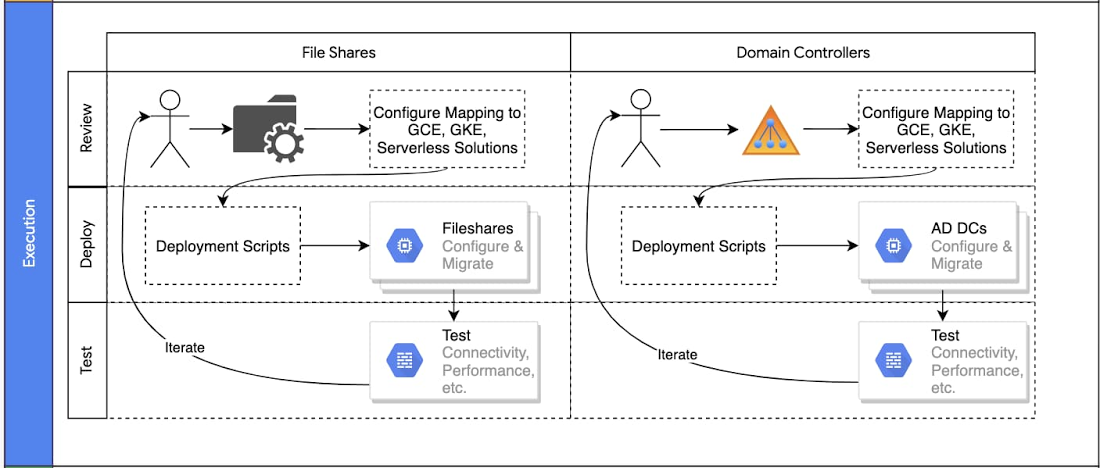
Data Migration Strategy
Transferring data seamlessly was critical. The strategy included using Extract, Transform, Load (ETL) tools and cloud-native data migration services to ensure data integrity and minimize downtime. Scheduled cutover windows were planned to transition data with minimal disruption to ongoing operations.
Application Migration
Applications were migrated based on their prioritization in the migration roadmap. Critical applications underwent refactoring to leverage cloud-native services, while others were rehosted to accelerate the migration timeline. Comprehensive testing was conducted at each stage to validate functionality and performance in the new environment.
Integration and Testing
Ensuring seamless integration with existing systems was vital. Migrated services were connected with on-premises systems through secure channels, and end-to-end testing—including load, performance, and security assessments—was performed to validate system behavior under expected workloads.
Post-Migration Optimization
Performance Optimization
After migration, continuous monitoring of performance metrics allowed for the optimization of resource allocation. Auto-scaling configurations were fine-tuned to align with demand patterns, ensuring optimal performance while controlling costs. Storage and compute resources were adjusted based on usage insights to maintain efficiency.
Cost Management and Reporting
Utilizing cloud cost management tools provided visibility into spending patterns. Implementing tagging practices and budget alerts helped track expenditures and identify areas for cost savings. Regular reviews of resource utilization enabled the organization to optimize reserved instances and adjust provisioning based on actual demand.
Continuous Improvement
The migration journey was treated as an ongoing process. Feedback loops involving developers, IT teams, and end-users facilitated the refinement of architectural designs and operational processes. The organization embraced cloud innovations such as machine learning and Internet of Things (IoT) services to drive additional business value and stay competitive.
Lessons Learned and Best Practices
Thorough Discovery
A deep understanding of existing dependencies, data flows, and security requirements was essential. Comprehensive discovery enabled accurate planning and reduced unforeseen challenges during migration.
Incremental Migration
Adopting a phased approach mitigated risks and allowed for iterative improvements. Migrating in stages provided opportunities to refine strategies and address issues progressively.
Security as a Priority
Integrating security measures from the outset ensured that the cloud environment was protected against threats. Continuous monitoring and proactive security practices were critical in maintaining data integrity and compliance.
Training and Cultural Shift
Empowering teams with cloud training and fostering a culture of continuous learning facilitated a smooth transition. Equipping staff with the necessary skills enabled them to leverage cloud tools effectively and drive innovation.
Conclusion
Transitioning from a traditional on-premises environment to a cloud-based solution involves meticulous planning, strategic execution, and ongoing optimization. By conducting a comprehensive assessment, adopting a phased migration approach, and prioritizing security and performance, the organization successfully navigated the complexities of cloud migration. The move resulted in enhanced scalability, cost efficiency, and operational agility, positioning the company for sustained growth and innovation in a competitive market.
References
 docs.aws.amazon.com
Last updated February 14, 2025