
The Blueprint of Life Uncopied: Unraveling the Intricate Dance of DNA Replication
Discover how cells meticulously duplicate their genetic material, a cornerstone process for life itself.
DNA replication is a fundamental biological process, essential for all known life. It is the mechanism by which a cell creates an identical copy of its entire DNA before cell division, ensuring that each daughter cell receives a complete and accurate set of genetic instructions. This remarkable feat of molecular machinery is vital for growth, development, tissue repair, and the faithful transmission of hereditary traits from one generation to the next.
Essential Insights: Key Takeaways
- Semiconservative Copying: DNA replication is termed "semiconservative" because each newly formed DNA molecule consists of one original (parental) strand and one newly synthesized strand. This ensures high fidelity in copying the genetic code.
- Enzyme-Driven Precision: A complex orchestra of specialized enzymes meticulously carries out the replication process. Key players include helicase (to unwind DNA), DNA polymerase (to synthesize new DNA), primase (to initiate synthesis), and ligase (to join DNA fragments).
- Three Fundamental Stages: The entire process is typically divided into three main phases: Initiation (starting the process at specific sites), Elongation (synthesizing the new DNA strands), and Termination (completing the replication and resolving any remaining structures).
What is DNA Replication? The Foundation of Genetic Continuity
Deoxyribonucleic acid (DNA) replication is the intricate process by which a cell duplicates its DNA. This biological marvel occurs in all living organisms, from the simplest bacteria to complex multicellular life. In eukaryotic cells (like those in humans), DNA replication takes place during the S (Synthesis) phase of the cell cycle, a tightly regulated period before a cell divides either by mitosis (for growth and repair) or meiosis (for sexual reproduction). The primary goal is to produce two identical DNA molecules from a single template molecule, ensuring that genetic information is preserved and accurately passed on.
The structure of DNA, a double helix with two complementary, antiparallel strands, is key to its replication. The sequence of nucleotide bases (Adenine, Thymine, Guanine, Cytosine) on one strand dictates the sequence on the other (A pairs with T, G pairs with C). During replication, these two strands separate, and each serves as a template for the synthesis of a new, complementary strand. This is known as semiconservative replication, a concept first proposed by Watson and Crick and experimentally confirmed by Meselson and Stahl.
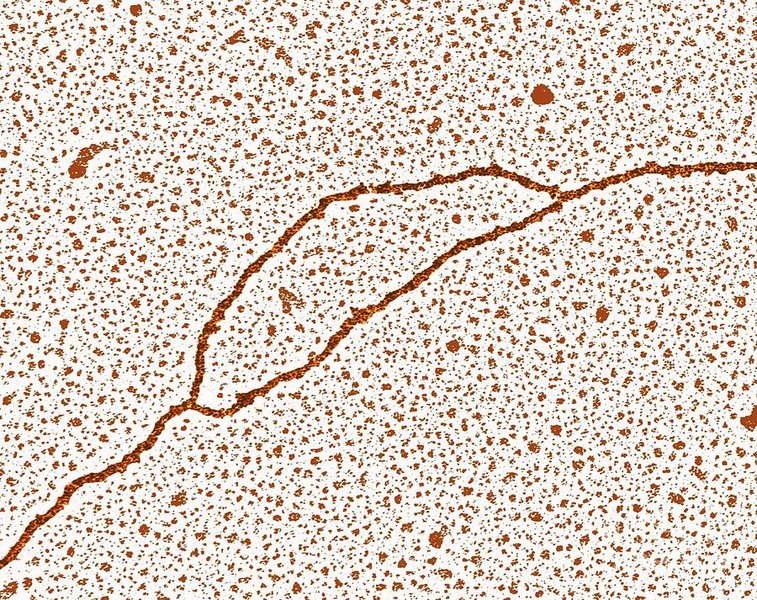
A DNA replication bubble, where the two strands of the DNA helix are separated to allow for the synthesis of new strands.
The Three Acts of Replication: A Detailed Staging
DNA replication is a highly coordinated and sequential process, broadly categorized into three distinct stages: initiation, elongation, and termination.
Act I: Initiation - Setting the Stage
The replication journey begins at specific DNA sequences known as origins of replication (ori). These sites act as docking points for the replication machinery.
Origins of Replication
Prokaryotic organisms, like bacteria, typically have a single origin of replication on their circular chromosome. In contrast, eukaryotic organisms, with their much larger linear chromosomes, utilize multiple origins of replication. This multi-origin approach allows for the efficient and timely duplication of vast amounts of genetic material.
The Unwinding Process: Helicase and the Replication Bubble
Once initiator proteins bind to the origin, they recruit other proteins, most notably an enzyme called DNA helicase. Helicase acts like a molecular zipper, unwinding the DNA double helix by breaking the hydrogen bonds between complementary base pairs. This separation of strands creates a 'replication bubble', which consists of two Y-shaped structures called replication forks. These forks are the actual sites of DNA synthesis and move in opposite directions along the DNA.
Stabilizing the Strands: SSBs and Topoisomerase
As the DNA unwinds, the exposed single strands have a natural tendency to re-anneal (stick back together). To prevent this, single-strand binding proteins (SSBs) quickly coat the separated strands, keeping them apart and accessible for templating. Furthermore, the unwinding process can create torsional stress and supercoiling in the DNA ahead of the replication fork. Enzymes called topoisomerases (e.g., DNA gyrase in bacteria) relieve this strain by cutting, swiveling, and rejoining the DNA strands.
Act II: Elongation - Building the New Strands
With the template strands exposed and stabilized, the synthesis of new DNA can begin. This is primarily orchestrated by enzymes called DNA polymerases.
The Role of DNA Polymerase: The Master Builder
DNA polymerases are responsible for adding new nucleotides to the growing DNA chain, using the parental strands as templates. They ensure that the correct nucleotide (A, T, C, or G) is incorporated opposite its complementary base on the template strand. A crucial characteristic of DNA polymerases is that they can only synthesize DNA in one direction: the 5' to 3' direction (referring to the orientation of the sugar-phosphate backbone). This directional constraint leads to different modes of synthesis for the two template strands, which are antiparallel.
Priming the Pump: The Necessity of RNA Primers
DNA polymerases cannot initiate DNA synthesis from scratch; they require a pre-existing short nucleic acid sequence, called a primer, to add nucleotides onto. This primer is a short stretch of RNA (typically 5-10 nucleotides long) synthesized by an enzyme called primase. The primer provides a free 3'-OH group, which is essential for DNA polymerase to begin its work.
The Leading Strand: Continuous Synthesis
One of the template strands, oriented 3' to 5' relative to the direction of replication fork movement, allows for continuous synthesis of the new strand. This is called the leading strand. DNA polymerase can add nucleotides in the 5' to 3' direction, moving along with the replication fork as it unwinds. Only one RNA primer is needed to initiate synthesis of the leading strand.
The Lagging Strand: Discontinuous Synthesis and Okazaki Fragments
The other template strand, oriented 5' to 3' relative to the replication fork movement, poses a challenge. Since DNA polymerase can only synthesize in the 5' to 3' direction, synthesis on this strand must occur discontinuously, in a direction opposite to the overall movement of the replication fork. This strand is known as the lagging strand. It is synthesized in short, separate segments called Okazaki fragments (named after their discoverer, Reiji Okazaki). Each Okazaki fragment requires its own RNA primer to initiate synthesis. As the fork opens further, primase lays down a new primer, and DNA polymerase synthesizes another fragment.
Sealing the Gaps: Primer Removal and DNA Ligase
Once the Okazaki fragments are synthesized, the RNA primers must be removed. This is typically done by enzymes like RNase H or the exonuclease activity of certain DNA polymerases (e.g., DNA polymerase I in prokaryotes). The same DNA polymerase then fills in the resulting gaps with DNA nucleotides. Finally, the nicks or breaks between the newly synthesized DNA fragments (where primers were) and the adjacent Okazaki fragments are sealed by an enzyme called DNA ligase. Ligase creates a phosphodiester bond, joining the fragments into a continuous strand.
Act III: Termination - Completing the Masterpiece
Replication continues until the entire DNA molecule has been duplicated.
Meeting of Forks and End-Replication
In organisms with circular chromosomes (like bacteria), termination occurs when the two replication forks meet at a specific termination site on the opposite side of the chromosome from the origin. In eukaryotes with linear chromosomes, replication proceeds until forks meet between adjacent origins or until they reach the ends of the chromosomes. The ends of linear eukaryotic chromosomes, called telomeres, present a special challenge. Because the lagging strand synthesis requires primers, a small portion of DNA at the very end of the chromosome cannot be fully replicated by conventional DNA polymerase action, leading to the "end-replication problem." Specialized enzymes like telomerase help to maintain telomere length in certain cells.
The Final Product: Two Identical DNA Molecules
Once termination is complete, the replication machinery disassembles, and the cell is left with two identical DNA double helices. Each new helix is a faithful copy of the original, ready to be segregated into daughter cells during cell division. The entire process is remarkably efficient and accurate, ensuring the stability of the genome across generations.
The Enzymatic Orchestra: Key Players in DNA Replication
DNA replication relies on a sophisticated ensemble of enzymes and proteins, each playing a critical role. The table below summarizes the functions of the major players involved in this intricate process.
| Enzyme/Protein | Primary Function | Notes |
|---|---|---|
| DNA Helicase | Unwinds the DNA double helix at the replication fork. | Breaks hydrogen bonds between base pairs. |
| Primase | Synthesizes short RNA primers. | Provides a 3'-OH starting point for DNA polymerase. |
| DNA Polymerase III (Prokaryotes) | Main enzyme for synthesizing new DNA strands. Adds nucleotides in the 5' to 3' direction. | Has proofreading capabilities. |
| DNA Polymerase I (Prokaryotes) | Removes RNA primers and fills the resulting gaps with DNA. | Also involved in DNA repair. |
| DNA Polymerases (e.g., Pol δ, Pol ε, Pol α) (Eukaryotes) | Carry out DNA synthesis. Pol α often initiates synthesis, while Pol δ and Pol ε are major replicative enzymes. | Different polymerases have specialized roles. |
| DNA Ligase | Joins DNA fragments together by forming phosphodiester bonds. | Essential for sealing Okazaki fragments on the lagging strand. |
| Topoisomerases (e.g., DNA Gyrase) | Relieve supercoiling and torsional strain ahead of the replication fork. | Prevents DNA tangling. |
| Single-Strand Binding Proteins (SSBs) | Bind to and stabilize separated single strands of DNA. | Prevent re-annealing of the strands. |
| Sliding Clamp (e.g., PCNA in Eukaryotes) | Helps DNA polymerase remain attached to the DNA template strand. | Increases the processivity of DNA polymerase. |
| RNase H | Removes RNA primers (in some systems). | Works in conjunction with or as an alternative to DNA Pol I's exonuclease activity for primer removal. |
Visualizing Replication Dynamics: A Comparative Look
DNA replication, while universal, exhibits variations between prokaryotic and eukaryotic organisms. These differences reflect the distinct cellular architectures and genomic complexities. The radar chart below provides an opinionated comparison of several key aspects of DNA replication in these two domains of life. The values are illustrative, on a relative scale from approximately 10 to 100, to highlight general trends rather than precise quantitative measurements.
This chart illustrates that while both systems achieve high accuracy, prokaryotic replication is generally faster and involves fewer origins due to smaller, simpler genomes. Eukaryotic replication, on the other hand, is more complex, involving intricate chromatin remodeling and specialized mechanisms for handling the ends of linear chromosomes (telomeres).
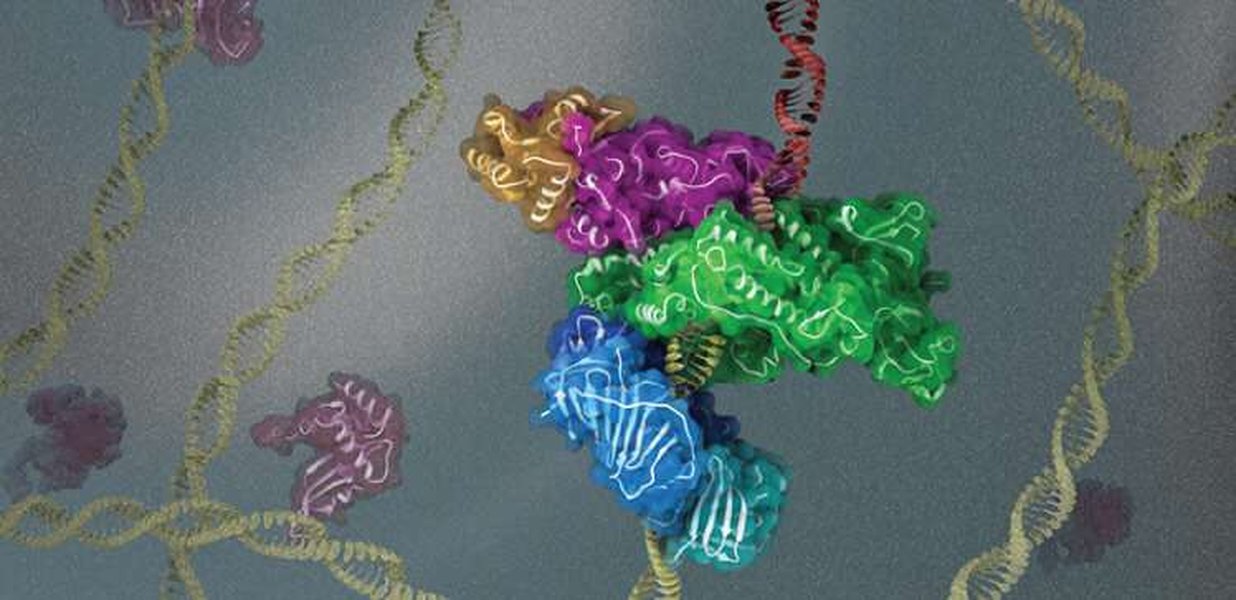
Visualizing the dynamic process of DNA replication within a cell using advanced microscopy techniques.
Mapping the Process: A DNA Replication Mindmap
To provide a holistic overview, the following mindmap illustrates the interconnected components and stages of DNA replication. It highlights the central process and branches out to key enzymes, fundamental features, and the overall significance of this cellular mechanism.
Okazaki Fragments)"] id1b4["RNA Primers (Primase)"] id1c["Termination"] id1c1["Meeting of Forks / End of Chromosome"] id1c2["Ligase Sealing Nicks"] id2["Key Enzymes & Proteins"] id2a["Helicase"] id2b["DNA Polymerase (various types)"] id2c["Primase"] id2d["Ligase"] id2e["Topoisomerase"] id2f["Single-Strand Binding Proteins (SSBs)"] id2g["Sliding Clamp"] id3["Core Features"] id3a["Semiconservative"] id3b["Bidirectional"] id3c["High Fidelity / Proofreading"] id3d["5' to 3' Synthesis Direction"] id4["Biological Significance"] id4a["Genetic Inheritance"] id4b["Cell Division (Mitosis & Meiosis)"] id4c["Growth & Development"] id4d["Tissue Repair"] id5["Variations"] id5a["Prokaryotic (Single Origin, Circular DNA)"] id5b["Eukaryotic (Multiple Origins, Linear DNA, Telomeres)"]
This mindmap serves as a conceptual framework, visually organizing the main ideas surrounding DNA replication, from the initial unwinding of the DNA molecule to the precise synthesis of new strands and the roles of the molecular machinery involved.
Animated Insight: Witnessing DNA Replication in Action
Visualizing the dynamic and complex process of DNA replication can greatly enhance understanding. The following 3D animation provides a clear depiction of how DNA is copied within a cell, illustrating the unzipping of the double helix and the coordinated action of enzymes to synthesize two identical DNA molecules.
This animation effectively shows the separation of the two DNA strands and how each serves as a template. It highlights the formation of the replication fork, the continuous synthesis on the leading strand, and the discontinuous synthesis of Okazaki fragments on the lagging strand. Watching these molecular machines in action provides a vivid sense of the precision and complexity inherent in this fundamental life process.
Ensuring Fidelity: The Proofreading and Repair Mechanisms
The accuracy of DNA replication is paramount for the survival and stability of organisms. Errors in copying DNA can lead to mutations, which may have detrimental effects, including genetic disorders and cancer. Cells have evolved sophisticated mechanisms to ensure that DNA replication is performed with extremely high fidelity.
The Importance of Accuracy
An error rate of even one mistake per million base pairs could lead to thousands of mutations each time a human cell divides, given the size of the human genome (approximately 3 billion base pairs). Fortunately, the actual error rate is much lower, typically in the range of one error per billion nucleotides replicated.
DNA Polymerase Proofreading
The primary mechanism for ensuring accuracy is the proofreading capability of DNA polymerases themselves. Most replicative DNA polymerases have a 3' to 5' exonuclease activity. If the polymerase adds an incorrect nucleotide to the growing strand, this exonuclease activity can remove the mismatched nucleotide. The polymerase then "backs up," removes the incorrect base, and inserts the correct one before continuing synthesis. This proofreading function significantly reduces the error rate.
Mismatch Repair System
Even with proofreading, some errors may still slip through. A secondary layer of correction is provided by the mismatch repair (MMR) system. This system scans newly replicated DNA for mismatched base pairs that were missed by the DNA polymerase's proofreading. MMR enzymes recognize the distortion in the DNA helix caused by a mismatch, remove the incorrect segment from the newly synthesized strand, and allow DNA polymerase to fill in the gap correctly, using the original parental strand as a template. The ability to distinguish the new strand from the old template strand is crucial for this process (e.g., via methylation patterns in bacteria or nicks in the new strand in eukaryotes).
Together, these mechanisms ensure that DNA replication is an incredibly precise process, safeguarding the integrity of the genetic information passed from one generation to the next.
Frequently Asked Questions about DNA Replication
What is semiconservative replication?
Semiconservative replication describes the process by which DNA is duplicated. When a DNA double helix replicates, each of the two daughter DNA molecules will have one "old" or parental strand and one "newly" synthesized strand. The original DNA molecule essentially unwinds, and each strand serves as a template for the construction of a new, complementary strand. This ensures that each new DNA molecule retains half of the original genetic material, preserving the genetic information with high fidelity.
Why is DNA replication so important for living organisms?
DNA replication is crucial for several fundamental biological processes:
- Cell Division: Before a cell can divide (e.g., during mitosis for growth and repair, or meiosis for reproduction), it must duplicate its DNA so that each daughter cell receives a complete copy of the genome.
- Growth and Development: Multicellular organisms grow and develop through repeated cell divisions, all of which require DNA replication.
- Tissue Repair: When tissues are damaged, new cells are produced to replace the lost or damaged ones, a process reliant on DNA replication.
- Genetic Inheritance: For organisms that reproduce sexually, DNA replication ensures that genetic information can be passed from parents to offspring.
What are Okazaki fragments and why are they formed?
Okazaki fragments are short, newly synthesized DNA segments that are formed on the lagging strand during DNA replication. Their formation is a consequence of two facts:
- DNA strands are antiparallel (one runs 5' to 3', the other 3' to 5').
- DNA polymerase can only synthesize DNA in the 5' to 3' direction.
How is accuracy maintained during DNA replication?
Accuracy in DNA replication is critical to prevent harmful mutations. Several mechanisms contribute to its high fidelity:
- Complementary Base Pairing: The fundamental A-T and G-C pairing rules inherently guide the selection of correct nucleotides.
- DNA Polymerase Proofreading: Most DNA polymerases have a "proofreading" function. If an incorrect nucleotide is inserted, the enzyme can detect the error, remove the mismatched base using its 3'-to-5' exonuclease activity, and then insert the correct nucleotide.
- Mismatch Repair (MMR) System: After replication, the MMR system scans the newly synthesized DNA for any remaining errors (mismatched bases) that were missed by polymerase proofreading. It then removes and replaces the incorrect segment.
Recommended Explorations
To delve deeper into the fascinating world of DNA replication, consider exploring these related topics:
- Explore the differences in DNA replication between prokaryotic and eukaryotic cells.
- What are the mechanisms of DNA repair associated with replication errors?
- How do telomeres affect DNA replication in eukaryotic chromosomes?
- Investigate the role of specific DNA polymerases in various organisms.
References
Last updated May 8, 2025