
Understanding the Determinant as a Volume Measure in n-Dimensional Space
Exploring the Geometric Significance of Determinants Through 2x2 and 3x3 Matrices
Key Takeaways
- The determinant of an n × n matrix measures the scaling factor of volume in n-dimensional space.
- For 2 × 2 matrices, the determinant represents the area of a parallelogram formed by its column vectors.
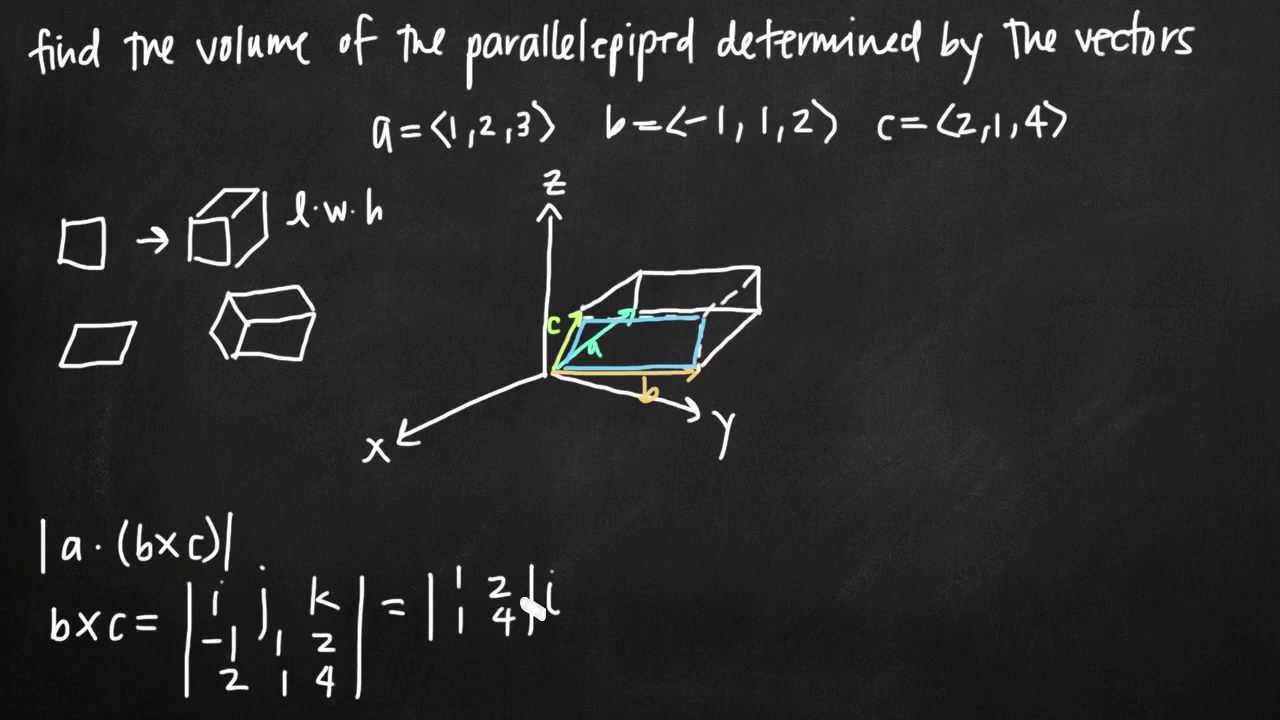
- For 3 × 3 matrices, the determinant corresponds to the volume of a parallelepiped defined by its column vectors.
Introduction
In linear algebra, the determinant of a matrix is a scalar value that encapsulates several key properties of the matrix. One of its most profound geometric interpretations is its role in measuring the volume of a parallelepiped in n-dimensional Euclidean space. This interpretation not only provides intuitive insight into linear transformations but also bridges abstract mathematical concepts with tangible geometric constructs.
Determinant and Volume: A General Perspective
At its core, the determinant serves as a scaling factor for volumes under linear transformations. Consider an n × n matrix A representing a linear transformation in ℝn. When this transformation is applied to the unit hypercube in ℝn, the resulting shape is an n-dimensional parallelepiped. The absolute value of the determinant of A, denoted |det(A)|, quantifies the n-dimensional "hypervolume" of this parallelepiped.
The sign of the determinant indicates the orientation of the transformation: a positive determinant preserves orientation, while a negative determinant reflects it. Moreover, if det(A) = 0, the transformation collapses the hypercube into a lower-dimensional space, indicating that the column vectors of A are linearly dependent.
Special Cases: 2 × 2 and 3 × 3 Matrices
2 × 2 Matrices: Determinant as Area of a Parallelogram
For a 2 × 2 matrix, the determinant provides a direct measure of the area of the parallelogram formed by its column vectors in ℝ².
Mathematical Representation
Consider matrix A:
A = [[a, b],
      [c, d]]
The determinant of A is calculated as:
$$ \text{det}(A) = ad - bc $$
Geometric Interpretation
The columns of A, represented as vectors v₁ = (a, c) and v₂ = (b, d), define a parallelogram in 2D space. The area of this parallelogram is given by the absolute value of the determinant:
$$ \text{Area} = |ad - bc| $$
Example
Let’s illustrate with an example:
A = [[1, 2], [0, 3]]
$$ \text{det}(A) = (1 \times 3) - (2 \times 0) = 3 $$
The area of the parallelogram formed by the vectors (1, 0) and (2, 3) is 3 square units.
Visualization
If the determinant is positive, the orientation of the vectors is preserved; if negative, the parallelogram is reflected. However, the area remains a positive quantity.
3 × 3 Matrices: Determinant as Volume of a Parallelepiped
Moving to three dimensions, the determinant of a 3 × 3 matrix extends this concept to volume measurement.
Mathematical Representation
Consider matrix B:
B = [[a, b, c],
      [d, e, f],
      [g, h, i]]
The determinant of B is calculated as:
$$ \text{det}(B) = a(ei - fh) - b(di - fg) + c(dh - eg) $$
Geometric Interpretation
The columns of B, represented as vectors v₁ = (a, d, g), v₂ = (b, e, h), and v₃ = (c, f, i), define a parallelepiped in ℝ³. The volume of this parallelepiped is given by the absolute value of the determinant:
$$ \text{Volume} = |\text{det}(B)| $$
Example
Let’s consider:
B = [[1, 2, 3], [0, 1, 4], [5, 6, 0]]
$$ \text{det}(B) = 1(1 \times 0 - 4 \times 6) - 2(0 \times 0 - 4 \times 5) + 3(0 \times 6 - 1 \times 5) $$
$$ \text{det}(B) = -24 + 40 - 15 = 1 $$
The volume of the parallelepiped formed by the vectors is 1 cubic unit.
Visualization
Similar to the 2D case, a positive determinant indicates preservation of orientation, while a negative determinant indicates reflection. The magnitude reflects the scaling of volume.
General Properties of Determinants in Geometric Terms
Scaling and Volume
The determinant serves as a volume scaling factor. When a matrix scales space by a factor, the determinant quantifies this change. For instance, if a matrix scales all dimensions by a factor of 2, the determinant will be 2ⁿ, where n is the dimension.
Orientation and Sign
The sign of the determinant indicates the orientation of the transformed space relative to the original. A positive determinant implies that the orientation is preserved, whereas a negative determinant indicates a reflection.
Linear Dependence and Degeneracy
A determinant of zero signifies that the vectors are linearly dependent, causing the parallelepiped to collapse into a lower-dimensional space with zero volume. This is a critical concept in understanding the invertibility of matrices, as only matrices with non-zero determinants are invertible.
Multiplicative Property
The determinant of a product of matrices equals the product of their determinants:
$$ \text{det}(AB) = \text{det}(A) \times \text{det}(B) $$
This mirrors the way volumes scale under successive linear transformations, reinforcing the determinant's role as a volume measure.
Comparative Overview of 2 × 2 and 3 × 3 Matrices
| Aspect | 2 × 2 Matrix | 3 × 3 Matrix |
|---|---|---|
| Geometric Shape | Parallelogram | Parallelepiped |
| Number of Vectors | 2 | 3 |
| Determinant Interpretation | Area of Parallelogram | Volume of Parallelepiped |
| Formula | det(A) = ad - bc | det(B) = a(ei - fh) - b(di - fg) + c(dh - eg) |
| Orientation | Positive or Negative Area | Positive or Negative Volume |
| Linear Dependence | Det(A) = 0 indicates collinear vectors | Det(B) = 0 indicates coplanar vectors |
Higher Dimensions: Extending the Concept
The interpretation of the determinant as a volume measure generalizes seamlessly to higher dimensions. In n-dimensional space, the determinant of an n × n matrix represents the n-dimensional hypervolume of the parallelepiped formed by its column vectors. While visualization becomes increasingly abstract beyond three dimensions, the algebraic properties of determinants maintain their geometric significance.
Challenges in Visualization
Unlike 2D and 3D, visualizing higher-dimensional parallelepipeds is not feasible. However, the mathematical principles remain consistent. The determinant continues to serve as a scaling factor, indicating how the n-dimensional volume is stretched or compressed under the associated linear transformation.
Applications in Higher Dimensions
This property is invaluable in various fields such as multivariable calculus, differential geometry, and data science, where understanding volume scaling in high-dimensional spaces is crucial for tasks like integration, optimization, and analyzing transformations.
Mathematical Tools: Cross Product and Scalar Triple Product
Cross Product in 2D and 3D
The cross product of two vectors in 2D can be represented as the determinant of a 2 × 2 matrix formed by these vectors. Similarly, the scalar triple product in 3D, which involves three vectors, is equivalent to the determinant of a 3 × 3 matrix containing these vectors.
Formulas
For vectors u = (u₁, u₂) and v = (v₁, v₂) in 2D:
$$ \text{Area} = |u₁v₂ - u₂v₁| = |\text{det}(A)| $$
For vectors u = (u₁, u₂, u₃), v = (v₁, v₂, v₃), and w = (w₁, w₂, w₃) in 3D:
$$ \text{Volume} = |u \cdot (v \times w)| = |\text{det}(B)| $$
Implementation in Code
To compute the determinant of a 3 × 3 matrix in Python, one can use the following function:
def determinant_3x3(matrix):
    """
    Calculate the determinant of a 3x3 matrix.
    :param matrix: List of lists, where each sublist is a row of the matrix.
    :return: Determinant value.
    """
    a, b, c = matrix[0]
    d, e, f = matrix[1]
    g, h, i = matrix[2]
    return a*(e*i - f*h) - b*(d*i - f*g) + c*(d*h - e*g)

# Example usage:
matrix = [
    [1, 2, 3],
    [0, 1, 4],
    [5, 6, 0]
]
print(determinant_3x3(matrix))  # Output: 1
Conclusion
The determinant of an n × n matrix serves as a crucial bridge between linear algebra and geometry, encapsulating how linear transformations scale volumes in n-dimensional space. Through the lens of 2 × 2 and 3 × 3 matrices, this interpretation becomes tangible by associating determinants with areas and volumes of parallelograms and parallelepipeds, respectively. Extending to higher dimensions, the determinant continues to represent the scaling factor of hypervolumes, maintaining its foundational role in understanding the geometric impact of linear transformations.
References
Last updated February 2, 2025