
Unlocking Team Potential: Crafting a Transformative Upskilling Journey Across Diverse Skill Levels
Strategies for empowering every member of your transformation team to drive impactful organizational change.
Key Insights for a Dynamic Upskilling Plan
- Comprehensive Needs Assessment: Begin by meticulously evaluating existing skills and identifying precise gaps across the team, ensuring a data-driven approach to development.
- Personalized and Blended Learning Paths: Design custom training programs that cater to varying skill levels and learning styles, integrating a mix of formats for optimal engagement and knowledge retention.
- Cultivating a Culture of Continuous Growth: Foster an environment of psychological safety, peer learning, and immediate skill application to ensure sustained development and measurable impact on transformation goals.
Developing a robust training and upskilling plan for a transformation team with diverse skill levels is pivotal for navigating complex organizational change. The objective is to bridge existing knowledge gaps, adapt to new challenges, and cultivate a cohesive, high-performing unit capable of driving successful initiatives. This requires a strategic, multi-faceted approach that considers individual needs while fostering collective growth.
Foundational Steps for Plan Development
The initial phase of creating an effective upskilling plan involves a thorough diagnostic of the team's current state and a clear articulation of future needs.
Assessing Current Capabilities and Defining Future Needs
A successful upskilling journey begins with a clear understanding of where the team stands and where it needs to go. This involves both quantitative and qualitative assessments to gather comprehensive insights.
Conducting a Comprehensive Skills Gap Analysis
The first critical step is to identify knowledge and skill gaps. This evaluation should encompass each team member's existing competencies against the specific demands of the transformation initiatives. Methods include:
- Surveys and Self-Evaluations: Allow team members to assess their own strengths and areas for development.
- Manager Feedback and Performance Reviews: Incorporate insights from direct supervisors who have a daily view of performance.
- Skills Audits: Utilize structured assessments or diagnostic tools to objectively measure proficiency in key areas such as digital literacy, agile methodologies, or specific technical tools.
- Role-Specific Requirements: Define the ideal skill sets for each role within the transformation team and identify discrepancies.
It's crucial to avoid assumptions and instead rely on data to pinpoint areas where team members either excel or require significant development.
Prioritizing Critical Skills for Transformation Success
Based on the identified gaps, prioritize the skills most critical for the transformation's success. This ensures that upskilling efforts are focused and directly contribute to organizational growth and the achievement of strategic objectives. Key areas often include:
- Change Management Methodologies: Understanding frameworks like ADKAR or Kotter's 8-Step Process.
- Agile Practices: Proficiency in Scrum, Kanban, or other agile development principles.
- Digital Literacy and Tool Proficiency: Competence with new software, data analytics platforms, or automation tools.
- Leadership and Soft Skills: Strategic thinking, decision-making, conflict resolution, emotional intelligence, and effective communication are paramount for navigating change.
Setting SMART and Aligned Program Goals
Clearly defined objectives are essential for any successful program. Goals for the upskilling initiatives should be SMART (Specific, Measurable, Achievable, Relevant, Time-Bound) and align with the overall organizational change management and transformation goals. This alignment ensures that every training effort directly supports the broader strategic vision. KPIs (Key Performance Indicators) should be established to measure progress, such as proficiency gains, application of skills in real projects, and contributions to transformation outcomes.
Designing an Inclusive and Dynamic Training Program
Once needs and goals are established, the focus shifts to creating a comprehensive program that caters to varying skill levels and fosters engagement.
Tailoring Learning Paths for Diverse Skill Levels
A one-size-fits-all approach is ineffective for transformation teams with varied expertise. Customization is key to ensuring relevance and engagement for every participant.
Segmenting the Team for Targeted Learning
Group participants based on their experience and expertise. This segmentation allows for content tailoring without isolating any subgroup. Consider:
- Beginner Tracks: Foundational concepts and basic tool proficiency.
- Intermediate Tracks: Deeper dives into methodologies, practical application, and problem-solving.
- Advanced Tracks: Strategic leadership, innovation, complex problem-solving, and mentoring skills.
- Role-Specific Modules: Content tailored to the unique responsibilities of different team members.
Implementing Blended Learning Approaches
Offer a variety of training modalities to accommodate different learning styles, schedules, and depths of understanding. This multifaceted approach maximizes engagement and knowledge retention:
- Instructor-Led Workshops: For interactive learning, discussions, and immediate feedback.
- Self-Paced Online Courses & Certifications: Provide flexibility for individuals to learn at their own pace and on their own schedule.
- Microlearning Units: Short, web-based modules (5-10 minutes) covering specific topics, ideal for busy professionals and addressing immediate skill deficiencies.
- Hands-On Projects & Case Studies: Allow immediate application of new skills in a practical, real-world context.
- Virtual Team-Building Training Days: Reinforce practical application of skills in a collaborative team environment.
- Lunch-and-Learn Sessions: Informal, relaxed settings to share knowledge and integrate professional development into daily routines.
Incorporating Core Transformation Competencies
Beyond technical skills, the training plan must emphasize the behavioral and strategic competencies essential for successful transformation.
Strategic Skill Development Areas
Training should focus on skills that enhance adaptability, resilience, and the ability to drive change:
- Change Management: Deep dives into methodologies, tools, and best practices.
- Leadership Development: Programs on strategic thinking, decision-making, conflict resolution, and emotional intelligence crucial for guiding change.
- Cross-Training and Knowledge Sharing: Encourage internal platforms where team members can act as both learners and educators, fostering a culture of continuous growth. This can involve pairing members with different skills or organizing regular knowledge-sharing sessions.
- Adaptability and Innovation: Include concepts like design thinking, agile mindset, and fostering openness to new situations and challenges.
Leveraging Technology for Personalized Learning
Utilize Human Capital Management (HCM) platforms, Learning Management Systems (LMS), and other digital tools to streamline the training process:
- Track Skills and Progress: Monitor individual and team skill development over time.
- Deliver Targeted Training: Use data analytics to recommend personalized learning paths.
- Provide Just-in-Time Training: Offer resources accessible precisely when needed, such as short video tutorials or quick guides.
- AI-Driven Recommendations: Leverage AI to suggest courses and content tailored to individual skill gaps and career aspirations.
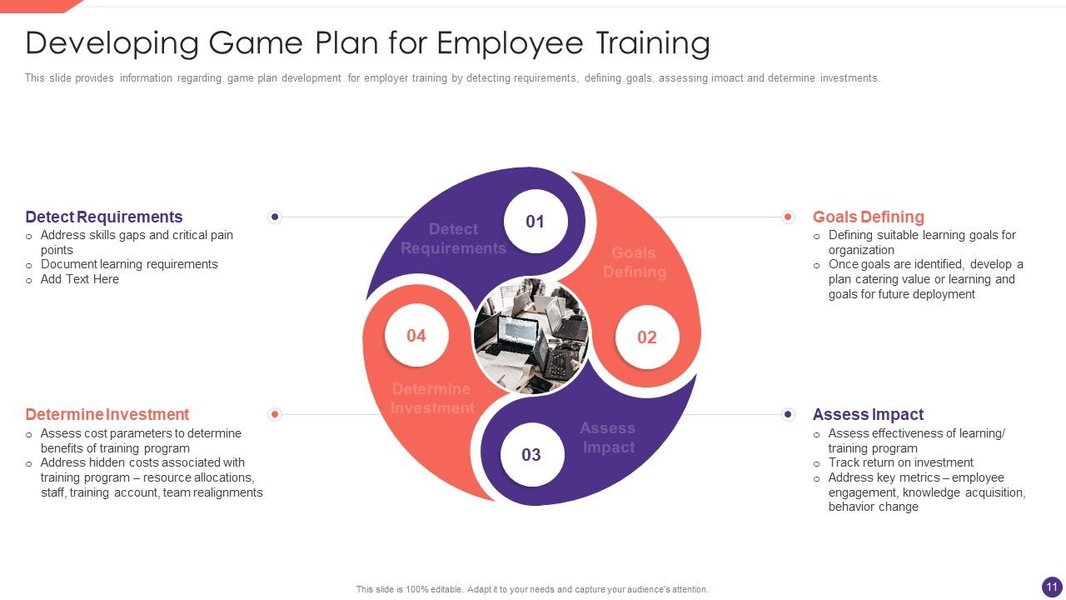
A comprehensive game plan for employee training, emphasizing strategic development.
Implementing and Sustaining the Upskilling Journey
Effective implementation ensures that the investment in upskilling translates into tangible results and sustained performance, particularly for mixed-ability teams.
Fostering a Supportive Learning Environment
A positive and inclusive atmosphere is paramount for encouraging engagement and reducing intimidation among team members with varying skill levels.
Cultivating Psychological Safety and Peer Learning
Establish a friendly and supportive space where the team feels safe to share ideas, experiment, and even fail. Encourage open discussions, active listening, and respectful conversations to build trust and teamwork. Promote peer learning opportunities through:
- Mentorship Programs: Pair more experienced team members with less experienced ones for ongoing support and guidance.
- Collaborative Projects: Design team assignments that require individuals with different skill sets to work together, encouraging knowledge transfer.
- Skills Exchange Sessions: Employee-driven platforms where team members teach each other specialized skills.
Differentiated Instruction and Individualized Challenges
When coaching mixed-ability teams, it’s essential to treat everyone equally while accommodating their different needs:
- Varying Difficulty Levels: For practical exercises, design activities with tiered complexity. For example, a task could have basic, intermediate, and advanced variations, ensuring everyone is suitably challenged.
- Small-Sided Group Work: Breaking the team into smaller groups for specific tasks can provide more individual attention and allow for tailored coaching.
- Individualized Tasks: While the team works on a core concept, allow more advanced players to work on specific, more complex tasks that stretch their abilities.
- Focus on Fundamentals for All: Regardless of skill level, ensure all team members master the foundational elements of new skills. Simplify communication to reduce confusion for beginners.
Understanding the individual context behind varying skill levels (e.g., prior training, learning pace) is key to tailoring appropriate learning opportunities.
Applying New Skills and Continuous Improvement
Upskilling is only valuable if new knowledge is applied and continuously refined.
Post-Training Application and Feedback Loops
Ensure that the time and resources invested in upskilling translate into tangible results by creating clear post-training plans. This involves:
- Assigning New Tasks or Projects: Immediately apply newly acquired skills in real-world scenarios. For instance, if an employee completes training on new CRM software, assign them roles that utilize these new capabilities.
- Stretch Roles and New Responsibilities: Provide opportunities for team members to take on challenging roles that align with their newly developed competencies.
- Regular Feedback and Coaching: Implement periodic check-ins, performance reviews, and 360-degree feedback to monitor progress, refine goals, and provide ongoing support.
Empowering Change Champions and Leaders
Identify and empower individuals within the organization who can serve as role models, advocates, and ambassadors for the transformation. Provide them with additional resources, leadership training, and support to effectively communicate the vision and benefits of the transformation to their peers.
Monitoring Progress and Adapting the Plan Iteratively
Transformation is a dynamic process, requiring ongoing monitoring and adjustments. Regularly evaluate the program's effectiveness through metrics like skill mastery rates, employee engagement, retention, and direct impact on transformation project outcomes. The transformation leadership team should ideally meet on a rolling 90-day plan to assess progress and adjust the strategy as necessary. This iterative approach ensures the plan remains responsive to the evolving needs of the team and the organization.
This radar chart illustrates the perceived strength of various components within an ideal transformation team's upskilling plan, as assessed across key strategic areas. Each axis represents a critical aspect, with higher values indicating a stronger focus or perceived effectiveness. This helps visualize areas of strength and potential improvement, highlighting the multifaceted nature of a successful upskilling initiative.
Key Stages and Activities in Upskilling a Transformation Team
The table below summarizes the essential stages involved in developing and implementing a training and upskilling plan for a transformation team, highlighting key activities at each phase.
| Stage | Key Activities | Expected Outcomes |
|---|---|---|
| 1. Assessment & Goal Setting | Conduct skills gap analysis, identify current competencies, define required skills for transformation, prioritize key skills, set SMART goals for the program. | Clear understanding of skill deficits, prioritized training needs, measurable objectives for upskilling. |
| 2. Program Design | Segment team by skill level, create personalized learning paths, develop customized content, select blended learning formats (workshops, online courses, microlearning). | Tailored curriculum for diverse needs, engaging and flexible learning experiences. |
| 3. Content Focus | Incorporate change management, agile methodologies, digital literacy, leadership, cross-training, adaptability, and innovation skills. | Team equipped with both technical and soft skills essential for driving change. |
| 4. Implementation & Support | Deliver training sessions, establish mentorship/coaching, foster psychological safety, encourage peer learning, empower change champions, leverage learning technology. | Supportive learning environment, enhanced knowledge transfer, accessible learning resources. |
| 5. Application & Iteration | Assign post-training tasks/projects, facilitate real-world application, gather feedback on effectiveness, monitor progress, adjust plan iteratively, celebrate milestones. | Measurable skill application, continuous improvement of the program, sustained team performance. |
Visualizing the Upskilling Journey: A Mindmap
This mindmap provides a high-level overview of the interconnected components essential for a successful training and upskilling plan for a transformation team. It illustrates how various elements, from assessment to ongoing support, contribute to a holistic and effective development strategy.
An interactive mindmap illustrating the key phases and components of an effective upskilling plan for transformation teams.
Deep Dive: Upskilling for the Future of Work
Understanding the broader context of upskilling in today's dynamic business environment is crucial. The following video provides valuable insights into strategies and best practices for upskilling the workforce, aligning with the needs of transformation teams.
This video, "Upskilling for the Future of Work: Strategies & Best Practices," delves into the evolving landscape of workforce development. It emphasizes the importance of preparing teams with new skills for the challenges and opportunities of the future, particularly in the context of AI and continuous adaptation. For transformation teams, this translates to the need for proactive, strategic upskilling that anticipates future demands and fosters a resilient, agile workforce ready to embrace change. The video discusses aligning learning objectives with business goals and cultivating engagement, which are central tenets for any successful transformation upskilling plan.
Frequently Asked Questions
What are the initial steps for developing an upskilling plan?
How can training be customized for a team with various skill levels?
What role does technology play in upskilling transformation teams?
How can a culture of continuous learning be fostered?
Why is post-training application important for transformation teams?
Recommended Further Exploration
- Explore best practices for integrating agile methodologies into transformation team training.
- Investigate the profound impact of robust leadership development on the success of organizational change initiatives.
- Discover effective strategies for quantifying the return on investment (ROI) of employee upskilling programs.
- Learn how to build and maintain psychological safety within high-performing teams to foster innovation and learning.