
Unlocking the Secrets of Digital Image Correlation
Discover the advanced non-contact optical technique measuring deformations with precision
Essential Insights
- Non-contact Measurement: DIC eliminates physical interference, preserving material integrity.
- Full-field Data Acquisition: Unlike traditional discrete methods, DIC captures comprehensive surface behavior.
- Versatility across Applications: Extensively used from aerospace to biomechanics and civil engineering.
Understanding Digital Image Correlation
Digital Image Correlation (DIC) is a sophisticated, non-contact optical technique employed to measure displacement, deformation, and strain on an object's surface. The method harnesses the power of high-resolution digital imaging to capture the state of a surface at different stages under various loading conditions. Subsequently, by analyzing the captured images, DIC algorithms are able to determine the deformation behavior of the surface.
Core Principles of DIC
Image Acquisition and Preparation
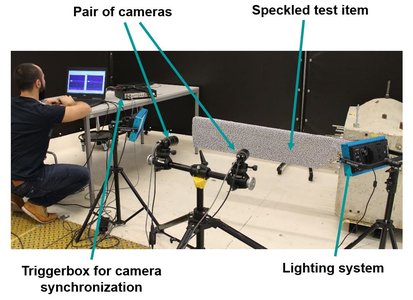
The process begins with capturing images of the object's surface using one or more high-resolution cameras. For effective analysis, a random or specifically applied speckle pattern is often introduced on the surface. This pattern creates distinct subsets that can be tracked throughout the deformation process. In cases where a three-dimensional analysis is required, two or more synchronized cameras are used to capture stereo images.
Correlation Algorithm and Analysis
Once images have been acquired, DIC involves comparing a reference image with images captured after deformation. The analysis primarily revolves around a correlation algorithm that examines small subsets in the image to track displacement and strain fields with sub-pixel accuracy. This method allows DIC systems to provide full-field data, which gives a detailed depiction of the entire surface rather than isolated points.
Types of DIC: 2D and 3D Approaches
DIC can be implemented in both two-dimensional (2D) and three-dimensional (3D) configurations. The 2D approach involves a single camera and is suitable for planar specimens where depth is not a consideration. On the other hand, the 3D method employs multiple cameras to capture stereo views, enabling comprehensive analysis including depth information. The choice between 2D and 3D DIC largely depends on the complexity of the subject geometry and the specifics of the testing environment.
Applications and Use Cases in Diverse Fields
The versatility of Digital Image Correlation has seen its adoption across several disciplines:
Materials Science and Engineering
In the realm of materials testing, DIC facilitates the precise measurement of strain and deformation. By monitoring the behavior of materials under tensile, compressive, and fatigue loads, engineers can obtain critical insights into material properties such as stress distribution and crack propagation. The full-field measurement capability of DIC is particularly valuable in studying localized phenomena – such as micro-cracks or residual stresses – that traditional gauges might miss.
Aerospace and Civil Engineering
Aerospace engineers employ DIC to analyze the structural integrity of aircraft components and assemblies. For instance, DIC is used to study the performance of wings and shear panels under dynamic loads. Civil engineers utilize the technique for assessing the deformation and strain in large structures like bridges or buildings, thereby ensuring that safety and design standards are met. In both contexts, non-contact measurement is crucial as it prevents measurement-induced disturbances to the structures.
Biomechanics and Medical Research
In biomechanics, DIC plays a pivotal role in analyzing the mechanical behavior of biological tissues. Its non-invasive nature allows researchers to study soft tissues, bones, and other organic materials without the need for intrusive sensors that might alter natural behavior. This has immense applications in medical device testing, surgical procedure planning, and rehabilitation research.
Advantages and Limitations
Digital Image Correlation offers a host of benefits along with several challenges that are important for users to consider:
Advantages
- Non-contact Measurement: The technique avoids physical interaction, thus preserving the natural behavior of the specimen.
- Full-field Analysis: Provides detailed mapping of displacement and strain over the entire surface, offering insight into localized deformations.
- High Spatial Resolution: Capable of attaining sub-pixel accuracy, which is critical for high-precision applications.
- Versatility: Applicable to various fields and can be configured for both 2D and 3D measurements, enhancing its adaptability.
Limitations
- Surface Requirements: A high-quality speckle or textured pattern is necessary for accurate correlation. Poor surface preparation can lead to errors in measurement.
- Lighting Sensitivity: Inconsistent or inadequate lighting conditions can adversely affect image quality, thereby impacting the reliability of data.
- Setup Complexity: Especially for 3D DIC, calibration of multiple cameras and precise alignment is critical to ensure accuracy. The computational intensity required to process high-resolution images can also be substantial.
Comparative Overview of DIC Concepts
The table below consolidates key varied aspects of Digital Image Correlation, summarizing core features, application domains, and experimental considerations:
| Aspect | Description | Applications |
|---|---|---|
| Measurement Technique | Non-contact optical method using high-resolution imaging to monitor surface deformation | Materials testing, structural health monitoring, biomedical research |
| Image Acquisition | Utilizes one or more cameras; requires a random/high-contrast speckle pattern for tracking | Static and dynamic tests in laboratories, field studies in engineering |
| Types of DIC | 2D (single camera) for planar measurement; 3D (stereo cameras) for comprehensive spatial analysis | Planar components in material science; three-dimensional structures in aerospace |
| Advantages | Full-field data, high precision, non-invasive | Structural integrity analysis, biomechanical strain measurement, material behavior studies |
| Challenges | Requires high-quality surface patterns, sensitive to light variations, demands precise calibration | All applications where rigorous surface conditions and control environments are needed |
Broader Perspective on DIC and Future Trends
The evolution of Digital Image Correlation continues to impact a range of scientific and engineering disciplines. As advancements are made in digital camera technology, image processing algorithms, and computational power, the precision and efficiency of DIC are set to improve. The integration of machine learning and artificial intelligence into DIC analysis is currently under exploration, enabling even more robust and automated interpretation of deformation data.
Moreover, the broad adaptability of the technique means it is finding new applications, such as in the evaluation of soft robotics, flexible electronics, and dynamic material characterization. Its potential incorporation with Digital Volume Correlation (DVC), which extends similar concepts to volume imaging (e.g., X-ray CT scans), opens exciting avenues for the holistic understanding of internal stress and strain distributions.
Integration with Other Measurement Technologies
Although DIC stands out with its non-invasive capabilities and comprehensive full-field measurements, it is often complemented by other techniques for enhanced precision. For instance, traditional strain gauges might be used in tandem with DIC to validate localized measurements. Similarly, combining DIC with Digital Volume Correlation provides a fuller picture when tracking internal deformations alongside surface changes.
References
- Digital Image Correlation Technology - Correlated Solutions
- DIC Overview - ZEISS Metrology
- Digital Image Correlation Solutions - Dantec Dynamics
- DIC and Tracking - Wikipedia
- Digital Image Correlation Basics - EikoSim
Recommended for Further Exploration
 photo-sonics.co.uk
Last updated March 28, 2025