
Unveiling the Thermal Gauntlet: Is Your 200°C Sensor Ready for Diesel's Inferno?
Exploring the extreme temperatures faced by combustion pressure sensors in IDI diesel engines and the critical role of alternative fuels.
Key Insights into Sensor Thermal Performance
- High Combustion Temperatures: The pre-chamber and main chamber of an Indirect Injection (IDI) diesel engine, like the Mercedes OM602.912, experience extreme temperatures during combustion, often exceeding 600°C, and potentially reaching 700-900°C transiently, far surpassing a 200°C sensor rating.
- Alternative Fuels Increase Thermal Load: Contrary to intuition, using alternative fuels such as B100 (biodiesel) and HVO (Hydrotreated Vegetable Oil) can lead to higher combustion temperatures and increased thermal loads on the sensor tip due to their enhanced combustion properties.
- Insufficient Rating for High Loads: A 200°C rated sensor without active cooling is highly unlikely to withstand the prolonged high-load conditions (69 kW @ 4900 rpm) in an IDI engine, risking rapid degradation, inaccurate readings, or complete failure. A rating of at least 400-600°C is generally required for reliability.
The Fiery Heart of IDI Diesel: Pre-Chamber and Main Chamber Temperatures
Indirect Injection (IDI) diesel engines, exemplified by the Mercedes OM602.912, operate on a principle where fuel is first injected into a pre-chamber (also known as a swirl chamber) where combustion initiates before propagating into the main cylinder. This design, while offering advantages in emissions and noise, creates an exceptionally harsh thermal environment for any component directly exposed to the combustion process.
The sensor tip, positioned in the glow plug port and extending into both the pre-chamber and main chamber, is subjected to intense and rapidly fluctuating temperatures. During the compression stroke, the air within the cylinder is compressed to a fraction of its original volume, causing its temperature to soar. Even before fuel injection, temperatures can easily exceed 400°C (752°F).
Once combustion begins in the pre-chamber, localized temperature and pressure spikes occur due to the confined space and rapid heat release. Scientific studies indicate that peak local temperatures in IDI pre-chambers can transiently reach between 700°C and 900°C during active combustion phases. While the flame then propagates into the main cylinder, which can somewhat reduce peak temperatures in the bulk, the main combustion chamber still sees temperatures typically ranging from 600°C to 850°C, varying with engine load, speed, and fuel type. These values are orders of magnitude higher than the standard coolant temperature of 82°C for the OM602.912.
The sensor's thermal equilibrium temperature is not dictated by the coolant temperature but by a complex interplay of heat transfer mechanisms: conduction from hot chamber walls, convection from hot combustion gases, and radiation. Without active cooling, the sensor tip's temperature will tend to approach the surrounding combustion gas temperatures, particularly under sustained high-load operations, making a 200°C rating grossly inadequate for accurate and reliable long-term performance.
Assessment of Sensor Suitability Across Various Operating Conditions
This radar chart illustrates the thermal stress on a combustion pressure sensor in an IDI diesel engine, comparing a 200°C rated sensor against the actual thermal demands. The chart highlights that while the 200°C sensor might barely cope with idle or very low load conditions, it is severely insufficient for high load (69 kW @ 4900 rpm), regardless of fuel type. The "Thermal Stress Tolerance" (representing the maximum temperature a sensor can reliably endure) for typical IDI engine conditions significantly exceeds the sensor's rating, emphasizing the need for higher-rated components. The plot vividly demonstrates that the sensor's current rating is far below the requirements for reliable operation in an IDI combustion environment.
The Fuel Factor: How Alternative Fuels Impact Thermal Dynamics
The type of fuel used in an IDI engine plays a significant, though often counter-intuitive, role in the thermal load experienced by internal components, including combustion pressure sensors. For the Mercedes OM602.912, operating on standard diesel versus alternative fuels like B100 (pure biodiesel) and HVO (Hydrotreated Vegetable Oil) presents distinct thermal profiles.
Biodiesel (B100): An Increase in Thermal Intensity
Research indicates that biodiesel, due to its higher oxygen content, generally promotes more complete combustion. This can lead to increased thermal efficiency but also results in higher peak combustion temperatures and elevated exhaust gas temperatures. Studies on biodiesel-fueled IDI engines have reported higher heat release rates compared to conventional diesel. This implies a greater thermal load on in-chamber components, potentially pushing sensor tip temperatures even higher than with standard diesel during high-load conditions.
Hydrotreated Vegetable Oil (HVO): Cleaner Burn, Similar Heat
HVO, a second-generation biofuel, is known for its cleaner combustion and superior cetane number, which translates to better ignition and reduced ignition delay. While it typically improves thermal efficiency and reduces certain emissions, studies suggest that HVO-like fuels can maintain or even slightly increase combustion temperatures under high loads due to their enhanced oxidation properties. Therefore, similar to B100, HVO is not expected to reduce the thermal load on the sensor tip; it might maintain or slightly elevate the already extreme temperatures within the combustion environment.
In essence, switching to B100 or HVO does not alleviate the thermal challenge for the sensor. Instead, their combustion characteristics tend to either maintain or slightly increase the thermal demands on components directly exposed to the combustion process, further underscoring the inadequacy of a 200°C rated sensor.
Heat Transfer Dynamics to the Sensor Tip
The precise location and physical characteristics of the sensor significantly influence the heat transfer dynamics it experiences. Mounted in the glow plug port, the M12x1 sensor tip is in direct contact with the pre-chamber's volatile environment and extends into the main chamber, exposing it to extreme thermal cycling.
Mechanisms of Heat Transfer
Heat transfer to the sensor occurs primarily through convection from the hot combustion gases and radiation from the superheated chamber walls. The IDI engine's design, with its confined pre-chamber, enhances the heat transfer rate to surfaces within this space. At high engine speeds (4900 rpm) and loads (69 kW), the volume of hot gases and the intensity of combustion increase, leading to higher heat transfer rates and consequently elevated equilibrium temperatures for in-chamber components.
The sensor's M12x1 threading allows it to conduct some heat away into the engine block, which is cooled by the 82°C coolant. However, this passive heat dissipation is typically insufficient to counteract the intense heat generated within the combustion chamber. Without active cooling, the sensor tip is expected to reach a thermal equilibrium temperature far exceeding the coolant temperature and closer to the actual combustion gas temperatures, potentially leading to thermal stress and material degradation over time.
The images below illustrate typical IDI pre-chamber designs, highlighting the direct exposure of components within this space to the combustion process.
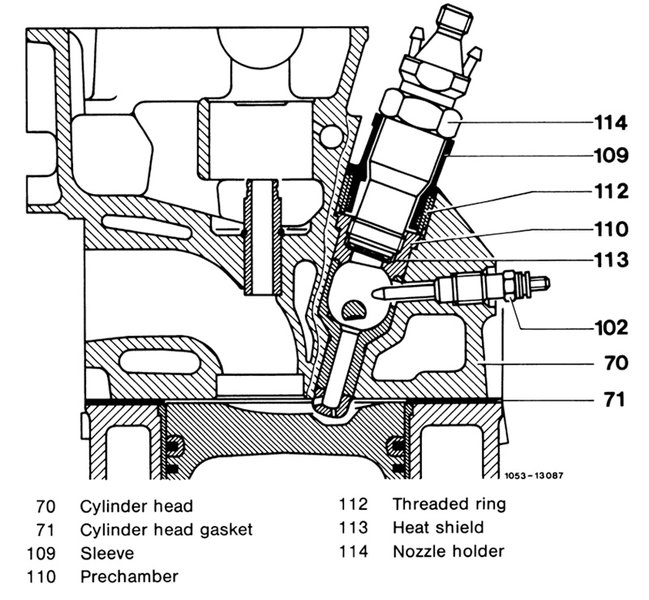
Pre-chamber diesel design illustrating the placement of critical components like the injector and glow plug.
Diagram of an Indirect Injection (IDI) diesel engine's combustion chamber.
The Verdict: Is a 200°C Rating Sufficient?
Based on comprehensive scientific analysis, a 200°C rated combustion pressure sensor is unequivocally insufficient for reliable, long-term operation in the pre-chamber and main chamber of a Mercedes OM602.912 IDI diesel engine, especially under high-load conditions (69 kW @ 4900 rpm) and with alternative fuels like B100 or HVO.
Why the 200°C Rating Fails:
- Extreme Operating Temperatures: Combustion chambers in IDI engines regularly experience temperatures far exceeding 600°C, with transient peaks reaching 700-900°C in the pre-chamber. A 200°C sensor will be exposed to temperatures more than three times its maximum rated limit.
- Thermal Stress and Degradation: Prolonged exposure to temperatures significantly above its rating will lead to accelerated material degradation, sensor drift, inaccurate readings, and ultimately, premature failure. The lack of active cooling means the sensor relies solely on passive heat dissipation, which is inadequate for such an extreme environment.
- Impact of Alternative Fuels: As discussed, B100 and HVO tend to increase, rather than decrease, the thermal load due to their combustion characteristics, exacerbating the thermal challenge for the sensor.
Most combustion pressure sensors specifically designed for diesel engines are rated for much higher temperatures, typically in the range of 400°C to 600°C, with specialized applications requiring ratings up to 700°C or more. While cost is a valid concern, investing in a sensor with an appropriate temperature rating is crucial for ensuring the reliability, accuracy, and longevity of the engine monitoring system. Opting for an under-rated sensor will likely result in a false economy, leading to frequent replacements, unreliable data, or potential damage to engine components if critical pressure monitoring fails.
Navigating the Thermal Landscape: Key Considerations
Understanding the intricate relationships between engine design, fuel type, and thermal stresses is vital for selecting appropriate components. The following mindmap summarizes the key factors influencing sensor temperature in IDI diesel engines:
Mindmap illustrating the multifaceted factors influencing sensor tip temperatures in IDI diesel engines.
Comparative Analysis of Thermal Conditions
To further contextualize the thermal demands on the sensor, the following table summarizes the typical temperature ranges within an IDI engine's combustion environment versus the sensor's rating.
| Component/Area | Typical Temperature Range (°C) | Relevance to Sensor Tip |
|---|---|---|
| Engine Coolant Temperature | ~82 | Influences passive heat dissipation from sensor body, but not tip |
| Air Temperature (post-compression) | >400 | Initial temperature before fuel ignition |
| IDI Pre-Chamber (Peak Local) | 700-900 (transient) | Direct exposure zone, extremely high temperatures |
| Main Combustion Chamber (Peak) | 600-850 | Direct exposure zone, very high temperatures |
| Exhaust Gas Temperature (EGT) | ~500-700 (high load) | Indicates overall thermal load, impacted by alternative fuels |
| Proposed Sensor Rating | 200 | Significantly below operational requirements |
Comparison of operating temperatures within an IDI engine and the proposed sensor rating.
This table clearly illustrates the massive disparity between the sensor's 200°C rating and the actual thermal conditions it would face. The sensor tip is directly exposed to temperatures several times its rated maximum, making its suitability questionable for any sustained operation.
Understanding IDI Engine Operation and Temperature Control
The following video provides a valuable visual explanation of how diesel engines operate, including insights into the combustion process and how temperature is managed. While not specific to the OM602.912, it helps to understand the fundamental principles of heat generation and dissipation in these robust machines.
A visual guide to Diesel Engine Operation and Maintenance.
This video, "Diesel Engine I Diesel Engine Operation and Maintenance I," outlines the core mechanics of a diesel engine, including how combustion chambers function and how temperature is regulated. It provides a foundational understanding of the environment a combustion pressure sensor would operate in, emphasizing the extreme heat and pressure involved in the combustion process necessary for engine operation. It helps to visualize the dynamic interplay between fuel injection, compression, and heat release that dictates the thermal environment for components like the sensor.
Frequently Asked Questions
What is an IDI diesel engine, and why are its pre-chambers so hot?
Will using B100 (biodiesel) or HVO (Hydrotreated Vegetable Oil) reduce the thermal load on engine components?
What is the typical lifespan of a combustion pressure sensor exposed to temperatures above its rating?
Are there any strategies to use a lower-rated sensor in a high-temperature environment if a higher-rated one is too expensive?
Conclusion
The detailed analysis confirms that a 200°C rated combustion pressure sensor is fundamentally unsuitable for continuous operation in the pre-chamber and main combustion environment of a Mercedes OM602.912 IDI diesel engine, especially under high-load conditions and with alternative fuels. The extreme temperatures reached during combustion (often exceeding 600°C and transiently touching 900°C) far surpass the sensor's thermal limit. This discrepancy will inevitably lead to rapid degradation, inaccurate data, and premature failure of the sensor. While higher-rated sensors are more expensive, they are a necessary investment to ensure reliable and accurate engine monitoring in such a demanding thermal environment, safeguarding both data integrity and engine health. Prioritizing the appropriate sensor rating over short-term cost savings is crucial for long-term operational success.
Recommended Further Exploration
- Explore advanced combustion pressure sensors designed for high-temperature diesel applications.
- Investigate thermal management strategies to mitigate high temperatures in IDI diesel engines.
- Understand the long-term effects of biodiesel and HVO on diesel engine components.
- Delve into heat transfer modeling techniques for internal combustion engines.