
Operation Error vs. Cumulative Error: Unpacking the Key Differences
Understanding how single mistakes differ from errors that build up over time is crucial in many fields.
Distinguishing between different types of errors is fundamental in fields ranging from science and engineering to finance and data analysis. Two commonly discussed types are "operation error" and "cumulative error." While they might sound similar, they refer to distinct concepts with different origins, characteristics, and impacts. Let's delve into what sets them apart.
Quick Insights: Operation vs. Cumulative Error
- Scope Difference: Operation errors typically occur within a single, isolated action or step, while cumulative errors are the result of inaccuracies building up over multiple, sequential steps.
- Nature of Impact: An operation error affects the outcome of that specific operation. Cumulative errors progressively magnify the total deviation from the true value as the process continues.
- Underlying Cause: Operation errors often stem from immediate factors like human mistakes or temporary glitches. Cumulative errors usually arise from persistent, systematic biases or flaws in measurement or calculation methods.
What is an Operation Error?
Pinpointing Errors in Single Actions
An "operation error" refers to an error that occurs during a specific, individual task, measurement, or step within a larger process. It's essentially a mistake or deviation linked to one particular action.
Nature and Scope
This type of error is localized to the operation in which it occurs. It doesn't inherently grow or compound unless the same erroneous operation is repeated under identical conditions that cause the error systematically. Operation errors can be either:
- Random: Varying unpredictably in magnitude and direction (e.g., accidentally misreading a dial slightly differently each time).
- Systematic (within the single operation): A consistent bias during that one action, perhaps due to a specific misunderstanding of a step or a temporary instrument issue causing a consistent deviation for that measurement.
Common Causes
Operation errors often arise from:
- Human Factors (Operator Error): Mistakes resulting from inattention, lack of experience, carelessness, fatigue, misinterpretation of instructions, or incorrect data entry.
- Procedural Lapses: Failing to follow established protocols or standard operating procedures for a specific task.
- Equipment Malfunction (Temporary): A glitch or fault in an instrument or system during a specific use.
- Environmental Factors (Isolated): A sudden, temporary change in conditions affecting a single measurement (e.g., a vibration during a sensitive reading).
Examples
- Incorrectly recording a single temperature reading from a thermometer.
- Making a calculation mistake in one step of a multi-step problem.
- Accidentally adding the wrong reagent during one instance of a chemical experiment.
- A software bug causing an incorrect output for a specific set of inputs during one run.

Random errors, which can manifest as operation errors, show variations around the true value without a consistent bias.
What is Cumulative Error?
When Small Errors Snowball
Cumulative error, often closely related or synonymous with systematic error in many contexts, is the total error that results from the accumulation of smaller errors over a series of repeated measurements, calculations, or operations. Crucially, these individual errors typically occur consistently in the same direction (either always positive or always negative).
Nature and Accumulation
The defining characteristic of cumulative error is its tendency to grow or "accumulate" as the number of operations increases. Instead of potentially canceling each other out (like purely random errors might), these errors compound, leading to a progressively larger deviation from the true or expected value. This error follows a predictable pattern, often related to a physical or mathematical law governing the systematic bias.
Underlying Causes (Systematic Bias)
Cumulative errors stem from persistent, systematic issues, such as:
- Instrument Calibration Errors: A measuring device consistently reads too high or too low (e.g., a ruler with incorrect markings, a scale that isn't zeroed properly).
- Consistent Environmental Effects: Temperature or pressure consistently affecting measurements in the same way (e.g., thermal expansion of a measuring tape used repeatedly).
- Methodological Bias: An inherent flaw in the experimental or calculation procedure that consistently skews results.
- Rounding Errors (in Computation): In numerical calculations involving many steps, consistently rounding numbers in the same direction can lead to significant cumulative rounding error.
Examples
- Surveying: Using a measuring tape that is slightly too short. Each time a segment is measured, the result is slightly longer than the actual distance. Over many segments (chaining), this small error accumulates into a significant discrepancy in the total measured length.
- Machining: In multi-axis machining, small, consistent errors in the movement of each axis can accumulate, leading to inaccuracies in the final dimensions of the workpiece.
- Numerical Integration: Approximating an integral using small steps can introduce a small error at each step. If this error is consistently positive or negative, it accumulates over the entire interval.
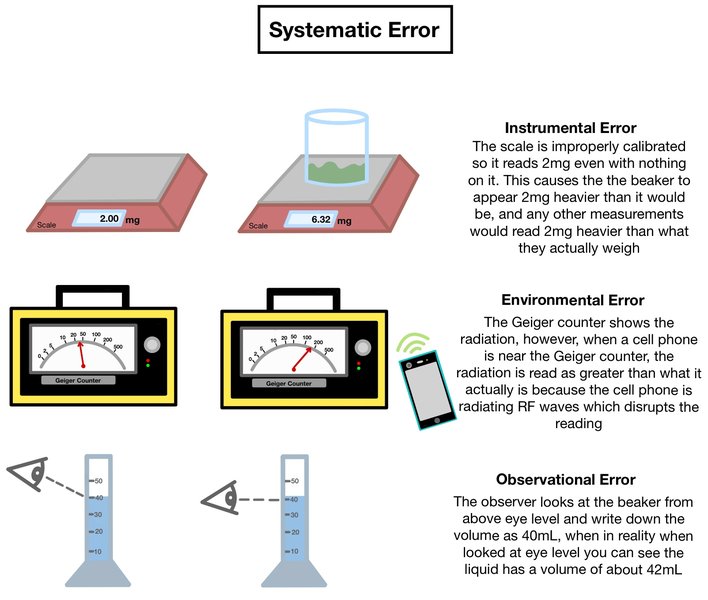
Systematic errors, the foundation of cumulative errors, consistently shift measurements away from the true value in one direction.
Key Differences Summarized
Operation Error vs. Cumulative Error at a Glance
The following table highlights the core distinctions between these two types of errors:
| Aspect | Operation Error | Cumulative Error |
|---|---|---|
| Scope | Single, specific operation or measurement. | Result of multiple sequential operations or measurements. |
| Nature | An error occurring at one point in time or one step. Can be random or systematic for that instance. | Accumulation of errors, typically systematic ones, over time or repetitions. |
| Error Growth | Contained within the single operation; does not inherently increase unless repeated systematically. | Increases (accumulates) as the number of operations or steps increases. |
| Cause | Often human factors (mistakes, negligence), procedural lapse, temporary equipment issue. | Typically stems from persistent systematic bias (instrument calibration, environmental factors, flawed method). |
| Predictability | Often unpredictable if random or due to negligence; predictable if caused by a systematic factor within that single operation. | Generally predictable if the underlying systematic cause is understood; follows a pattern or law. |
| Impact | Localized effect on the result of that one operation. | Global effect that grows, potentially leading to significant deviation in the final result. |
| Correction | Often mitigated by checks, training, redundancy, careful procedure following. | Often requires identifying the systematic cause and applying corrections, calibration, or adjustments. |
| Example | Misreading a burette volume once. | Total distance error after using a consistently stretched tape measure multiple times. |
Visualizing Error Characteristics
Comparing Error Profiles
This chart visually compares hypothetical profiles of operation errors and cumulative errors across several key characteristics. Note that the scores are illustrative, representing typical tendencies rather than absolute values.
- Scope (Single vs. Multiple Ops): How confined the error is (lower = single op).
- Predictability: How easily the error can be anticipated (higher = more predictable).
- Accumulation Factor: Tendency to grow over repetitions (higher = strong accumulation).
- Impact Magnitude (Single): Typical size of error in one instance.
- Impact Magnitude (Total): Potential size of error after many operations.
- Systematic Nature: Likelihood of being caused by a consistent bias (higher = more systematic).
- Correctability (Post-Hoc): Ease of applying mathematical corrections after measurement (higher = easier).
Understanding Error Relationships
A Map of Measurement Errors
Errors in measurement and processes can be broadly categorized. This mindmap illustrates how operation errors and cumulative errors fit within the general landscape of error types, which often includes Gross Errors (Mistakes), Random Errors, and Systematic Errors.
As the mindmap shows, "Operation Errors" often overlap with Gross Errors/Mistakes and can also involve random components. "Cumulative Error," however, is fundamentally linked to the repetition of "Systematic Errors." Understanding this hierarchy helps in diagnosing the source and nature of inaccuracies.
Errors in Practice: A Surveying Example
Cumulative vs. Compensating Errors in Chaining
Surveying provides excellent examples of different error types. Chain surveying, the process of measuring distances using a chain or tape measure over consecutive segments, is particularly prone to both cumulative and other types of errors. An operation error might be misreading the tape for one segment. A cumulative error arises if the tape itself is faulty (e.g., stretched due to tension, or affected by temperature) and this systematic error is repeated for every segment measured, causing the total measured distance to deviate significantly.
The following video discusses errors in chaining, including cumulative errors and compensating errors (random errors that tend to cancel each other out), providing a practical illustration of these concepts.
Video explaining types of errors in chain surveying, including cumulative and compensating errors.
Frequently Asked Questions
Clarifying Common Queries
Is an operation error always random?
Not necessarily. While many operation errors are random mistakes (like misreading a scale slightly differently each time), an operation error can stem from a systematic cause affecting that single instance. For example, misunderstanding one step in a procedure might lead to a consistent type of error whenever that specific operation is performed by that person, but it's still tied to the execution of that operation. However, the term "operation error" emphasizes the link to a specific action rather than an inherent, persistent bias across the whole system or instrument like typical systematic errors leading to cumulative effects.
Is cumulative error always systematic?
Primarily, yes. Cumulative error arises because errors from individual steps consistently add up in the same direction, rather than cancelling out. This consistent directionality is the hallmark of systematic errors (e.g., always measuring short, always calculating high). While theoretically, a series of random errors could coincidentally lean heavily in one direction, the defining characteristic and usual cause of significant cumulative error is an underlying systematic bias being repeated.
Can an operation error cause cumulative error?
Yes, indirectly. If the factor causing an error during a specific operation is *systematic* (e.g., using a miscalibrated pipette for every titration, consistently applying incorrect tension to a measuring tape) and that operation is *repeated multiple times*, then the systematic operation error will contribute to and result in a cumulative error over the series of operations.
How are these different types of errors typically mitigated?
Mitigation strategies differ:
- Operation Errors (especially mistakes/random): Addressed through careful work practices, clear procedures, training, double-checking results, using checklists, automation, and designing systems to be less prone to human error.
- Cumulative Errors (Systematic): Addressed by identifying the source of the systematic bias. This often involves calibrating instruments regularly, controlling environmental conditions, refining experimental methods or calculation algorithms, and applying mathematical corrections based on the known error characteristics.
References
Sources Used for This Analysis
- What is Cumulative Error? - Science Oxygen
- Errors in Chain Surveying - Types and Causes | The Constructor
- Errors In Surveying | Their Types, Sources, & Examples - Civil Engineers Forum
- Cumulative error Definition & Meaning - Merriam-Webster
-
Cumulative Error - an overview | ScienceDirect Topics
- What is the difference between cumulative and compensating errors in surveying? - Quora
- Surveying Types of Errors - MADE EASY
Recommended Reading
Explore Further Insights
Last updated April 21, 2025