
Unveiling the Twin Pillars of Change: Differential vs. Integral Calculus
Explore the dynamic duo of mathematics that describes everything from motion to accumulation.
Calculus, a cornerstone of modern mathematics, is broadly divided into two fundamental branches: differential calculus and integral calculus. While both deal with the concept of continuous change, they approach it from different perspectives and serve distinct purposes. Understanding their differences and interconnectedness is key to grasping the power of calculus in solving complex problems across various fields like physics, engineering, economics, and computer science.
Core Distinctions at a Glance
- Focus: Differential calculus is concerned with instantaneous rates of change and the slopes of curves, while integral calculus focuses on the accumulation of quantities and the areas under curves.
- Operation: The primary operation in differential calculus is differentiation, which finds a function's derivative. In integral calculus, it's integration, which finds a function's integral or antiderivative.
- Relationship: They are fundamentally linked by the Fundamental Theorem of Calculus, which establishes that differentiation and integration are inverse operations.
Differential Calculus: The Science of Instantaneous Change
Differential calculus provides the tools to analyze how functions change from moment to moment. It's like having a high-precision microscope for examining the behavior of a function at any specific point.
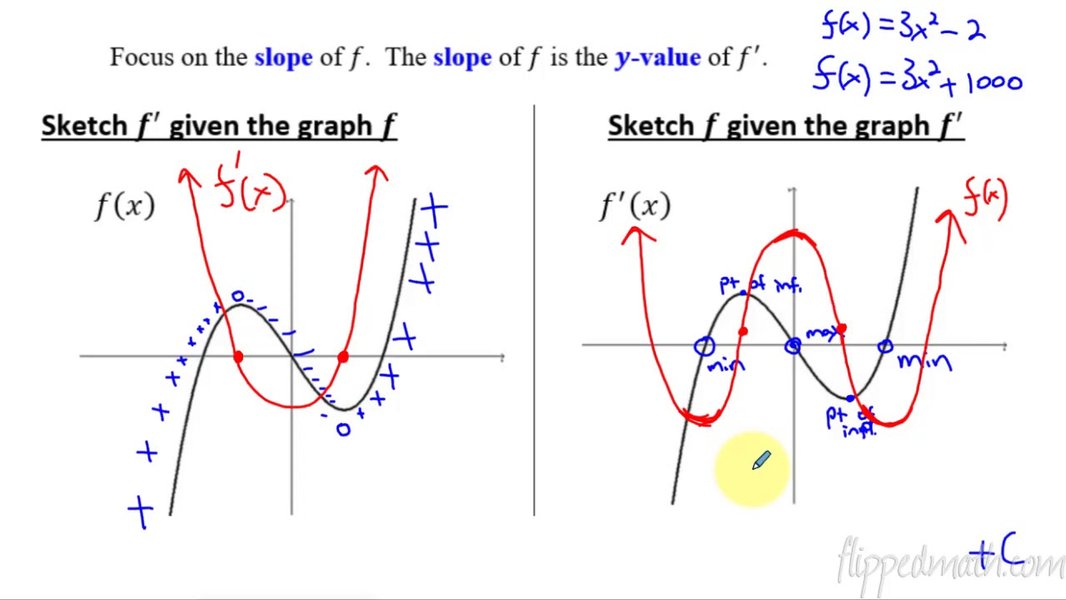
A visual representation of tangent lines on a curve, illustrating how differential calculus determines slopes at specific points.
Definition and Core Focus
Differential calculus is primarily concerned with the concept of the derivative. The derivative of a function at a certain point measures the rate at which the function's value is changing at that precise point. Geometrically, it represents the slope of the tangent line to the graph of the function at that point.
If you have a function \( y = f(x) \), its derivative, often denoted as \( f'(x) \) or \( \frac{dy}{dx} \), tells you how \( y \) changes with an infinitesimal change in \( x \). The formal definition involves a limit:
\[ \frac{dy}{dx} = f'(x) = \lim_{\Delta x \to 0} \frac{f(x + \Delta x) - f(x)}{\Delta x} \]This essentially captures the idea of "rise over run" for an infinitesimally small interval.
Key Concepts and Operations
The Derivative
The derivative is the central tool. For example, if a function describes the position of an object over time, its derivative with respect to time gives the object's instantaneous velocity. If the function is \( y = x^2 \), its derivative is \( f'(x) = 2x \). This means the slope of the parabola \( y = x^2 \) at any point \( x \) is \( 2x \).
Differentiation
Differentiation is the process of finding the derivative. Various rules have been developed to differentiate different types of functions, such as:
- Power Rule: For \( f(x) = x^n \), \( f'(x) = nx^{n-1} \).
- Product Rule: For \( f(x) = u(x)v(x) \), \( f'(x) = u'(x)v(x) + u(x)v'(x) \).
- Quotient Rule: For \( f(x) = \frac{u(x)}{v(x)} \), \( f'(x) = \frac{u'(x)v(x) - u(x)v'(x)}{[v(x)]^2} \).
- Chain Rule: For a composite function \( f(g(x)) \), its derivative is \( f'(g(x))g'(x) \).
Applications of Differential Calculus
Differential calculus is indispensable in numerous fields:
- Physics: Calculating velocity and acceleration from position, analyzing forces.
- Engineering: Optimizing designs, analyzing stress and strain in materials.
- Economics: Determining marginal cost and marginal revenue, optimizing profit.
- Biology: Modeling population growth rates, understanding rates of chemical reactions.
- Optimization Problems: Finding maximum or minimum values of functions (e.g., minimizing material usage, maximizing profit).
Integral Calculus: The Art of Accumulation
Integral calculus, on the other hand, deals with the accumulation of quantities. It allows us to sum up infinitely many infinitesimally small pieces to find a total, such as an area, volume, or total change.
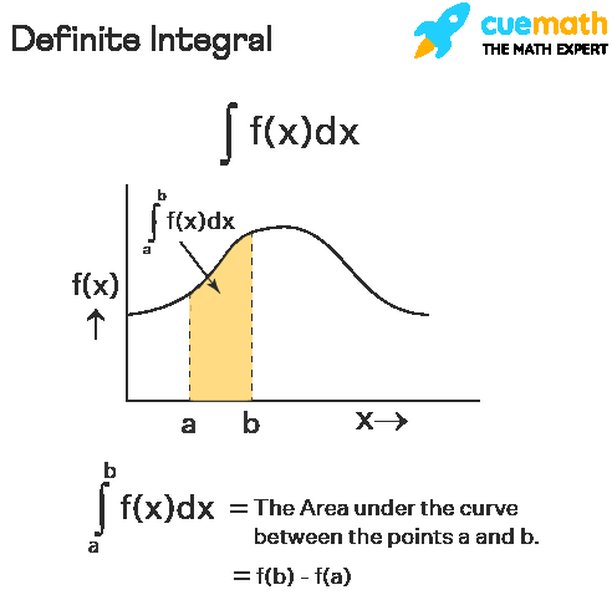
The definite integral calculates the net area between a function's graph and the x-axis over a specified interval.
Definition and Core Focus
Integral calculus is centered around the concept of the integral. It can be thought of as the reverse process of differentiation. If differentiation breaks things down, integration builds them up.
Key Concepts and Operations
The Integral
There are two main types of integrals:
- Indefinite Integral (Antiderivative): An indefinite integral of a function \( f(x) \), denoted \( \int f(x) \, dx \), is a family of functions whose derivative is \( f(x) \). Since the derivative of a constant is zero, indefinite integrals always include a constant of integration, \( C \). For example, if \( f'(x) = 2x \), then the indefinite integral is \( \int 2x \, dx = x^2 + C \).
- Definite Integral: A definite integral, denoted \( \int_a^b f(x) \, dx \), calculates the net signed area between the graph of \( f(x) \) and the x-axis, from \( x=a \) to \( x=b \). It represents the accumulation of the function's values over that interval.
Integration
Integration is the process of finding an integral. Techniques include:
- Basic Rules: Reversing differentiation rules (e.g., \(\int x^n \, dx = \frac{x^{n+1}}{n+1} + C\), for \( n \neq -1 \)).
- Substitution Method: Used for integrating composite functions, analogous to the chain rule in reverse.
- Integration by Parts: Used for integrating products of functions, derived from the product rule of differentiation.
- Partial Fractions: Used for integrating rational functions.
Applications of Integral Calculus
Integral calculus has wide-ranging applications:
- Physics: Calculating work done by a variable force, finding the center of mass, determining fluid pressure.
- Engineering: Calculating volumes of solids, surface areas, moments of inertia.
- Geometry: Finding areas of irregular shapes and lengths of curves.
- Economics: Determining total revenue or cost from marginal functions, calculating consumer and producer surplus.
- Probability and Statistics: Finding probabilities for continuous random variables by integrating probability density functions.
The Fundamental Theorem of Calculus: The Unifying Bridge
The most profound connection between differential and integral calculus is established by the Fundamental Theorem of Calculus. This theorem has two parts:
- The first part states that if \( F(x) \) is an antiderivative of \( f(x) \) (meaning \( F'(x) = f(x) \)), then the definite integral of \( f(x) \) from \( a \) to \( b \) can be easily calculated as: \[ \int_a^b f(x) \, dx = F(b) - F(a) \] This part provides a powerful method for evaluating definite integrals.
- The second part states that if a function \( G(x) \) is defined as \( G(x) = \int_a^x f(t) \, dt \), then the derivative of \( G(x) \) is \( f(x) \); i.e., \( G'(x) = f(x) \). This essentially says that differentiation "undoes" integration.
In essence, the Fundamental Theorem of Calculus demonstrates that differentiation and integration are inverse operations. This insight, independently discovered by Isaac Newton and Gottfried Wilhelm Leibniz in the late 17th century, revolutionized mathematics by unifying these two seemingly distinct concepts and providing a powerful framework for solving a vast array of problems.
This video provides an excellent explanation of the relationship between differentiation and integration, highlighting the Fundamental Theorem of Calculus.
Visualizing the Differences: A Comparative Radar Chart
To better illustrate the distinct characteristics and complementary roles of differential and integral calculus, the following radar chart compares them across several key attributes. Each attribute is scored on a scale of 1 to 10, reflecting its prominence or nature within each branch. For example, "Focus on Rate" is high for differential calculus and low for integral calculus, while "Focus on Accumulation" shows the opposite.
This chart visually summarizes that differential calculus excels in analyzing instantaneous rates and local behavior, often being more initially intuitive. Integral calculus, while potentially more complex operationally, is powerful for understanding accumulated totals and global behavior over intervals.
Mapping the Concepts: Calculus Core Ideas
The following mind map illustrates the main concepts of differential and integral calculus, showing their individual focuses and their connection through the Fundamental Theorem of Calculus.
Rates of Change,
Slopes of Curves"] id1_2["Core Operation:
Differentiation"] id1_3["Key Output:
Derivative (f'(x) or dy/dx)"] id1_4["Applications:
- Velocity & Acceleration
- Optimization (Maxima/Minima)
- Marginal Analysis (Economics)"] id2["Integral Calculus"] id2_1["Focus:
Accumulation of Quantities,
Areas, Volumes"] id2_2["Core Operation:
Integration"] id2_3["Key Output:
Integral (Indefinite: F(x) + C,
Definite: ∫ₐᵇ f(x)dx)"] id2_4["Applications:
- Area Under Curves
- Volumes of Solids
- Work Done by a Force
- Total Change"] id3["Fundamental Theorem of Calculus"] id3_1["Connects Differentiation & Integration"] id3_2["Inverse Operations"] id3_3["Allows Definite Integrals
via Antiderivatives"]
This mind map provides a clear visual hierarchy of the core ideas within each branch and how they relate, emphasizing the central role of the Fundamental Theorem in linking these two powerful mathematical tools.
Summarizing the Showdown: Differential vs. Integral Calculus
The table below provides a concise summary of the key differences between differential and integral calculus:
| Feature | Differential Calculus | Integral Calculus |
|---|---|---|
| Primary Focus | Rates of change; slopes of curves; instantaneous behavior | Accumulation of quantities; areas under curves; volumes of solids; total change over an interval |
| Core Operation | Differentiation | Integration |
| Main Output/Concept | Derivative (e.g., \(f'(x)\), \(\frac{dy}{dx}\)) | Integral (Indefinite: \( \int f(x) dx = F(x) + C \); Definite: \( \int_a^b f(x) dx \)) |
| Conceptual Idea | Analyzing how a function changes at a specific point (zooming in) | Summing up the effects of a function over an interval (zooming out to see the total) |
| Inverse Relationship | The inverse of integration (loosely speaking) | The inverse of differentiation (finding an antiderivative) |
| Typical Questions Answered | "How fast is it changing?" "What is the slope here?" | "How much has accumulated?" "What is the total area/volume?" |
| Example Application | Calculating instantaneous velocity from a position function; finding the rate of a chemical reaction. | Calculating the total distance traveled from a velocity function; finding the area of an irregular shape. |
| Educational Sequence | Often taught first, as the concept of rate of change can be more intuitive. | Usually taught after differential calculus, building upon the understanding of derivatives. |
Frequently Asked Questions (FAQ)
What is the main difference between differential and integral calculus in simple terms?
In simple terms, differential calculus is about finding the rate at which something is changing at a specific instant (like a car's speedometer reading). Integral calculus is about figuring out how much of something has accumulated over a period (like the total distance a car has traveled on a trip).
Which is harder to learn: differential or integral calculus?
Many students find the initial concepts of differential calculus (like slopes and rates of change) more intuitive. However, the techniques of integration in integral calculus can sometimes be more complex and require more varied strategies, leading some to perceive integral calculus as more challenging. Difficulty is subjective and depends on the individual learner.
Which branch of calculus should I learn first?
Typically, differential calculus is taught before integral calculus. This is because understanding derivatives and the process of differentiation provides a foundation that makes the concepts of integration and the Fundamental Theorem of Calculus easier to grasp.
What is an antiderivative, and how does it relate to integral calculus?
An antiderivative of a function \(f(x)\) is another function \(F(x)\) whose derivative is \(f(x)\) (i.e., \(F'(x) = f(x)\)). Finding an antiderivative is the core of indefinite integration in integral calculus. For example, an antiderivative of \(2x\) is \(x^2\), because the derivative of \(x^2\) is \(2x\). The general antiderivative includes a constant of integration, \(C\), so it would be \(x^2 + C\).
How are differential and integral calculus used in real life?
They are used extensively. Differential calculus helps in optimizing profits in business, calculating velocities in physics, designing efficient structures in engineering, and understanding growth rates in biology. Integral calculus is used to calculate areas and volumes in design and manufacturing, determine total amounts of substances in chemistry, calculate work and energy in physics, and in financial modeling to sum up continuous streams of income or costs.
Conclusion
Differential and integral calculus are two sides of the same mathematical coin, each offering a unique lens through which to analyze and understand the world of continuous change. Differential calculus dissects functions to understand their instantaneous behavior, while integral calculus synthesizes these behaviors to understand accumulated effects. United by the Fundamental Theorem of Calculus, they form a powerful and elegant system that is foundational to countless advancements in science, engineering, and beyond. Their combined strength allows us to model, predict, and optimize in ways that would otherwise be impossible.
Recommended Further Exploration
- What is the Fundamental Theorem of Calculus and why is it important?
- Explore real-world applications of derivatives in engineering.
- Discover how integral calculus is used in economics and finance.
- Learn about the historical development of calculus by Newton and Leibniz.
References
Last updated May 21, 2025