
Unraveling the Labyrinth: How Science Distinguishes Real Memories from False Ones
Exploring the fascinating and complex world of memory accuracy through scientific research.
The human memory, often perceived as a reliable recorder of past events, is actually a dynamic and reconstructive process. This means our recollections can be surprisingly malleable, susceptible to distortion, suggestion, and even complete fabrication. Understanding the difference between genuine memories (accurate recollections of experienced events) and false memories (memories of events that never happened or happened differently) is a critical area of research in psychology and neuroscience, with profound implications for everything from personal understanding to legal proceedings. This exploration delves into the scientific articles and findings that shed light on this complex distinction.
Key Insights into Memory Differentiation
- Memory is Reconstructive: Recalling an event isn't like playing back a video; it involves piecing together information, making it vulnerable to errors and external influences.
- False Memories Can Feel Real: Individuals often report high confidence in false memories, making subjective certainty an unreliable indicator of accuracy.
- Neural and Cognitive Markers Exist: While challenging, researchers are identifying differences in brain activity patterns and cognitive characteristics (like sensory detail) that can help distinguish true from false recollections.
The Nature of Memory: Reconstruction, Not Recording
Contrary to the popular metaphor of memory as a storage vault or video camera, cognitive science reveals it as a fundamentally reconstructive process. When we remember, our brains actively rebuild past experiences using fragments of stored information, inferences, and current knowledge or beliefs. This inherent reconstruction makes memory susceptible to various forms of error and distortion.
How False Memories Form
False memories aren't necessarily deliberate lies; they often arise unconsciously through several mechanisms:
- Suggestion and Misinformation: Pioneering work by researchers like Elizabeth Loftus demonstrated that exposure to misleading information after an event can alter existing memories or even implant entirely new ones (the "misinformation effect"). Suggestive questioning or therapeutic techniques can inadvertently contribute to this.
- Source Misattribution: We might correctly remember a piece of information but incorrectly attribute its source. For example, remembering details learned from a story as if they were part of a personally experienced event.
- Imagination Inflation: Simply imagining an event, especially repeatedly, can increase confidence that the event actually occurred.
- Schema-Based Reconstruction: Our brains use existing knowledge structures (schemas) to fill in gaps in memory. While efficient, this can lead to incorporating typical, but not actually experienced, details into a memory.
- Emotional Factors: Strong emotions can enhance memory for central details but sometimes impair memory for peripheral details. Emotional states, wish fulfillment, and the need for coherent narratives can also influence memory reconstruction, potentially leading to inaccuracies.
Studying False Memories: The DRM Paradigm
One classic experimental method used to induce and study false memories in the lab is the Deese-Roediger-McDermott (DRM) paradigm. Participants study lists of semantically related words (e.g., *bed, rest, awake, tired, dream*). Later, during a recall or recognition test, they often falsely remember or recognize a related but non-presented critical word (e.g., *sleep*). This demonstrates how easily associative activation can lead to memory errors.
The Challenge: Telling True from False
Distinguishing accurately between a genuine memory and a false one is notoriously difficult, both for the individual experiencing the memory and for external observers. Research consistently shows that:
- Confidence is Unreliable: People can be highly confident in their false memories, sometimes even more confident than in their true memories. Studies, including those involving identifying rich false memories of committing crimes, show people struggle to differentiate based on confidence alone.
- Subjective Experience Can Deceive: False memories can sometimes feel incredibly vivid and real, mimicking the subjective qualities often associated with genuine experiences.
- Overlap in Neural Mechanisms: While differences exist, neuroimaging studies show that true and false memories often activate overlapping brain networks, particularly during retrieval, making simple brain scans insufficient for definitive differentiation in many cases.
Potential Differentiating Factors: What Science Looks For
Despite the challenges, researchers have identified several characteristics and methods that show promise in differentiating true and false memories:
Sensory and Contextual Detail
Genuine memories, particularly those derived from direct experience, tend to be richer in specific sensory details (sights, sounds, smells) and contextual information (where and when the event occurred) compared to false memories. False memories might feel familiar or gist-based but often lack these specific perceptual details. Research using Reality Monitoring (RM) criteria assesses these qualitative characteristics to infer memory origin.
Neural Signatures
Neuroimaging techniques like fMRI are revealing subtle differences in brain activity associated with true versus false remembering:
- Encoding Differences: Some studies suggest differences in brain activity during the initial encoding phase might predict later true versus false memory formation.
- Retrieval Differences: True memories often show greater activation in sensory processing areas (like visual or auditory cortex) and regions strongly associated with episodic recollection, such as the hippocampus and medial temporal lobe (MTL). False memories might involve more activity in frontal regions associated with monitoring and reasoning, potentially reflecting the reconstructive effort involved. However, patterns can vary depending on the type of memory and individual differences.
- White Matter Connections: Research suggests individual differences in the structure of white matter tracts (which connect brain regions) correlate with tendencies toward true versus false memory retrieval. For instance, the integrity of the inferior longitudinal fasciculus has been linked to true memory, while the superior longitudinal fasciculus has been associated with false memory proneness.
Cognitive Processes
Theoretical frameworks like Fuzzy-Trace Theory propose that we encode both verbatim (specific details) and gist (meaning/semantic content) traces of experiences. False memories often arise from relying heavily on gist information, leading to endorsements of items or events consistent with the gist but not actually experienced. Activation-Monitoring Theory focuses on how related concepts become activated during encoding or retrieval, and errors occur when we fail to monitor the source of this activation correctly.
Visualizing Memory Concepts
Mindmap of Memory Differentiation
This mindmap provides a conceptual overview of the key factors involved in understanding and differentiating genuine and false memories.
Comparing Typical Memory Characteristics
This chart visually contrasts the typical qualitative features often associated with genuine versus implanted false memories, based on general research findings. Note that these are tendencies, and individual memories can vary significantly. Scores represent relative strength or presence of the feature (higher score = stronger presence).
Key Theories and Paradigms
Several theoretical frameworks and experimental paradigms guide research into false memories. Understanding these helps clarify how errors in memory can arise.
| Theory / Paradigm | Core Concept | Explanation of False Memory |
|---|---|---|
| Deese-Roediger-McDermott (DRM) Paradigm | Experimental method using lists of related words. | False recall/recognition of a non-presented "critical lure" (e.g., "sleep") occurs due to strong semantic association and spreading activation among related concepts. |
| Fuzzy-Trace Theory (FTT) | Memory involves encoding both verbatim (exact details) and gist (meaning, semantic content) traces. | False memories often result from relying on gist information. An event or item that fits the general meaning (gist) might be falsely remembered, even if the specific details (verbatim trace) are absent or weak. |
| Activation-Monitoring Framework | Memory retrieval involves activation of related concepts; requires monitoring processes to determine the source of activation. | False memories occur when related concepts are activated (either during encoding or retrieval) and monitoring processes fail to correctly identify the source (e.g., mistaking internal thought for external event). |
| Reality Monitoring (RM) | A decision process used to distinguish memories of internal thoughts/imaginations from memories of external perceived events. | Failures in RM contribute to false memories. Memories originating from external events typically have more perceptual/contextual detail than those originating from internal thought/imagination. Errors occur when these characteristics are misjudged. |
Visualizing Memory Research
Scientific investigations into memory often utilize brain imaging techniques like functional Magnetic Resonance Imaging (fMRI). These tools allow researchers to observe brain activity while participants engage in memory tasks, providing clues about the neural processes underlying both true and false recollections. Images like fMRI scans help visualize which brain regions are more active during different types of memory retrieval, contributing to our understanding of the distinctions discussed earlier.
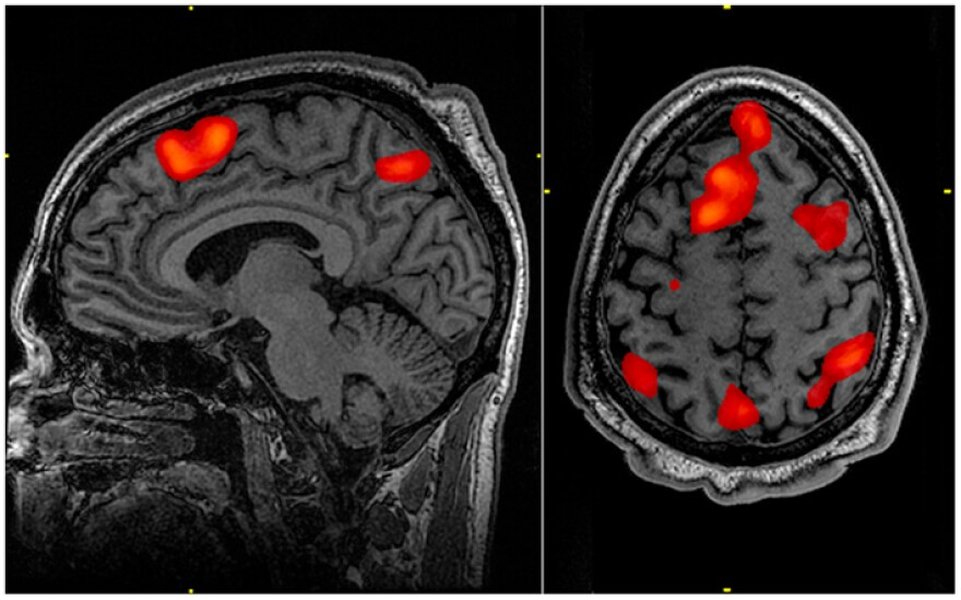
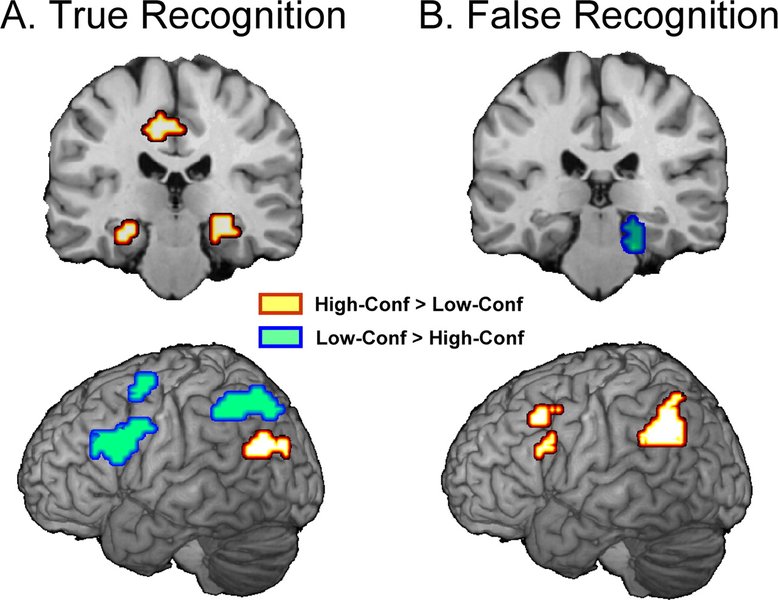
Examples of fMRI scans and brain region diagrams used in memory research.
While fMRI has limitations and cannot definitively "read" a specific memory's truthfulness in isolation, patterns of activation across many trials and participants reveal valuable information. For example, heightened activity in sensory processing areas might correlate more strongly with true memories, while increased prefrontal cortex activity might signal the cognitive control involved in reconstructing or evaluating a less certain (potentially false) memory. These visual representations are crucial tools in the ongoing scientific effort to decode the neural basis of memory accuracy.
Expert Perspective: Elizabeth Loftus on False Memories
Dr. Elizabeth Loftus is a world-renowned cognitive psychologist whose groundbreaking research over several decades has significantly shaped our understanding of memory malleability and false memories. Her work, often involving ingenious experiments demonstrating the misinformation effect and the possibility of implanting rich false autobiographical memories (like being lost in a mall as a child), has had a major impact on psychology and legal practices regarding eyewitness testimony. In this video, Dr. Loftus discusses how easily memories can be changed and why we should be cautious about their reliability.
Frequently Asked Questions (FAQ)
Can a false memory feel completely real?
Yes, absolutely. One of the most challenging aspects of false memories is that they can be accompanied by a strong subjective feeling of reality and high confidence. Research shows that richness, detail, and emotional content can sometimes be associated with false memories, making them difficult to distinguish from genuine ones based solely on subjective experience.
Are some people more prone to false memories?
Yes, research suggests individual differences exist. Factors like age (children and older adults can be more susceptible), personality traits (e.g., high suggestibility, dissociative tendencies), cognitive styles (e.g., reliance on gist vs. verbatim detail), and certain neurological or psychological conditions can influence an individual's susceptibility to forming false memories.
Can brain scans reliably tell if a memory is true or false?
Currently, no brain scan can definitively determine the truthfulness of a specific, individual memory with perfect accuracy. While fMRI and other neuroimaging techniques can reveal patterns of brain activity that differ *on average* between groups of true and false memories in experimental settings (e.g., more sensory cortex activation for true memories), there is significant overlap, and applying this to individual cases, especially in real-world contexts, is highly complex and generally not yet feasible or reliable for forensic purposes.
What is the difference between a false memory and confabulation?
While both involve inaccurate memories, they differ in origin and context. False memories, as discussed here, often arise in healthy individuals due to suggestion, misinformation, or normal reconstructive processes. Confabulation typically refers to the production of fabricated or distorted memories without the conscious intention to deceive, often associated with neurological conditions like dementia, Korsakoff's syndrome, or brain injury affecting frontal lobe function and memory monitoring.
References
- False memories in forensic psychology: do cognition and brain activity tell the same story? - Frontiers
-
A Review on Cognitive and Neural Mechanisms Underlying False Memories: From the Perspective of the Fuzzy-Trace and Activation-Monitoring Theories - PMC NCBI
-
Do False Memories Look Real? Evidence That People Struggle to Identify Rich False Memories of Committing Crime and Other Emotional Events - PMC NCBI
- What science tells us about false and repressed memories - Taylor & Francis Online
- Differentiating True and False Schematic Memories in Older Adults: An fMRI Study - The Journals of Gerontology: Series B
- Study: True memories are rich in varied details - Cornell Chronicle
- True and False Memories as an Illustrative Case of the Difficulty of Developing Accurate and Practical Neurophysiological Indexes of Psychological States - NCBI Bookshelf
Recommended Further Exploration
Last updated April 5, 2025