
Unlocking New Value: How Digital Transformation Revolutionizes the Value Stick
Explore the profound ways digital technologies reshape willingness to pay, pricing, costs, and supplier engagement, maximizing value for all stakeholders.
Key Insights: The Digital Impact on Value Creation
- Enhanced Customer Value: Digital transformation significantly boosts customers' willingness to pay (WTP) through personalized experiences, innovative digital offerings, and improved service quality.
- Operational Excellence: Technologies like AI, automation, and data analytics drive down operational costs and optimize processes, directly improving firm margins.
- Strategic Supplier & Employee Engagement: Digital tools improve collaboration and efficiency, potentially lowering the willingness to sell (WTS) for suppliers and employees by offering non-monetary benefits and streamlined interactions.
The Value Stick Framework: A Foundation for Strategic Insight
The Value Stick, a concept popularized by Harvard Business School professor Felix Oberholzer-Gee, is a powerful strategic tool. It visually deconstructs how businesses create and capture value in any transaction. Understanding its components is crucial before exploring the impact of digital transformation.
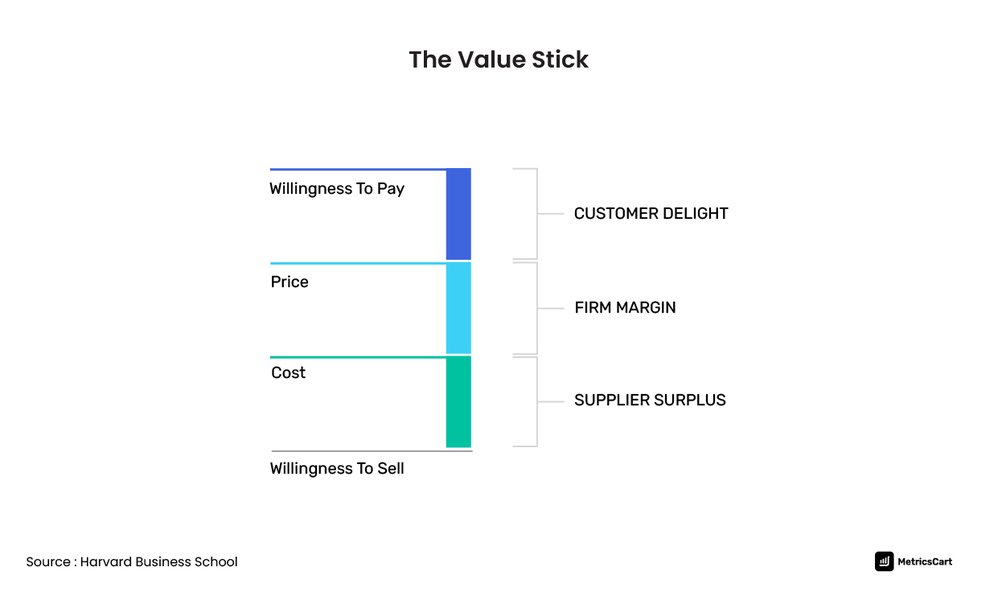
A visual representation of the Value Stick, illustrating the core levers of value creation and capture.
Deconstructing the Value Stick: Key Levers
The framework is built upon four primary levers:
Willingness to Pay (WTP)
This represents the absolute maximum amount a customer is willing to spend for a product or service. It's a reflection of the perceived value, benefits, and utility the customer associates with the offering.
Price
The actual amount the company charges the customer for the product or service. This must be carefully set between the WTP and the company's cost.
Cost
This encompasses all expenses the firm incurs to produce, market, and deliver the product or service. It includes everything from raw materials and labor to overheads.
Willingness to Sell (WTS)
This is the minimum amount that suppliers (including employees, for their labor and expertise, and external vendors) are willing to accept to provide their inputs, components, or services. A lower WTS can be achieved through efficiency gains or by offering non-monetary value.
The Value Wedges: Where Value Resides
These four levers define three critical "wedges" of value, illustrating how the total value created is distributed:
Customer Delight (or Consumer Surplus)
The difference between what a customer is willing to pay (WTP) and the actual price they pay (Price). A larger gap here signifies higher customer satisfaction and perceived value.
Firm Margin (or Profit)
The difference between the price charged to the customer (Price) and the cost incurred by the firm (Cost). This is the value captured by the business.
Supplier Surplus
The difference between the cost the firm incurs for inputs (which is the revenue for suppliers) and the suppliers' own willingness to sell (WTS). This represents the value captured by suppliers and employees.
For a business to thrive sustainably, the relationship WTP > Price > Cost > WTS must hold, ensuring that value is created and shared among all parties. The strategic goal is often to "stretch" the Value Stick by increasing WTP and decreasing WTS, thereby expanding the total available value.
Digital Transformation: The Engine of Modern Value Creation
Digital transformation is the integration of digital technologies into all areas of a business, fundamentally changing how it operates and delivers value to customers. It's not just about adopting new tools; it's a cultural shift that requires organizations to continually challenge the status quo, experiment, and become comfortable with change. Key technologies driving this shift include artificial intelligence (AI), machine learning (ML), data analytics, cloud computing, Internet of Things (IoT), and automation.
Stretching the Stick: Amplifying Value Through Digital Innovation
Digital transformation directly impacts each lever of the Value Stick, enabling companies to enhance value creation and capture in unprecedented ways.
Elevating Customer Willingness to Pay (WTP)
Digital technologies empower firms to significantly increase customers' WTP by:
- Enhanced Customer Experience: AI-driven personalization, seamless omni-channel engagement (integrating online and offline touchpoints), and faster, more responsive customer service dramatically improve customer satisfaction and loyalty. For example, predictive analytics can anticipate customer needs, offering solutions before a problem even arises.
- Innovative Digital Products and Services: Digital transformation enables the creation of entirely new value propositions. Think of telemedicine platforms offering convenient healthcare access, IoT-enabled predictive maintenance services for industrial equipment, or on-demand streaming services. These digital offerings often provide superior utility, convenience, or unique features that command a higher WTP.
- Building Trust and Community: Digital platforms can foster stronger customer communities and enhance brand reputation. Transparent communication, user-generated content, and responsive social media engagement build trust and a sense of belonging, which can elevate WTP beyond purely functional benefits.
- Data-Driven Insights: By leveraging data analytics, businesses gain deeper insights into customer preferences and behaviors. This allows for the development of highly targeted offerings that customers perceive as more valuable, thus increasing their WTP.
Optimizing Price for Enhanced Value Capture
While directly linked to WTP, digital transformation also provides sophisticated tools for pricing strategies:
- Dynamic Pricing Models: AI algorithms can analyze real-time data on demand, competitor pricing, customer behavior, and even external factors (like weather for travel industries) to adjust prices dynamically. This allows companies to maximize revenue by charging different prices to different segments or at different times.
- Value-Based Pricing: With a clearer understanding of the value delivered to specific customer segments (thanks to data analytics), companies can more confidently implement value-based pricing. This means setting prices based on the perceived value to the customer rather than solely on cost or competitor prices, allowing firms to capture a fairer share of the value they create.
Driving Down Costs Through Efficiency and Automation
One of the most significant impacts of digital transformation is on the cost lever:
- Automation and Process Efficiency: Robotic Process Automation (RPA), AI, and ML can automate repetitive manual tasks across various functions like manufacturing, customer service (chatbots), finance (invoice processing), and supply chain management. This reduces labor costs, minimizes errors, and speeds up processes.
- Optimized Operations and Workflows: Digital tools enable the redesign and optimization of existing processes, removing bottlenecks and enhancing overall productivity. Cloud platforms offer scalable and cost-effective IT infrastructure, reducing capital expenditure on hardware and maintenance.
- Supply Chain Optimization: Digital platforms improve transparency and collaboration across the supply chain. Real-time tracking, predictive analytics for demand forecasting, and optimized logistics can significantly reduce inventory holding costs, waste, and transportation expenses.
- Data-Driven Decision Making: Advanced analytics optimize resource allocation, identify areas of inefficiency, and support better strategic decisions, all contributing to cost reduction.
Reducing Supplier and Employee Willingness to Sell (WTS)
Digital transformation can also favorably impact the WTS of both external suppliers and internal employees:
- Improved Supplier Collaboration: Digital platforms can streamline procurement processes, enhance communication, and foster greater transparency with suppliers. This can lead to more efficient partnerships, reduced transaction costs for suppliers, and potentially more favorable terms (lower WTS) for the firm. Data-driven supplier management can also identify better sourcing opportunities.
- Enhanced Employee Experience and Efficiency: Providing employees with better digital tools, access to information, and more efficient workflows can increase job satisfaction and productivity. A more supportive and efficient work environment can contribute to higher employee retention and make the company a more attractive employer, potentially influencing the "WTS" of talent (i.e., their compensation expectations relative to the value they derive from their job).
- Data-Driven Talent Management: Digital HR platforms can help in better aligning talent incentives with company strategies, improving engagement, and streamlining HR processes, which can indirectly impact labor cost-effectiveness.
Quantifying the Shift: Digital Transformation's Influence on Value Metrics
The impact of digital transformation on the Value Stick levers can be visualized. The following radar chart provides an opinionated comparison of a business's potential standing on key value dimensions before and after a comprehensive digital transformation. It illustrates how digital initiatives can significantly enhance performance across the board, leading to greater overall value creation.
This chart visualizes a qualitative assessment. A 'Digitally Transformed Business' generally shows higher scores, indicating improvements such as greater WTP Enhancement (customers are willing to pay more), better Cost Efficiency (costs are lower), and increased Firm Profitability.
Making Digital Transformation Stick: Key Success Factors
Realizing the full potential of digital transformation to positively impact the Value Stick requires more than just technology investment. Several strategic and organizational factors are critical:
The Imperative of a Clear Digital Strategy
A well-defined digital strategy, aligned with overall business objectives, is paramount. This strategy should clearly articulate how digital initiatives will create value for customers, the firm, and suppliers, and how success will be measured using Key Performance Indicators (KPIs).
Aligning Technology with Business Goals
Technology investments must be strategic, supporting specific business outcomes rather than being pursued for technology's sake. The focus should be on how technology can enhance the levers of the Value Stick.
Cultivating Organizational Change Capabilities
Digital transformation is as much about people and processes as it is about technology. Organizations need to foster a culture that embraces change, agility, continuous learning, and customer-centricity. Effective change management is crucial to overcome resistance and ensure adoption.
Leadership and a Culture of Continuous Improvement
Strong leadership commitment is essential to drive digital transformation. Leaders must champion the vision, allocate resources, simplify funding for digital initiatives, clarify governance, and foster an environment where teams feel empowered to experiment and innovate. Continuous monitoring and recalibration of digital efforts are necessary to capture all available value.
Mapping the Connections: Digital Transformation and the Value Ecosystem
The interplay between digital transformation and the Value Stick levers can be visualized as an interconnected system. The mindmap below illustrates how various digital transformation initiatives branch out to influence each component of the Value Stick, ultimately aiming to expand the total value created and captured.
This mindmap highlights that digital transformation isn't a single action but a multifaceted strategy. Efforts to enhance WTP, for instance, involve creating personalized experiences and new digital products, both fueled by data. Similarly, cost reduction is achieved through a combination of automation, process streamlining, and leveraging cloud technologies.
At a Glance: Digital Transformation's Effect on Value Stick Levers
The following table summarizes the primary ways digital transformation impacts each lever of the Value Stick framework, along with concrete examples or mechanisms through which these impacts are realized.
| Lever | Impact of Digital Transformation | Examples/Mechanisms |
|---|---|---|
| Willingness to Pay (WTP) | Significantly Increased | Personalization (AI-driven recommendations), seamless omni-channel customer experiences, innovative digital services (e.g., SaaS, IoT solutions, telemedicine), enhanced product quality through data feedback loops, building digital communities. |
| Price | Optimized for Value Capture & Flexibility | Dynamic pricing algorithms based on real-time data, value-based pricing models enabled by better customer insight, personalized offers and discounts, subscription models for digital services. |
| Cost | Substantially Reduced | Automation of manual tasks (RPA, AI in manufacturing and services), streamlined operational workflows, cloud computing for scalable and cost-effective IT, predictive analytics for resource optimization (e.g., inventory, energy), optimized supply chains through digital platforms. |
| Willingness to Sell (WTS) | Lowered or Optimized | Digital collaboration platforms for suppliers (improving efficiency and transparency), improved employee tools and digital workplaces (enhancing productivity and job satisfaction), data-driven supplier relationship management, efficient talent acquisition and management via HR tech. |
Expert Insights: Felix Oberholzer-Gee on Value and Digital Strategy
To further understand how digital transformation aligns with value-based strategy, it's insightful to hear from Professor Felix Oberholzer-Gee, the academic who extensively developed and popularized the Value Stick framework. The following video features him discussing digital transformation strategy based on value creation.
In this discussion, Professor Oberholzer-Gee typically emphasizes how digital tools can be strategically employed to either increase customer willingness to pay or decrease employee/supplier willingness to sell, thereby creating more value. He often stresses focusing on a few critical improvements rather than attempting to do everything at once, aligning perfectly with the strategic application of the Value Stick in the digital age.
The Financial Payoff: Enhanced Returns and Growth
The impact of digital transformation on the Value Stick levers is not just theoretical; it translates into tangible financial outcomes. Studies have shown that companies leading in digital transformation achieve significantly higher shareholder returns and enterprise value growth compared to their slower-adopting peers. For instance, digital leaders often report earnings growth nearly double that of laggards. This financial outperformance is a direct result of their ability to effectively use digital technologies to increase WTP, lower costs, optimize pricing, and manage WTS—ultimately expanding firm margins while delivering superior value to customers and maintaining healthy supplier relationships.
Frequently Asked Questions (FAQ)
How does increasing Willingness to Pay (WTP) through digital means benefit the company if prices don't increase proportionally?
Can digital transformation negatively impact any lever of the Value Stick?
Is cost reduction the primary goal when applying digital transformation to the Value Stick?
How does the "inverted firm" model mentioned in some literature relate to digital transformation and the Value Stick?
Conclusion: Reshaping Value in the Digital Age
Digital transformation provides a powerful toolkit for fundamentally reshaping the levers of the Value Stick. By strategically implementing digital technologies, businesses can significantly increase customer willingness to pay, optimize pricing strategies for better value capture, drive down operational costs, and enhance relationships with suppliers and employees to lower their willingness to sell. The cumulative effect is a "stretched" Value Stick, representing a larger total value pie and enabling firms to achieve greater customer delight, healthier firm margins, and improved supplier surplus. However, success hinges on a clear strategy, effective organizational change management, and a relentless focus on creating and capturing value for all stakeholders.
Recommended Further Exploration
- What are the key metrics for measuring the success of digital transformation on value creation?
- How do different industries leverage the Value Stick framework in their digital transformation strategies?
- What are the common challenges organizations face when trying to digitally transform their value chains?
- Explore case studies of companies that successfully used digital transformation to enhance their Value Stick.
References
 assets.kpmg.com
Last updated May 21, 2025