
Never Lose Your Feline Friend Again: Build Your Own Lightweight, Subscription-Free GPS Cat Tracker!
Discover how to create a cost-effective, USB-C rechargeable tracker using GPS and LoRaWAN technology.
Losing a beloved cat is a heart-wrenching experience. While commercial GPS trackers exist, they often come with hefty subscription fees, bulky designs, or short battery life. This guide outlines a plan to build your own lightweight, efficient, and affordable cat tracker, leveraging the power of GPS for location accuracy and LoRaWAN (specifically the Helium Network) for long-range, low-power data transmission without recurring costs.
Project Highlights
- Lightweight & Cat-Friendly: Designed to weigh 15 grams or less, ensuring comfort and safety for your cat.
- Subscription-Free Tracking: Utilizes the LoRaWAN Helium Network for data transmission, eliminating monthly fees typically associated with cellular trackers.
- Affordable & DIY: Built with readily available components aiming for a total cost under $50, featuring the efficient RAK3172 module.
The Concept: Solving Cat Loss Affordably
Product Details & Core Objectives
The primary goal is to create a reliable tracking device specifically tailored for cats. It needs to be small and light enough not to hinder their natural movement, offer a decent battery life to minimize recharging frequency, and provide accurate location data without locking users into expensive subscription plans. This project focuses on achieving these objectives through smart component selection and leveraging open network technologies.
Key Specifications:
- Target Weight: ≤ 15 grams (including case and battery)
- Target Battery Life: Approximately 7 days per charge (dependent on configuration and usage patterns)
- Target Component Cost: ~$30-40 (comfortably under the $50 budget ceiling)
- Connectivity: GPS for location, LoRaWAN (Helium Network) for data transmission
- Charging: USB-C via a dedicated charging module (TP4056 or similar)
- Enclosure: Custom 3D-printed case (approx. 40mm x 20mm x 8mm)
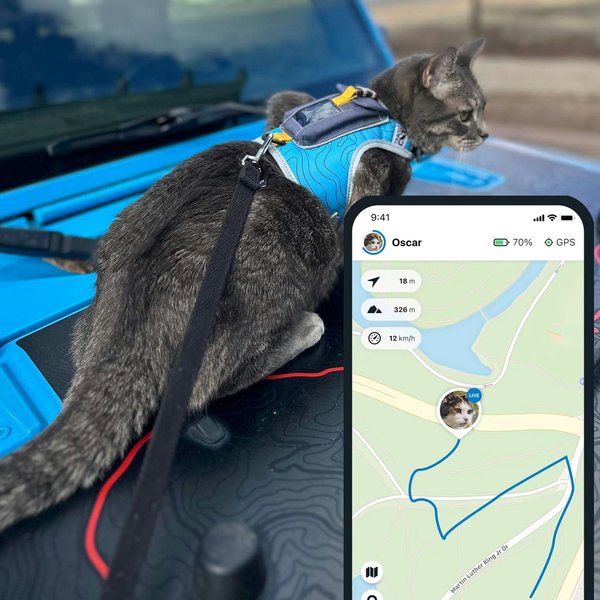
Conceptual representation of a cat wearing a tracker, integrated with a mobile application for location monitoring.
How It Works: The Technology Behind the Tracker
Functionality and Data Flow
The tracker operates by combining GPS positioning with LoRaWAN communication. Here’s a breakdown of the process:
- Location Acquisition: A small, low-power GPS module determines the tracker's geographical coordinates (latitude and longitude).
- Data Processing: The microcontroller (integrated within the RAK3172 module) reads the GPS data.
- LoRaWAN Transmission: The RAK3172 module formats the location data and transmits it wirelessly using the LoRaWAN protocol. This protocol is designed for long-range (kilometers, depending on environment) communication with very low power consumption, making it ideal for battery-powered devices.
- Network Relay (Helium): Nearby LoRaWAN gateways, part of the decentralized Helium Network, receive the data packet. These gateways are often community-run and forward the data over the internet.
- Application Server: The data is routed from the network server to an application platform (like TagoIO, Ubidots, or a custom backend).
- User Interface: The cat's location is displayed on a map accessible via a smartphone app or web browser.
The RAK3172 Advantage: Simplification, Not Magic
It's important to clarify a common point of confusion. While some descriptions might suggest the RAK3172 has GPS *built-in* to the same chip, this is generally not the case for standard RAK3172 modules used in these DIY projects. You will typically need a separate, small GPS module (like the u-blox MAX series) to acquire location data.
The real advantage of the RAK3172 lies in its integrated STM32WLE5CC microcontroller. This powerful chip can directly interface with the external GPS module, process the location data, and manage the LoRaWAN communication stack all on one board. This contrasts with some other DIY approaches that might require a separate microcontroller (like an Arduino board), a GPS module, *and* a LoRa module, leading to more complex wiring, larger size, potentially higher power consumption, and more intricate code. The RAK3172 simplifies the electronics and firmware development by handling processing and LoRa communication effectively, contributing to the project's small size, lower cost, and potentially easier assembly compared to multi-board solutions.
Visualizing the Workflow
The following mindmap illustrates the journey of location data from the cat's collar to your screen.
Reads & Formats GPS Data"] id3["3. LoRaWAN Transmission"] id3a["RAK3172 LoRa Radio
Sends Low-Power Packet"] id4["4. Network Reception"] id4a["Helium Network Gateway
Receives Data Packet"] id5["5. Cloud Backend"] id5a["Helium Network Server
Routes Data"] id5b["Application Server
(e.g., TagoIO, Custom)"] id6["6. User Interface"] id6a["Smartphone App / Web App
Displays Location on Map"]
Materials We Use: Components & Cost
Bill of Materials
Achieving the target specifications requires careful selection of lightweight and low-power components. The RAK3172 module is central to this design due to its efficiency and integrated processing capabilities. The total estimated cost remains well within the $50 budget.
| Component | Description | Estimated Cost (USD) | Notes |
|---|---|---|---|
| RAK3172 WisDuo Module | LoRaWAN module with integrated STM32WLE5CC microcontroller. Handles LoRa communication and processes GPS data. | $10 - $15 | Core communication and processing unit. Requires AT command configuration or custom firmware. |
| GPS Module | Small, low-power GPS receiver (e.g., u-blox MAX-7Q, Beitian BN-180). | $10 - $20 | Provides location data. Must be interfaced with the RAK3172's microcontroller. |
| LiPo Battery | 300mAh Lithium Polymer battery. | $3 - $6 | Powers the device. Capacity balances size/weight and desired 7-day runtime (requires aggressive power saving). |
| TP4056 Charging Module (USB-C variant) | Module for safely charging the LiPo battery via USB-C. | $1 - $3 | Provides convenient and modern charging capability. |
| Antennas | Small antennas suitable for GPS frequency and LoRa frequency band (e.g., 915MHz for US, 868MHz for EU). | $2 - $5 | Crucial for signal reception and transmission. Size/type impacts performance. |
| 3D Printed Case | Custom enclosure designed in CAD software (e.g., Fusion 360) and printed. | $1 - $5 (filament/printing cost) | Houses components, provides protection, allows collar attachment. Material: PLA, PETG, or similar. |
| Passive Components & Wires | Resistors, capacitors, wires, connectors as needed for assembly. | $1 - $3 | Miscellaneous parts for circuit assembly. |
| Total Estimated Cost | ~$28 - $57 | Final cost depends on specific component choices and suppliers. Likely achievable under $50. |

Example of assembled electronics for a DIY pet tracker, showcasing the integration of different modules.
Plan of Action: How We Make It
Step-by-Step Build Process
Building the tracker involves several distinct phases, from initial prototyping to final testing.
Phase 1: Component Selection & Breadboard Prototyping
- Select specific models for the RAK3172, GPS module, battery, and charger based on availability, specs, and reviews.
- Connect the RAK3172, GPS module, and power components (battery + charger interface) on a breadboard.
- Use a USB-to-UART converter to communicate with the RAK3172.
- Verify basic functionality: Power up, microcontroller communication with GPS (receiving NMEA sentences), basic RAK3172 response to AT commands.
Phase 2: Firmware Development (Coding)
- Develop firmware for the RAK3172's microcontroller (e.g., using Arduino IDE with appropriate board support, or STM32CubeIDE).
- Write code to:
- Initialize and configure the GPS module.
- Parse NMEA data to extract latitude, longitude, and timestamp.
- Format the location data into a compact payload suitable for LoRaWAN.
- Configure the RAK3172 for LoRaWAN operation (using AT commands or LoRaWAN libraries).
- Handle joining the LoRaWAN network (e.g., Helium via OTAA).
- Transmit the data payload periodically.
- Implement aggressive power-saving modes (putting GPS and MCU to sleep between transmissions) to maximize battery life.
- Test code by sending data to the Helium network and viewing it on the Helium Console or an integrated platform.
Phase 3: Case Design (Fusion 360)
- Design a custom enclosure using 3D CAD software like Fusion 360.
- Model the case to precisely fit all components (RAK3172, GPS, battery, charger board, antennas) within the target dimensions (approx. 40x20x8mm).
- Include necessary cutouts for the USB-C port and potentially status LEDs.
- Incorporate a secure mechanism for attaching the tracker to a standard cat collar (e.g., loops, clips). Ensure smooth edges for comfort.
- Export the design as an STL file suitable for 3D printing.

Example 3D model of a case designed for a cat tracking device.
Phase 4: Assembly & Integration
- 3D print the case using a suitable material (e.g., PETG for durability, PLA for ease of printing).
- Solder components together, potentially using a small perfboard or a custom-designed PCB for compactness and reliability. Ensure robust connections, especially for the battery and antennas.
- Carefully fit the assembled electronics into the 3D-printed case. Secure the components and close the enclosure.
Phase 5: Testing & Refinement
- GPS Accuracy: Test outdoors to verify GPS lock speed and accuracy. Aim for ±5 meters or better in open sky conditions.
- LoRaWAN Connectivity: Test the range and reliability of LoRaWAN transmissions in various environments (urban, suburban). Ensure data packets are consistently received by the Helium network.
- Battery Life: Conduct real-world testing to measure battery duration under typical usage patterns (e.g., location update every 5-15 minutes). Optimize firmware power-saving settings as needed to approach the 7-day target.
- Durability & Comfort: Assess the case's robustness and the attachment mechanism. Observe how a cat tolerates wearing the device (using a dummy weight first is advisable).
DIY LoRa Cat Tracker in Action
Building and Tracking with LoRa
Building a LoRa-based tracker involves integrating hardware and software to achieve long-range communication. The video below demonstrates a similar project, showcasing how you can track your cat's location using LoRa technology visualized on Google Maps. While the specific components might differ slightly from the RAK3172 plan outlined here, the core principles of using LoRa for pet tracking are well illustrated, providing valuable insights into setting up the communication link and visualizing the data.
Visualizing the Design
Conceptual Models and Sketches
Visual aids help understand the final product's form and internal layout.
3D Model of Working Product
Imagine a sleek, compact (40x20x8mm) device rendered in a blue and green color scheme. The case, primarily green, has smooth, rounded edges for safety and comfort. A small cutout on the side reveals the blue accent of the USB-C charging port. Subtle icons (perhaps embossed or using color variations) could indicate GPS lock (satellite icon) or LoRa transmission status (radio wave icon). Two integrated loops on the back allow threading a standard cat collar through.
Sketches: Outside (Solid) and Inside (Organ)
- Outside (Solid View): A simple sketch showing the final assembled tracker's external shape and dimensions. Annotations highlight the USB-C port, collar attachment points, and overall size (40x20x8mm). The color scheme is predominantly green with blue tech accents.
- Inside (Organ / Exploded View): A conceptual sketch showing the internal arrangement of components ("organs") within the case ("soliton" - the stable enclosure). This would depict the RAK3172 module, the smaller GPS module connected to it, the flat LiPo battery positioned to optimize space, the tiny TP4056 charging board near the USB-C port, and the placement of the GPS and LoRa antennas. Callouts label each key component. This helps visualize how everything fits together tightly to achieve the small form factor.
Comparative Tracker Features (Conceptual)
This radar chart provides a conceptual comparison between the proposed DIY LoRaWAN tracker and typical commercial options (Subscription GPS, Bluetooth-only). The DIY tracker aims for a balance of good range, long battery life, and low cost, while accepting potential trade-offs in absolute ease-of-use or guaranteed global coverage compared to subscription services. Weight is a key advantage.
Frequently Asked Questions (FAQ)
Is a 15g tracker safe and comfortable for my cat?
Yes, generally. Most veterinarians and animal welfare organizations suggest that items worn on a collar should be as light as possible. While there's no universal standard, many commercial GPS trackers are heavier than 15g. A weight of 15 grams is considered quite light and should be comfortable for most adult cats (e.g., those weighing 4kg or more). Ensuring the case has smooth edges and is securely attached without dangling or snagging hazards is also crucial for safety and comfort.
How long does the USB-C charging take?
With a 300mAh battery and a standard TP4056 charging module, a full charge typically takes around 1 to 1.5 hours. The exact time can vary slightly based on the specific charger used (its current output) and the battery's state when charging begins. The USB-C port offers modern convenience for recharging.
Do I need Helium network coverage in my area?
Yes, for this specific design relying on LoRaWAN via Helium, you need adequate Helium network coverage in the areas your cat frequents. The Helium network is community-powered and its coverage varies geographically. You can check the Helium Network Explorer map to see gateway coverage in your vicinity. If coverage is sparse, the tracker might not be able to transmit its location reliably. Alternatives exist (like using other LoRaWAN networks or different technologies like NB-IoT/LTE-M which require subscriptions), but this plan focuses on the subscription-free Helium approach.
References
- Lora Based Gps Tracker Using RAK3172 - Instructables
- RAK3172 WisDuo LPWAN Module - RAKwireless
- RAK3172 Module Quick Start Guide - RAKwireless Docs
- Handmade GPS Tracker Keeps An Eye On Adventurous Cats - Hackaday
- Build the GPS Cat Tracker 2.0 - Make: Magazine
- DIY Cat GPS Tracker: Components and Considerations - American Cat
- How To Track Your Pets With The Helium Network - HeliumMart Blog
Recommended Reading
 kevinsaye.wordpress.com

Last updated April 23, 2025