
Understanding and Implementing Document Revision Records
Key Practices for Tracking and Documenting Document Changes
Key Insights into Document Revision Tracking
- Detailed Identification: It is crucial to meticulously document changes, specifying the chapter, page, a description of the alteration, and the reason for the change within the 'Record of Revisions'.
- Comprehensive History: Maintaining a thorough record of revisions allows for traceability, understanding the evolution of a document, and facilitates effective change management.
- Enhanced Communication and Compliance: Clear and detailed revision records improve communication among stakeholders and are essential for demonstrating compliance with quality management systems and regulatory requirements.
Document revision control is a fundamental aspect of effective document management across various industries. It involves systematically tracking and managing modifications made to documents over time. The core principle is to ensure that there is a clear, accurate, and accessible history of all changes, who made them, when they were made, and importantly, why they were made.
The Importance of a 'Record of Revisions'
A 'Record of Revisions', often presented as a table or log, serves as the central repository for information regarding document changes. This record is vital for several reasons:
- Traceability: It provides a clear audit trail of how a document has evolved from its initial version to the current one. This is critical for understanding the context of changes and reverting to previous versions if necessary.
- Accountability: By documenting who made the changes and when, it establishes accountability for modifications.
- Understanding the 'Why': Including the reason for a change is paramount. It provides context and helps future users understand the rationale behind specific revisions. This is particularly important in technical or regulated environments where changes can have significant impacts.
- Communication: A well-maintained revision record facilitates communication among team members and stakeholders, ensuring everyone is aware of the latest version and the nature of the changes.
- Compliance: Many quality management systems (like ISO 9001) and regulatory requirements mandate robust document control and the maintenance of revision histories.
Structuring the Revision Record
To effectively capture the necessary information, a 'Record of Revisions' should be structured logically. While the exact format may vary depending on the document type and organizational needs, key elements are consistently required:
Essential Columns in a Revision Record
A typical revision record table includes columns to capture the critical details of each change:
| Revision Number/Letter | Date of Change | Changed By | Chapter/Section | Page Number (If applicable) | Description of Change | Reason for Change |
|---|---|---|---|---|---|---|
| 1.0 | YYYY-MM-DD | [Author Name] | All | N/A | Initial Document Release | N/A |
| 1.1 | YYYY-MM-DD | [Reviewer Name] | Section 3 | Page 15 | Corrected typographical error and clarified step 4. | Improved clarity and accuracy. |
| 2.0 | YYYY-MM-DD | [Approver Name] | Section 5, Appendix A | Page 25, Pages 40-42 | Added new procedure for X and updated data in Table B. | Incorporated new process requirement and updated supporting data. |
This table illustrates a basic structure. Depending on the complexity of the document and the change process, additional columns might be included, such as approval date, effective date of the change, or references to change requests.
Implementing Detailed Change Identification
The instruction emphasizes the need to identify changes in detail within the 'Record of Revisions'. This goes beyond simply noting that a change occurred. It requires specifying precisely where the change is located within the document and providing a clear description of what was altered.
Pinpointing the Location of Changes
Mentioning the chapter and, if applicable, the corresponding page number helps users quickly locate the specific sections that have been revised. This is particularly helpful for lengthy documents where scanning the entire text for changes would be inefficient.
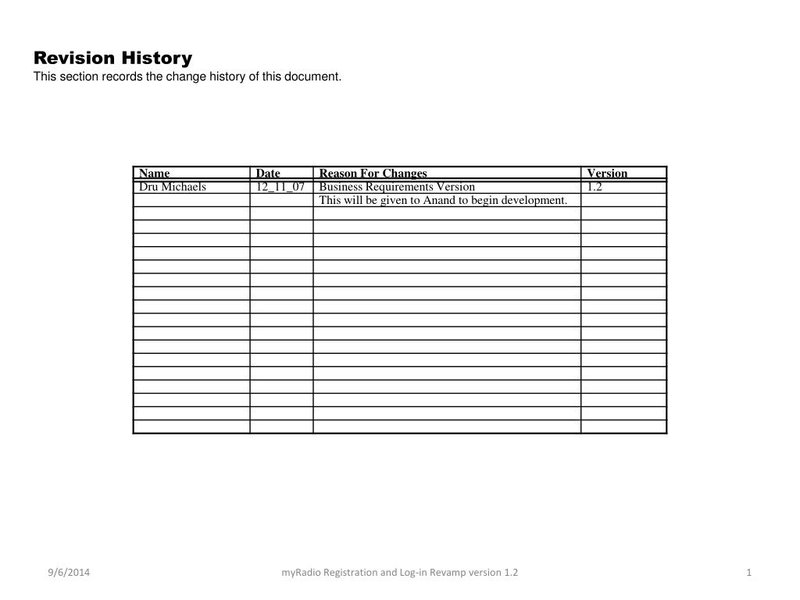
A visual representation of a basic document revision history.
Describing the Inserted Change
The description of the inserted change should be concise yet informative. It should accurately reflect the nature of the modification. Examples include:
- "Added paragraph on safety precautions in Section 4.1."
- "Revised data in Table 2. Removed outdated entries."
- "Corrected formula for calculating X in Appendix B."
- "Updated contact information in the footer."
Using clear and unambiguous language in the description is essential to avoid confusion.
Explaining the Reason for the Change
Perhaps the most critical element highlighted in the instruction is including the reason for the change. This provides the necessary context and justification for the revision. Reasons for changes can be varied and might include:
-
Correction of errors (typographical, technical, etc.)
-
Updates due to new information or data
-
Compliance with new regulations or standards
-
Improvements to clarity or completeness
-
Response to feedback from reviewers or users
-
Changes in process or procedure
Documenting the reason for the change allows stakeholders to understand the impact and necessity of the revision. It also supports continuous improvement efforts by providing insights into why documents are being modified.
Best Practices for Document Revision Control
Beyond the specific instruction provided, several best practices contribute to effective document revision control:
Utilizing Version Control Systems
While manual methods using tables within documents are possible, utilizing dedicated version control systems or features within document management software is highly recommended. These systems automate much of the tracking process, reduce the risk of errors, and provide more robust features like rollback capabilities and access controls.
Many modern document editing tools and content management systems have built-in version control features. These features automatically track changes, allowing users to view previous versions and see who made specific edits. This can significantly streamline the revision process compared to manual methods.
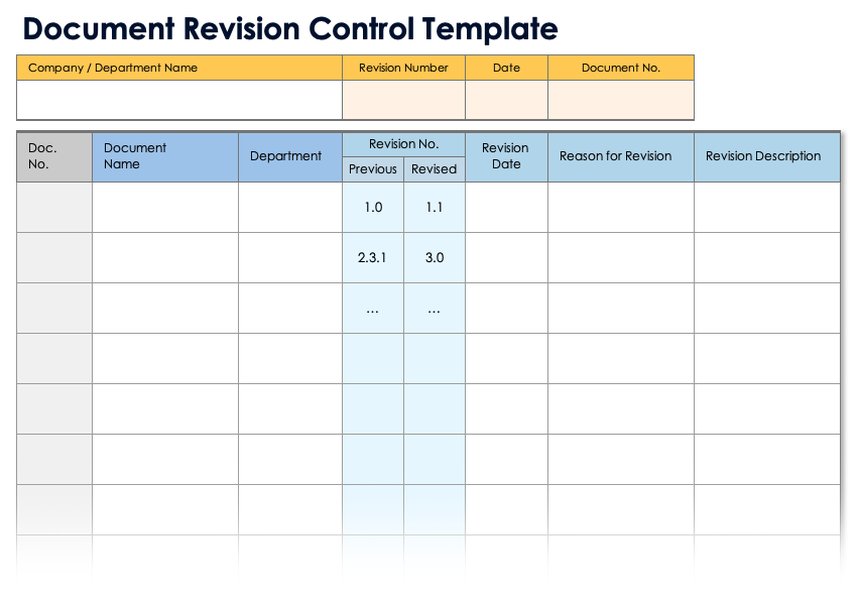
A template illustrating how document revisions can be controlled.
Establishing Naming Conventions
Consistent and clear naming conventions for documents and their revisions are essential. This helps avoid confusion and ensures that users can easily identify the latest version of a document. A common practice is to include the document title, a unique identifier, and the revision number in the file name (e.g., "Procedure_XYZ_Rev_2.0.docx").
Implementing a Defined Change Control Process
For critical documents, particularly in regulated industries, a formal change control process is necessary. This process typically involves submitting a change request, reviewing the proposed change, obtaining necessary approvals, implementing the change, and verifying its effectiveness. The 'Record of Revisions' is an integral part of this process, documenting the approved changes.
Document change control is defined as the process of managing modifications, revisions, or updates to critical documents within an organization. It ensures that all revisions are tracked, documented, and implemented accurately. This process is vital for maintaining the accuracy, integrity, traceability, and compliance of documents throughout their lifecycle.
Training and Communication
Ensuring that all individuals involved in document creation, review, and approval are trained on the revision control procedures is crucial. Clear communication about document updates and the availability of new revisions is also essential to prevent the use of outdated information.
The Role of Revision Records in Different Contexts
The requirement to maintain detailed revision records is relevant across various fields:
Quality Management Systems (QMS)
In QMS, such as those based on ISO 9001, document control and the maintenance of revision history are mandatory requirements. The 'Record of Revisions' provides objective evidence of compliance with these standards.
Technical Documentation
For technical manuals, specifications, and procedures, accurate revision records are vital for ensuring that users are working with the correct and most up-to-date information. This is particularly important in industries where outdated documentation could lead to safety hazards or equipment malfunctions.
Engineering and Design
In engineering and design, revision control is crucial for managing changes to drawings, specifications, and models. A well-maintained revision table on a drawing, for example, indicates the history of modifications and helps prevent manufacturing or construction based on incorrect designs.
Regulatory Compliance
Industries such as pharmaceuticals, medical devices, and aerospace have strict regulatory requirements regarding document control and record keeping. Detailed revision records are essential for demonstrating compliance with these regulations during audits and inspections.
This video discusses how to design a document revision history log, providing practical insights into its structure and content.
Conclusion
In summary, the instruction to identify changes in detail within the 'Record of Revisions', including the chapter, page, description, and reason for the change, embodies a core principle of effective document revision control. By adhering to this principle and implementing best practices, organizations can ensure the accuracy, integrity, and traceability of their documents, leading to improved communication, reduced errors, and enhanced compliance.
Frequently Asked Questions
What is the difference between document version control and document revision control?
While often used interchangeably, version control typically refers to tracking iterative changes during the development of a document, where each save might create a new version. Revision control, on the other hand, often implies a more formal process of managing controlled versions of a document, usually marked by significant changes and requiring formal approval before a new "revision" is issued.
Why is it important to include the reason for a change in the revision record?
Including the reason provides crucial context for the change. It helps users understand the justification behind the modification, which is essential for maintaining the integrity and purpose of the document, especially over time and with multiple contributors.
How can software help with document revision control?
Document management systems and version control software automate the tracking of changes, make it easier to access previous versions, manage approvals, and maintain a centralized history, significantly improving efficiency and accuracy compared to manual methods.
Should all documents have a 'Record of Revisions'?
Documents that are subject to change and require a history of those changes for traceability, compliance, or clarity should have a 'Record of Revisions'. This is particularly important for controlled documents in formal systems.
References
Last updated May 15, 2025