
Unlock Smoother Investing: How Dollar-Cost Averaging Tames Market Risk
Discover the strategy that reduces volatility's sting and fosters disciplined wealth building, regardless of market swings.
Highlights: Minimizing Risk with DCA
- Volatility Buffer: By investing fixed amounts regularly, DCA averages out your purchase price, buying more shares when prices are low and fewer when high, thus smoothing the impact of market swings.
- Timing Tamer: It eliminates the perilous game of market timing, preventing the risk of investing a large sum right before a downturn.
- Discipline Driver: This strategy encourages consistent investing habits and removes emotional decision-making (like panic selling or FOMO buying) from the equation.
Understanding Dollar-Cost Averaging (DCA)
What is this Strategy?
Dollar-cost averaging (DCA) is an investment strategy characterized by its simplicity and discipline. Instead of investing a large sum of money all at once (lump-sum investing), DCA involves investing a fixed dollar amount into a specific asset at regular intervals—say, monthly or quarterly—regardless of the asset's price at that moment. For example, you might decide to invest $200 into a particular mutual fund on the 1st of every month. This methodical approach has roots in value investing principles, notably discussed by Benjamin Graham in his seminal 1949 book, The Intelligent Investor.
The core idea is to automate the investment process and reduce the impact of volatility on the overall purchase cost. It's a common strategy automatically employed in many retirement plans, like 401(k)s, where contributions are deducted and invested with each paycheck.
Core Mechanisms: How DCA Reduces Investment Risk
Taming Market Volatility
Financial markets are inherently volatile; prices go up and down. Investing a large sum at a single point exposes you to the risk of buying at a market peak, which could lead to significant initial losses if the market declines shortly after. DCA mitigates this risk by spreading purchases over time.
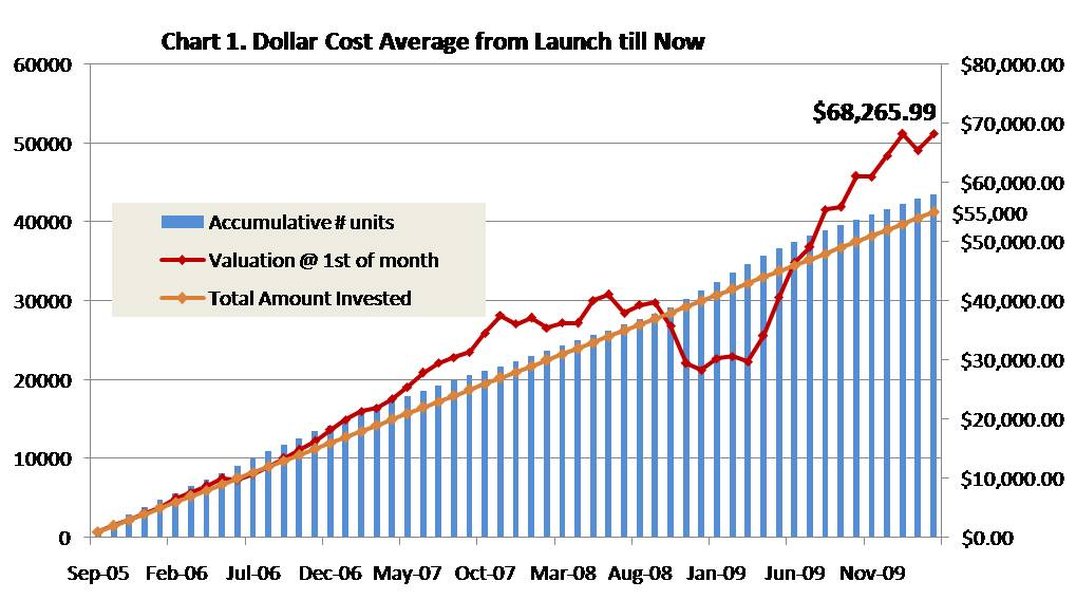
Example showing how DCA leads to buying more shares at lower prices.
Averaging Down the Cost
When you invest the same amount of money each period:
- If the price of the asset falls, your fixed investment buys more shares.
- If the price of the asset rises, your fixed investment buys fewer shares.
Eliminating the Guesswork: Avoiding Market Timing Pitfalls
Trying to "time the market"—predicting the best moments to buy low and sell high—is notoriously difficult, even for seasoned professionals. Making the wrong call can be costly. Investing a lump sum requires deciding on the "right" moment, introducing significant timing risk.
Systematic vs. Speculative Investing
DCA removes the need for market timing predictions. By committing to invest regularly, regardless of market conditions, you sidestep the risk of investing all your capital at an inopportune moment (e.g., just before a market crash). This systematic approach ensures you are consistently participating in the market, capturing gains over the long term while mitigating the risk associated with trying to pinpoint market bottoms or peaks.
Building Discipline: The Psychological Edge
Investment decisions are often clouded by emotions. Fear during market downturns can lead to panic selling, while greed during market rallies can lead to chasing performance or taking excessive risks. These behavioral biases can significantly harm long-term returns.
Automating Consistency
DCA fosters a disciplined investment habit. By automating regular contributions, it takes emotions out of the equation. You stick to the plan whether the market is soaring or plummeting. This consistency prevents impulsive actions driven by short-term market noise. Furthermore, breaking down a large investment into smaller, periodic amounts can be psychologically easier for many investors, reducing the anxiety associated with committing significant capital at once, especially for those who are risk-averse or new to investing.
DCA in Action: A Simplified Example
Illustrating the Average Cost Benefit
Let's compare investing $1,200 via DCA ($300 per month for 4 months) versus investing the full $1,200 as a lump sum at the beginning. Assume the share price fluctuates as follows:
| Month | Share Price | DCA Investment ($300) | Shares Purchased (DCA) | Lump Sum Shares (@ $10) |
|---|---|---|---|---|
| 1 | $10 | $300 | 30.00 | 120 (Invested all $1200) |
| 2 | $8 | $300 | 37.50 | - |
| 3 | $12 | $300 | 25.00 | - |
| 4 | $11 | $300 | 27.27 | - |
| Total/Average | Avg Price: $10.25 | $1,200 | 119.77 Shares | 120 Shares |
| Avg Cost (DCA): $10.02 ($1200 / 119.77) | Avg Cost (Lump Sum): $10.00 ($1200 / 120) |
In this scenario, the average share price over the four months was $10.25. The DCA investor acquired shares at an average cost of approximately $10.02 per share. The lump-sum investor bought all shares at $10. If the lump sum had been invested in Month 3 at $12, the average cost would have been significantly higher ($12/share). While in this specific example the lump sum at the start price was slightly better, DCA still achieved a lower average cost than the average market price and protected the investor from potentially investing everything at the $12 peak.
Visualizing DCA vs. Lump Sum Investing Characteristics
A Comparative Radar Chart
This chart visually compares Dollar-Cost Averaging (DCA) and Lump Sum Investing across several key characteristics relevant to risk and return. The scores reflect general tendencies rather than guaranteed outcomes, as market conditions play a crucial role.
As illustrated, DCA generally scores higher on factors related to risk reduction (volatility mitigation, timing risk, emotional discipline) and suitability for beginners. Lump Sum investing tends to score higher on potential maximum return (specifically in steadily rising markets) and simplicity (single transaction). The potential for a lower average cost is slightly higher with DCA, especially in volatile or declining markets.
Understanding the Trade-offs: Risk vs. Return
Is DCA Always Better?
While DCA excels at minimizing certain types of risk, it's not without potential drawbacks. The primary trade-off is potentially lower overall returns compared to investing a lump sum, particularly in markets that are consistently trending upwards. By holding some cash back and investing it gradually, DCA means less money is exposed to the market early on. If the market rises steadily during the investment period, the lump-sum investment (which puts all capital to work immediately) would likely outperform DCA.
However, the risk reduction offered by DCA is often seen as a worthwhile trade-off, especially for:
- Risk-Averse Investors: Those who prioritize capital preservation and smoother returns over maximizing potential gains.
- Investors Without a Large Lump Sum: Many people invest regularly from their income, making DCA the natural approach.
- Volatile Market Conditions: When market direction is uncertain, DCA provides a cautious entry method.
- Novice Investors: The simplicity and discipline make it an accessible strategy for beginners.
Mapping the DCA Strategy
A Mindmap Overview
This mindmap provides a conceptual overview of Dollar-Cost Averaging, summarizing its definition, mechanics, core benefits related to risk minimization, key considerations, and typical applications.
at regular intervals"] id1b["Ignores short-term
price fluctuations"] id2["Mechanism"] id2a["Fixed Dollar Amount"] id2b["Regular Intervals
(e.g., monthly, quarterly)"] id2c["Buys More Shares
When Price is Low"] id2d["Buys Fewer Shares
When Price is High"] id2e["Averages Purchase Cost"] id3["Risk Minimization Benefits"] id3a["Reduces Volatility Impact"] id3a1["Smooths out purchase prices"] id3b["Mitigates Market Timing Risk"] id3b1["Avoids investing all
at a potential peak"] id3c["Controls Emotional Investing"] id3c1["Encourages discipline"] id3c2["Reduces panic selling
or FOMO buying"] id3d["Lowers Average Cost Basis
(potentially)"] id4["Considerations & Trade-offs"] id4a["vs. Lump Sum Investing"] id4a1["Potentially lower returns
in rising markets (cash drag)"] id4a2["Generally lower risk profile"] id4b["Market Conditions"] id4b1["Most beneficial in volatile
or declining markets"] id4c["Time Horizon"] id4c1["Typically a long-term strategy"] id5["Common Uses"] id5a["Retirement Accounts (401k, IRA)"] id5b["Systematic Investment Plans (SIPs)"] id5c["Beginner Investors"] id5d["Risk-Averse Individuals"]
The mindmap highlights how the core mechanics of DCA directly translate into its risk-reducing benefits, while also acknowledging the important context of market conditions and the comparison with lump-sum investing.
Video Explanation: DCA Simplified
Visualizing the Concept
For a quick visual overview of Dollar-Cost Averaging and how it works to limit risk when investing a chunk of money, check out this explanation:
This video provides a concise explanation of the strategy, reinforcing the core concepts of spreading out investments to manage the risks associated with market timing and volatility.
Frequently Asked Questions (FAQ)
Is Dollar-Cost Averaging guaranteed to make money or prevent losses?
No, DCA is not a guarantee against losses or a foolproof way to ensure profits. If the overall market trend for the asset you are investing in is downwards over your entire investment period, you will still likely experience losses. DCA is a risk *management* strategy, not a risk *elimination* strategy. It primarily helps reduce the risk associated with volatility and poor market timing but does not protect against the fundamental risk of an asset declining in value.
When is DCA most effective for minimizing risk?
DCA tends to be most advantageous for risk reduction in volatile or sideways markets, or during market downturns (bear markets). In these scenarios, the strategy allows you to consistently buy shares at lower average prices as the market fluctuates or declines, positioning you well for potential recovery. In a steadily rising market (bull market), lump-sum investing often yields higher returns because all the capital benefits from the upward trend from the start.
How does DCA compare to Lump Sum investing in terms of risk?
Generally, DCA is considered less risky than lump-sum investing, primarily because it mitigates timing risk. A lump-sum investment carries the risk of being made at a market peak, potentially leading to large immediate losses. DCA spreads this risk over time. However, DCA also has the risk of missing out on potential gains if the market consistently rises (often called 'cash drag' risk). Lump-sum investing has historically provided higher average returns over the long term, but with higher potential volatility and timing risk.
Can I use DCA for any type of investment?
Yes, DCA can be applied to various types of investments that fluctuate in price, such as individual stocks, mutual funds, exchange-traded funds (ETFs), and even cryptocurrencies. The key requirement is that the asset can be purchased in fractional amounts or that the fixed investment amount allows for purchasing whole units regularly. It's particularly well-suited for investments intended for long-term growth where volatility is expected along the way.
Recommended
- Explore how DCA and Lump Sum investing perform differently in bull, bear, and sideways markets.
- Understand the behavioral finance aspects that make DCA appealing beyond just risk metrics.
- Investigate how transaction costs can affect the returns of frequent DCA investments.
- Learn about an alternative systematic investment strategy called Value Averaging and its differences from DCA.
References
Last updated May 1, 2025