
Formation of Regularly Branched Polyethylene Using Dual Catalyst Systems
Analyzing the viability of introducing regular branches in polyethylene via dual catalyst systems
Key Takeaways
- Dual catalyst systems for ethylene polymerization are already implemented on an industrial scale in the United States to produce polyethylene with regular branches.
- Group VIa transition metal catalysts are not commonly used for introducing regular branches in polyethylene via dual catalyst systems.
- Aluminum-based activators are effective and widely used in essential reaction steps within dual catalyst systems for ethylene polymerization.
Introduction
Polyethylene, a versatile and widely used polymer, plays a critical role in numerous industries due to its desirable properties such as chemical resistance, durability, and flexibility. The ability to tailor these properties expands its applicability, and one effective method is by modifying the polymer's branching structure. Introducing regular branches into the polyethylene backbone using only ethylene monomer can enhance characteristics like toughness, impact resistance, and processability. Achieving this requires sophisticated catalytic systems, particularly dual catalyst systems that can orchestrate the formation of both linear and branched chains simultaneously.
Understanding Polyethylene Polymerization
Homogeneous Catalysts and High-Density Polyethylene
Polyethylene polymerization predominantly utilizes coordination catalysts to facilitate the polymerization of ethylene monomers. Homogeneous catalysts, such as metallocenes and traditional Ziegler-Natta catalysts, are renowned for producing high-density polyethylene (HDPE) with linear chains and minimal branching. The linearity of HDPE results in a highly crystalline structure, imparting strength and rigidity to the material.
The Significance of Regular Branching
Introducing regular branches into the polyethylene chain disrupts the crystallinity, reducing density and enhancing flexibility. This branching creates low-density polyethylene (LDPE) or linear low-density polyethylene (LLDPE), which exhibit improved toughness and elasticity. Such modifications are essential for applications like films, packaging materials, and flexible containers where ductility is crucial.
Dual Catalyst Systems in Polyethylene Production
Industrial Implementation of Dual Catalyst Systems
The utilization of dual catalyst systems to produce polyethylene with regular branches using only ethylene monomer is a well-established practice on an industrial scale in the United States. These systems strategically combine two catalysts, each contributing distinct functionalities:
- First Catalyst: Promotes the formation of linear polyethylene chains, contributing to the strength and rigidity of the polymer.
- Second Catalyst: Facilitates branch formation through mechanisms such as chain walking, incorporating long-chain branches that enhance flexibility and impact resistance.
By adjusting the ratio and activity of these catalysts, manufacturers can precisely control the polymer architecture, tailoring properties to meet specific application requirements. Industrial processes have successfully implemented this technology, leading to the production of advanced polyethylene grades with customized performance profiles.
Advantages of Industrial Dual Catalyst Systems
The industrial implementation of dual catalyst systems offers significant benefits:
- Property Customization: Enables the production of polyethylene with targeted mechanical and physical properties by controlling branching frequency and molecular weight distribution.
- Process Efficiency: Combines polymerization steps, reducing the need for blending and additional processing, thus streamlining production.
- Cost-Effectiveness: Utilizes ethylene as the sole monomer, simplifying raw material sourcing and minimizing costs associated with co-monomers.
- Enhanced Material Performance: Produces polymers with a balance of strength and flexibility, expanding their suitability for diverse applications.
Analyzing Catalyst Options for Branch Formation
Group VIa Transition Metal Catalysts
Group VIa transition metals, comprising chromium (Cr), molybdenum (Mo), and tungsten (W), are known for their roles in various catalytic processes. In polyethylene production, chromium-based catalysts, such as the Phillips catalyst, are employed primarily for HDPE synthesis. While these catalysts are effective for linear polymerization, they are not typically associated with the introduction of regular branches through dual catalyst systems using only ethylene monomer.
The mechanisms facilitated by Group VIa catalysts do not inherently promote the chain-walking or branching necessary for producing regularly branched polyethylene. Therefore, the statement:
"One can use a catalyst of a group VIa transition metal in combination with specific activators."
is not commonly applicable or supported by industrial practices for achieving the desired branching in polyethylene via dual catalyst systems.
Noble Metal Catalysts and Their Limitations
Noble metals, including palladium (Pd), platinum (Pt), and rhodium (Rh), have exhibited potential in catalyzing ethylene polymerization with branch formation due to their ability to facilitate chain-walking mechanisms. Palladium catalysts, for instance, can produce highly branched polyethylene with unique properties.
However, the significant cost of noble metals poses a substantial barrier to their industrial application in large-scale polyethylene production. Additionally, these catalysts often require stringent conditions and are sensitive to impurities, further complicating their practicality. Therefore, while:
"Certain noble metal catalysts can be used but are too expensive."
is a correct statement, the economic impracticality renders noble metals unsuitable for mainstream industrial processes focused on producing branched polyethylene using only ethylene monomer.
Role of Aluminum-Based Activators
Aluminum-based activators, such as methylaluminoxane (MAO) and trialkylaluminum compounds (e.g., triethylaluminum), are integral to coordination polymerization, serving as cocatalysts that activate transition metal catalysts. They aid in the formation of active catalytic species by alkylating and stabilizing the metal center, which is essential for polymer chain initiation and propagation.
In the context of dual catalyst systems for ethylene polymerization, aluminum-based activators are effective in facilitating both linear and branched polymer growth. Their versatility allows them to support various catalyst types, including metallocenes and post-metallocenes, enhancing the overall efficiency of the polymerization process.
Contradicting the assertion:
"Aluminum-based activators do not work for the essential additional reaction step."
the reality is that these activators are crucial for the success of the essential reaction steps in dual catalyst systems. Their widespread use and proven efficacy in industrial applications underscore their importance in producing regularly branched polyethylene.
Mechanisms Facilitating Regular Branching
Chain Walking Polymerization
Chain walking is a mechanism where the growing polymer chain migrates along the catalyst site, leading to the incorporation of branches at regular intervals. This process is facilitated by certain catalysts that allow for reversible β-hydride elimination and reinsertion, enabling the chain to 'walk' along the backbone.
Catalysts based on late transition metals, particularly nickel and palladium complexes with α-diimine ligands, are renowned for promoting chain walking. These catalysts can produce polyethylene with varying degrees of branching, from short to long-chain branches, solely from ethylene monomer.
Dual Catalyst Strategies
Employing a dual catalyst system combines the benefits of different catalytic behaviors:
- Metallocene Catalysts: Typically early transition metals like zirconium (Zr) or titanium (Ti) metallocenes produce linear polyethylene chains due to their strong preference for 1,2-insertion of ethylene.
- Post-Metallocene Catalysts: Late transition metal catalysts like nickel or palladium complexes enable chain walking, introducing branches into the polymer chain.
This strategic combination allows for the production of polyethylene with a bimodal molecular weight distribution and controlled branching, enhancing properties such as melt strength and mechanical performance. Industrial implementations leverage this approach to create high-performance materials for demanding applications.
Industrial Case Studies
Bimodal Polyethylene Production
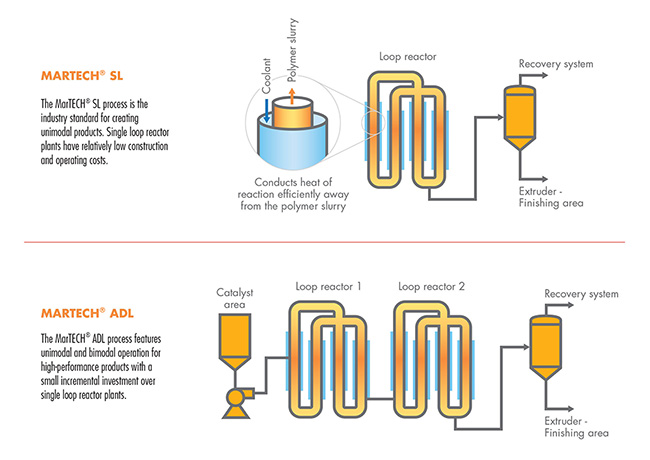
Bimodal polyethylene consists of a mixture of high and low molecular weight polymers, combining the favorable properties of both. Dual catalyst systems enable the production of such materials in a single reactor by concurrently facilitating different polymerization pathways. This results in polymers with enhanced processability and mechanical strength, suitable for applications like pressure pipes and large containers.
Advanced Catalyst Technologies
Leading chemical companies have developed proprietary dual catalyst technologies that are implemented on an industrial scale in the United States. These technologies focus on:
-
Enhancing Catalyst Efficiency: Improving the activity and selectivity of catalysts to maximize production rates and product quality.
-
Customization of Polymer Properties: Tailoring molecular architecture to meet specific performance criteria required by end-users.
-
Environmental Considerations: Reducing energy consumption and minimizing waste through efficient catalytic processes.
These advancements demonstrate the practical and economic viability of dual catalyst systems in producing regularly branched polyethylene on a large scale.
Conclusion
Considering the analysis of catalyst systems and industrial practices, the correct statement regarding the formation of a polymer with regular branches using only ethylene as the monomer and a dual catalyst system is:
"Such combined systems are already implemented on an industrial scale in the US."
This assertion accurately reflects the current state of the industry, where dual catalyst systems are effectively utilized to produce polyethylene with controlled branching. The other statements, while containing elements of truth, either do not align with common industrial practices or inaccurately represent the role of certain catalysts and activators in the process.
In summary, dual catalyst systems employing combinations of catalysts and activators are integral to modern polyethylene production, enabling the synthesis of materials with tailored properties to meet the evolving demands of various industries.
References
Last updated January 26, 2025