
Understanding Earth's Motion and Gravity
A comprehensive explanation of why Earth is never still and how gravity holds everything in place
Key Highlights
- Continuous Movement: Earth rotates, revolves around the Sun, and moves through space, making it far from stationary.
- Role of Gravity: Earth's gravity pulls everything towards its center, ensuring that objects, including rocks, remain anchored.
- Inertial and Atmospheric Effects: The combination of inertia and the co-movement of the Earth's atmosphere makes it impossible to feel the planet’s smooth, constant motion.
The Dynamics of Earth's Motion
Earth is in a state of constant motion involving multiple types of movement simultaneously. At its most basic level, the planet rotates on its axis, revolves around the Sun, and is carried along as part of the Milky Way galaxy's journey through space. This layered motion is a fundamental characteristic of how planets and stars navigate the cosmos.
Earth's Rotation
Daily Spin
The Earth rotates about its axis, a motion that is responsible for the cycle of day and night. This rotation occurs approximately every 24 hours, making the phenomenon familiar to us in the form of sunrise and sunset. At the equator, the rotational speed is around 1,000 miles per hour (roughly 1,600 kilometers per hour). Despite this rapid spin, the rotation is smooth and consistent, meaning that humans and objects on the surface feel no perceptible force because there is no rapid acceleration or sudden change.
Centrifugal Effects
Although the Earth's rotation does generate a centrifugal force, which tends to push objects outward, it is significantly weaker than the gravitational pull of the Earth. This balance is critical; gravity, which acts towards the Earth's center, is strong enough that it keeps objects, including rocks, firmly attached to the surface. Thus, even at extreme rotational speeds, the net effect is the persistent adherence of objects to the ground.
Earth's Revolution Around the Sun
Orbital Mechanics
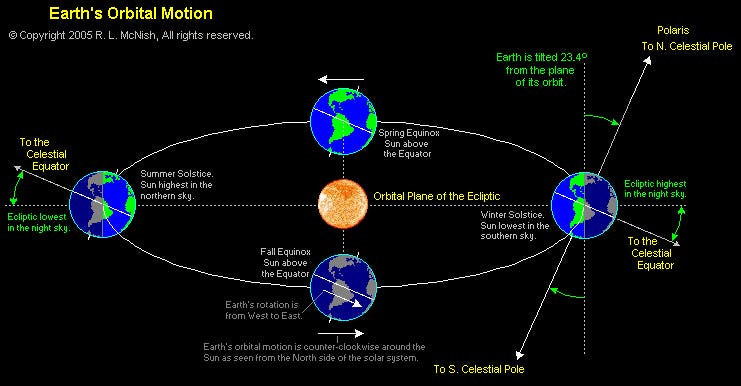
In addition to spinning on its axis, Earth orbits the Sun. It completes one full revolution roughly every 365.25 days. This orbital motion means that the Earth travels an extraordinary distance at speeds estimated to be around 67,000 miles per hour (107,000 kilometers per hour). Despite this tremendous speed, the movement is uniform and steady. As a consequence, both people and objects on Earth do not feel this motion in the same way we perceive acceleration or abrupt changes in speed.
Gravity and Orbital Balance
The force of gravity not only keeps objects tethered on Earth's surface but also plays a critical role in maintaining its orbit around the Sun. The gravitational pull between the Earth and the Sun creates a delicate balance. Earth is effectively in free fall towards the Sun; however, its significant tangential velocity ensures that it constantly "misses" the Sun, thus remaining in orbit. This phenomenon underscores that motion, while dynamic and powerful over cosmic scales, does not lead to objects such as rocks being flung away from the planet.
Broader Motions within the Universe
Solar System Journey
Beyond its own rotational and orbital movements, our planet is part of an even larger system. The entire solar system travels together as it orbits the center of the Milky Way galaxy. This path through space is another layer of motion, adding complexity to the overall dynamics. Movement on this scale is not directly perceptible to humans because it is gradual and uniform.
Galactic Motion
Additionally, the Milky Way itself is moving through space relative to other galaxies. This grand-scale motion shows that no object in the universe is truly stationary; everything is perpetually in motion relative to something else. Yet, on a human scale, and particularly on Earth, these motions appear unremarkable thanks to the principles of gravity and inertia.
Why Rocks and Objects Don't Fall Off Earth
A common question arises: if Earth is continuously moving, why don't rocks and other objects just fly off into space? The answer lies in fundamental physical principles, primarily gravity and inertia.
The Force of Gravity
Gravity is the omnipresent force that pulls objects toward the center of mass—in this case, the Earth's center. Regardless of the planet's speed or its orbital path, gravity remains the dominant force acting on objects at the surface. This gravitational pull is what anchors everything, ensuring that whether it's a rock, a tree, or a person, no object is free to leave the Earth's surface unless acted upon by another significant force.
Inertia and Co-Movement
Inertia, described in Newton's first law of motion, is the tendency for an object to remain at rest or continue moving in a uniform motion unless acted upon by an external force. Since all objects on Earth, including the atmosphere, are moving together with the Earth’s rotation and orbit, there is a uniform movement where relative to each other, nothing seems out of place. This is why a person jumping straight up will come back down to the same spot: the upward motion does not counteract the co-moving system that includes both the person and the Earth.
Balancing Forces: Gravity vs. Centrifugal Force
An important aspect in this discussion is the interaction between gravitational force and the centrifugal force that arises from the Earth's rotation. The centrifugal force tends to push objects away from the axis of rotation. However, this force is very weak when compared to the gravitational pull at the surface of the Earth. A simple table illustrates this balance:
| Force | Description | Magnitude | Effect |
|---|---|---|---|
| Gravitational Force | Attracts all objects toward the center of Earth | Strong (~9.8 m/s² at surface) | Keeps objects anchored on the surface |
| Centrifugal Force | Results from rotation, pushing objects outward | Much weaker than gravity (varies with latitude) | Negligible effect on objects due to Earth's large mass |
This table clearly shows that while the centrifugal force does contribute to a slight reduction in effective gravity—particularly noticeable at the equator—its magnitude is insufficient to counter the pull of gravity. The dominance of gravity ensures that rocks and other objects remain securely bound to the surface.
Perception of Movement
Despite the immense speeds at which Earth moves, humans do not feel this motion. This phenomenon is primarily due to the uniformity of the movement. When you are inside a smoothly moving vehicle or an airplane flying at a steady speed, you generally do not feel the speed of the journey. Similarly, because Earth’s rotation and orbit are constant and smooth, there is no sudden change in speed or direction that the human body could detect.
Role of the Atmosphere
Another factor is that the Earth’s atmosphere moves in synchrony with the planet. Objects within the atmosphere experience the same overall movement, which means that relative to one another, they appear stationary. This co-movement helps mask the fact that Earth is in constant motion. Whether it is the spin of the Earth or its orbital journey around the Sun, everything is moving together in a seamless flow.
Lack of Perceived Acceleration
Human perception is very adept at sensing acceleration rather than uniform motion. Because Earth's movements are almost entirely constant and free of sudden accelerative changes, the lack of perceived forces means that individuals on Earth do not feel the motion. This concept is analogous to how passengers in a smoothly cruising airplane do not feel the sheer speed of the aircraft.
Implications of Halting Earth’s Motion
While our discussion so far affirms that Earth is continuously in motion, it is also intriguing to consider the theoretical implications if Earth were to suddenly stop moving. Although this scenario is purely hypothetical, it helps illustrate the fundamental importance of the current balance of forces.
Impact on Climate and Environment
A sudden stop in Earth's rotation would lead to drastic changes in environmental and climatic conditions. Without the centrifugal balance provided by rotation, the distribution of water, air, and even the thermal dynamics of the planet would be dramatically altered. Temperatures could soar in regions suddenly exposed to prolonged sunlight and drop precipitously in others, fundamentally destabilizing the climate.
Effects on the Ecosystem and Gravitational Equilibrium
Beyond temperature and weather changes, a halt in Earth's motion would disrupt the balancing forces of gravity and inertia. With no centrifugal force to counter even slightly against gravity, objects might experience a different distribution of forces. However, it’s crucial to note that gravity would still act uniformly towards the center of the Earth, meaning objects would continue to remain “anchored” to the surface. Even in such an extreme hypothetical situation, the idea that rocks might casually fly off into space is extraordinarily unlikely — but the overall equilibrium of forces would be thrown into disarray, leading to unforeseen and substantial environmental and geological challenges.
Scientific Principles Underpinning Earth's Movement
Newton’s Laws and Universal Gravitation
The explanation of why objects do not fall off the Earth, despite the planet's immense movement, is deeply rooted in fundamental physics. Newton’s laws of motion and the law of universal gravitation provide the framework for understanding this phenomenon.
Newton's First Law of Motion
Newton's first law states that an object in motion remains in motion at constant velocity unless acted upon by an external force. Since atoms, rocks, and even air molecules on the Earth are all moving with the planet, they do not experience any sudden accelerative forces that would make them feel as though the Earth is abruptly changing pace.
Universal Gravitation
Furthermore, Newton’s law of universal gravitation quantifies the attractive force between masses. The Earth's large mass results in a significant gravitational pull, which ensures that nothing is free to drift away despite the rotation or orbit of the planet. This gravitational force is what ultimately holds objects in place and makes the sensation of the planet’s rapid movement imperceptible to us.
Integration of Cosmic Movements
It is essential to recognize that Earth's motion does not exist in isolation. The continuous, predictable movement of our planet is a reflection of the larger, well-orchestrated dynamics of the universe. Our solar system is just one small part of the Milky Way, which in turn exists within a vast cosmos where motion is the rule rather than the exception.
Movement in the Context of the Universe
In astrophysics, no celestial body is entirely stationary relative to a universal frame of reference. Even seemingly static stars are moving relative to one another. Understanding Earth's motion provides perspective on how gravitational interactions across cosmic distances govern the behavior of galaxies, clusters, and even individual stars. This interconnected view underscores the universality of the physical laws discussed above.
Practical Observations
Observations such as the apparent movement of the Sun across the sky, seasonal weather patterns, and the predictable nature of eclipses all reinforce the fact that Earth is in constant motion. Scientific instruments and experiments have long verified our planet's rotation and orbital speed, validating the theoretical foundations with empirical evidence.
Conclusion and Final Thoughts
To summarize, Earth is far from standing still. Its constant rotation, orbit around the Sun, and broader motion through the galaxy are fundamental characteristics inherent to all celestial bodies. Despite moving at extraordinary speeds—whether it be the roughly 1,000 miles per hour at the equator due to its rotation or the tremendous orbital velocity around the Sun—Earth's continuous and smooth motion goes largely unnoticed by us on its surface.
This inconspicuous nature of motion is largely due to the overwhelming pull of gravity which firmly anchors objects to the planet. Gravity, combined with the principles of inertia and the synchronized movement of the atmosphere, ensures that rocks and other objects cannot simply fly off into space. The balance between gravitational pull and comparatively weak centrifugal forces maintains the stable environment that makes life possible.
The discussion here also illustrates broader scientific principles, such as Newton's laws and the universal nature of gravitational forces. By recognizing these underlying principles, one gains a deeper appreciation for the elegance and coherence of the physical laws that govern everything from our everyday experiences to large-scale cosmic events.
References
- Why don't we feel Earth's motion? - Caltech's Cool Cosmos
- Why Can’t We Feel Earth’s Spin? - EarthSky
- How Does Earth Move Through Space? Now We Know On Every Scale - Forbes
- Earth's Rotation - Wikipedia
- If the Earth is Spinning, Why Don’t Things Move Around? - The Conversation
Recommended Searches
Last updated February 25, 2025