
Unveiling the Cosmic Yardstick: Just How Far is Our Sun?
Discover the dynamic dance between Earth and Sun, a distance that shapes our world, measured in millions of miles and minutes of light.
The distance separating Earth from the Sun is not a static figure but a dynamic interplay governed by celestial mechanics. Understanding this distance is fundamental to grasping our place in the solar system, the nature of planetary orbits, and even the conditions that allow life to flourish on our planet.
Essential Insights: Earth's Solar Connection
- The Average Span: On average, Earth orbits the Sun at a distance of approximately 93 million miles (150 million kilometers). This average is so significant it forms the basis of a standard astronomical measurement.
- An Elliptical Journey: Earth's path around the Sun is not perfectly circular but elliptical, causing the distance to vary by several million miles throughout the year, from its closest approach (perihelion) to its farthest point (aphelion).
- Cosmic Speed Limit: Light from the Sun, traveling at an incredible speed, takes roughly 8 minutes and 20 seconds to traverse this vast distance and reach Earth.
The Astronomical Unit: A Solar System Ruler
To manage the immense distances within our solar system, astronomers use a convenient unit of measurement called the Astronomical Unit (AU). One AU is defined as the average distance between the Earth and the Sun. The International Astronomical Union (IAU) has established a precise value for the AU:
\[ 1 \text{ AU} = 149,597,870,700 \text{ meters} \]
This is approximately 92.956 million miles or 149.6 million kilometers. Using AU simplifies discussions about planetary distances; for example, Mars is about 1.5 AU from the Sun, while Jupiter orbits at roughly 5.2 AU.
Earth's Elliptical Path: A Dance of Distance
The primary reason the Earth-Sun distance varies is due to Earth's orbit, which is not a perfect circle but an ellipse, with the Sun located at one of the two foci of this ellipse. This orbital shape means Earth rhythmically moves closer to and farther from the Sun over the course of a year.
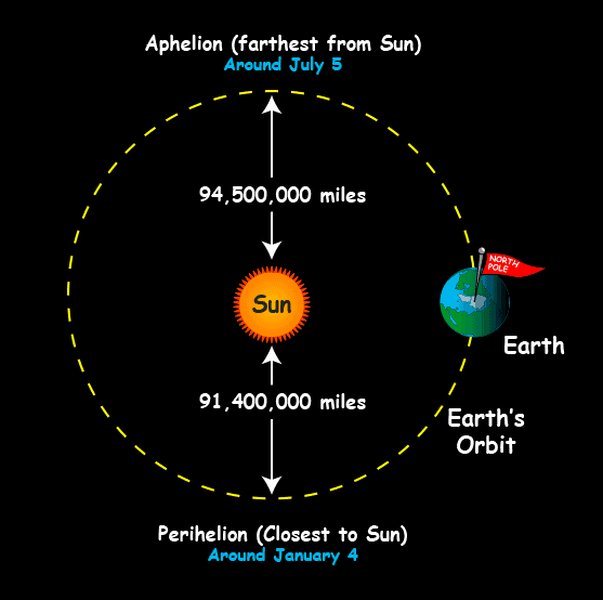
Earth's elliptical orbit, illustrating the points of perihelion (closest to the Sun) and aphelion (farthest from the Sun).
Perihelion: Earth's Closest Embrace
Perihelion is the point in Earth's orbit where it is closest to the Sun. This typically occurs around January 3rd each year. At perihelion, the distance is approximately:
- 91.4 million miles
- 147.1 million kilometers
- Roughly 0.983 AU
It's a common misconception that Earth's seasons are determined by its distance from the Sun. However, the Northern Hemisphere experiences winter during perihelion, demonstrating that seasons are primarily due to the tilt of Earth's axis, not its proximity to the Sun.
Aphelion: Earth's Farthest Point
Aphelion is the point in Earth's orbit where it is farthest from the Sun. This usually happens around July 4th. At aphelion, the distance increases to approximately:
- 94.5 million miles
- 152.1 million kilometers
- Roughly 1.017 AU
During aphelion, the Northern Hemisphere experiences summer, again highlighting the dominant role of Earth's axial tilt in seasonal changes.
A Summary of Orbital Distances
The table below provides a quick comparison of these key orbital distances:
| Orbital Point | Distance in Miles (approx.) | Distance in Kilometers (approx.) | Distance in AU (approx.) | Typical Date |
|---|---|---|---|---|
| Perihelion (Closest) | 91.4 million | 147.1 million | 0.983 AU | Early January |
| Average Distance | 93.0 million | 149.6 million | 1.000 AU | N/A (Mean Value) |
| Aphelion (Farthest) | 94.5 million | 152.1 million | 1.017 AU | Early July |
Visualizing Orbital Characteristics
The following chart offers a visual comparison of Earth's position relative to the Sun at perihelion, aphelion, and its average distance. The "Relative Sunlight Intensity" is a conceptual representation, indicating that sunlight is slightly more intense at perihelion due to closer proximity, and slightly less intense at aphelion. The "Orbital Velocity" is also conceptual, as Earth moves faster at perihelion and slower at aphelion according to Kepler's laws of planetary motion.
The Journey of Sunlight
The speed of light in a vacuum is a universal constant, approximately 186,282 miles per second (or about 299,792 kilometers per second). Given the average Earth-Sun distance of 93 million miles (150 million km), we can calculate the time it takes for sunlight to reach our planet.
This journey takes, on average, about 8 minutes and 20 seconds. This means that when we look at the Sun (with proper eye protection, of course!), we are seeing it as it was over 8 minutes in the past. This "light lag" is a crucial consideration for space communication and observations.
This video provides an engaging overview of the Earth-Sun distance and its various units of measurement.
A Glimpse into History and Future Drifts
Early Estimations
Humanity has long been fascinated by the cosmos and our place within it. Ancient Greek astronomers were among the first to attempt to measure the Earth-Sun distance. Aristarchus of Samos in the 3rd century BCE, for instance, used geometric methods based on the angle between the half-moon and the Sun. While his estimate was significantly off by modern standards, his approach was ingenious for its time. Over centuries, astronomers like Hipparchus, Ptolemy, Copernicus, and notably Johannes Kepler, refined these calculations. Kepler's laws of planetary motion, formulated in the early 17th century, allowed for precise calculations of the relative distances of planets from the Sun.
Is the Distance Changing?
Interestingly, the average distance between Earth and the Sun is not absolutely fixed over very long timescales. The Sun is constantly losing mass through nuclear fusion (converting mass to energy) and the solar wind (ejection of charged particles). As the Sun's mass decreases, its gravitational pull on Earth weakens slightly. This causes Earth to gradually drift away from the Sun by a minuscule amount—estimated to be about 6 centimeters (2.36 inches) per year. While this change is negligible on human timescales and dwarfed by the annual variation from the elliptical orbit, it is a fascinating aspect of our solar system's long-term evolution.
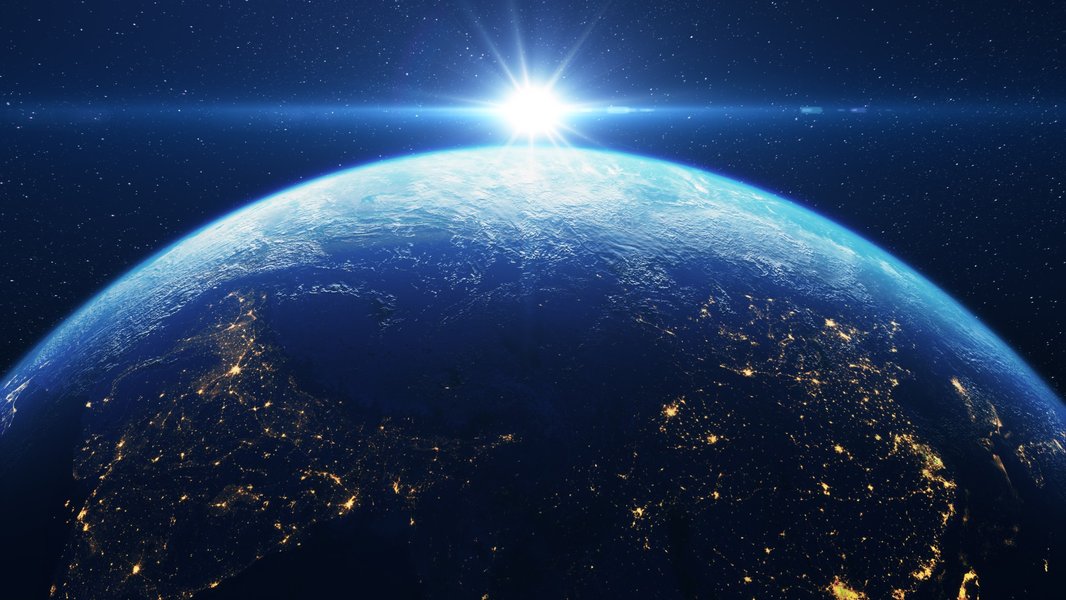
The Earth-Sun distance, while vast, is finely tuned, contributing to our planet's habitability.
Key Concepts at a Glance: Earth-Sun Distance Mindmap
This mindmap visually organizes the core concepts related to the distance between Earth and the Sun, from the fundamental definition of the Astronomical Unit to the nuances of Earth's orbital characteristics and the implications of this vast separation.
Frequently Asked Questions (FAQ)
What is an Astronomical Unit (AU)?
An Astronomical Unit (AU) is the average distance from the Earth to the Sun. It's a standard unit of length used primarily for measuring distances within the solar system. The International Astronomical Union (IAU) defines 1 AU as exactly 149,597,870,700 meters (about 92.956 million miles or 149.6 million kilometers).
Why does the distance between Earth and Sun change?
The distance changes because Earth's orbit around the Sun is not a perfect circle but an ellipse. The Sun is at one of the foci of this ellipse. As Earth travels along this path, its distance from the Sun varies throughout the year. The closest point is called perihelion, and the farthest point is called aphelion.
Does the changing distance affect Earth's seasons?
No, the primary cause of Earth's seasons is the tilt of its rotational axis (23.5 degrees) relative to its orbital plane, not its varying distance from the Sun. This tilt causes different parts of Earth to receive more direct sunlight at different times of the year. For example, the Northern Hemisphere experiences winter when Earth is closest to the Sun (perihelion).
How long does it take for sunlight to reach Earth?
On average, it takes about 8 minutes and 20 seconds for light from the Sun to reach Earth. This time can vary slightly depending on Earth's exact position in its orbit (whether it's at perihelion or aphelion).
Is Earth moving farther away from the Sun over time?
Yes, but very slowly. The Sun is gradually losing mass due to nuclear fusion and the solar wind. This slight reduction in mass means its gravitational pull on Earth weakens over time, causing Earth to drift away at a rate of about 6 centimeters (2.36 inches) per year. This change is extremely small and has no noticeable effect on human timescales.
Recommended Further Exploration
- How does Earth's elliptical orbit affect its climate and seasons in detail?
- What are the historical methods used to calculate the astronomical unit accurately?
- How does the Sun's energy output (solar constant) vary with the Earth-Sun distance?
- What are the distances of other planets in our solar system from the Sun in astronomical units?
References
Last updated May 6, 2025