
Mastering the Art of AI Communication: Crafting Effective Prompts
Unlock the full potential of AI by learning to speak its language with precision and clarity.
In the rapidly evolving landscape of artificial intelligence, the ability to communicate effectively with AI models has become a crucial skill. This discipline, known as prompt engineering, is both an art and a science. It involves designing and optimizing the inputs—or "prompts"—you provide to an AI system to guide it toward generating the desired responses. Whether you're aiming for creative content, detailed analysis, or precise problem-solving, the quality of your prompt directly dictates the quality of the AI's output. A well-crafted prompt can transform a generic response into an accurate, relevant, and highly useful piece of information.
Key Takeaways for Effective AI Prompting
- Clarity and Specificity are Paramount: Vague prompts lead to generic or inaccurate results. Always be explicit about your intent, desired output, and any constraints.
- Context Enriches Responses: Provide sufficient background information, persona, and format requirements to help the AI understand the framework for its answer.
- Iterative Refinement is Key: Don't expect perfection on the first try. Experiment, observe the AI's responses, and refine your prompts based on the outcomes to continuously improve results.
Understanding Prompt Engineering
Prompt engineering is more than just typing a question; it's about strategic communication with sophisticated AI models. Large Language Models (LLMs) and other generative AI tools are trained on vast datasets, enabling them to understand and generate text, images, code, and more. However, without clear guidance, these models might produce outputs that are off-topic, inaccurate, or simply not what you envisioned. Prompt engineering helps bridge this gap, allowing you to effectively "program with words" and harness the AI's capabilities for a wide array of applications, from content creation and customer support to data analysis and enhancing workflows.
This evolving field requires a blend of linguistic skills and creative expression. By mastering prompt engineering, you gain a deeper understanding of AI's strengths and limitations, enabling you to extract precise and relevant outputs for diverse tasks.
The Core Principles of Prompt Design
Effective prompts are built upon several foundational principles that guide the AI towards producing the best possible results. These principles ensure that your instructions are clear, comprehensive, and actionable for the AI model.
Be Clear and Concise
Avoid ambiguity and unnecessary jargon. Every word in your prompt should serve a purpose. Instead of "Tell me about AI," a better prompt would be "Explain the process of prompt engineering to a beginner in simple terms." This level of clarity helps the AI focus on your specific request and reduces the chance of misinterpretation or irrelevant outputs.
Provide Ample Context
Context is king. The more background information you provide, the better the AI can tailor its response. This includes defining the scenario, the target audience, the purpose of the output, and any specific constraints. For instance, asking for a "funny and heartwarming family story that includes apple pie" is far more effective than just "Write a funny story." Context helps the AI understand the nuances of your request.
Specify the Desired Format and Structure
If you need the output in a specific format (e.g., a list, a table, a step-by-step guide, an email), explicitly state it. This helps the AI structure its response in a way that is immediately useful to you. For example, "Provide a step-by-step guide on how to bake a sourdough bread" will yield a much more organized response than a general request about sourdough.
Advanced Prompting Techniques for Superior Results
Beyond the basics, several advanced techniques can significantly enhance the quality and reliability of AI outputs. These methods often involve breaking down complex tasks, guiding the AI through reasoning processes, or leveraging external information.
Role-Playing and Persona Assignment
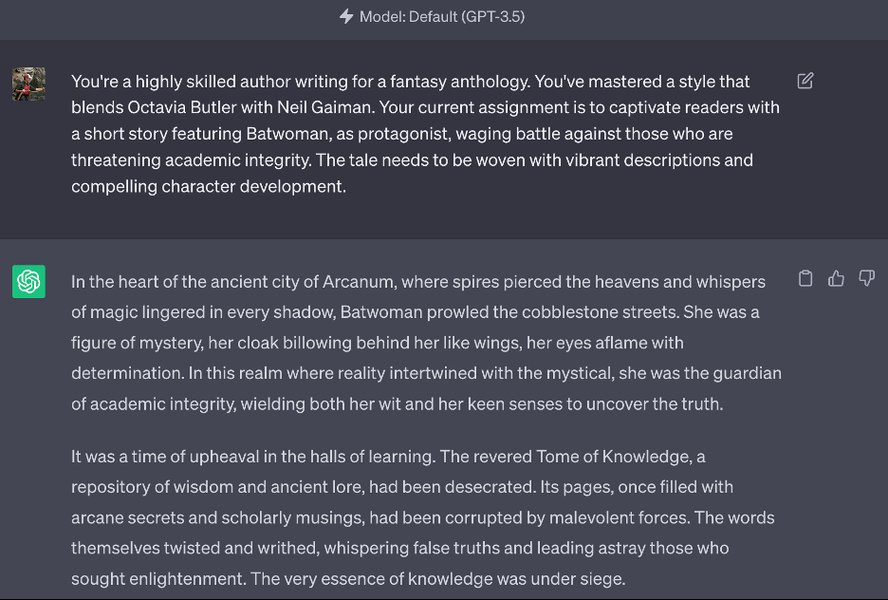
Instructing the AI to adopt a specific persona can dramatically influence the tone, style, and content of its response. For example, asking the AI to "Act as a seasoned marketing expert" or "Respond as a friendly customer support agent" will result in outputs that align with that particular role. This is particularly useful for tasks like drafting professional emails, generating creative content, or simulating conversations.

Few-Shot and Zero-Shot Prompting
- Zero-shot prompting: This involves providing a prompt without any examples, relying solely on the AI's pre-trained knowledge to generate a response. It's effective for straightforward tasks.
- Few-shot prompting: For more complex tasks, providing a few examples within the prompt can significantly improve the AI's understanding and performance. This helps the model infer the desired pattern or style.
Chain-of-Thought (CoT) Prompting
CoT prompting encourages the AI to explain its reasoning process step-by-step before arriving at the final answer. This technique is particularly valuable for complex problems that require logical deduction or multi-stage thinking. By requesting "Think step by step" or "Show your reasoning," you can not only get a more accurate answer but also understand how the AI arrived at it.
Iterative Refinement and Feedback Loops
Prompt engineering is an iterative process. It's rare to get a perfect output on the first try. Instead, view your interaction with the AI as a conversation. If the initial response isn't satisfactory, refine your prompt based on what the AI provided. This could involve:
- Adding more specific details.
- Clarifying ambiguous instructions.
- Adjusting the desired tone or length.
- Requesting a different format.
This continuous feedback loop helps you steer the AI towards increasingly precise and relevant results.
Elements of an Effective Prompt
A well-structured prompt often includes several key components, though not all are necessary for every interaction. Understanding these elements allows you to construct prompts that effectively guide the AI.
| Element | Description | Example Integration |
|---|---|---|
| Task/Goal | Clearly state what you want the AI to do. This is the core instruction. | "Summarize the main points of the article." |
| Context | Provide relevant background information, data, or scenario details. | "Considering current economic inflation rates and recent stock market volatility..." |
| Persona | Instruct the AI to adopt a specific role or character. | "Act as a seasoned financial advisor." |
| Format | Specify the desired structure for the output (e.g., list, table, essay, code). | "Present the information as a bulleted list." |
| Tone | Define the emotional or stylistic quality of the response (e.g., formal, casual, humorous, academic). | "Maintain a professional yet encouraging tone." |
| Constraints/Limitations | Set boundaries on length, complexity, or specific information to exclude. | "Keep the summary under 150 words and avoid technical jargon." |
| Examples (Few-shot) | Provide a few input-output pairs to demonstrate the desired pattern. | "Here are examples of good customer service replies: [Example 1], [Example 2]." |
Optimizing Prompts for Diverse AI Applications
The principles of prompt engineering apply across various AI applications, from text generation to image creation. However, specific considerations come into play depending on the AI model's purpose.
Prompts for Text-Based AI (LLMs)
When working with LLMs like those used for writing, summarization, or question answering, focus on:
- Clarity and precision: Be unambiguous.
- Audience and purpose: Tailor the output for specific readers and goals.
- Keywords: Use relevant terms to guide the AI's lexical choices.
- Length requirements: Specify word counts or paragraph limits.
For example, instead of "Write an email," try: "Write a formal email invitation for a webinar about prompt engineering, targeting small business owners, including registration details and a call to action, keeping it concise."
Prompts for Image Generation AI
Creating compelling images with AI requires descriptive and imaginative prompts. Focus on:
- Subject details: What is the main focus? (e.g., "A futuristic city skyline")
- Style and artistic influences: (e.g., "in the style of Van Gogh," "cyberpunk aesthetic," "photorealistic")
- Atmosphere and mood: (e.g., "warm lighting," "ethereal atmosphere," "dramatic contrast")
- Composition and perspective: (e.g., "wide-angle shot," "side profile pose," "close-up")
- Colors and textures: (e.g., "gradient neon violet," "metallic sheen," "soft lighting")
A good image prompt might be: "A majestic lion standing proudly on a savanna at sunset, photorealistic, cinematic lighting, golden hour warmth, epic scale, 8K resolution, detailed fur, vibrant colors."

The Impact of Prompt Quality on AI Output
The relationship between prompt quality and AI output is direct and profound. A well-engineered prompt acts as a precise guiding mechanism, ensuring the AI model understands and fulfills your intent with accuracy and relevance. Conversely, a poorly constructed prompt can lead to a cascade of undesirable outcomes, ranging from generic responses to outright factual inaccuracies or "hallucinations."
This radar chart illustrates how different aspects of prompt quality affect the overall output of an AI. A high-quality prompt, characterized by strong specificity, rich contextual depth, clear instructions, adherence to desired formats, the ability to elicit creative nuances, and thoughtful bias mitigation, consistently leads to superior results. Conversely, a low-quality prompt, lacking these attributes, often yields outputs that are vague, irrelevant, or even problematic. This visual representation underscores the importance of a holistic approach to prompt design.
Practical Tips for Writing Better Prompts
Based on insights from various AI guides and expert recommendations, here are actionable tips to elevate your prompt engineering skills:
Start Simple, Then Elaborate
Begin with a clear, basic instruction. If the initial response isn't what you need, gradually add more details, constraints, or context. This iterative approach helps you pinpoint what additional information the AI requires.
Use Clear and Direct Language
Avoid jargon, slang, or overly complex sentences unless you specifically intend for the AI to emulate such language. The easier it is for the AI to understand your prompt, the better it can fulfill your request. Think of it like giving instructions to a new employee or intern.
Be Specific About Your Desired Outcome
Don't just ask for "a story"; ask for "a 500-word science fiction story about a lone astronaut discovering a new alien species on a barren planet, with a hopeful and mysterious tone." The more specific you are, the less guesswork the AI has to do.
Define the AI's Role or Persona
Instructing the AI to "Act as a professional copywriter" or "Imagine you are a historical expert" can significantly refine the output's style and content to match your expectations.
Provide Examples (Few-Shot Learning)
If you have specific examples of the type of output you want, include them in your prompt. This is particularly effective for tasks requiring a specific style, format, or pattern. For instance, show the AI examples of good customer service replies before asking it to generate new ones.
Request Step-by-Step Thinking (Chain-of-Thought)
For complex tasks, explicitly ask the AI to "Think step-by-step" or "Show your reasoning." This can lead to more accurate and robust answers, as the AI breaks down the problem into manageable parts.
This video provides an excellent visual and auditory guide to mastering prompt engineering, covering essential tips and advanced techniques that can significantly improve your AI interactions. It emphasizes the importance of clear, structured prompts and iterative refinement, reinforcing many of the concepts discussed in this guide. Watching it can help solidify your understanding and provide practical demonstrations.
Refine and Iterate
Prompt engineering is an ongoing process of trial and error. If the initial response isn't quite right, don't start over. Instead, identify what was missing or incorrect and modify your prompt accordingly. This iterative refinement is key to getting the most out of AI models.
# Example of iterative refinement:

# Initial vague prompt
prompt_v1 = "Write about renewable energy."
# AI response: General overview.

# Refinement 1: Add specificity
prompt_v2 = "Explain the pros and cons of solar energy for residential use in California."
# AI response: More focused, but maybe too technical.

# Refinement 2: Adjust tone and audience
prompt_v3 = "Explain the pros and cons of solar energy for residential use in California, as if explaining to a homeowner with no technical background."
# AI response: Clearer, more accessible.

# Refinement 3: Specify format
prompt_v4 = "Explain the pros and cons of solar energy for residential use in California, as if explaining to a homeowner with no technical background. Present it as a bulleted list."
# AI response: Clear, accessible, and well-formatted.
Understanding AI Limitations
While AI models are incredibly powerful, they are not infallible. It's crucial to understand their limitations:
- Hallucinations: AI can sometimes generate plausible-sounding but factually incorrect information. Always verify critical information.
- Bias: AI models learn from the data they are trained on, which can reflect existing biases. Be mindful of this and prompt for neutrality where necessary.
- Lack of true understanding: AI models generate responses based on patterns and probabilities, not genuine comprehension or consciousness.
- Context window limits: While increasing, there's a limit to how much information an AI can process and remember within a single conversation. For entirely new topics, starting a fresh chat can be beneficial.
Conclusion: The Future of Human-AI Collaboration
Effective prompt engineering is not just a technical skill; it's a bridge between human intent and artificial intelligence capabilities. As AI models become more sophisticated, the art of crafting precise and nuanced prompts will only grow in importance. By embracing clarity, context, iterative refinement, and an understanding of AI's strengths and limitations, you can unlock the full potential of these transformative tools, driving innovation and efficiency across countless domains. Prompt engineering empowers you to be a more effective communicator with AI, transforming your ideas into powerful, actionable results.
Frequently Asked Questions (FAQ)
What is prompt engineering?
Why is prompt engineering important?
Can I use natural language when writing prompts?
How do I improve my AI prompts if the first response isn't good?
What are some common mistakes to avoid in prompt engineering?
Recommended Further Reading
- Explore advanced prompt engineering techniques for complex tasks.
- Learn strategies for debugging and refining problematic AI responses.
- Discover model-specific prompt engineering guides for different AI platforms.
- Understand the ethical implications and best practices in crafting AI prompts.
