
Navigating the Landscape of Environmental Impact Assessment (EIA) Methodologies
A Comprehensive Guide to Tools, Techniques, and Best Practices for Sustainable Development
Environmental Impact Assessment (EIA) is a crucial process designed to evaluate the potential environmental effects of proposed projects or developments before they are carried out. It serves as a vital tool in guiding sustainable development by identifying and mitigating negative impacts while enhancing positive outcomes. The effectiveness of an EIA hinges significantly on the methodologies employed, which range from simple qualitative approaches to complex quantitative models.
Key Highlights in EIA Methodologies
- Diverse Methodologies: EIA utilizes a wide array of methodologies, including checklists, matrices, networks, overlays, and advanced computational tools like GIS and Life Cycle Assessment (LCA).
- Systematic Approach: Regardless of the specific method, a robust EIA process involves systematic steps: screening, scoping, baseline study, impact prediction, evaluation, mitigation, public consultation, reporting, decision-making, and monitoring.
- Best Practices for Effectiveness: Key best practices emphasize early and meaningful stakeholder engagement, a strong focus on avoiding significant impacts, and the continuous incorporation of emerging technologies and adaptive management strategies.
Understanding Environmental Impact Assessment (EIA)
EIA is a formal process that assesses the environmental consequences of a plan, policy, program, or project. Its primary goal is to ensure that decision-makers consider environmental values during the planning and implementation phases of development activities. This proactive approach helps prevent irreversible environmental damage and promotes more sustainable practices.
The core objectives of EIA methodologies include understanding the nature and location of a project, identifying factors for analysis, performing preliminary impact identification and scoping, conducting baseline studies, predicting and assessing impacts, comparing alternatives, outlining mitigation measures, and establishing monitoring and impact management plans.
The Foundational Steps of an EIA Process
A typical EIA follows a structured, multi-stage process to ensure comprehensive assessment and informed decision-making. These stages are interconnected, with insights from one phase often informing the next.
Step 1: Screening and Scoping
The initial phase involves determining whether a project requires an EIA (screening) and defining the boundaries and focus of the assessment (scoping). Screening identifies the potential for significant environmental effects, while scoping identifies the relevant environmental, social, and economic impacts to be evaluated, along with the appropriate methods and resources. This step is crucial for streamlining the process and ensuring that efforts are concentrated on the most significant issues.
Step 2: Baseline Study and Impact Prediction
This stage involves collecting data on the existing environmental conditions of the project site, which serves as a benchmark for measuring potential impacts. Baseline data includes information on air and climate, land, water, ecology, and socioeconomic factors. Following this, scientific methods are used to predict how the proposed project might alter these conditions. Prediction methods can range from simple to complex, often involving modeling and expert judgment to forecast changes in environmental parameters.

Environmental professionals conducting fieldwork during a Phase I Environmental Site Assessment.
Step 3: Mitigation and Impact Management
Once potential impacts are predicted, mitigation measures are designed to minimize negative effects and enhance positive ones. This often involves identifying alternative project designs, technologies, or operational procedures. Impact management plans are then developed to ensure these measures are implemented effectively throughout the project lifecycle, often including detailed monitoring programs to track environmental performance.
Step 4: Public Consultation and Reporting
Public and stakeholder engagement is a critical component, involving various methods such as public hearings, workshops, and consultations. This ensures community input is considered throughout the process, fostering transparency and democratic decision-making. The culmination of the EIA is a comprehensive report—an Environmental Impact Statement (EIS)—which details the findings, proposed mitigation, and alternatives, significantly influencing whether projects proceed and under what conditions.
Core EIA Methodologies and Techniques
EIA methodologies are diverse, ranging in complexity and application. The choice of method often depends on the project's scale, available data, expertise, and regulatory requirements. These methodologies are designed to identify, predict, evaluate, and communicate environmental changes resulting from a proposed action.
Qualitative and Quantitative Approaches
EIA methodologies can be broadly categorized into qualitative, quantitative, or mixed-method approaches. Qualitative methods often rely on expert judgment and descriptive analysis, particularly for impacts that are difficult to quantify, such as landscape quality or social acceptance. Quantitative methods utilize numerical data and models to measure impacts precisely, such as carbon footprint or water usage. Mixed-method approaches combine both to provide a more holistic assessment.
Ad Hoc Methods
Ad hoc methods involve a team of experts assessing potential impacts based on their collective experience and professional judgment. While flexible, they can lack structure and reproducibility, providing minimal guidance and potentially being inefficient without clear guidelines.
Checklist Methods
Checklists are structured lists of environmental parameters or potential impacts associated with a project. They help ensure no important areas are overlooked during scoping and assessment. Types include:
- Simple Checklists: A basic list of environmental components that might be affected.
- Descriptive Checklists: Provide additional information beyond a simple list, describing the possibility or potential existence of an impact.
- Scaling Checklists: Incorporate subjective scaling of the magnitude or importance of impacts on environmental parameters.
- Scaling-Weighting Checklists: Assign numerical weights to environmental factors based on their importance, allowing for a more quantitative comparison of impacts.
Matrix Methods
Matrix methods provide a framework for identifying interactions between project activities and their potential environmental impacts. The most common type is a two-dimensional chart listing project actions along one axis and environmental characteristics along the other. Cells within the matrix indicate the potential impact, often with numerical ratings for magnitude and significance. The Battelle Environmental Evaluation System (EES) is a well-known matrix method that divides environmental impacts into main categories such as ecology, pollution, aesthetics, and human interest, with hierarchical assessment of environmental quality indicators.
Network Methods
Network diagrams visually represent cause-effect relationships between project activities and environmental impacts, including secondary and indirect impacts. They are effective for illustrating complex linkages and multiple impact areas stemming from a single action, making them useful for presentations and identifying cascading effects.
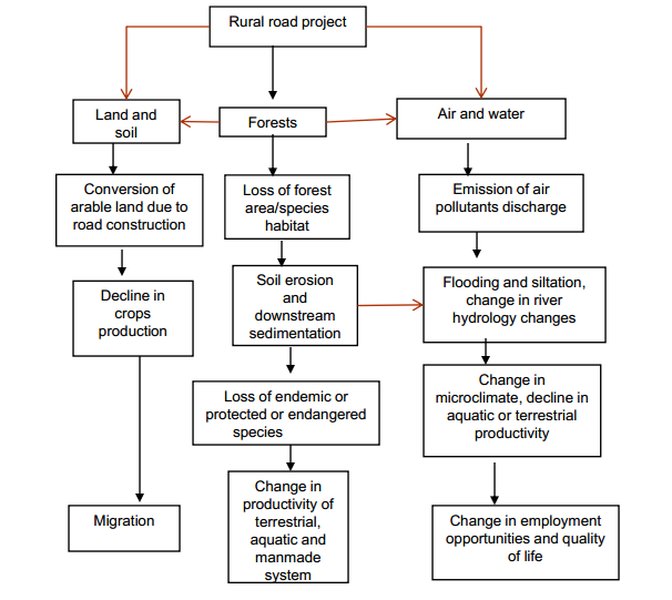
An example of a network diagram used in Environmental Impact Assessment.
Overlay Methods
Overlay methods are based on mapping, where multiple maps of environmental characteristics (e.g., geology, hydrology, land use, population density) are superimposed to identify areas of potential conflict or impact. Geographic Information Systems (GIS) have revolutionized this method, allowing for sophisticated spatial analysis and visualization of impacts.
Advanced Methodologies and Tools
Modern EIA practices increasingly integrate advanced tools and techniques to enhance precision and comprehensiveness:
- Geographical Information Systems (GIS): Essential for spatial analysis, mapping, and visualizing environmental data and impacts. Esri's ArcGIS Pro is a widely used GIS tool in EIA.
- Life Cycle Assessment (LCA): Used for identifying and measuring the environmental impact of industrial products throughout their entire life cycle, from raw material extraction to disposal. Tools like SimaPro, GaBi, and OneClickLCA specialize in LCA.
- Expert Systems: AI-driven systems that can assist in complex environmental assessments by applying expert knowledge.
- The Flash Environmental Assessment Tool (FEAT) 2.0: A rapid assessment tool for initial environmental screening.
- Fuzzy Logic: Approximate reasoning methods used when environmental impacts cannot be precisely quantified, such as landscape quality or social acceptance, relying on expert judgment and community sentiment.
- Enablon: Software that helps companies measure, control, and reduce environmental impacts, useful for compliance with standards like ISO 14001.
Comparative Analysis of EIA Methodologies
The selection of an appropriate EIA methodology depends on various factors, including project complexity, data availability, required level of detail, and regulatory context. The following table provides a comparison of common EIA methodologies:
| Methodology | Description | Strengths | Limitations | Typical Application |
|---|---|---|---|---|
| Ad Hoc | Team of experts assesses impacts based on experience. | Flexible, quick for simple projects. | Subjective, lacks systematic guidance, difficult to reproduce. | Preliminary assessments, small-scale projects. |
| Checklists | Lists of environmental parameters or impacts. | Simple, ensures comprehensive coverage, good for initial screening. | Limited in showing cause-effect relationships, can be too generic. | Screening, scoping, impact identification. |
| Matrices | Two-dimensional tables showing interactions between project actions and environmental components. | Systematic, identifies interactions, allows for qualitative/quantitative ratings. | Can be complex for large projects, difficulty in weighting impacts. | Detailed impact identification and evaluation. |
| Networks | Visual flowcharts showing cause-effect pathways of impacts. | Identifies secondary and tertiary impacts, visually intuitive, good for complex interdependencies. | Can become overly complex for numerous interactions, difficult to quantify impacts. | Understanding impact chains, public communication. |
| Overlays (GIS) | Superimposing maps of environmental characteristics. | Excellent for spatial analysis, visual representation of impacts, handles large datasets. | Requires specialized software and expertise, data availability. | Site selection, land-use planning, cumulative impact assessment. |
| Life Cycle Assessment (LCA) | Assesses environmental impacts over a product's entire life cycle. | Holistic view, quantifies resource use and emissions, supports eco-design. | Data intensive, specific to products/processes, can be time-consuming. | Industrial products, sustainability reporting. |
Illustrating Methodological Capabilities: A Radar Chart Analysis
To further illustrate the strengths of various EIA methodologies, consider the following radar chart. This chart provides a subjective assessment of how well different categories of EIA methodologies perform across several key criteria crucial for effective environmental assessment. Each axis represents a desirable characteristic of an EIA methodology, and the plotted points demonstrate the relative strength of each method type in that area. Higher values indicate stronger performance.
Best Practices in EIA Methodologies
Effective EIA goes beyond simply applying methods; it involves adhering to best practices that ensure the assessment is fair, credible, and contributes meaningfully to sustainable development.
This video provides insights into Module 10: Scoping for Environmental Impact Assessment (EIA), discussing best practices for EIA consultants and report formatting.
Early and Meaningful Stakeholder Engagement
Involving stakeholders from the project's outset is paramount. Early engagement allows for input on identifying potential impacts, suggesting alternatives, and improving the quality of EIA reports and final decisions. This includes consulting Indigenous Peoples, women and girls, youth, and affected communities to ensure diverse perspectives are considered and human rights impacts are addressed.
Comprehensive Scope and Avoiding Significant Impacts
A key principle in modern EIA is to avoid all significant impacts, with other mitigation options serving secondary roles. This requires a paradigm shift towards proactive avoidance rather than merely attempting to minimize or compensate for harm. The assessment must be comprehensive, recognizing intricate systems and complex inter-relationships within the environment.
Integration of Emerging Technologies and Data
The advancement of technology, such as drone monitoring, precision farming, and bioengineering, is crucial for improving how environmental impacts are assessed and managed. Tools like GIS enable more efficient, cost-effective, and precise monitoring and mitigation. The use of robust data and models ensures higher precision and certainty in analyses.
Quality Control and Adaptive Management
Employing a rigorous quality management system for the entire EIA process and report preparation is essential. The EIA report must be comprehensive, transparent, and provide sufficient evidence and analysis. Furthermore, EIA should be viewed as a continuous source of information throughout the project cycle, with follow-up mechanisms to audit the accuracy of predictions and assess the success of mitigation measures, allowing for adaptive management based on actual outcomes.
Future Trends and Challenges in EIA
As environmental challenges evolve, so too must EIA methodologies. Future trends point towards even greater integration of climate change considerations, biodiversity conservation, and human rights aspects into assessments. Challenges include addressing cumulative impacts, dealing with data uncertainties, and ensuring effective implementation and enforcement of EIA recommendations across diverse jurisdictions.
The continuous refinement of international best practice principles by organizations like the International Association for Impact Assessment (IAIA) underscores the dynamic nature of the field. The focus remains on developing methodologies that are appropriate to the task, free from bias, and capable of providing credible information for decision-making towards a more sustainable future.
Frequently Asked Questions (FAQs)
What is the main purpose of an Environmental Impact Assessment (EIA)?
What are the key stages in the EIA process?
How do qualitative and quantitative methods differ in EIA?
Why is stakeholder engagement important in EIA?
What are some advanced tools used in modern EIA?
Conclusion
Environmental Impact Assessment methodologies are critical instruments for fostering responsible development and safeguarding our planet. From foundational checklists and matrices to sophisticated GIS and LCA tools, the array of techniques available enables a thorough analysis of environmental consequences. The emphasis on systematic processes, early stakeholder engagement, impact avoidance, and continuous improvement through technology and adaptive management positions EIA as an indispensable practice for achieving a harmonious balance between human activity and environmental preservation. As we move forward, the evolution of these methodologies will continue to be vital in addressing increasingly complex environmental challenges and guiding sustainable futures.
Recommended Further Exploration
- Explore advanced tools and techniques enhancing EIA effectiveness.
- Discover best practices for meaningful stakeholder involvement in environmental assessments.
- Understand how Geographic Information Systems revolutionize spatial analysis in EIA.
- Learn about incorporating climate change impacts and adaptation into EIA.
References

 mjcetce455.blogspot.com
Last updated May 21, 2025