
Navigating the Landscape of Environmental Impact Assessment Methodologies in 2025
A Comprehensive Guide to Evaluating Project Impacts for Sustainable Development
Key Insights into EIA Methodologies
- Diverse Approaches for Comprehensive Analysis: Environmental Impact Assessment (EIA) methodologies are not one-size-fits-all. They encompass a wide array of techniques, from simple checklists to complex quantitative models and spatial analysis, designed to identify, predict, and evaluate environmental changes caused by proposed projects. The choice of methodology depends heavily on the project's nature, scope, available data, and regulatory requirements.
- Emphasis on Advanced Tools and Technology: In 2025, the field of EIA is increasingly leveraging advanced technologies such as Geographic Information Systems (GIS), Life Cycle Assessment (LCA) software, and even AI-powered tools. These technologies enhance the precision and efficiency of impact prediction, data analysis, and the visualization of complex environmental interrelationships, moving beyond traditional qualitative assessments.
- Holistic Assessment for Sustainable Outcomes: Effective EIA methodologies extend beyond purely biophysical impacts to include socioeconomic and cultural considerations. They aim to provide a holistic understanding of a project's potential effects, facilitate informed decision-making, and promote the implementation of effective mitigation and monitoring strategies to ensure sustainable development.
Environmental Impact Assessment (EIA) is a crucial process for evaluating the potential environmental consequences of proposed projects, plans, or policies before their implementation. As we move further into 2025, the methodologies employed in EIA continue to evolve, integrating new technologies and approaches to provide more accurate, comprehensive, and actionable insights. The core objective remains to identify, predict, evaluate, and mitigate the biophysical, social, and other relevant effects of development proposals prior to major decisions being made.
The Foundational Pillars of EIA Methodologies
Understanding the Purpose and Evolution of Assessment Tools
EIA methodologies are systematic approaches developed to identify, predict, and value environmental changes resulting from a specific action. These methodologies are designed to quantify or assess these changes across various environmental dimensions, including physical, chemical, biological, socioeconomic, cultural, and landscape values. A robust EIA methodology should be easily understood, adoptable within given constraints (such as time and budget), and adaptable to further modifications if necessary.
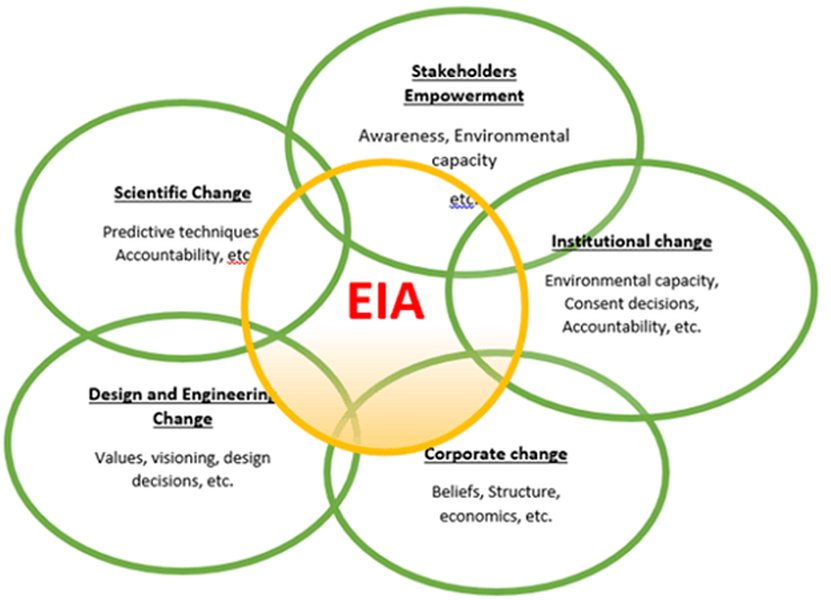
A visual representation of the interconnected elements considered in an Environmental Impact Assessment.
Core Objectives of EIA Methodologies
The overarching objectives of EIA methodologies typically include:
- Project Understanding and Alternatives: Gaining a thorough understanding of the nature and location of a proposed project and exploring possible alternatives.
- Impact Identification and Scoping: Early identification of potential impacts and defining the scope of the assessment, including relevant factors and assessment objectives.
- Baseline Studies: Conducting comprehensive studies of existing environmental conditions to establish a benchmark against which future changes can be measured.
- Prediction and Assessment: Forecasting the likely impacts of the project and comparing them against various alternatives.
- Mitigation and Monitoring: Proposing measures to minimize adverse impacts and establishing systems for ongoing monitoring and impact management throughout the project lifecycle.
- Communication: Presenting the findings in a clear, concise, and understandable manner to decision-makers and the public.
Categorization of EIA Methodologies
A Spectrum of Approaches for Diverse Projects
EIA methodologies range from simple, qualitative techniques to highly complex, quantitative models, each requiring different types of data, formats, expertise, and technological sophistication. The analyses they produce offer varying levels of precision and certainty. Generally, these methodologies can be categorized into several major types:
1. Ad-Hoc Methods
Ad-hoc methods involve a multidisciplinary team of experts assessing potential impacts based on their professional judgment and experience. While flexible and customizable for specific projects, they often lack a structured approach, making comparisons and systematic evaluation difficult. They provide minimal guidance and can be inefficient if not managed properly.
2. Checklist Methods
Checklists are structured lists of environmental factors or impacts that should be considered during an EIA. They come in various forms:
- Simple Checklists: Basic lists of environmental components or impact categories.
- Descriptive Checklists: Provide additional information or brief descriptions of potential impacts.
- Scaling Checklists: Allow for subjective scaling of impact magnitude (e.g., high, medium, low).
- Scaling-Weighting Checklists: Assign numerical weights to different environmental factors based on their importance, and then scale the predicted impacts.
Checklists are effective for impact identification and can raise awareness of potential issues. However, they may not adequately address indirect or secondary impacts, or the interactions between different environmental components.
3. Matrix Methods
Matrices are two-dimensional charts that show the interaction between project activities and environmental components. They are one of the most commonly used methods for impact identification. A common example is the Leopold Matrix, which lists project actions along one axis and environmental characteristics along the other. Intersections indicate potential impacts, often with notations for magnitude and importance. Matrices are excellent for visualizing direct impacts and can sometimes show indirect linkages.
4. Network Methods
Network diagrams use a visual flow chart to link an impact to an action, allowing for the tracing of primary, secondary, and even higher-order impacts. They are particularly useful for illustrating cause-effect relationships and understanding the cascading effects of a project activity across various environmental and social systems. This method works well for visually representing complex interactions and helps in identifying multiple impact areas from a single action.
5. Overlay Methods
Overlay methods are based on mapping, involving the superimposition of several maps of environmental characteristics (e.g., geology, hydrology, land use, sensitive habitats). Areas of high sensitivity or potential conflict can be identified where proposed project elements overlap with vulnerable environmental features. Geographic Information Systems (GIS) have revolutionized this method, allowing for sophisticated spatial analysis and visualization of impacts.
6. Quantitative and Predictive Models
These methods utilize mathematical models and simulations to predict the magnitude and extent of environmental changes. Examples include air dispersion models, hydrological models, and ecological population models. They vary from simple empirical equations to complex, dynamic simulations that can account for feedback loops and uncertainties. The U.S. EIA, for instance, uses extensive models for its Annual Energy Outlook, including new modules for hydrogen markets and carbon capture, reflecting a move towards more granular and accurate predictions.
7. Cost-Benefit Analysis (CBA)
While not a standalone EIA methodology, CBA is often integrated to provide an economic valuation of environmental impacts and mitigation measures. It compares the monetary costs of a project and its negative impacts with the monetary benefits, including those derived from environmental improvements or avoided damages.
Key Considerations for Choosing an EIA Methodology
Factors Influencing the Selection of Assessment Tools
The selection of an appropriate EIA methodology is critical for the success and credibility of the assessment. Several factors influence this choice:
- Project Characteristics: The type, size, and complexity of the project, as well as its location and potential environmental sensitivity.
- Data Availability: The quantity, quality, and type of data available for baseline studies and impact prediction.
- Regulatory Requirements: Specific legal and policy frameworks governing EIA in the relevant jurisdiction.
- Resources: Available budget, time, and expertise within the assessment team.
- Stakeholder Involvement: The need for public participation and the level of detail required for effective communication with stakeholders.
- Desired Output: The level of precision, certainty, and comprehensiveness required in the assessment report.
This video provides a concise overview of Environmental Impact Assessment (EIA), emphasizing its critical role in evaluating potential environmental effects of projects before they commence, thereby guiding sustainable development practices. It is highly relevant to understanding the fundamental purpose behind EIA methodologies.
Advanced Tools and Emerging Trends in EIA for 2025
Leveraging Technology for Enhanced Environmental Assessment
The field of EIA is continuously evolving, with 2025 seeing a greater emphasis on integrated, data-driven, and technology-enhanced approaches. The U.S. EIA's Annual Energy Outlook 2025, for example, highlights significant model developments, including a new hydrogen market module and advanced carbon capture allocation features, underscoring the shift towards more sophisticated analytical capabilities.
Integration of GIS and Remote Sensing
Geographic Information Systems (GIS) are indispensable tools in modern EIA. They facilitate the collection, storage, analysis, and visualization of spatially referenced environmental data. GIS enables practitioners to conduct complex spatial analyses, identify cumulative impacts, map sensitive areas, and present findings through clear, interactive maps. Remote sensing complements GIS by providing up-to-date environmental data over large areas, which is crucial for baseline studies and monitoring.
Life Cycle Assessment (LCA)
Life Cycle Assessment (LCA) is a comprehensive methodology used to evaluate the environmental impacts associated with all stages of a product's or process's life, from raw material extraction to disposal. It provides a holistic view of environmental burdens, including carbon footprint, water footprint, human toxicity, and land use. Several LCIA (Life Cycle Impact Assessment) methods, such as IPCC 2021, EF v3.1, and ReCiPe 2016, are available, allowing for a structured approach to quantifying impacts across various categories.
Artificial Intelligence (AI) and Machine Learning
While still emerging, AI and machine learning are increasingly being explored for EIA applications in 2025. These technologies can process vast datasets, identify complex patterns, and enhance predictive modeling. AI could assist in:
- Automating the initial screening and scoping phases by analyzing project proposals against regulatory databases and environmental sensitivities.
- Improving the accuracy of impact prediction through advanced algorithms that learn from historical data and environmental responses.
- Optimizing mitigation strategies by simulating different scenarios and identifying the most effective interventions.
- Enhancing public engagement by analyzing feedback and identifying key concerns from vast amounts of qualitative data.
However, the application of AI in EIA also presents challenges, including data quality, model interpretability, and ethical considerations, which are actively being addressed by researchers and practitioners.
Quantitative vs. Qualitative Methods: A Balanced Approach
Modern EIA often employs a mix of quantitative, qualitative, and mixed-method approaches. While quantitative methods (e.g., predictive models) provide measurable data and objective analysis, qualitative methods (e.g., expert judgment, public consultation) capture subjective values, community perceptions, and impacts that are difficult to quantify, such as landscape aesthetics or social well-being. A balanced approach ensures a comprehensive assessment that accounts for both measurable effects and socio-cultural nuances.
The radar chart above illustrates a comparative analysis of different EIA methodologies based on their perceived strengths in various aspects. Advanced AI/GIS Integrated Methods demonstrate high capabilities in Impact Identification, Prediction Accuracy, Mitigation Planning, Data Integration, and Holistic Scope, reflecting their cutting-edge nature. Traditional Matrix Methods offer a balanced approach, strong in Impact Identification and Cost-Effectiveness, but less so in advanced data handling. Basic Checklist Methods, while highly Cost-Effective, show lower performance in areas requiring detailed analysis and integration. This visualization helps in understanding the trade-offs and strengths inherent in each methodological approach for an EIA in 2025.
Stages of the EIA Process and Methodological Application
Where Methodologies Fit into the Project Lifecycle
Regardless of the specific methodologies employed, the EIA process generally follows a series of structured steps, where different methodologies are applied:
| EIA Stage | Description | Relevant Methodologies & Tools |
|---|---|---|
| Screening | Determines whether a project requires an EIA based on its potential significant environmental impacts. | Simple checklists, project categorization guidelines. |
| Scoping | Identifies key environmental issues and impacts to be assessed, defines the boundaries of the study, and determines the appropriate methodologies. | Ad-hoc methods (expert judgment), checklists, preliminary matrices, stakeholder consultations. |
| Baseline Study | Collects data on the existing environmental conditions of the project area to serve as a benchmark. | Field surveys, remote sensing, GIS mapping, ecological surveys, socioeconomic data collection. |
| Impact Prediction & Analysis | Forecasts the nature, magnitude, duration, and significance of potential impacts (positive and negative). | Matrices, network diagrams, quantitative models (e.g., air, water quality models), LCA, expert judgment. |
| Mitigation Measures | Identifies and proposes measures to avoid, reduce, remedy, or compensate for adverse impacts. | Best practice guidelines, engineering solutions, environmental management plans, expert judgment, cost-benefit analysis. |
| Public Consultation | Engages affected communities and stakeholders to gather input, concerns, and local knowledge. | Workshops, public hearings, surveys, focus groups. |
| EIA Report Preparation | Documents the findings of the assessment, including impacts, mitigation measures, and alternatives. | Structured reporting formats, data visualization tools (charts, maps), GIS. |
| Decision-Making | Utilizes the EIA report to inform decisions on project approval, modification, or rejection. | Comparative analysis of alternatives, regulatory compliance review. |
| Monitoring & Auditing | Tracks the actual impacts during project implementation and operation, and verifies the effectiveness of mitigation measures. | Environmental monitoring programs, remote sensing, compliance audits. |
The Significance of EIA in 2025
Ensuring Sustainable Development Amidst Evolving Challenges
In 2025, the importance of EIA is more pronounced than ever due to escalating environmental challenges, increased public scrutiny, and a growing global commitment to sustainability. EIA serves as a critical planning tool that integrates environmental considerations into the decision-making process, moving beyond simple compliance to foster truly sustainable development. It acts as a preventive measure, allowing for the anticipation and management of environmental risks before they manifest.

Visualizing sustainable urban development, a key goal supported by robust EIA processes.
As the U.S. Energy Information Administration (EIA) continues to refine its Annual Energy Outlook, providing projections through 2050, the methodologies underpinning such comprehensive assessments are vital. The AEO2025 emphasizes long-term energy trends and includes significant model improvements, reflecting the need for increasingly sophisticated tools to evaluate complex energy systems and their environmental footprints.
Frequently Asked Questions (FAQ)
What is the primary purpose of Environmental Impact Assessment (EIA)?
How has technology influenced EIA methodologies in recent years?
What are the key stages in the EIA process?
Why is public involvement crucial in EIA?
Recommended Further Exploration
- Explore future trends in environmental monitoring technologies and their impact on EIA accuracy.
- Investigate the expanding role of Artificial Intelligence in predictive environmental modeling for better impact assessment.
- Delve into a comparative study of international EIA regulations and best practices around the globe.
- Understand the challenges and innovative solutions in assessing cumulative environmental impacts.
References
 mjcetce455.blogspot.com

Last updated May 21, 2025