
Navigating the Landscape of Environmental Impact Assessment Methodologies
A Deep Dive into Techniques for Sustainable Development
Key Insights into EIA Methodologies
- Diverse Toolset: Environmental Impact Assessment (EIA) employs a variety of methodologies, ranging from simple checklists to complex quantitative models and advanced geospatial systems, each suited for different project complexities and data availability.
- Systematic Process: Effective EIA methodologies follow a structured process encompassing screening, scoping, baseline studies, impact prediction, mitigation, public consultation, reporting, and monitoring, ensuring a comprehensive evaluation of potential environmental effects.
- Continuous Evolution: The field of EIA is dynamic, with ongoing advancements in technology, such as GIS and remote sensing, and the integration of sophisticated analytical tools like Life Cycle Assessment (LCA) and fuzzy logic, enhancing the precision and predictive power of assessments.
Environmental Impact Assessment (EIA) is a critical process for evaluating the potential environmental effects of a proposed project or development before it is carried out. The core objective of EIA is to ensure that environmental considerations are integrated into decision-making, promoting sustainable development and mitigating adverse impacts. To achieve this, a range of methodologies and techniques have been developed over the years, each with its strengths, weaknesses, and specific applications. Understanding these methodologies is crucial for environmental practitioners to select the most appropriate approach for a given project, ensuring a robust and unbiased assessment.
The Fundamental Principles of EIA Methodologies
Ensuring Robust and Credible Assessments
At its heart, an EIA methodology aims to identify, predict, evaluate, and mitigate environmental changes resulting from a proposed action. The chosen methodology should be appropriate for the task, free from bias, easily understood, and adaptable to specific project and environmental contexts. It should also be capable of handling vast quantities of diverse data and presenting findings clearly to various stakeholders.
Core Objectives of EIA Methodologies:
- Project Understanding: Comprehending the nature and location of the project, including potential alternatives.
- Impact Identification: Pinpointing potential environmental, social, and economic impacts, both positive and negative.
- Baseline Studies: Establishing existing environmental conditions to serve as a benchmark for impact measurement.
- Impact Prediction and Assessment: Utilizing scientific methods to forecast how the project might alter the environment.
- Mitigation and Management: Developing strategies to minimize negative impacts and manage environmental performance throughout the project lifecycle.
- Public Consultation: Ensuring early and meaningful public involvement to gather input and perspectives.
- Reporting and Decision-Making: Documenting findings in a comprehensive report to inform decision-makers and the public.
- Monitoring and Auditing: Tracking actual impacts against predictions and evaluating the success of mitigation measures.
Commonly Employed EIA Methodologies
A Spectrum of Approaches for Environmental Evaluation
EIA methodologies range in complexity and the level of data and expertise they require. The choice often depends on the project's scale, available resources, and regulatory requirements. Here's an overview of the most frequently used methods:
1. Ad Hoc Methods: Expert Judgment and Flexibility
Ad hoc methods rely heavily on the professional judgment and experience of experts in various environmental fields. While they offer flexibility and can be applied quickly, they may lack systematic guidance and can be prone to subjectivity and inefficiency. They are often used for preliminary assessments or in situations where detailed data is scarce.
Video: An introduction to the Ad Hoc Method in EIA methodologies, explaining its reliance on expert opinion.
2. Checklist Methods: Structured Identification of Impacts
Checklists are standardized lists of potential environmental impacts associated with different project activities. They serve as strong indicators for impact identification and can effectively draw attention to critical environmental factors. Checklists can be simple, descriptive, scaling, or scaling-weighting, providing varying levels of detail and subjective scaling of impacts. They are invaluable for ensuring that no important areas are overlooked during the scoping phase.
Simple checklists provide a basic list of environmental parameters without information on magnitude or importance. Descriptive checklists offer more detail. Scaling checklists add subjective scaling of impacts, while scaling-weighting checklists incorporate importance weightings for different factors.
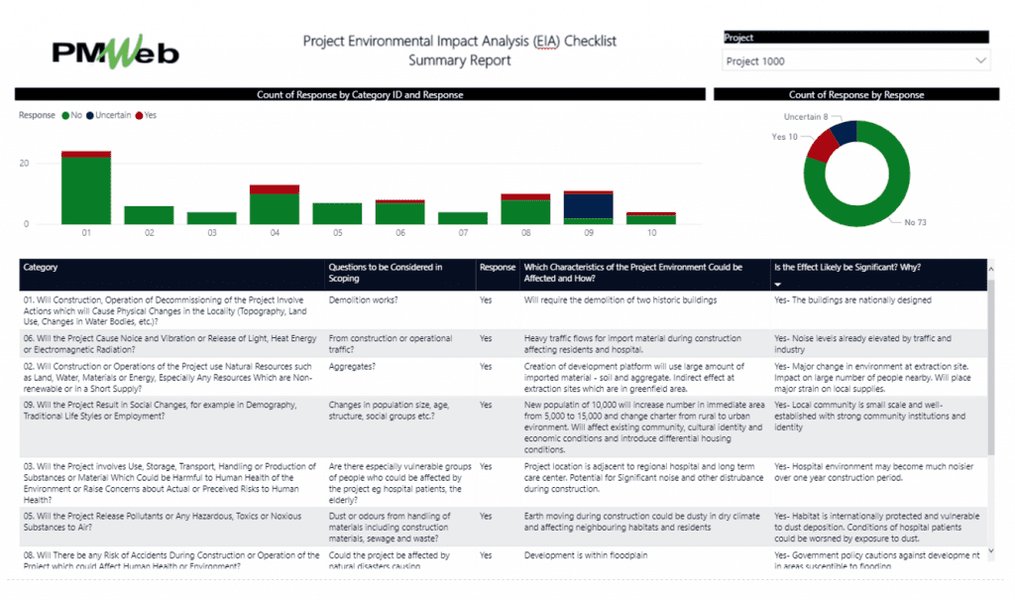
An example of an EIA checklist, a common tool for systematically identifying potential impacts.
3. Matrix Methods: Interaction Between Activities and Environment
Matrices provide a framework for illustrating the interaction between project activities and their potential environmental impacts. The Leopold Matrix, for example, lists project actions on one axis and environmental characteristics on the other, with cells indicating the magnitude and importance of the impact. Matrices are widely used for impact identification and offer a visual representation of cause-effect linkages, making it easier to see multiple impact areas for a single action.
For instance, a simple interaction matrix helps visualize how a specific construction activity might affect water quality, air quality, or local biodiversity. More complex matrices can incorporate quantitative measures or weightings to prioritize impacts.
4. Network Methods: Tracing Indirect and Cumulative Impacts
Network diagrams, also known as systematic sequential approaches (SSA), use visual flowcharts to directly connect an impact to an action. A key advantage of network methods is their ability to capture secondary (indirect) and cumulative impacts, which might not be immediately obvious. They help in "scientific thinking through" the potential impacts, showing how environmental, social, and economic systems interrelate and react to human disturbances throughout the project cycle.
Video: An explanation of the Network Method for assessing environmental impacts, showing how it traces direct and indirect effects.
5. Overlay Methods: Geospatial Analysis for Sensitivity Mapping
Overlay methods are map-based techniques that involve superimposing several maps of environmental characteristics (e.g., land use, sensitive habitats, water bodies, population density) to identify areas of high environmental sensitivity or potential conflict. Geographic Information Systems (GIS) play a crucial role in modern overlay analysis, enabling detailed spatial analysis and visualization of impacts. This method is particularly effective for site selection and assessing potential conflicts with existing land uses.
GIS tools like Esri's ArcGIS Pro are prime examples of technology that facilitates sophisticated overlay analysis, allowing for precise identification of environmental hotspots and visualization of potential impacts on a geographical scale.
6. Quantitative and Predictive Models: Forecasting Environmental Change
These methods involve the use of mathematical models and simulations to predict changes in environmental parameters. They can range from simple statistical analyses to complex dynamic models. Examples include air quality dispersion models, hydrological models, and ecological population models. Predictive models move EIA beyond simple listing of impacts to forecasting the magnitude and probability of changes, often accounting for uncertainties.
The output from such models can provide precise, quantifiable data on expected impacts, which is invaluable for rigorous environmental assessments. However, they require significant data input and expertise in modeling.
7. Life Cycle Assessment (LCA): Holistic Product and Process Evaluation
LCA is a comprehensive methodology used to assess the environmental impacts associated with all stages of a product's life cycle, from raw material extraction through processing, manufacturing, distribution, use, repair and maintenance, and disposal or recycling. It identifies and measures the environmental footprint of industrial products and processes, considering multiple impact categories like climate change, human toxicity, and resource depletion. Tools like SimaPro and OneClickLCA are widely used for conducting LCAs.
LCIA (Life Cycle Impact Assessment) methods, such as "IPCC 2021" or "ReCiPe 2016", are crucial components of LCA, categorizing and quantifying environmental impacts from elementary flows. They provide a structured approach to assessing the overall environmental burden of products and processes, informing sustainable design and decision-making.
Comparative Analysis of EIA Methodologies
Assessing Strengths, Weaknesses, and Applicability
Comparing EIA methods involves clarifying the purpose and context of the assessment. Different methodologies excel in different areas, and the choice of method often depends on factors such as project complexity, data availability, required precision, and regulatory compliance. The table below summarizes key characteristics for comparison:
| Methodology | Primary Use | Key Strength | Key Limitation | Data Requirements | Expertise Level |
|---|---|---|---|---|---|
| Ad Hoc | Initial screening, rapid assessment | Flexible, quick to implement | Subjective, inconsistent results | Low (expert opinion) | High (experienced experts) |
| Checklists | Impact identification, scoping | Systematic, ensures comprehensiveness | Lacks detail on magnitude/interaction | Moderate | Moderate |
| Matrices | Interaction assessment, impact visualization | Shows cause-effect relationships clearly | Can become complex for many interactions | Moderate to High | Moderate to High |
| Networks | Tracing direct/indirect/cumulative impacts | Highlights complex pathways, visual | Can be difficult to quantify impacts | Moderate to High | Moderate to High |
| Overlay (GIS) | Site selection, spatial impact analysis | Visual, identifies sensitive areas spatially | Requires robust GIS data and software | High (geospatial data) | High (GIS specialists) |
| Quantitative Models | Impact prediction, forecasting | Precise, quantifiable predictions | High data/expertise needs, model dependency | High (specific parameters) | High (modelers, domain experts) |
| Life Cycle Assessment (LCA) | Product/process environmental footprint | Holistic, identifies impacts across lifecycle | Complex, data-intensive, scope definition | Very High (cradle-to-grave data) | High (LCA specialists) |
Comparative overview of various EIA methodologies, highlighting their primary applications, strengths, weaknesses, and resource requirements.
Choosing the Right Methodology: A Multifaceted Decision
Tailoring the Approach to Project Needs
The selection of an EIA methodology is not a one-size-fits-all decision. It requires careful consideration of several factors:
- Project Scope and Size: Larger, more complex projects often necessitate sophisticated quantitative or spatial modeling, while smaller projects might be adequately assessed with checklists or matrices.
- Nature of Impacts: If direct, easily quantifiable impacts are expected, simpler methods might suffice. For complex, indirect, or cumulative impacts, networks or advanced predictive models become essential.
- Data Availability and Quality: The reliability of the assessment hinges on the availability of accurate baseline data. Methods requiring extensive data (e.g., quantitative models, LCA) are only feasible if such data can be collected.
- Resources (Time, Finance, Staff): Methodologies vary significantly in their demands for time, budget, and specialized personnel. Ad hoc methods are quicker and cheaper, while LCA or advanced GIS analyses are more resource-intensive.
- Regulatory Requirements: Specific laws and regulations often mandate certain types or levels of assessment, influencing the choice of methodology.
- Stakeholder Engagement: The chosen method should facilitate transparent communication and meaningful public involvement, providing information in a clear and understandable format.
The Evolving Landscape of EIA Tools and Technologies
Leveraging Innovation for Enhanced Assessment
Technological advancements are continuously improving the precision and efficiency of EIA. Modern tools and software are streamlining data collection, analysis, and reporting:
- Geographic Information Systems (GIS): As mentioned, GIS tools like Esri's ArcGIS Pro are indispensable for spatial analysis, mapping environmental sensitivities, and visualizing impacts. They enable detailed site characterization and help identify areas of potential conflict.
- Environmental Software Platforms: Tools like Enablon, SimaPro, and OneClickLCA provide comprehensive solutions for managing environmental data, conducting Life Cycle Assessments, and ensuring compliance with standards like ISO 14001.
- Remote Sensing and Drone Monitoring: These technologies offer efficient, cost-effective, and precise methods for collecting baseline environmental data and monitoring changes over time, particularly for large or inaccessible areas.
- Fuzzy Logic and Expert Systems: For impacts that are difficult to quantify (e.g., landscape quality, social acceptance), approximate reasoning methods like fuzzy logic can be employed. Expert systems can integrate knowledge from various domains to aid in complex decision-making within EIA.
- Building Information Modeling (BIM): In the construction industry, BIM can integrate environmental performance data throughout the design and construction phases, allowing for early assessment and optimization of environmental impacts.

A conceptual framework demonstrating the integration of diverse data and tools within environmental assessment processes.
Assessing the Efficacy of EIA Methodologies
A Radar Chart Perspective
To provide a clearer comparative perspective on the effectiveness and practicality of various EIA methodologies, I have created a radar chart. This chart evaluates each methodology across several key performance indicators: Ease of Use, Data Intensity, Ability to Capture Indirect Impacts, Precision of Results, Cost-Effectiveness, and Stakeholder Engagement Potential. A higher score indicates a stronger performance in that specific aspect.
This radar chart visually compares different EIA methodologies across key performance metrics, illustrating their relative strengths and weaknesses for various project contexts.
Challenges and Future Directions in EIA Methodologies
Enhancing the Effectiveness of Environmental Assessments
Despite significant advancements, EIA methodologies face ongoing challenges, particularly in developing countries where a lack of standardized frameworks and data can hinder effectiveness. The increasing complexity of environmental issues, including climate change and cumulative impacts, also demands more sophisticated and integrated approaches.
Future directions in EIA methodologies will likely focus on:
- Greater Integration: Moving towards more integrated assessments that consider not only environmental but also social, economic, and health impacts holistically.
- Strategic Environmental Assessment (SEA): Applying EIA principles at strategic levels (policies, plans, programs) to ensure environmental considerations are embedded upstream in decision-making.
- Artificial Intelligence and Machine Learning: Leveraging AI for faster data processing, predictive modeling, and identifying complex environmental patterns.
- Improved Data Accessibility and Standardization: Developing robust data infrastructures and common standards to enhance the quality and comparability of assessments globally.
- Adaptive Management: Integrating feedback loops from monitoring into ongoing project management to allow for adjustments and continuous improvement of environmental performance.
Conclusion
EIA methodologies are fundamental to achieving sustainable development by systematically evaluating the environmental implications of proposed projects. From the expert-driven Ad Hoc methods to the data-intensive Life Cycle Assessments and the spatially powerful GIS overlays, a diverse toolkit exists to address various assessment needs. The continuous evolution of these methodologies, driven by technological innovation and a deeper understanding of complex environmental systems, promises more precise, comprehensive, and ultimately, more effective environmental protection. The careful selection and rigorous application of the appropriate methodology are paramount to ensuring that environmental values are not only considered but actively championed in decision-making processes worldwide.
Recommended Further Exploration
- How to conduct a comprehensive environmental impact assessment?
- Role of GIS in environmental impact assessment
- Difference between EIA and Strategic Environmental Assessment (SEA)
- Emerging technologies in environmental impact assessment
References
 mjcetce455.blogspot.com

Last updated May 21, 2025