
Navigating Environmental Impact Assessment: A Deep Dive into Methodologies
Unveiling the Diverse Approaches to Evaluate Project Impacts on Our Planet
Key Insights into EIA Methodologies
- Holistic Evaluation: Environmental Impact Assessment (EIA) methodologies are structured approaches to identify, predict, evaluate, and mitigate the potential biophysical, social, and economic consequences of proposed projects, policies, or programs. They ensure that environmental considerations are integrated into decision-making processes.
- Diverse Toolset: From simple checklists and detailed matrices to sophisticated network diagrams, geographic information systems (GIS), and life cycle assessments (LCA), a wide array of methodologies exist. The selection of an appropriate method depends on the project's complexity, available data, required precision, and budget.
- Crucial for Sustainable Development: EIA plays a vital role in promoting sustainable development by anticipating environmental changes, suggesting mitigation measures, and providing a framework for informed decisions that balance economic development with environmental protection.
Environmental Impact Assessment (EIA) is a critical process for evaluating the potential environmental consequences of a proposed plan, policy, program, or project before decisions are made and commitments are finalized. Originating in the 1960s amid growing environmental awareness, EIA has evolved into a fundamental tool for ensuring that development is carried out responsibly and sustainably. The core objective of EIA methodologies is to systematically identify, predict, evaluate, and ultimately mitigate the changes an action may impose on physical, chemical, biological, socioeconomic, cultural, and landscape values and processes.
The methodologies employed in EIA range from straightforward to highly intricate, demanding varying levels of data, expertise, and technological proficiency for accurate interpretation. The selection of a suitable methodology hinges on several factors, including the nature and location of the project, the specific analytical and assessment objectives, and the types of environmental components—both natural and social systems—that could be affected across different timeframes and spatial scales.
The Foundational Pillars of EIA Methodology
Defining the Core Purpose of EIA Methodologies
At its heart, an EIA methodology is a structured approach designed to quantify and assess environmental changes. These changes encompass a broad spectrum of issues, including physical alterations (e.g., changes in land use, air quality), chemical impacts (e.g., pollution levels), biological effects (e.g., biodiversity loss, habitat disruption), socioeconomic consequences (e.g., impact on livelihoods, community health), and cultural and aesthetic values. The fundamental principles guiding EIA methodologies emphasize equality, openness, cost-effectiveness, and efficiency, ensuring a fair and transparent assessment process that delivers credible information for decision-makers.
The Essential Steps in the EIA Process
While methodologies vary, the EIA process generally follows a series of systematic steps to ensure a comprehensive evaluation:
- Screening: This initial step determines whether a project requires an EIA and, if so, what level of assessment is appropriate. This can range from a rapid assessment to a full-blown EIA.
- Scoping: This involves identifying the key environmental issues and impacts that need to be addressed in the EIA, setting the boundaries of the assessment, and determining the necessary information. Public consultation is often a critical part of this phase.
- Baseline Study and Impact Prediction: This stage involves collecting data on the existing environmental conditions (the baseline) and predicting the potential positive and negative impacts of the proposed project on these conditions. Both quantitative and qualitative methods are used here.
- Mitigation and Impact Management: Developing measures to avoid, reduce, remedy, or compensate for adverse environmental impacts. This also includes formulating management plans to ensure these measures are implemented effectively.
- Public Consultation: Engaging with affected communities and stakeholders to gather their input, concerns, and local knowledge, ensuring their perspectives are considered in the assessment.
- Reporting: Documenting the findings of the EIA in a clear and concise report (Environmental Impact Statement - EIS) that can be easily understood by decision-makers and the public.
- Decision-Making: Using the information from the EIA report to make informed decisions about whether to approve the project, with or without modifications, or reject it.
- Monitoring and Auditing: After project implementation, monitoring actual impacts against predictions and auditing the effectiveness of mitigation measures to ensure compliance and identify any unforeseen effects.
This systematic approach ensures that all potential environmental ramifications are thoroughly examined before significant development decisions are made.
Key Methodologies for Environmental Impact Assessment
Traditional and Widely Used EIA Methods
Several established methodologies form the backbone of EIA practice. These methods provide frameworks for identifying and assessing impacts, ranging from simple qualitative approaches to more complex quantitative analyses.
Checklist Methods
Checklists are among the simplest and most common EIA methods. They consist of pre-defined lists of environmental parameters or potential impacts that need to be considered for a project. There are several variations:
- Simple Checklists: These are basic lists of environmental parameters without specific guidelines on how to interpret or measure them. They help ensure no major environmental factor is overlooked.
- Descriptive Checklists: Similar to simple checklists but include additional information or descriptions regarding the possibility or potential existence of an impact.
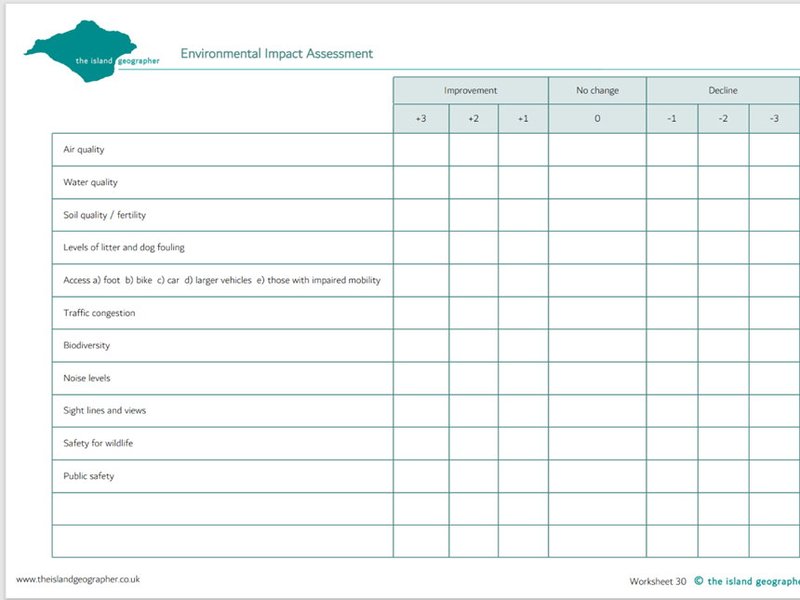
- Scaling Checklists: These introduce a subjective scaling of the magnitude or importance of impacts on environmental parameters, often using numerical scores or qualitative ratings.
- Weighting Checklists: Environmental factors are assigned importance weightings, and scaling techniques are applied to the impacts of each alternative, allowing for a more nuanced comparison.
Checklists are effective for initial impact identification and raising awareness among stakeholders. However, they may lack the ability to show interactions between impacts or their relative significance.
Matrix Methods
Matrix methods provide a structured framework for examining the interactions between project activities and environmental components. The Leopold Matrix, for instance, lists about 100 project actions against approximately 88 environmental characteristics and conditions. Each cell in the matrix indicates the potential impact of a specific activity on an environmental factor, often with notations for magnitude and importance. Matrices are excellent for displaying EIA results and identifying potential impacts, but they can be complex to fill out and may struggle to distinguish between direct and indirect impacts or avoid double-counting.
An example of an environmental impact assessment survey being conducted in the field.
Network Methods
Network methods, also known as interaction diagrams, are designed to identify cause-and-effect relationships and secondary or higher-order impacts. They trace the pathways of impacts from a project activity through various environmental components, illustrating how an initial impact can trigger a cascade of further effects. While useful for understanding complex interdependencies, network methods can become very intricate and challenging to represent comprehensively.
Overlay Methods
Overlay methods are fundamentally mapping-based. They involve superimposing several maps of environmental characteristics (e.g., land use, water bodies, sensitive habitats) to visually identify areas where project activities might have significant impacts. Geographic Information Systems (GIS) have revolutionized this method, allowing for sophisticated spatial analysis, visualization of developmental scenarios, and prediction of environmental impacts. GIS is a powerful tool for planning and informed decision-making due to its ability to handle and analyze vast amounts of spatial data.
Advanced and Specialized EIA Techniques
Beyond the traditional methods, several advanced techniques offer more sophisticated analysis and address specific types of impacts or project complexities.
Life Cycle Assessment (LCA)
LCA is a comprehensive method used primarily for industrial products, policies, or services. It assesses the environmental impacts throughout a product's entire life cycle, from raw material extraction, through production, use, and ultimately disposal. LCA helps identify "hotspots" of environmental impact and supports decision-making for more sustainable product design and consumption. This method considers factors like resource depletion, energy consumption, and emissions across all stages.
Fuzzy Logic and Approximate Reasoning
Many environmental impacts, such as landscape quality, lifestyle quality, and social acceptance, are difficult to quantify precisely. Fuzzy logic provides a way to deal with this uncertainty by using approximate reasoning. It allows for the integration of qualitative information, expert judgment, and community sentiment into the assessment process, providing a more holistic view of impacts where hard data might be scarce.
Cost-Benefit Analysis (CBA)
CBA attempts to assign monetary values to both the costs (negative impacts) and benefits (positive impacts) of a project. While challenging for environmental impacts that are difficult to monetize, CBA can provide a framework for comparing different project alternatives on a monetary basis, aiding in prioritization and decision-making, particularly for projects with significant economic implications.
Predictive or Simulation Methods
These methods involve using mathematical models and simulations to forecast environmental changes. They can range from simple statistical models to complex dynamic simulations that account for feedback loops and higher-order impacts. These methods are crucial for understanding future environmental conditions and the effectiveness of proposed mitigation measures.
Comparison of Key EIA Methodologies
The table below provides a comparative overview of some of the most common EIA methodologies, highlighting their strengths and limitations.
| Methodology | Primary Use | Strengths | Limitations |
|---|---|---|---|
| Checklists | Initial impact identification, screening | Simple, ensures comprehensive coverage of parameters, good for awareness | Limited ability to show interactions, subjective, lacks detail on magnitude/importance |
| Matrices | Identifying interactions between project activities and environmental components | Structured, good for displaying results, highlights potential impacts | Can be complex, difficulty distinguishing direct/indirect impacts, potential for double-counting |
| Networks | Tracing cause-effect relationships, identifying secondary impacts | Excellent for understanding complex interdependencies and higher-order impacts | Can become extremely intricate and difficult to manage for large projects |
| Overlay (GIS) | Spatial analysis, visualizing impacts, site selection | Strong visual representation, powerful for spatial data, facilitates informed planning | Requires specialized software and expertise, data availability can be an issue |
| Life Cycle Assessment (LCA) | Assessing product/process environmental impacts from "cradle to grave" | Holistic view of impacts across entire life cycle, identifies hotspots | Data intensive, complex, can be time-consuming, scope definition is crucial |
| Cost-Benefit Analysis (CBA) | Economic evaluation of environmental impacts, project prioritization | Provides a monetary basis for comparison, useful for decision-making | Difficulty in monetizing all environmental impacts, ethical considerations, may overlook non-economic values |
Criteria for Selecting an EIA Methodology
Factors Influencing Method Choice
The selection of an appropriate EIA methodology is a crucial decision that impacts the effectiveness and credibility of the assessment. Several criteria guide this choice:
- Nature and Scale of the Project: Large-scale, complex projects with diverse impacts will require more sophisticated and integrated methodologies than smaller, simpler projects.
- Type and Amount of Data Available: Some methods require extensive quantitative data, while others can incorporate qualitative information or rely on expert judgment. The availability of data (quantitative, qualitative, spatial, temporal) will significantly influence the choice.
- Level of Precision and Certainty Required: Regulatory requirements and the sensitivity of the environment dictate the desired level of accuracy in impact prediction.
- Time and Budget Constraints: More complex methodologies often demand more time and financial resources.
- Expertise and Technological Skills: The availability of personnel with the necessary expertise in specific methodologies (e.g., GIS, statistical modeling) is a practical consideration.
- Compliance with Regulations: The chosen method must adhere to local, national, and international environmental regulations and guidelines.
- Communication and Interpretability: The methodology should produce results that are clear, understandable, and easily communicated to decision-makers and the public.
Ultimately, the goal is to choose a methodology that is appropriate to the task, free from bias, and capable of organizing, summarizing, and displaying a large mass of heterogeneous data in a direct and relevant fashion.
This radar chart illustrates a subjective comparison of various EIA methodologies across several key attributes. Each axis represents a desirable characteristic of an EIA method, with higher values indicating stronger performance in that area. For example, 'Checklists' might rate highly on 'Simplicity' but lower on 'Depth of Analysis', while 'LCA' might show the reverse. This visual aid helps in understanding the trade-offs and strengths of different approaches when selecting the most suitable methodology for a given environmental assessment project.
Understanding EIA Through Visual Learning
Exploring EIA Methodologies with a Detailed Video
To further contextualize the discussion on EIA methodologies, the following video offers an insightful overview of the various approaches used in environmental impact assessment. It helps in grasping the practical application of these methods in real-world scenarios, particularly focusing on the identification and prediction of ecological impacts, which are crucial aspects of any comprehensive EIA study.
This video, "Lecture 39: EIA Methods for Ecology (Impact Prediction and ...) - YouTube," delves into specific techniques like plot methods, transects, and line intercepts used for flora and fauna assessments. Understanding these field-based methodologies is vital for gathering accurate baseline data, which then feeds into the broader analytical frameworks discussed earlier. It provides a deeper look into the groundwork necessary before quantitative or qualitative impacts can be predicted and evaluated effectively.
Future Trends and Tools in EIA
Integrating Technology for Enhanced Assessments
The field of EIA is continuously evolving, with increasing integration of advanced technologies and methodologies to enhance accuracy, efficiency, and comprehensiveness. The rise of sophisticated software tools and platforms is transforming how EIAs are conducted.
For instance, specialized software like Enablon helps companies manage and reduce their environmental footprint, aligning with ISO 14001 requirements. Tools such as GaBi are widely used for Life Cycle Assessments, providing detailed insights into the environmental performance of products and processes. OneClickLCA automates LCA and environmental reporting, making it easier for industries like construction and manufacturing to meet sustainability goals. These digital solutions streamline data collection, analysis, and reporting, making the EIA process more robust and accessible.
The emphasis is shifting towards more dynamic and predictive models that can identify not just first-order impacts but also complex feedback loops and higher-order impacts, accounting for uncertainties inherent in environmental predictions. This move reflects a deeper understanding of ecosystem complexity and the long-term consequences of human activities.
Frequently Asked Questions (FAQ)
What is the primary purpose of an Environmental Impact Assessment (EIA)?
What are the main types of EIA methodologies?
How is a suitable EIA methodology selected?
Can EIA methods quantify all environmental impacts?
What role does public consultation play in EIA?
Conclusion
EIA methodologies are indispensable tools in the pursuit of sustainable development. By providing structured frameworks for anticipating and addressing environmental consequences, they enable informed decision-making that balances societal needs with ecological preservation. The diversity of available methods, from foundational checklists to advanced computational models, underscores the adaptability and evolving nature of environmental assessment. As technology advances and our understanding of complex ecosystems deepens, EIA methodologies will continue to evolve, becoming even more critical for shaping a responsible and sustainable future.
Recommended Further Exploration
- How to conduct an effective EIA scoping process?
- What is the role of GIS in environmental impact assessment?
- What are the challenges in environmental impact assessment in developing countries?
- What are the benefits of integrating EIA into project planning?
References
 mjcetce455.blogspot.com
Last updated May 21, 2025