

Highlights: The Essence of Eigen-Concepts
- Invariant Directions: Eigenvectors identify special directions in space that remain unchanged in orientation when a linear transformation is applied, only being scaled.
- Scaling Factors: Eigenvalues quantify the exact amount of scaling (stretching, shrinking, or reversing) that occurs along these invariant eigenvector directions.
- Simplifying Complexity: Together, eigenvalues and eigenvectors allow for the decomposition of complex linear transformations into simpler, understandable scaling actions, crucial for analysis across diverse fields.
In the vast landscape of linear algebra, eigenvalues and eigenvectors stand as cornerstones, providing profound insights into the behavior of linear transformations and the intrinsic characteristics of matrices. They reveal how a transformation acts upon specific vectors, isolating those special directions that remain unperturbed in orientation, only experiencing a change in magnitude. This conceptual elegance makes them indispensable tools in theoretical mathematics and a myriad of applied disciplines, from physics and engineering to data science and quantum mechanics.
Deciphering the Core: Definitions and the Eigenvalue Equation
At its heart, the relationship between a matrix, an eigenvector, and its corresponding eigenvalue is captured by a simple yet powerful equation. For a given square matrix \(A\), a non-zero vector \(v\) is an eigenvector if, when multiplied by \(A\), the result is merely a scalar multiple of \(v\). This scalar multiple is known as the eigenvalue, denoted by \(\lambda\). Mathematically, this is expressed as:
\[ Av = \lambda v \]Here, \(A\) is an \(n \times n\) matrix, \(v\) is a non-zero \(n \times 1\) column vector (the eigenvector), and \(\lambda\) is a scalar (the eigenvalue). This equation signifies that the linear transformation represented by \(A\) does not alter the direction of \(v\); it merely stretches, shrinks, or reverses it along its original line of action. If \(\lambda\) is positive, the eigenvector is stretched; if negative, it is stretched and reversed. An eigenvalue between 0 and 1 indicates compression, while an eigenvalue greater than 1 signifies stretching. An eigenvalue of 1 means the eigenvector remains unchanged, and an eigenvalue of 0 maps the eigenvector to the zero vector.
The Characteristic Equation: Unlocking Eigenvalues
To find the eigenvalues of a matrix \(A\), the eigenvalue equation \(Av = \lambda v\) can be rearranged. By introducing the identity matrix \(I\) (of the same dimension as \(A\)), the equation becomes \((A - \lambda I)v = 0\). For a non-zero eigenvector \(v\) to exist, the matrix \((A - \lambda I)\) must be singular, meaning its determinant must be zero. This leads to the characteristic equation:
\[ \det(A - \lambda I) = 0 \]The roots of this polynomial equation are the eigenvalues \(\lambda\). For an \(n \times n\) matrix, there will be \(n\) eigenvalues, counting multiplicities, which can be real or complex. Once the eigenvalues are determined, the corresponding eigenvectors are found by solving the homogeneous system of linear equations \((A - \lambda I)v = 0\) for each \(\lambda\).
Illustrative Example of Eigenvalue Calculation
Consider a simple \(2 \times 2\) matrix \(A = \begin{bmatrix} 2 & -1 \ -1 & 2 \end{bmatrix}\). To find its eigenvalues, we set up the characteristic equation:
\[ \det\begin{bmatrix} 2-\lambda & -1 \ -1 & 2-\lambda \end{bmatrix} = (2-\lambda)(2-\lambda) - (-1)(-1) = (2-\lambda)^2 - 1 = \lambda^2 - 4\lambda + 4 - 1 = \lambda^2 - 4\lambda + 3 = 0 \]Factoring the quadratic equation yields \((\lambda - 1)(\lambda - 3) = 0\), so the eigenvalues are \(\lambda_1 = 1\) and \(\lambda_2 = 3\).
Eigenspaces and Multiplicity
For each eigenvalue \(\lambda\), the set of all eigenvectors associated with it, along with the zero vector, forms a subspace called the eigenspace. The dimension of this eigenspace is known as the geometric multiplicity of the eigenvalue. The number of times an eigenvalue appears as a root of the characteristic polynomial is its algebraic multiplicity. A crucial concept for diagonalization is that for a matrix to be diagonalizable, the geometric multiplicity must equal the algebraic multiplicity for each eigenvalue.
The Geometric Intuition: Visualizing Invariant Directions
Geometrically, eigenvectors are the "special directions" or "invariant lines" of a linear transformation. Imagine a transformation rotating and scaling a grid of vectors. Most vectors will change both their length and direction. However, eigenvectors are those rare vectors that, after the transformation, lie along the same line as they did before, only scaled by the eigenvalue. This visual perspective is incredibly helpful for understanding the fundamental nature of these concepts.
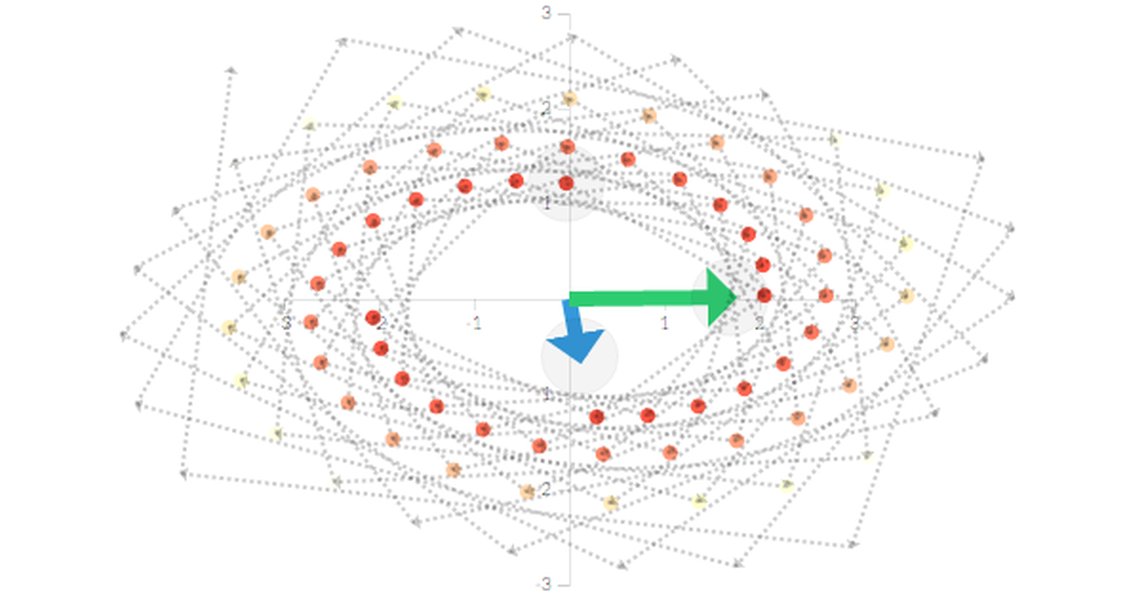
Visualizing how eigenvectors (purple arrows) maintain their direction under a linear transformation.
The YouTube video "Eigenvectors and eigenvalues | Chapter 14, Essence of linear ..." by 3Blue1Brown offers an exceptional visual explanation of these concepts. It demystifies the abstract mathematical definitions by showing how a matrix transformation deforms space and highlights the specific vectors that remain on their original span. This visual intuition is paramount for truly grasping why eigenvalues and eigenvectors are so powerful in understanding linear transformations, illustrating the "stretch" and "rotation" aspects in an easily digestible manner.
The Power of Diagonalization: Simplifying Complex Systems
One of the most significant theoretical and practical outcomes of understanding eigenvalues and eigenvectors is the ability to diagonalize a matrix. A matrix \(A\) is diagonalizable if it can be expressed in the form \(A = PDP^{-1}\), where \(D\) is a diagonal matrix whose entries are the eigenvalues of \(A\), and \(P\) is an invertible matrix whose columns are the corresponding eigenvectors. This decomposition simplifies many computations, especially when dealing with matrix powers:
\[ A^k = PD^k P^{-1} \]Since \(D^k\) is simply the diagonal matrix with each eigenvalue raised to the power \(k\), calculating powers of \(A\) becomes vastly easier. Not all matrices are diagonalizable, particularly those where the geometric multiplicity of an eigenvalue is less than its algebraic multiplicity. In such cases, one might resort to the Jordan canonical form.
Broad Spectrum of Applications: Where Eigen-Concepts Shine
The utility of eigenvalues and eigenvectors extends far beyond theoretical linear algebra, permeating numerous scientific and engineering disciplines. Their capacity to identify fundamental modes of behavior or principal directions makes them invaluable for simplifying and analyzing complex systems.
Principal Component Analysis (PCA) in Data Science
In data science, particularly for dimensionality reduction, PCA is a cornerstone technique built upon eigenvalues and eigenvectors. Here, the eigenvectors of a covariance matrix represent the principal components—new orthogonal directions that capture the maximum variance in the data. The corresponding eigenvalues indicate the amount of variance explained by each principal component. This allows high-dimensional data to be projected onto a lower-dimensional space while retaining as much information as possible, which is crucial for visualization, noise reduction, and machine learning efficiency.
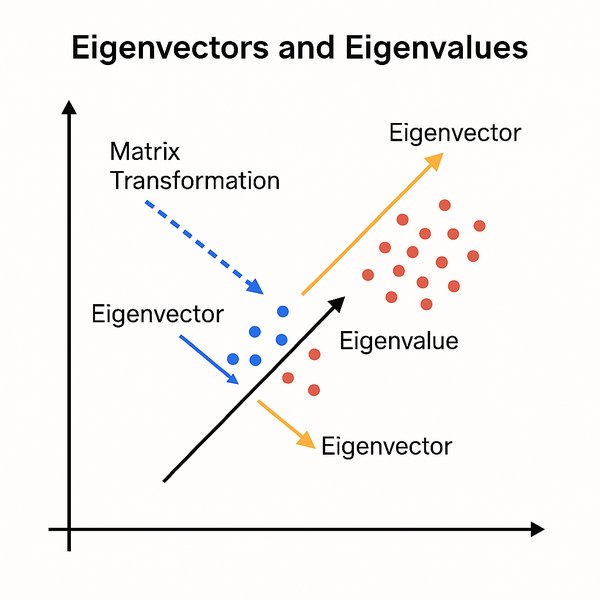
Illustration of Principal Component Analysis, where eigenvectors define the principal components of data variance.
Dynamical Systems and Differential Equations
Eigenvalues are critical for analyzing the stability and behavior of dynamical systems and solving systems of linear differential equations. In these contexts, eigenvalues often represent growth rates, decay rates, or oscillation frequencies. For instance, in a system of differential equations, eigenvalues can determine whether solutions converge to a stable equilibrium, diverge, or oscillate. Positive real parts of eigenvalues typically indicate exponential growth, while negative real parts suggest decay and stability.
Engineering and Physics
In engineering, particularly in structural analysis and control theory, eigenvalues correspond to natural frequencies of vibration or resonant modes. Understanding these allows engineers to design structures that avoid destructive resonances. In quantum mechanics, eigenvalues represent observable physical quantities (like energy levels), and eigenvectors correspond to the quantum states of a system. The singular value decomposition (SVD), closely related to eigenvalues, is also extensively used in image processing for compression and noise reduction.
Navigating the Landscape: A Mindmap of Key Concepts
To consolidate the interconnectedness of eigenvalues and eigenvectors within linear algebra and their broader implications, the following mindmap outlines the key concepts discussed.
The Pervasive Impact: A Summary of Applications
The applications of eigenvalues and eigenvectors are remarkably diverse, demonstrating their fundamental role across numerous quantitative fields. The table below summarizes some key applications and the specific way these concepts are utilized.
| Application Area | Role of Eigenvalues | Role of Eigenvectors | Benefit/Insight Provided |
|---|---|---|---|
| Principal Component Analysis (PCA) | Measures variance explained by components. | Define principal components (directions of max variance). | Dimensionality reduction, data visualization, noise reduction. |
| Dynamical Systems | Determines system stability (growth/decay rates, oscillation frequencies). | Identify stable/unstable directions. | Predicting system behavior over time, stability analysis. |
| Vibration Analysis (Engineering) | Represents natural frequencies of vibration. | Describes mode shapes of vibration. | Structural design, avoiding resonance. |
| Quantum Mechanics | Corresponds to measurable observable values (e.g., energy levels). | Represents the quantum states of a system. | Understanding physical properties at atomic/subatomic level. |
| Image Compression (SVD) | Relates to singular values, indicating importance of features. | Contribute to basis vectors for image reconstruction. | Efficient data storage and transmission. |
| Graph Theory | Can indicate properties like connectivity or centrality. | Define "eigen-centrality" or community structure. | Analyzing network structures (e.g., social networks, web graphs). |
Conclusion: The Enduring Significance
Eigenvalues and eigenvectors are far more than abstract mathematical curiosities; they are foundational concepts that provide a critical framework for understanding and simplifying the complexities of linear transformations. By revealing the invariant directions and corresponding scaling factors of a matrix, they offer a powerful lens through which to analyze a myriad of problems across science, engineering, and technology. Their ability to decouple complex systems into simpler, independent components makes them indispensable tools, continuing to drive innovation and understanding in our increasingly data-driven world.
Frequently Asked Questions (FAQ)
What is the main difference between an eigenvalue and an eigenvector?
Why are eigenvalues and eigenvectors important for diagonalizable matrices?
Can a matrix have complex eigenvalues or eigenvectors?
What is an eigenspace?
How are eigenvalues and eigenvectors used in Principal Component Analysis (PCA)?
Recommended Further Exploration
- How do eigenvalues affect stability in dynamical systems?
- What is the Jordan canonical form and when is it used?
- Explain Singular Value Decomposition and its relation to eigen-concepts
- Advanced applications of eigenvalues and eigenvectors in machine learning