
Unveiling the Massive Energy Footprint of 5,000 Homes
Calculating the collective electricity demand and the key factors driving consumption.
Understanding the electricity required to power a community of 5,000 homes involves looking at average consumption patterns and the multitude of factors that can influence energy use. While averages provide a baseline, real-world demand is complex and dynamic.
Key Insights
- Significant Annual Demand: Serving 5,000 average U.S. homes requires approximately 54 million kilowatt-hours (kWh) of electricity per year.
- Variable Consumption: Actual electricity usage can vary significantly based on geographic location, home size, appliance efficiency, and occupant behavior.
- Peak Power Needs: Beyond total energy (kWh), ensuring sufficient instantaneous power capacity (measured in megawatts, MW) is crucial to meet simultaneous demand, potentially reaching 15-25 MW for 5,000 homes.
Calculating Electricity Needs for 5,000 Homes
Starting with the Average Household
To estimate the total electricity consumption for 5,000 homes, we first need a reliable figure for the average usage of a single U.S. household. Based on data from sources like the U.S. Energy Information Administration (EIA) and energy providers, as of recent years (referencing data up to 2022, the latest comprehensive figures often cited):
- The average annual electricity consumption for a U.S. residential customer is approximately 10,791 kWh.
- This breaks down to an average monthly usage of about 900 kWh (10,791 kWh / 12 months).
- On a daily basis, this equates to roughly 29.5 kWh per household (10,791 kWh / 365 days).
It's crucial to remember that these are averages. Actual consumption can range from roughly 9,600 kWh to over 12,000 kWh per year depending on numerous factors discussed below.
Scaling Up to 5,000 Homes
Using the average annual figure of 10,791 kWh per home, we can calculate the total electricity requirement for 5,000 homes:
Annual Electricity Consumption:
\[ \text{Total Annual Energy} = 10,791 \, \frac{\text{kWh}}{\text{home} \times \text{year}} \times 5,000 \, \text{homes} \] \[ \text{Total Annual Energy} = 53,955,000 \, \frac{\text{kWh}}{\text{year}} \]
This means approximately 54 Gigawatt-hours (GWh) of electricity are needed annually to serve 5,000 typical U.S. homes.
Monthly Electricity Consumption:
Based on the average monthly usage of 900 kWh per home:
\[ \text{Total Monthly Energy} = 900 \, \frac{\text{kWh}}{\text{home} \times \text{month}} \times 5,000 \, \text{homes} \] \[ \text{Total Monthly Energy} = 4,500,000 \, \frac{\text{kWh}}{\text{month}} \]
So, roughly 4.5 Gigawatt-hours (GWh) of electricity are consumed by these 5,000 homes each month.
Why Consumption Varies: Key Influencing Factors
The figures calculated above are based on national averages. The actual electricity demand for any specific group of 5,000 homes could be significantly different due to a variety of factors:
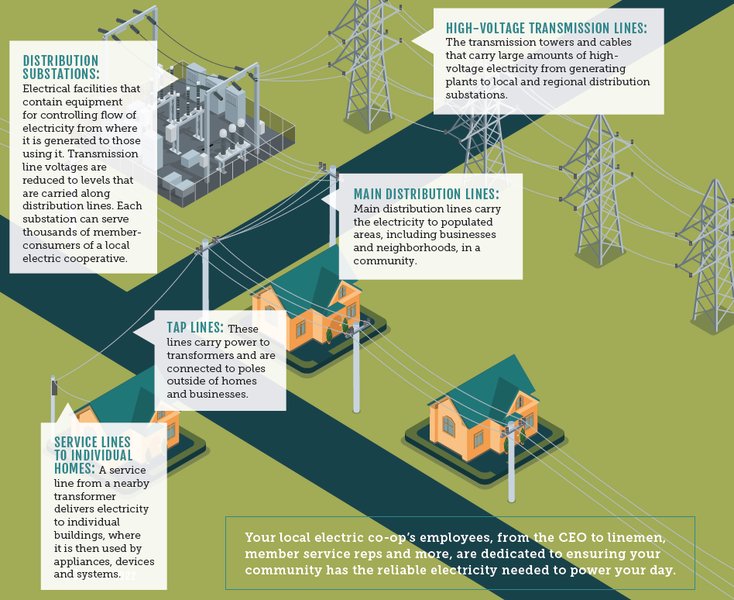
Electricity travels from generation sources through transmission and distribution systems to power homes.
Location and Climate
Weather patterns play a major role. Homes in regions with extreme temperatures (hot summers or cold winters) generally use more electricity for air conditioning and heating. For instance, Southern states often see higher summer usage due to AC, while some Northern states might have higher winter usage if electric heating is prevalent.
Home Characteristics
Size and Type
Larger homes naturally tend to consume more electricity due to greater space to heat, cool, and light. A 3,000 sq ft home might use around 14,210 kWh annually, significantly more than the average. The type of dwelling (single-family detached, apartment, townhouse) also influences energy needs.
Age and Insulation
Older homes may be less energy-efficient due to poorer insulation, drafty windows, and older construction standards, leading to higher heating and cooling costs. Newer homes built to modern energy codes generally perform better.
Occupant Behavior and Appliances
Number of Occupants
More people living in a home typically translates to higher electricity use – more devices running, more hot water usage, more lighting, etc.
Appliance Use and Efficiency
The number, type, age, and efficiency of appliances are critical. Major consumers include:
- Heating, Ventilation, and Air Conditioning (HVAC): Often the largest single user of electricity, especially central air conditioning and electric furnaces.
- Water Heating: Electric water heaters consume significant energy.
- Refrigeration: Refrigerators and freezers run 24/7.
- Lighting: Though less dominant with efficient LEDs, lighting still contributes.
- Electronics and Entertainment: TVs, computers, game consoles, etc.
- Laundry: Clothes washers and especially electric dryers.
Lifestyle Choices
Factors like working from home (increasing daytime energy use), charging electric vehicles (EVs), using swimming pool pumps, or having energy-intensive hobbies can substantially increase a household's electricity footprint.
Visualizing Energy Consumption Factors
The relative impact of different end-uses on household electricity consumption can vary. The radar chart below provides a conceptual comparison of major electricity consumers in a typical home profile versus a high-consumption profile (e.g., large home in a hot climate with many occupants and less efficient appliances).
This chart illustrates how factors like HVAC and water heating often dominate usage, and how these shares can increase in higher-consumption scenarios. The values represent relative impact rather than precise kWh figures.
Understanding the Calculation and Influences
The mindmap below provides a visual summary of how the total electricity requirement is estimated and the key factors that influence this calculation.
This mindmap highlights the core calculation based on average use and the major variables that cause real-world consumption to differ.
Consumption Scenarios: A Comparative Look
To illustrate the impact of varying factors, the table below presents hypothetical annual electricity consumption scenarios for 5,000 homes.
| Scenario | Assumed Annual kWh per Home | Total Annual kWh for 5,000 Homes | Total Annual GWh for 5,000 Homes | Notes |
|---|---|---|---|---|
| U.S. Average | 10,800 kWh | 54,000,000 kWh | 54 GWh | Based on typical national averages. |
| Lower Consumption | 9,000 kWh | 45,000,000 kWh | 45 GWh | Smaller homes, milder climate, high efficiency, fewer occupants. |
| Higher Consumption | 14,000 kWh | 70,000,000 kWh | 70 GWh | Larger homes, extreme climate (high AC/heat use), less efficient appliances, more occupants. |
| Very High Consumption (e.g., All-Electric Homes) | 16,000+ kWh | 80,000,000+ kWh | 80+ GWh | Homes relying solely on electricity for heating, water heating, cooking, etc., potentially with EV charging. |
This table demonstrates the wide range possible for the electricity needs of 5,000 homes, emphasizing why specific local data is essential for accurate planning.
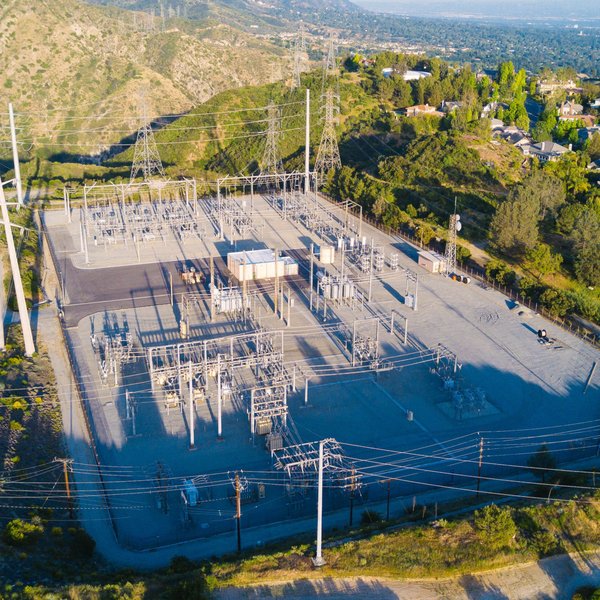
Electrical substations are crucial infrastructure for stepping down voltage and distributing power to communities.
Beyond Energy (kWh): Understanding Power Demand (kW/MW)
While kilowatt-hours (kWh) measure the total amount of energy consumed over time, kilowatts (kW) or megawatts (MW) measure power – the rate at which energy is used at any given moment. A utility provider must not only supply the total energy (kWh) but also have enough capacity (MW) to meet the peak demand, which occurs when many homes use electricity simultaneously (e.g., during a hot afternoon when AC units are running).
- A single home might have an average instantaneous power draw of 1-2 kW but could peak much higher (e.g., 5-10 kW or more) when large appliances run.
- For 5,000 homes, while the average simultaneous power draw might be around 6 MW (5,000 homes * ~1.2 kW/home), the peak demand could realistically range from 15 MW to 25 MW or even higher, depending on the factors mentioned earlier and the diversity of usage patterns.
Planning for electricity supply requires understanding both total energy consumption (GWh per year) and peak power demand (MW).
Frequently Asked Questions (FAQ)
What uses the most electricity in a typical home?
Heating and cooling (HVAC systems) typically account for the largest share of residential electricity consumption, often close to 50% in many U.S. homes. Electric water heating is usually the next largest consumer, followed by appliances like refrigerators, clothes dryers, lighting, and electronics.
How does home size impact electricity usage?
Larger homes generally require more energy to heat, cool, and light. Increased living space often correlates with more appliances and potentially more occupants. While a small apartment might use significantly less than the average, a large single-family home (e.g., 3,000-5,000 sq ft) can consume considerably more, sometimes exceeding 14,000-20,000 kWh per year.
Does the time of day affect electricity consumption?
Yes, household electricity usage typically follows daily patterns, often peaking in the morning as people get ready for work/school and again in the evening when people return home, cook dinner, use entertainment systems, and adjust thermostats. Utilities must manage these peaks in demand. Some regions also experience seasonal peaks (e.g., summer afternoons due to air conditioning).
How much electricity does an electric vehicle (EV) add to home consumption?
Charging an EV at home can significantly increase household electricity consumption. The exact amount depends on the vehicle's efficiency, miles driven, and charging habits. Driving 1,000 miles per month might add roughly 250-350 kWh to monthly usage, potentially increasing a home's annual consumption by 3,000-4,000 kWh or more.
Recommended Reading
- What factors most influence how much electricity a home uses?
- What is the average electricity bill for a typical family?
- How can I reduce my home's electricity consumption?
- What is the difference between peak electricity demand and base load energy?
References
Last updated May 3, 2025