
Mapped Emotions in Plutchik's Model
A comprehensive exploration of emotions and their interplay
Highlights
- Understanding the Core Emotions: Explore the eight primary emotions identified by Plutchik, their characteristics, and intensity variations.
- Emotion Relationships and Combinations: Learn how basic emotions combine to create complex feelings, and how opposites interact.
- Practical Applications: Discover how mapping emotions can improve emotional literacy, self-awareness, and guide effective emotional management.
Introduction to Plutchik's Emotion Model
Plutchik's Wheel of Emotions is a seminal model developed to clarify and illustrate how human emotions are structured, interact, and vary in terms of intensity. At its core, the model identifies eight primary emotions: sadness, joy (happiness), fear, surprise, trust, disgust, anger, and anticipation. These foundational emotional states serve as the building blocks for more complex feelings that arise in everyday experience.
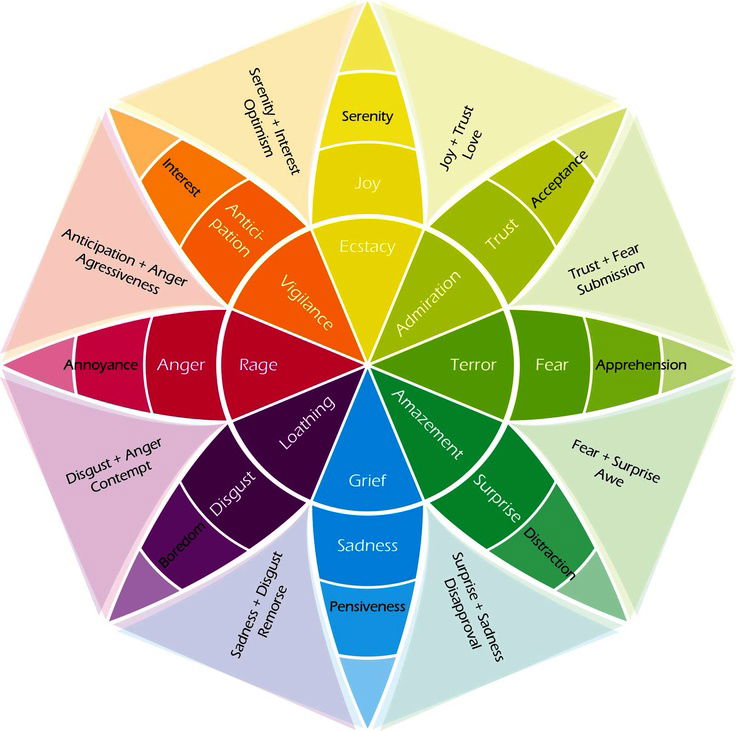
The model is visually represented as a circular wheel, where emotions are arranged both in intensity and in relationships with one another. Emotions closer to the center signify stronger feelings, while those toward the periphery represent milder states. Additionally, the wheel emphasizes that certain emotions exist as direct opposites. For instance, sadness is placed opposite joy, fear stands in opposition to anger, and trust is countered by disgust.
Core Emotions and Their Descriptions
Primary Emotions Explained
According to Plutchik's structure, there are eight basic emotions that are considered primary because they are innate and universal. Here is a detailed look at some of the key emotions under consideration:
Sadness
Sadness is characterized by feelings of loss, grief, disappointment, and a general low mood. In the Plutchik model, it is positioned directly opposite joy and is recognized as a primary emotion that may intensify into grief or exist in milder forms such as pensiveness or sorrow. When mapped, sadness has an intrinsic value as a negative emotion since it often signals a need for introspection or change.
Happiness (Joy)
Joy, often equated with happiness, represents a state of pleasure, contentment, and satisfaction. It is the heart of positive affect and is placed opposite sadness on the emotion wheel. Variations in intensity can range from serenity (a milder form) to ecstasy (an extremely intense expression of joy). Its positive valence makes it a cornerstone emotion that motivates and reinforces social bonds.
Fear
Fear is a reaction triggered by perceived threats or danger and serves an evolutionary role in preparing individuals for survival. In the model, fear is paired as a primary emotion alongside its oppositional relationship with anger. Its intensity can vary from apprehension to terror, reflecting how acute or subdued a threat is perceived to be.
Surprise
Surprise is a reaction to unexpected events or stimuli and can bear no inherent positive or negative valence. Instead, its assessment often depends on context. The model marks surprise as a primary emotion that fluctuates in intensity from distraction at a lower level to amazement or shock at higher intensities.
Trust and Peaceful Emotions
Trust is recognized as a primary emotion linked to feelings of security and reliability. It is often associated in Plutchik’s model with positive affect and is counterbalanced by disgust. The emotion “peaceful” is not explicitly one of the core emotions; however, it is conceptually aligned with trust as both evoke a sense of calm, stability, and safety.
Disgust
Disgust is a strong sense of aversion or repulsion. As noted in the model, it holds an essential place as a primary emotion and stands opposed to trust. It exists in various intensities—ranging from slight disapproval or boredom to profound loathing—thus portraying the spectrum of negative affect.
Anticipation
Anticipation embodies the excitement or anxiety of awaiting future events. This emotion, foundational in the model, pairs with surprise as its counterpart. It is typically considered positive when it signals eagerness, yet it may also slip into negative experiences when laced with apprehension.
Mapping Emotions: Positive and Negative Valences
One of the profound insights offered by Plutchik’s emotion wheel is the idea of emotional valence—the quality of an emotion as positive or negative. Emotions like joy, trust, anticipation (when connected with positive outcomes), and love usually fall on the positive side. In contrast, sadness, fear, disgust, and often anger are seen as negative, indicating discomfort or providing warnings about potential threats. It is important to note that depending on context and cultural differences, these classifications may be interpreted in varying ways.
For the mapping exercise, consider the following detailed valuation for the emotions under study:
- Sadness: Negative
- Joy (Happy): Positive
- Fear: Negative
- Peaceful (aligned with Trust): Positive
- Love (a combination of Joy and Trust): Positive
- Courage (related to overcoming Fear): Can be seen as a bridge emotion whose development suggests a transformation from fear to empowered action)
- Disgusting (Disgust): Negative
- Surprise: Can be neutral depending on its triggering events but tends to skew positive when unexpected joy occurs
These classifications are not just academic; they have practical applications. Recognizing whether an emotion is positive or negative can assist in self-awareness, aiding in behavioral changes, therapeutic interventions, and decision-making processes.
Complex Emotions: Extensions and Combinations
Beyond the primary emotions, Plutchik’s wheel illustrates how emotions can blend to form more complex feelings. Such combinations, known as dyads or even tertiary emotions, manifest in myriad emotional experiences. For instance, love is frequently conceptualized as a synthesis of joy and trust. Likewise, courage may derive from merging the elements of anticipation and a moderated level of anger or fear.
Understanding these combinations provides a deeper insight into the emotional landscape. The interplay of primary emotions can be illustrated with these well-established pairs:
- Love: A blend of Joy and Trust.
- Remorse: Often emerging from the mix of Sadness and Disgust.
- Anxiety: A potential result of combining Fear with Surprise.
- Optimism: Formulated through Joy coupled with Anticipation.
- Courage: Can be framed as the outcome of Fortitude in the face of Fear and driven by a proactive anticipation for change.
Recognizing these blended states can not only aid in self-analysis but also in understanding behavioral responses in complex interpersonal relationships. When experiencing intense emotions, discerning the underlying primary emotions can offer clarity and guide more harmonious emotional regulation strategy.
Mapping Emotions: A Detailed Table
The table below summarizes key aspects of Plutchik's model including the primary emotions, their opposites, and associated intensities. This table encapsulates both direct mappings and the inter-relational dynamics between various emotions:
| Primary Emotion | Opposite Emotion | Mild Intensity | High Intensity |
|---|---|---|---|
| Joy (Happy) | Sadness | Serenity | Ecstasy |
| Trust (Peaceful aligned) | Disgust | Acceptance | Admiration |
| Fear | Anger* | Apprehension | Terror |
| Surprise | Anticipation | Distraction | Amazement |
| Sadness | Joy | Pensiveness | Grief |
| Disgust | Trust | Boredom | Loathing |
| Anger* | Fear | Annoyance | Rage |
| Anticipation | Surprise | Interest | Vigilance |
*Note: While anger is not one of the focal emotions in the current mapping, its reading as the emotional opposite of fear completes the relational model in Plutchik’s diagram.
Integrating Additional Emotions: Courage and Love
Certain emotions such as courage and love hold a special place in discussions about Plutchik's model. Although courage is not explicitly a primary emotion, it is recognized within the context of managing fear. When an individual displays courage, it often implies the adoption of a positive mindset—a combination of anticipatory thinking and a moderated reaction to fear leading to action.
Love, on the other hand, is generally understood not as a primary emotion but as a dyadic combination. In many conceptual frameworks, love is portrayed as the union of joy and trust. This synthesis creates a deep bonding experience, radiating positive feelings and reinforcing connectivity among individuals.
Practical Implications of Emotion Mapping
Enhancing Emotional Literacy
One of the primary applications of Plutchik's model is in improving emotional literacy—the ability to understand and articulate complex internal states. By mapping emotions, individuals gain insight into the subtle variations in their feelings. For example, recognizing that a state of nervousness may consist of elements of both fear and anticipation can help an individual to better regulate their response through targeted coping strategies.
Facilitating Better Communication
In interpersonal and professional settings, the clear identification of emotional states can lead to more effective communication. When people are able to articulate their feelings using the terminology of primary and secondary emotions, misunderstandings can be minimized. Whether discussing feelings of sadness or expressing joy, the clarity provided by an established model fosters empathy and creates pathways for deeper understanding.
Applications in Therapeutic and Educational Settings
Mental health practitioners and educators utilize emotion mapping to help individuals recognize patterns in their thinking and behavior. In therapy sessions, for example, mapping emotions can aid in pinpointing triggers, fostering emotional regulation, and developing strategies to transition from negative states such as fear or sadness to more positive conditions like trust and joy. Similarly, educators who incorporate these concepts into their curricula can promote well-being and emotional intelligence among students.
The Role of Intensity and Context in Emotional Experience
Plutchik's model is particularly powerful because it does not treat emotions as binary or static. Instead, it highlights the fluidity of emotional experiences through a spectrum of intensities. An emotion like joy can scale from a mild sense of contentment to an overwhelming feeling of ecstasy, while sadness may shift from a reflective pensiveness to impactful grief. This gradient is crucial for understanding that emotions are nuanced and influenced by context.
The context in which an emotion is experienced also plays a significant role. For instance, surprise might be perceived as positive in a celebratory setting (such as an unexpected gift), yet it might take on a negative tone in a situation that is startling and alarming. Through this lens, the model captures the dynamic interplay between the intensity of emotion and the situational factors that shape it. Recognizing these subtleties supports individuals in being proactive in their emotional management—choosing the right coping techniques that match the intensity and the context of their feelings.
Emotion Mapping: A Synthesis for Multiple Contexts
Personal Growth and Self-Awareness
On a personal level, mapping emotions using Plutchik’s framework can be an invaluable tool for self-reflection. Understanding that feelings such as sadness, fear, and disgust have an inherent place on the wheel enables individuals to better interpret their emotional responses to everyday challenges. By recognizing emotions in their nascent forms—whether it is a subtle shift towards apprehension or an intensification towards terror—one can progressively learn to manage these feelings more effectively.
This self-awareness is fundamental in personal growth, as individuals who accurately identify and map their emotions are often more adept at adapting their behaviors. Over time, this can lead to improved decision-making, enhanced interpersonal relationships, and more resilient psychological well-being.
Emotional Regulation in Group Dynamics
Group dynamics, whether in a workplace, a classroom, or family settings, also benefit from a widely understood emotional map. When members of a group are familiar with the conceptual framework of Plutchik's model, they are better equipped to articulate the nuances of their emotional states. This communal understanding fosters a climate of empathy and responsiveness, setting the stage for constructive conflict resolution and cooperative problem-solving.
In professional environments, for instance, leaders who are emotionally literate are more likely to inspire trust, manage crises effectively, and cultivate a supportive atmosphere. The mapping of emotions provides a shared language—enabling a shift away from vague labels (like "mood swings") to precise descriptors that reflect the true nature and intensity of the feelings involved.
Combining Theory with Practice
Implementing Emotion Mapping Tools
In response to the growing recognition of emotional intelligence as a key factor in personal and professional success, various tools and applications have emerged to facilitate emotion mapping. Simulation tools, apps, and educational resources often integrate Plutchik’s wheel of emotions to help users identify and track their emotional states. These tools encourage individuals to note shifts in intensity, enabling a better understanding of triggering factors and subsequent emotional responses.
Implementing these tools in daily routines and collaborative environments can uncover patterns that might otherwise go unnoticed. For instance, tracking changes in emotional intensity over time can inform therapeutic interventions or lead to the development of strategies aimed at enhancing overall well-being.
Scientific and Empirical Support
Research into emotional frameworks supports the utility of Plutchik’s model. Studies indicate that when individuals learn to map and articulate their emotions accurately, they experience better stress management and increased mindfulness. Moreover, the methodical classification of emotions into primary, secondary, and tertiary groups serves as a bridge between theoretical psychological constructs and actionable personal insights.
Conclusion
In summary, Plutchik's Wheel of Emotions offers a comprehensive framework for understanding, mapping, and managing human emotions. By identifying eight core emotions—spanning sadness, joy, fear, surprise, trust, and disgust—and acknowledging the intensity variations and combinations that lead to complex states such as love and courage, the model serves as both a theoretical tool and a practical guide. Through clear mapping of positive and negative valences, individuals can gain richer insights into their feelings and leverage this knowledge for personal and interpersonal growth.
This in-depth exploration reveals that effective emotion mapping not only enhances emotional literacy but also supports better communication and self-regulation. By embracing the dynamic and interrelated nature of emotions, as depicted in Plutchik's model, we can foster an environment where feelings become a pathway to understanding ourselves and others more deeply. Ultimately, this empowerment through self-awareness can drive improved decision-making, healthier relationships, and overall psychological resilience.
References
- Plutchik Wheel of Emotions - 6seconds
- Understanding Plutchik's Wheel - Psychology For
- Emotion Classification - Wikipedia
- Emotion Wheel Explained - Positive Psychology
Recommended Queries
Last updated February 21, 2025