
Unlocking Your Engine's Fuel Efficiency: A Deep Dive into BSFC Calculation
Discover precisely how much fuel your engine consumes for the power it produces, and what this means for its performance.
Key Highlights of Your Engine's BSFC
- Calculated BSFC: Your engine's Brake Specific Fuel Consumption (BSFC) is approximately 309.52 g/kWh based on the data provided.
- Efficiency Benchmark: BSFC is a vital measure of an internal combustion engine's fuel efficiency, quantifying fuel usage per unit of power output. A lower BSFC value signifies greater efficiency.
- Power Metric Used: The calculation relies on brake power (8.4 kW), which is the actual usable mechanical power at the engine's output shaft, not the indicated power (11 kW) generated within the cylinders.
Understanding Brake Specific Fuel Consumption (BSFC)
What Exactly is BSFC?
Definition and Core Importance
Brake Specific Fuel Consumption (BSFC) is a fundamental engineering metric used to assess the fuel efficiency of any prime mover that burns fuel to produce rotational power, such as internal combustion engines (diesel or gasoline), gas turbines, and steam turbines. It represents the rate of fuel consumption divided by the power produced. In simpler terms, BSFC tells you how much fuel (in mass) an engine needs to burn to generate one unit of energy (power over time), typically expressed in grams per kilowatt-hour (g/kWh) or pounds per horsepower-hour (lb/hp·h).
The primary significance of BSFC lies in its ability to provide a standardized measure for comparing the efficiency of different engines, irrespective of their size, displacement, or cylinder count. An engine with a lower BSFC is more efficient because it consumes less fuel to achieve the same power output, or conversely, produces more power from the same amount of fuel. This is crucial for vehicle manufacturers, engine designers, and even consumers, as it directly impacts fuel economy, operational costs, and environmental emissions.
The "Brake" in BSFC: Measuring Usable Power
The term "brake" in BSFC refers to "brake horsepower" or "brake power." Historically, this originates from the method used to measure an engine's torque and power output using a device called a Prony brake. This apparatus applies a frictional load (a "brake") to the engine's output shaft, and the force resisted by the brake at a given rotational speed allows for the calculation of torque and, subsequently, power.
Brake power is the actual, usable power delivered by the engine at its crankshaft (or flywheel) after accounting for all internal losses. These losses include friction between moving parts (pistons, bearings, etc.), power required to operate auxiliary components (like oil and water pumps, alternator), and pumping losses (energy spent moving air and exhaust gases through the engine). BSFC is specifically concerned with this net output power because it reflects the power available to do useful work, such as propelling a vehicle or driving machinery.
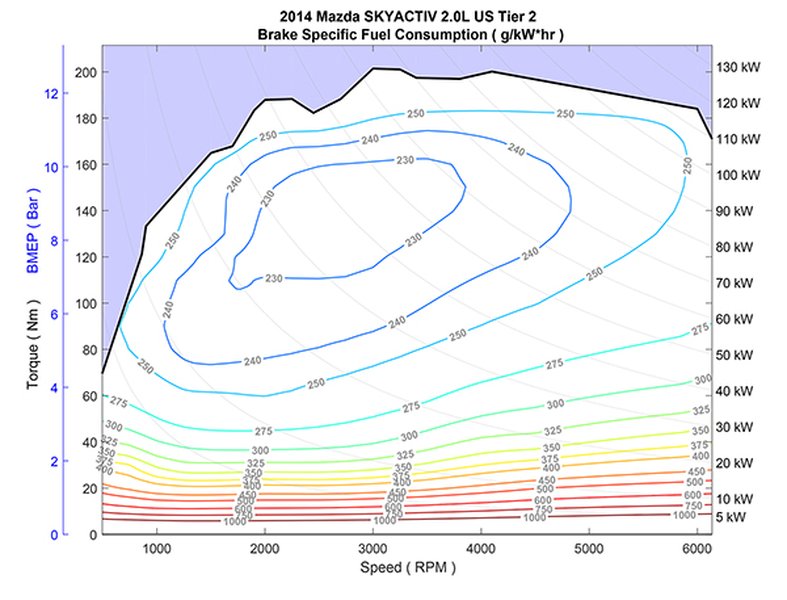
A typical BSFC map illustrates how fuel efficiency varies across an engine's operating range of speed and load. The "sweet spot" of lowest BSFC is usually found at mid-to-high load and mid-range speeds.
Why Indicated Power is Not Used for BSFC
It's important to distinguish brake power from indicated power. Indicated power is the theoretical power developed within the engine's cylinders by the combustion process, calculated from the pressure exerted on the pistons. However, this value doesn't account for the internal mechanical losses mentioned above.
Since BSFC is a measure of how efficiently an engine converts fuel into useful work, it must be based on the power that is actually delivered to the outside world – the brake power. Using indicated power would give an overly optimistic (lower) BSFC value that doesn't reflect the engine's true real-world efficiency. The difference between indicated power and brake power represents the engine's internal friction and pumping losses, and the ratio of brake power to indicated power is known as mechanical efficiency.
Calculating Your Engine's BSFC: A Step-by-Step Guide
Let's now proceed with calculating the BSFC for your engine using the provided data.
Given Data for Calculation
You've provided the following parameters for your engine:
- Engine Mechanical Power (Brake Power, \(P\)): 8.4 kW
- Indicated Power: 11 kW (This value is informative for understanding overall engine performance but is not directly used in the BSFC calculation itself.)
- Fuel Flow Rate (\(r_f\)): 2.6 kg/hr
The Fundamental BSFC Formula
The formula to calculate Brake Specific Fuel Consumption is:
\[ \text{BSFC} = \frac{\text{Fuel Flow Rate}}{\text{Brake Power}} \]To obtain BSFC in the desired units of grams per kilowatt-hour (g/kWh), we need to ensure our inputs are in grams per hour (g/hr) for the fuel flow rate and kilowatts (kW) for the brake power.
Step 1: Convert Fuel Flow Rate Units
The fuel flow rate is given as 2.6 kg/hr. Since we need it in grams per hour for the g/kWh unit:
1 kilogram (kg) = 1000 grams (g)
So, the fuel flow rate in g/hr is:
\[ \text{Fuel Flow Rate (g/hr)} = 2.6 \text{ kg/hr} \times 1000 \frac{\text{g}}{\text{kg}} = 2600 \text{ g/hr} \]Step 2: Apply the BSFC Formula and Calculate
Now, we can plug the converted fuel flow rate and the given brake power into the BSFC formula:
Fuel Flow Rate = 2600 g/hr
Brake Power = 8.4 kW
\[ \text{BSFC (g/kWh)} = \frac{2600 \text{ g/hr}}{8.4 \text{ kW}} \]Performing the division:
\[ \text{BSFC} = 309.5238095... \text{ g/kWh} \]Rounding to two decimal places for practical use, your engine's Brake Specific Fuel Consumption is:
BSFC ≈ 309.52 g/kWh
Interpreting Your BSFC Result of 309.52 g/kWh
What This Value Signifies for Your Engine
A BSFC of 309.52 g/kWh means that your engine consumes 309.52 grams of fuel for every kilowatt-hour of mechanical energy it produces at the output shaft, under the specific operating conditions at which these measurements were taken. As a standalone number, it provides a precise measure of fuel efficiency for that particular state. To understand if this is "good" or "bad," it needs to be compared with typical values for similar engine types and applications.
Comparative BSFC Values for Different Engine Types
BSFC values vary significantly across different engine technologies and designs. The table below provides a general comparison:
| Engine Type | Typical BSFC Range (g/kWh) | Key Characteristics & Notes |
|---|---|---|
| Gasoline (Spark-Ignition, SI) Engines | 225 - 350 g/kWh | Modern, highly efficient direct-injection gasoline engines can achieve BSFC values around 225-250 g/kWh at their most efficient operating points. Older or less optimized designs may have higher BSFC. |
| Diesel (Compression-Ignition, CI) Engines | 180 - 250 g/kWh | Diesel engines are generally more fuel-efficient than gasoline engines, especially under partial load and at lower speeds. Large, slow-speed marine diesels can achieve BSFC below 170 g/kWh. Peak efficiency is often around 200 g/kWh for automotive diesels. |
| Turboprop Engines (Aviation) | 240 - 300 g/kWh | These engines are a type of gas turbine optimized for propeller aircraft, offering good efficiency at cruise altitudes and speeds. |
| Large Two-Stroke Marine Diesel Engines | 155 - 180 g/kWh | These are among the most fuel-efficient heat engines ever built, often used for powering large cargo ships. Their massive size and slow operating speeds contribute to high thermal efficiency. |
| Your Calculated Engine | ~309.52 g/kWh | This value falls within the broader range of internal combustion engines. Compared to peak efficiencies of modern gasoline (around 225 g/kWh) or diesel (around 200 g/kWh) engines, this value suggests moderate efficiency. The specific engine type (e.g., older design, specific application, fuel type) would provide more context. |
Your engine's BSFC of ~309.52 g/kWh is higher than the "best-in-class" values for typical automotive gasoline or diesel engines, suggesting it might be an older design, operating outside its peak efficiency point, or designed for an application where peak fuel efficiency wasn't the absolute primary goal. However, without more context on the engine type and its intended application, it's a direct measure of its current performance.
Visualizing BSFC and Its Interconnections: A Mindmap
To better understand the concept of Brake Specific Fuel Consumption and its relationships with various engine parameters and influencing factors, the following mindmap provides a visual overview. It highlights how BSFC is defined, calculated, and what aspects of engine performance and design affect it.
per unit of brake power produced"] id1_2["Key indicator of engine
fuel efficiency"] id1_3["Lower BSFC value means
higher efficiency"] id2["Mathematical Formula"] id2_1["BSFC = (Fuel Mass Flow Rate) / (Brake Power)"] id2_2["Common Units:
g/kWh (grams per kilowatt-hour)
lb/hp·h (pounds per horsepower-hour)"] id3["Essential Inputs for Calculation"] id3_1["Fuel Flow Rate (mass per unit time, e.g., g/hr, kg/hr)"] id3_2["Brake Power (actual mechanical power at output shaft, e.g., kW, hp)"] id3_2_1["Accounts for internal engine losses
(friction, pumping, auxiliaries)"] id3_2_2["Distinct from Indicated Power"] id4["Significance & Applications"] id4_1["Comparative analysis of different engines"] id4_2["Guidance for engine design and optimization"] id4_3["Tool for performance tuning and calibration"] id4_4["Input for vehicle fuel economy simulations"] id5["Primary Factors Influencing BSFC"] id5_1["Engine Operating Point (Speed and Load)"] id5_2["Fuel Type and Quality (e.g., gasoline, diesel, ethanol)"] id5_3["Engine Design & Technology (e.g., SI vs. CI, turbocharging, VVT)"] id5_4["Combustion Process Efficiency"] id5_5["Ambient Conditions (temperature, pressure, humidity)"] id5_6["Mechanical Efficiency of the Engine"] id6["Related Engine Performance Metrics"] id6_1["Indicated Power (Power developed inside cylinders)"] id6_2["Mechanical Efficiency (Ratio of Brake Power to Indicated Power)"] id6_3["Thermal Efficiency (Overall energy conversion efficiency)"] id6_4["Volumetric Efficiency (Air intake efficiency)"]
This mindmap illustrates that BSFC is not an isolated metric but is deeply interconnected with an engine's design, operational state, and other performance characteristics.
Factors Influencing an Engine's BSFC
An engine's BSFC is not a constant value; it varies significantly based on several interconnected factors. Understanding these can help in optimizing engine performance and fuel economy.
Engine Speed and Load
This is arguably the most significant factor. BSFC is typically lowest (meaning highest efficiency) at a specific combination of engine speed (RPM) and load (throttle position or torque output). This "sweet spot" is often found at medium to high loads and mid-range engine speeds. At very low loads or very high speeds, efficiency tends to decrease due to factors like increased relative friction losses, pumping losses, or incomplete combustion.
Engine Design and Technology
The fundamental design of the engine plays a crucial role. For example:
- Compression Ratio: Higher compression ratios generally lead to better thermal efficiency and lower BSFC, up to a limit imposed by fuel knock (for SI engines) or material strength.
- Combustion Chamber Design: Optimized shape and fuel injection can improve combustion quality.
- Forced Induction (Turbocharging/Supercharging): Can improve BSFC by increasing volumetric efficiency and allowing for engine downsizing, but needs careful tuning.
- Variable Valve Timing (VVT) and Lift: Allows optimization of airflow across different speeds and loads, improving BSFC over a wider operating range.
- Direct Injection: Offers more precise fuel control, leading to better combustion and lower BSFC compared to port injection in many cases.
Fuel Type and Quality
Different fuels have different energy densities and combustion characteristics. For example, diesel fuel generally yields lower BSFC values than gasoline due to its higher energy density and the higher compression ratios used in diesel engines. Alternative fuels like ethanol or natural gas will have their own characteristic BSFC curves.
Mechanical Efficiency
The internal friction within the engine (bearings, piston rings, valve train) and the power consumed by auxiliaries (oil pump, water pump, alternator) directly impact how much of the indicated power is converted to brake power. Lower friction and more efficient auxiliaries lead to better mechanical efficiency and thus lower BSFC.
Ambient Conditions
Air temperature, pressure (altitude), and humidity affect the density of the intake air, which in turn influences the air-fuel mixture and combustion efficiency. Engines are often calibrated for standard conditions, and deviations can alter BSFC.
Comparative Engine Characteristics: A Radar Chart Perspective
The radar chart below offers a conceptual comparison between your calculated engine's profile (based on its BSFC), a typical modern gasoline engine, and a modern diesel engine. The axes represent desirable engine attributes, with higher values (further from the center) generally indicating better performance in that specific aspect. Note that these are illustrative, opinion-based scores to highlight general trade-offs and characteristics associated with different BSFC levels and engine types.
This chart helps visualize that while your engine's BSFC (and thus its score on "Low BSFC") might be less favorable than highly optimized modern engines, it could still possess other strengths depending on its design and purpose. For instance, diesel engines typically excel in low-RPM torque and achieve very low BSFC values, while gasoline engines might offer better power density or operational flexibility across a wider RPM range.
Deepen Your Understanding: BSFC Explained Visually
For a more dynamic explanation of Brake Specific Fuel Consumption and its importance in comparing engine efficiency, the following video from Engineering Explained provides excellent insights. It breaks down the concept in an accessible way and discusses how it's used in the automotive world.
This video elaborates on why BSFC is a superior metric for comparing true engine efficiency over other measures like horsepower or torque alone. It also touches upon how BSFC maps are generated and used by engineers to understand and optimize engine performance across various operating conditions.
Practical Applications of BSFC
BSFC is not just an academic number; it has significant practical applications in various fields:
Engine Design and Development
Engineers use BSFC targets and maps extensively during the design and development phase. The goal is often to achieve the lowest possible BSFC over the widest practical operating range, or to optimize it for specific conditions (e.g., highway cruising for a passenger car).
Performance Tuning
In motorsports and performance tuning, BSFC data (often measured on an engine dynamometer) helps tuners optimize engine calibration (fuel injection, ignition timing) to maximize power output while maintaining or improving fuel efficiency where possible.
Comparative Analysis
BSFC allows for fair and objective comparisons between different engine technologies and models. Fleet operators, for instance, might use BSFC data to choose vehicles with lower long-term fuel costs.
Environmental Regulations and Emissions
Fuel efficiency is directly linked to CO2 emissions. Lower BSFC means less fuel burned per unit of work, contributing to reduced greenhouse gas emissions. Regulatory bodies often consider engine efficiency metrics in setting emissions standards.
Frequently Asked Questions (FAQ)
What is Brake Specific Fuel Consumption (BSFC)?
Why is brake power used for BSFC instead of indicated power?
What does a BSFC value of 309.52 g/kWh mean for my engine?
How can an engine's BSFC be improved?
What are typical BSFC values for different engine types?
Conclusion
The Brake Specific Fuel Consumption for your engine, based on the provided mechanical power of 8.4 kW and a fuel flow rate of 2.6 kg/hr, is calculated to be approximately 309.52 g/kWh. This metric is a cornerstone in understanding and evaluating engine fuel efficiency, offering a standardized way to compare how effectively an engine converts chemical energy from fuel into useful mechanical work. While this specific value provides a snapshot of your engine's performance under the given conditions, remember that BSFC can vary significantly with engine speed, load, and various design and operational factors. Lower BSFC values are always desirable as they indicate superior fuel economy and, consequently, lower operational costs and environmental impact.
Recommended Further Exploration
To delve deeper into engine performance and efficiency, consider exploring these related topics:
- How does engine load and speed affect BSFC maps and overall fuel efficiency?
- What is the relationship between BSFC, thermal efficiency, and mechanical efficiency in an engine?
- Compare BSFC values for gasoline direct injection (GDI) vs port fuel injection (PFI) engines.
- How do alternative fuels like ethanol or biodiesel impact an engine's BSFC?
References
Last updated May 21, 2025