
Unlocking Engine Secrets: Calculating In-Cylinder Volume at 48° Crank Angle
A detailed calculation of an internal combustion engine's cylinder volume, considering its specific dimensions and crank position.
Highlights
- Understanding the Goal: We aim to calculate the precise volume within an engine cylinder when the crankshaft is 48° past its Top Dead Center (TDC).
- Key Engine Specifications: The calculation utilizes a bore of 84 mm, stroke of 94 mm, connecting rod length of 154 mm, and a compression ratio of 11.5.
- Calculated In-Cylinder Volume: The resulting in-cylinder volume at the specified crank angle is approximately 0.158 liters.
Understanding Engine Geometry and Volume
The in-cylinder volume of a reciprocating internal combustion engine is not constant; it changes dynamically as the piston moves up and down within the cylinder. This movement is driven by the rotation of the crankshaft, to which the piston is connected via a connecting rod. To calculate the volume at a specific crank angle, we need to understand several key parameters and fundamental volume definitions.
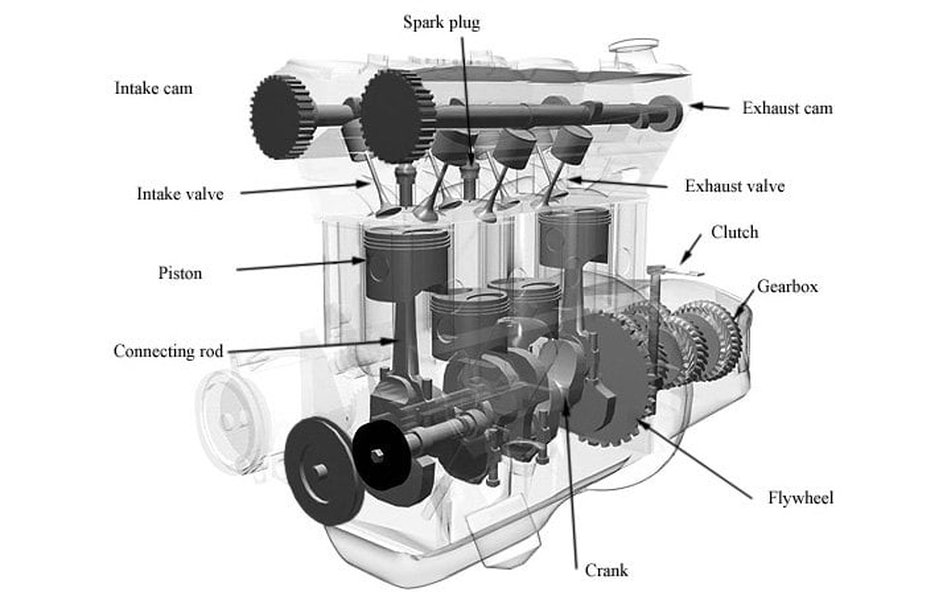
Components of an internal combustion engine.
Key Parameters
The engine in question has the following specifications:
- Bore (B): 84 mm (or 8.4 cm) - The diameter of the cylinder.
- Stroke (S): 94 mm (or 9.4 cm) - The distance the piston travels from Top Dead Center (TDC) to Bottom Dead Center (BDC).
- Connecting Rod Length (Lrod): 154 mm (or 15.4 cm) - The length of the rod connecting the piston to the crankshaft.
- Compression Ratio (CR): 11.5 - The ratio of the total cylinder volume (at BDC) to the clearance volume (at TDC).
- Crank Angle (θ): 48° from TDC - The specific rotational position of the crankshaft for which we are calculating the volume.
- Crank Radius (R): Calculated as Stroke / 2 = 94 mm / 2 = 47 mm (or 4.7 cm).
Fundamental Volumes
- Swept Volume (Vs): This is the volume displaced by the piston as it moves from TDC to BDC. It represents the engine's volumetric capacity per cylinder.
- Clearance Volume (Vc): This is the volume remaining in the cylinder when the piston is at TDC. It includes the combustion chamber volume.
- Instantaneous In-Cylinder Volume (V(θ)): This is the total volume inside the cylinder at a specific crank angle θ. It is the sum of the clearance volume and the volume displaced by the piston from TDC to its current position at angle θ.
Step-by-Step Calculation
We will proceed by calculating these volumes sequentially to arrive at the final in-cylinder volume at 48° past TDC. For consistency and accuracy, calculations will use centimeters (cm) and cubic centimeters (cm³), with the final result converted to liters (L).
Step 1: Calculate Swept Volume (Vs)
Formula
The swept volume for a single cylinder is given by:
\[ V_s = \frac{\pi}{4} \times B^2 \times S \]Calculation
Using B = 8.4 cm and S = 9.4 cm:
\[ V_s = \frac{\pi}{4} \times (8.4 \text{ cm})^2 \times 9.4 \text{ cm} \] \[ V_s = 0.78539816... \times 70.56 \text{ cm}^2 \times 9.4 \text{ cm} \] \[ V_s \approx 55.4177 \text{ cm}^2 \times 9.4 \text{ cm} \] \[ V_s \approx 520.926 \text{ cm}^3 \]Step 2: Calculate Clearance Volume (Vc)
Formula
The clearance volume is derived from the compression ratio (CR) and swept volume (Vs):
\[ CR = \frac{V_s + V_c}{V_c} \Rightarrow V_c = \frac{V_s}{CR - 1} \]Calculation
Using Vs ≈ 520.926 cm³ and CR = 11.5:
\[ V_c = \frac{520.926 \text{ cm}^3}{11.5 - 1} = \frac{520.926 \text{ cm}^3}{10.5} \] \[ V_c \approx 49.612 \text{ cm}^3 \]Step 3: Determine Piston Position (x) at 48° from TDC
Formula
The distance (x) of the piston from TDC at a given crank angle (θ) is calculated using the exact formula for a slider-crank mechanism:
\[ x = R(1 - \cos\theta) + L_{\text{rod}}\left(1 - \sqrt{1 - \left(\frac{R}{L_{\text{rod}}}\sin\theta\right)^2}\right) \]Where R is the crank radius (4.7 cm), Lrod is the connecting rod length (15.4 cm), and θ is the crank angle (48°).
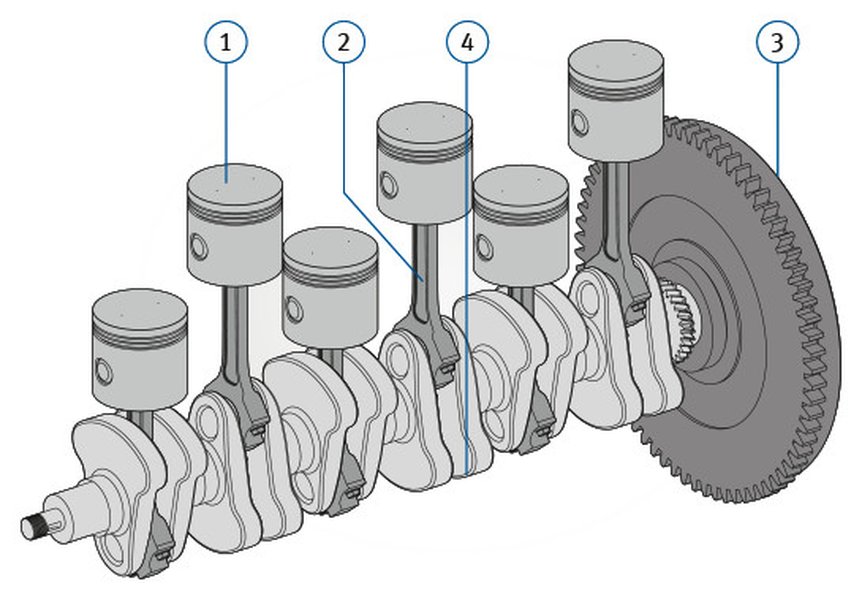
Crank mechanism illustrating piston displacement.
Calculation
First, calculate the necessary trigonometric values and ratios (using θ = 48°):
\[ \cos(48^\circ) \approx 0.66913 \] \[ \sin(48^\circ) \approx 0.74314 \] \[ \frac{R}{L_{\text{rod}}} = \frac{4.7 \text{ cm}}{15.4 \text{ cm}} \approx 0.30519 \]Substituting these values into the formula for x:
\[ x = 4.7(1 - 0.66913) + 15.4\left(1 - \sqrt{1 - (0.30519 \times 0.74314)^2}\right) \] \[ x = 4.7(0.33087) + 15.4\left(1 - \sqrt{1 - (0.22681)^2}\right) \] \[ x = 1.55509 + 15.4\left(1 - \sqrt{1 - 0.051443}\right) \] \[ x = 1.55509 + 15.4\left(1 - \sqrt{0.948557}\right) \] \[ x = 1.55509 + 15.4(1 - 0.97394) \] \[ x = 1.55509 + 15.4(0.02606) \] \[ x = 1.55509 + 0.40132 \] \[ x \approx 1.9564 \text{ cm} \]This is the distance the piston has moved downwards from TDC.
Step 4: Calculate Instantaneous Displaced Volume (Vd(θ))
Formula
The volume displaced by the piston as it moves distance x from TDC is:
\[ V_d(\theta) = A_p \times x = \left(\frac{\pi}{4} B^2\right) \times x \]Where Ap is the piston crown area.
Calculation
The piston area Ap is \( \frac{\pi}{4} \times (8.4 \text{ cm})^2 \approx 55.4177 \text{ cm}^2 \). Using x ≈ 1.9564 cm:
\[ V_d(48^\circ) = 55.4177 \text{ cm}^2 \times 1.9564 \text{ cm} \] \[ V_d(48^\circ) \approx 108.427 \text{ cm}^3 \]Step 5: Calculate Total In-Cylinder Volume (V(θ))
Formula
The total in-cylinder volume at crank angle θ is the sum of the clearance volume and the instantaneous displaced volume:
\[ V(\theta) = V_c + V_d(\theta) \]Calculation
Using Vc ≈ 49.612 cm³ and Vd(48°) ≈ 108.427 cm³:
\[ V(48^\circ) = 49.612 \text{ cm}^3 + 108.427 \text{ cm}^3 \] \[ V(48^\circ) \approx 158.039 \text{ cm}^3 \]To convert this to liters (1 L = 1000 cm³):
\[ V(48^\circ) = \frac{158.039 \text{ cm}^3}{1000} \approx 0.158039 \text{ L} \]Rounded to three decimal places, the in-cylinder volume at 48° from TDC is 0.158 Liters.
Key Engine Parameter Influences
The various geometric parameters of an engine have differing levels of influence on aspects like total displacement, peak pressures, and mechanical stresses. The radar chart below offers a hypothetical, opinionated visualization of these influences, scored on a scale of 1 to 10 (where 10 indicates highest influence). This chart is for illustrative purposes to conceptualize parameter interactions, not based on specific empirical data for this exact engine.
Calculation Dependencies Mindmap
The calculation of the in-cylinder volume involves several interconnected steps and parameters. The mindmap below illustrates the flow and dependencies of these calculations, starting from the given engine specifications to the final volume determination.
Summary of Calculations
The table below provides a summary of the initial parameters and the key values calculated throughout the process.
| Parameter | Symbol | Value | Unit |
|---|---|---|---|
| Bore | B | 84 | mm |
| Stroke | S | 94 | mm |
| Connecting Rod Length | Lrod | 154 | mm |
| Compression Ratio | CR | 11.5 | - |
| Crank Angle from TDC | θ | 48 | ° |
| Crank Radius | R | 47 | mm |
| Swept Volume | Vs | 520.926 | cm³ |
| Clearance Volume | Vc | 49.612 | cm³ |
| Piston Position from TDC | x | 1.9564 | cm |
| Instantaneous Displaced Volume at 48° | Vd(48°) | 108.427 | cm³ |
| Total In-Cylinder Volume at 48° | V(48°) | 158.039 | cm³ |
| Total In-Cylinder Volume at 48° | V(48°) | 0.158 | L |
Visualizing Engine Mechanics
Understanding engine displacement and compression ratios is fundamental to grasping engine operation. The following video provides a good overview of how these volumes are defined and calculated, which complements the specific calculations performed here. It helps to visualize how parameters like bore, stroke, and piston position contribute to the overall engine capacity and performance characteristics.
Conclusion
Through a systematic application of kinematic and geometric formulas, we have determined that for a reciprocating internal combustion engine with a bore of 84 mm, stroke of 94 mm, connecting rod length of 154 mm, and a compression ratio of 11.5, the in-cylinder volume when the crankshaft has rotated 48° from Top Dead Center is approximately 0.158 liters. This calculation is crucial for various aspects of engine design, analysis, and performance modeling, such as combustion analysis, thermal efficiency studies, and emissions control.
Frequently Asked Questions
What does TDC (Top Dead Center) mean in an engine?
Why is the connecting rod length a factor in calculating instantaneous cylinder volume?
How does the compression ratio influence an engine's characteristics?
Recommended Further Queries
- How does changing the connecting rod to stroke ratio affect piston kinematics?
- What is the impact of varying crank angle on cylinder pressure during the compression stroke?
- Calculate the mean piston speed for an engine with given stroke and RPM.
- How is volumetric efficiency calculated and what factors influence it?
Referenced Search Results
 leebillinghamblog.wordpress.com