
Key Insights into English Grammar Essentials
- Modals are indispensable auxiliary verbs that enrich sentences by expressing a wide range of nuances, including ability, permission, necessity, and prediction. They remain unchanged regardless of the subject and are always followed by the base form of the main verb.
- Mastering negatives and questions involves specific word order rules and the strategic use of auxiliary verbs, crucial for denying statements and formulating inquiries effectively.
- The passive voice is a powerful tool for shifting sentence focus from the performer of an action to the receiver of that action, particularly useful when the doer is unknown, irrelevant, or when emphasizing the action itself.
Exploring the Nuances of Modals in English
Modal verbs are a fundamental category of auxiliary verbs in English that do not change their form (i.e., they never add an "-s" for the third person singular, nor do they have infinitive, gerund, or participle forms). They precede a main verb in its base form, conveying additional meaning about the verb's action or state, such as possibility, necessity, ability, or permission.

An illustrative graphic depicting various modal verbs and their core functions.
Understanding Modals and Phrasal Modals
Simple Modals are single-word auxiliary verbs such as can, could, may, might, must, shall, should, will, and would. They always precede the base form of the main verb and do not inflect for person or number.
- Example: She can swim very well.
Phrasal Modals, also known as semi-modals or modal-like expressions, are multi-word phrases that function similarly to simple modals but can be conjugated and often involve verbs like "be" or "have." They provide flexibility, especially when simple modals cannot express certain tenses.
- Example: She is able to swim very well. (Expresses ability, like "can," but allows for different tenses or emphasis.)
- Example: We have to leave now. (Expresses necessity, similar to "must," but allows for past or future tenses.)
A helpful way to understand the distinction between modals and phrasal modals is through their flexibility in different grammatical contexts, as highlighted in this informative video:
This video explains the differences and appropriate usage between one-word modals like "must" and phrasal modals such as "have to," providing a clearer understanding of their roles in English grammar.
Delving into Complex Modals
Complex modals extend the functionality of simple modals by combining them with other auxiliary structures, most commonly perfect infinitives (have + past participle) or progressive infinitives (be + -ing). These forms allow for more nuanced expressions of past actions, ongoing states, or passive constructions.
- Modal Perfects: Used to make deductions or express obligations/advice about past situations.
- Example (Deduction about past): She must have left early. (It is a logical conclusion that she left early.)
- Example (Past obligation/advice not taken): You should have told me earlier.
- Modal Progressives: Used to express possibility or deduction about an ongoing action in the present or future.
- Example (Present possibility): They may be waiting outside.
- Passive Infinitives with Modals: Used to form passive constructions involving modal verbs.
- Example (Necessity in passive): The forms must be signed today.
Expressing Prediction: will, would, be going to, shall
These verbs and phrasal modals are used to talk about future events or make predictions, each carrying slightly different connotations.
- Will: Used for general predictions, spontaneous decisions, or future intentions.
- Example: It will rain tomorrow.
- Would: Can be used for predictions about the past, or in conditional sentences for hypothetical situations, or to describe future-in-the-past.
- Example (Future-in-the-past): He said he would call later.
- Be going to: Used for planned future actions or predictions based on present evidence.
- Example (Planned action): We are going to visit Paris next month.
- Example (Prediction based on evidence): Look at those dark clouds; it’s going to rain.
- Shall: Less common in modern everyday English for general prediction, but can be used in formal contexts or for strong suggestions, especially with "I" or "we."
- Example (Formal intention): We shall overcome this challenge.
Willingness, Habits, and Preferences: will and would
These modals help convey a speaker's willingness, describe recurring actions, or state preferences.
- Will: Expresses willingness or typical behavior/habit in the present.
- Example (Willingness): I will help you with the homework.
- Example (Present habit): He will always complain about the weather.
- Would: Expresses past habits or typical behavior, or polite preferences.
- Example (Past habit): When I was a child, I would often play in the park.
- Example (Preference): I would prefer tea.
Conveying Ability: can, could, be able to
These modals and phrasal modals denote the capacity or skill to perform an action.
- Can: Expresses present ability or general capability.
- Example: He can play the guitar.
- Could: Expresses past ability, or a more polite/tentative present ability, or possibility.
- Example (Past ability): She could swim when she was 5.
- Example (Polite request): Could I borrow your pen?
- Be able to: A versatile phrasal modal that expresses ability and can be used in tenses where "can" or "could" might not fit (e.g., future, perfect tenses). It can also emphasize ability in specific situations or achievements.
- Example (Future ability): They will be able to attend the meeting.
- Example (One-time past achievement): I was able to fix the computer yesterday.
Granting and Seeking Permission: can, could, may, might, be allowed to
These are used to ask for or give permission, varying in formality and tentativeness.
- Can: Common for informal permission or requests.
- Example: You can leave early today.
- Could: More polite than "can" for asking permission.
- Example: Could I borrow your pen?
- May: More formal than "can" or "could" for asking or giving permission.
- Example: May I ask a question?
- Might: Used for very tentative or indirect permission, often suggesting a slim possibility.
- Example: You might be able to get a refund, but I'm not sure.
- Be allowed to: A phrasal modal that expresses permission, often used when permission is granted by an authority or rule, and can be used in all tenses.
- Example: Children are not allowed to play here.
Indicating Possibility: may, might, can, could
These modals indicate the likelihood of something occurring or being true.
- May/Might: Express a possibility; "might" often suggests a slightly weaker possibility than "may."
- Example: It may rain later.
- Example: She might come to the party, but she's busy.
- Can: Can express a general possibility or capability.
- Example: Accidents can happen at any time.
- Could: Expresses a possibility, often hypothetical or a past possibility.
- Example (Present possibility): This could be a solution.
Expressing Necessity: must, have to, have got to, need to, needn't
These modals and phrasal modals convey obligation or requirement, with varying degrees of strength and source.
- Must: Expresses strong necessity or obligation, often from the speaker's internal feeling or a rule.
- Example: You must finish this today. (Strong, internal necessity)
- Have to: Expresses necessity or obligation, often external (e.g., a rule, a situation).
- Example: I have to attend the meeting. (External obligation)
- Have got to: Informal equivalent of "have to," often implying a stronger or more immediate obligation.
- Example: We’ve got to leave now.
- Need to: Expresses necessity, generally less strong than "must."
- Example: You need to call him.
- Needn't: Expresses lack of necessity (or "do not need to").
- Example: You needn’t bring anything. (It is not necessary)
Making Deductions: must, have to, have got to, can't and couldn't
These are used to make logical conclusions or deductions based on evidence or reasoning.
- Must/Have to/Have got to: Used for strong, affirmative deductions, indicating high certainty.
- Example: She must be tired after that long flight. (Logical conclusion)
- Can’t/Couldn’t: Used for strong, negative deductions, indicating certainty that something is not true or impossible.
- Example: He couldn’t have done it; he was at home. (Impossible conclusion)
Providing Obligation and Advice: should, ought to, be supposed to, had better
These modals and phrasal modals convey recommendations, duties, or strong advice.
- Should: Used for advice, recommendation, or a mild obligation/expectation.
- Example: You should call your mom. (General advice)
- Ought to: Similar to "should," often slightly more formal or implying a moral obligation.
- Example: We ought to help the poor.
- Be supposed to: Indicates an expectation or an obligation that is generally known or arranged.
- Example: He is supposed to arrive at 8 PM. (Expected arrival time)
- Had better: Expresses strong advice or a warning about potential negative consequences if the advice isn't followed.
- Example: You had better leave now, or you'll miss your flight. (Urgent advice with a warning)
Navigating Negatives and Questions in English
Forming negative statements and questions is a core aspect of English grammar, involving specific word order adjustments and the strategic use of auxiliary verbs.

An image featuring a stack of books, symbolizing the extensive knowledge base required for mastering English grammar.
Understanding Word Order in Negatives and Questions
The structure of sentences changes when converting affirmative statements into negatives or questions.
- Negatives: Generally formed by adding "not" after the first auxiliary or modal verb. If there is no auxiliary or modal, "do/does/did" is introduced.
- Statement: They are working hard.
- Negative: They are not working hard. (or They aren't working hard.)
- Statement: He speaks Spanish.
- Negative: He does not speak Spanish. (or He doesn't speak Spanish.)
- Questions (Yes/No): The first auxiliary or modal verb is placed before the subject. If no auxiliary/modal is present, "do/does/did" is used.
- Statement: They are working hard.
- Question: Are they working hard?
- Statement: She went to the store.
- Question: Did she go to the store?
- Questions (WH-questions): The WH-word (who, what, where, when, why, how) comes first, followed by the auxiliary/modal verb, then the subject.
- Statement: She went to the library.
- WH-Question: Where did she go?
Exploring Negative Questions and Question Tags
These structures add specific communicative functions, such as expressing surprise or seeking confirmation.
- Negative Questions: These questions begin with a negative auxiliary verb (e.g., "Don't you...?", "Isn't it...?"). They can express surprise, mild criticism, or simply seek confirmation with an expectation of a particular answer.
- Example (Expressing surprise): Didn't you finish your dinner yet?
- Example (Seeking confirmation): Aren't you cold without a coat?
- Question Tags: Short questions added to the end of a statement, typically to ask for confirmation. The tag uses an auxiliary/modal verb and a pronoun. The polarity of the tag is usually opposite to that of the main statement.
- Example (Positive statement, negative tag): It's a beautiful day, isn't it?
- Example (Negative statement, positive tag): You haven't seen my keys, have you?
Understanding Negative Words
Negative words are essential for expressing negation or absence. These include words like no, not, never, nobody, nothing, nowhere, barely, hardly, and scarcely. A crucial rule in Standard English is to avoid double negatives, as they can cancel each other out and create an unintended positive meaning.
- Correct: I don't have any money.
- Incorrect (Double Negative): I don't have no money. (This literally means "I have some money.")
- Example: She never eats meat.
Other Question Types
Beyond the basic yes/no and WH-questions, English offers several other question structures for various communicative purposes.
- Choice Questions: Offer two or more options, typically connected by "or."
- Example: Do you want tea or coffee?
- Indirect Questions: Questions embedded within another sentence, often following a reporting verb or phrase (e.g., "I wonder," "Could you tell me"). They maintain statement word order.
- Example: Could you tell me where the nearest bus stop is? (Not "where is the nearest bus stop?")
- Rhetorical Questions: Questions asked for effect or to make a point, rather than expecting a direct answer.
- Example: Who cares? (Implies "nobody cares.")
The Passive Voice: Shifting Focus in Sentences
The passive voice is a grammatical construction where the subject of the sentence receives the action of the verb rather than performing it. This shift in focus is achieved by using a form of the verb "to be" followed by the past participle of the main verb.
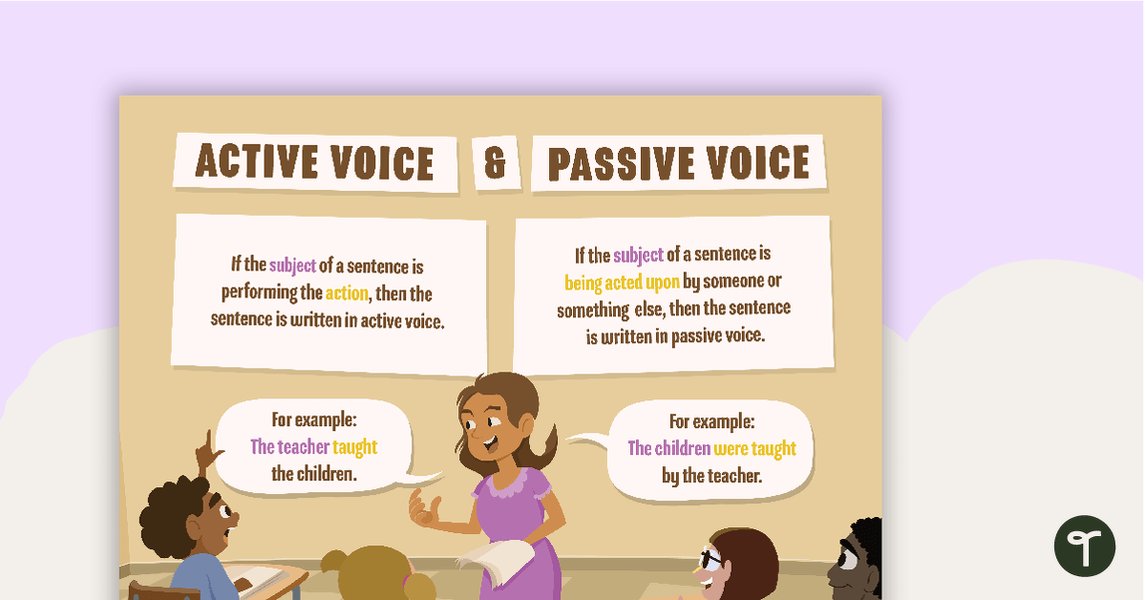
An educational poster visually contrasting active and passive voice constructions.
Active and Passive Voice
Understanding the difference between active and passive voice is crucial for effective communication.
- Active Voice: The subject performs the action. This voice is generally clearer, more direct, and concise.
- Structure: Subject + Verb + Object
- Example: Leonardo Da Vinci painted the Mona Lisa. (Leonardo Da Vinci is the subject doing the painting.)
- Passive Voice: The target of the action becomes the subject of the sentence, receiving the action of the verb. The "doer" of the action (agent) is often omitted or introduced with a "by-phrase."
- Structure: Object of Active Verb + Form of "to be" + Past Participle (+ by-phrase)
- Example: The Mona Lisa was painted by Leonardo Da Vinci. (The Mona Lisa is the subject receiving the action.)
Here's a visual representation of how different sentence components interact in active and passive constructions:
This mindmap illustrates the core distinctions between active and passive voice, their structural differences, typical uses, and various grammatical forms.
Passives with Modals, Infinitives, and Gerunds
The passive voice can be combined with other grammatical forms to express a wider range of meanings.
- With Modals: A modal verb is placed before "be" and the past participle.
- Example: The report must be submitted by Friday.
- Example: The package should be delivered tomorrow.
- With Infinitives: The structure "to be" + past participle is used.
- Example: I want to be seen by a doctor.
- With Gerunds: The structure "being" + past participle is used.
- Example: The children are excited about being taken to the zoo.
Passive Verbs
Passive verbs are consistently formed using a form of the verb "to be" (e.g., am, is, are, was, were, be, been, being) followed by the past participle of the main verb. Only transitive verbs (verbs that take a direct object in the active voice) can be used in the passive voice.
- Present Simple Passive: The window is cleaned daily.
- Past Simple Passive: The book was written by an author.
- Present Continuous Passive: The window is being cleaned now.
- Future Simple Passive: The report will be finished soon.
- Present Perfect Passive: The work has been completed.
The Uses of the Passive Voice
While the active voice is generally preferred for clarity and directness, the passive voice has specific and important uses:
- When the doer of the action is unknown or unimportant:
- Example: A car was broken into on Elm Street last night. (The identity of the thief is unknown.)
- When the focus is on the action itself or the recipient of the action, rather than the doer:
- Example: Over 20 different models have been produced in the past two years. (The emphasis is on the production of models, not who produced them.)
- To maintain objectivity or formality, common in scientific or technical writing:
- Example: The experiment was performed and the results were recorded.
- To avoid mentioning the agent (the person/thing doing the action) for various reasons, such as politeness or to avoid blame:
- Example: Mistakes were made. (This avoids assigning blame directly.)
Passives with By-Phrases and Ergatives
- By-phrases: When the doer of the action in a passive sentence is important or relevant to mention, a "by-phrase" is used to introduce the agent.
- Example: The novel was written by Jack Smith in 1912.
- Ergatives: In linguistics, an ergative verb is one that can be used both transitively (with an object, where the subject performs the action) and intransitively (without an object, where the subject undergoes the action). In the context of the passive voice, it relates to verbs where the subject of the intransitive use corresponds to the object of the transitive use.
- Example: The door opened. (Intransitive, the door undergoes the action)
- Example: The door was opened (by someone). (Passive, similar focus on the door, but implies an agent.)
Passives with Get
In informal contexts, especially in spoken English, the passive voice can sometimes be formed using "get" instead of "be." This often implies that the event was unexpected, sudden, or that the subject experienced a change of state, sometimes negative.
- Example: She got hurt in the accident. (Instead of She was hurt..., implying an event happened to her.)
- Example: The window got broken during the storm. (Instead of The window was broken..., emphasizing the event.)
- Example: He got promoted last year. (A change of state or event.)
Grammar Function Summary Table
This table summarizes the core functions and examples of modals, negatives, questions, and passive voice constructions discussed, providing a quick reference for their practical application.
| Category | Grammatical Function | Key Examples |
|---|---|---|
| Modals | Expressing Ability, Permission, Possibility, Necessity, Deduction, Obligation, Prediction, Willingness, Habits, Preferences. | She can swim. May I leave? It might rain. You must study. He must be tired. You should call her. It will rain tomorrow. I will help you. She would often cook. |
| Phrasal Modals | Functions similar to simple modals, but with conjugated forms allowing for broader tense usage. | She is able to swim. We have to leave. |
| Complex Modals | Deductions/obligations about past; possibilities about ongoing actions; passive constructions. | She must have left. They may be waiting. Forms must be signed. |
| Negatives | Denying statements by adding "not" after auxiliary/modal or using "do/does/did not." | They are not working. He does not speak Spanish. |
| Questions | Formulating inquiries by inverting subject/auxiliary or using "do/does/did." | Are they working? Did she go? Where did she go? |
| Negative Questions | Expressing surprise, mild criticism, or seeking confirmation with a negative tone. | Didn't you finish? Aren't you cold? |
| Question Tags | Short questions added to statements for confirmation, usually with opposite polarity. | It's cold, isn't it? You haven't seen my keys, have you? |
| Passive Voice | Shifting sentence focus from doer to receiver of action; formed with "be" + past participle. | The Mona Lisa was painted by Leonardo. The report must be submitted. I want to be seen. She hates being ignored. The window got broken. |
Frequently Asked Questions (FAQ)
What is the main difference between "must" and "have to"?
When should I use the passive voice instead of the active voice?
Can I use "will" and "be going to" interchangeably for future predictions?
What is a double negative, and why should I avoid it?
Conclusion
The English language provides a rich array of grammatical tools, from the expressive power of modals to the strategic focus of the passive voice and the precise constructions of negatives and questions. Mastering these elements is not merely about adhering to rules but about effectively conveying meaning, nuance, and intent. Modals allow us to express subtle differences in possibility, obligation, and deduction, while a firm grasp of negatives and questions enables clear inquiry and denial. The passive voice, though often advised against for overuse, serves crucial functions in specific contexts, shifting emphasis and maintaining objectivity. By understanding the purpose and application of these grammatical structures, speakers and writers can enhance their clarity, formality, and overall communicative effectiveness.
Recommended Further Exploration
- How do modal perfects change the meaning of past events?
- What are the subtle differences between different question types in English?
- When is it most effective to use the passive voice in academic writing?
- Can you provide more advanced examples of phrasal modals in complex sentences?