
Mastering the Queue: Your Comprehensive Enqueue Tutorial
Unlock the secrets of adding elements to queues with this step-by-step guide to the essential enqueue operation.
Welcome to this detailed tutorial on the enqueue operation, a cornerstone concept in the world of data structures. Understanding how to correctly add elements to a queue is fundamental for managing data in various computing applications, from scheduling tasks in an operating system to handling requests on a web server. This guide will walk you through the definition, mechanics, implementation, and applications of enqueue.
Essential Insights into Enqueue
- FIFO Principle: Enqueue adds elements to the rear (end) of a queue, ensuring the First-In, First-Out (FIFO) order is maintained. The first item added is the first one available for removal.
- Core Operation: It's one of the two primary operations for queues (along with dequeue), responsible for inserting new data into the structure.
- Implementation Variance: The exact mechanism of enqueue depends on the underlying implementation (e.g., array, linked list), affecting pointer management and overflow handling.
What Exactly is Enqueue?
Adding to the Back of the Line
In data structures, a queue works just like a real-world queue or line – think of people waiting for a bus or tasks waiting to be processed. Newcomers join at the back, and the person at the front is served first. The enqueue operation is the action of adding a new element to the rear (also called the tail or end) of this queue.
Every time an element is enqueued, it takes its place behind the previously added elements. This ensures that the sequence of removal (dequeue) follows the sequence of insertion, adhering strictly to the FIFO principle.
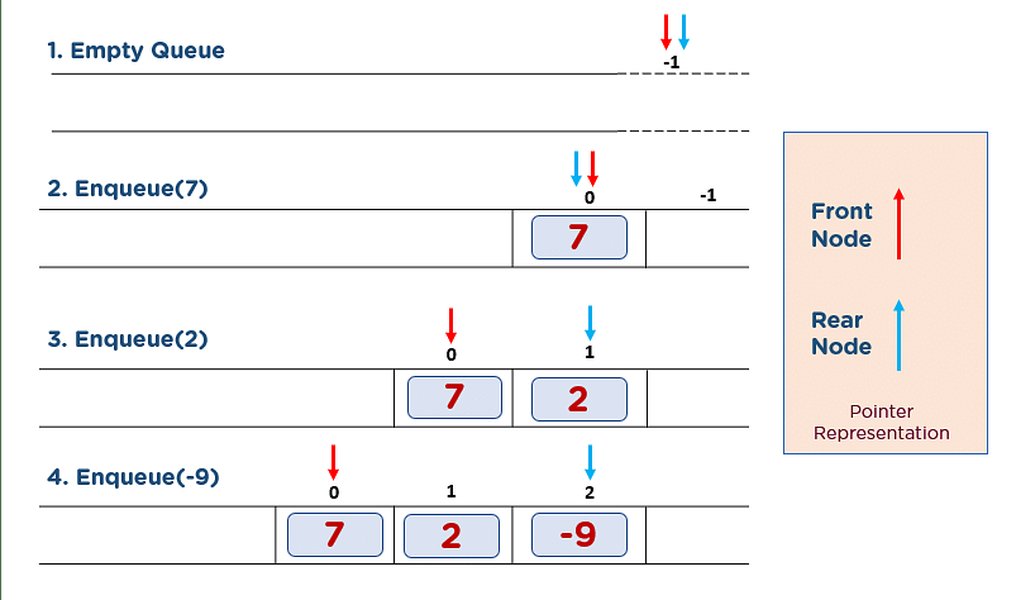
Visual representation of the enqueue operation adding an element to the rear of a queue.
The Mechanics: How Enqueue Works Step-by-Step
While the concept is simple, the implementation requires careful handling, especially when dealing with fixed-size queues (like those based on arrays).
- Check for Fullness (Overflow): The first critical step, particularly for array-based queues with a fixed capacity, is to check if the queue is already full. If
rearpoints to the last index of the array (or the condition for fullness in a circular queue is met), the enqueue operation cannot proceed. An "Overflow" error or exception should be signaled. - Handle the First Element Case: If the queue is currently empty (often indicated by
frontandrearpointers being at a special value like -1), adding the first element requires initializing bothfrontandrearto the starting position (usually index 0). - Increment the Rear Pointer: If the queue is not empty and not full, the
rearpointer (or index) is incremented to point to the next available slot at the end of the queue. In circular queues, this increment might involve wrapping around to the beginning of the array using the modulo operator. - Insert the Element: The new data element is placed at the position now indicated by the updated
rearpointer. - Update Size (Optional): Some implementations maintain a separate counter for the number of elements, which would be incremented here.
Pseudocode Example:
Here's a general algorithm representing the enqueue logic, assuming an array-based implementation:
// Function to add an element to the queue
function enqueue(queue, elementToAdd, front, rear, maxSize):
    // Step 1: Check if the queue is full
    if (rear == maxSize - 1):
        print "Queue Overflow: Cannot add element."
        return // Stop the operation

    // Step 2: Handle the case of an initially empty queue
    else if (front == -1 and rear == -1):
        front = 0
        rear = 0
        queue[rear] = elementToAdd
        print "Element enqueued successfully."

    // Step 3 & 4: Increment rear and insert element
    else:
        rear = rear + 1
        queue[rear] = elementToAdd
        print "Element enqueued successfully."

    // Note: This basic pseudocode doesn't handle circular queues.
    // Circular queue logic would involve modulo arithmetic for rear increment.
Implementing Enqueue: Arrays vs. Linked Lists
The choice of underlying data structure impacts how enqueue is implemented and its performance characteristics.
Array-Based Implementation
Using an array provides simplicity and often excellent performance due to memory locality. However, it typically imposes a fixed size, necessitating the overflow check.
Java Example:
public class ArrayQueue {
    private int maxSize;
    private int[] queueArray;
    private int front;
    private int rear;
    private int currentSize; // Optional: track number of items

    public ArrayQueue(int size) {
        maxSize = size;
        queueArray = new int[maxSize];
        front = 0; // Or -1, depending on convention
        rear = -1;
        currentSize = 0; // Optional
    }

    // Enqueue operation
    public void enqueue(int item) {
        if (isFull()) {
            System.out.println("Queue is full. Cannot enqueue " + item);
            return; // Overflow condition
        }
        // Consider circular queue logic here if applicable
        rear = rear + 1; // Simple linear increment
        queueArray[rear] = item;
        currentSize++; // Optional
        System.out.println("Enqueued: " + item);
        // Handle first element case if using -1 convention
        if (front == -1) {
            front = 0;
        }
    }

    public boolean isFull() {
        // Basic check for linear queue
        return (rear == maxSize - 1);
        // For circular queue: return (currentSize == maxSize);
    }

    // Other methods: dequeue, peek, isEmpty...
}
Linked List-Based Implementation
A linked list offers dynamic resizing – the queue can grow as needed, eliminating the overflow problem inherent in fixed-size arrays. Enqueue involves adding a new node at the end (tail) of the list.
Python Example:
class Node:
    # Node definition for the linked list
    def __init__(self, data):
        self.data = data
        self.next = None

class LinkedListQueue:
    def __init__(self):
        self.front = None # Head of the list
        self.rear = None  # Tail of the list
        self.size = 0

    def enqueue(self, element):
        # Create a new node
        new_node = Node(element)
        # If the queue is empty, the new node is both front and rear
        if self.rear is None:
            self.front = self.rear = new_node
        else:
            # Link the current rear node to the new node
            self.rear.next = new_node
            # Update the rear pointer to the new node
            self.rear = new_node
        self.size += 1
        print(f"Enqueued: {element}")

    def isEmpty(self):
        return self.front is None

    # Other methods: dequeue, peek, getSize...

# Example usage:
ll_queue = LinkedListQueue()
ll_queue.enqueue(10)
ll_queue.enqueue(20)
Circular Queues
A variation of the array-based queue, the circular queue, efficiently reuses empty space at the beginning of the array once elements are dequeued. Enqueue and dequeue operations use the modulo operator (%) to wrap indices around, making better use of the fixed array size.
Performance Characteristics of Queue Implementations
The choice between array, linked list, or circular array implementations affects performance. This radar chart visualizes the trade-offs based on common performance metrics. Note that these are general characteristics; specific performance can vary.
Interpretation:
- Enqueue/Dequeue Time Complexity: Generally O(1) (constant time) for all efficient implementations. Array-based enqueue can be O(1) amortized if resizing is needed.
- Space Efficiency: Linked lists are dynamic but have memory overhead per node. Arrays are contiguous but can be wasteful if oversized (linear) or very efficient if sized well (circular).
- Ease of Implementation: Basic linear arrays are often simplest. Linked lists require pointer management. Circular arrays need careful index handling with modulo arithmetic.
- Memory Overhead: Linked lists require extra memory for pointers in each node. Arrays have lower overhead per element but might pre-allocate unused space.
Enqueue in Context: Related Queue Operations
Enqueue doesn't exist in isolation. It's part of a set of operations that define the queue abstract data type (ADT). This mindmap illustrates the relationship between enqueue and other fundamental queue operations.
to Rear (Tail)"] id1b["Handles Overflow
(if capacity limited)"] id1c["Updates Rear Pointer"] id1d["Complexity: O(1) typical"] id2["Dequeue"] id2a["Removes element
from Front (Head)"] id2b["Handles Underflow
(if empty)"] id2c["Updates Front Pointer"] id2d["Complexity: O(1) typical"] id3["Peek / Front"] id3a["Returns Front element
without removing"] id4["Rear / Back"] id4a["Returns Rear element
without removing"] id5["isEmpty"] id5a["Checks if Queue
has zero elements"] id6["isFull"] id6a["Checks if Queue
has reached capacity
(Array-based)"]
This visualization shows how enqueue (adding to the rear) complements dequeue (removing from the front) to maintain the FIFO behavior, supported by auxiliary operations like peek, isEmpty, and isFull.
Visual Learning: Understanding Queues
Sometimes, seeing concepts explained visually can deepen understanding. This video provides an introduction to the queue data structure, including the enqueue and dequeue operations, and discusses common use cases.
Introduction to the Queue Data Structure (including enqueue/dequeue) - Courtesy of YouTube
The video walks through the core principles of queues, illustrating how elements are added (enqueued) and removed (dequeued), and provides context on where queues are practically applied in software development.
Beyond Data Structures: Enqueue in Other Domains
While predominantly associated with the queue data structure, the term "enqueue" is also used metaphorically or specifically in other systems where items are added to a processing sequence. A notable example comes from web development, specifically within the WordPress ecosystem.
Enqueue in WordPress
In WordPress theme and plugin development, functions like wp_enqueue_style() and wp_enqueue_script() are used to add CSS stylesheets and JavaScript files to a loading queue. WordPress then processes this queue to load these assets in the correct order and location (e.g., header or footer) on the webpage. This system helps manage dependencies, avoid conflicts, and optimize loading performance by ensuring assets are included properly and only when needed. Here, "enqueue" means "add this script/style to the list of assets to be loaded."
Practical Applications of Enqueue
Queues, and therefore the enqueue operation, are fundamental in many areas of computer science:
- Operating Systems: Managing processes waiting for CPU time, handling I/O requests.
- Networking: Buffering data packets for transmission or processing to maintain order.
- Printers: Print spooling, where print jobs are queued up.
- Breadth-First Search (BFS): Graph traversal algorithms use queues to keep track of nodes to visit.
- Simulations: Modeling waiting lines in real-world scenarios (e.g., customers at a bank).
- Asynchronous Processing: Task queues for background jobs in web applications.
Key Considerations and Potential Issues
Handling Constraints
When working with enqueue, especially in constrained environments or specific implementations, be mindful of:
- Queue Overflow: This is the primary issue with fixed-size (array-based) queues. Your enqueue logic must check if the queue is full before attempting to add an element. Failing to do so can lead to data corruption or program crashes.
- Time Complexity: Enqueue is typically a very efficient operation, usually taking O(1) constant time for both array and linked list implementations (assuming direct access to the rear pointer/index). However, if an array-based queue needs resizing, the enqueue operation that triggers the resize might take O(n) time, where n is the number of elements. This is often analyzed as O(1) amortized time.
- Space Complexity: Linked lists offer dynamic space but incur overhead for pointers. Arrays have lower overhead per element but might waste space if allocated much larger than needed (especially linear arrays). Circular arrays optimize space usage within a fixed allocation.
- Concurrency: In multi-threaded applications, multiple threads might try to enqueue (or dequeue) elements simultaneously. This requires synchronization mechanisms (like locks or mutexes) to prevent race conditions and maintain the integrity of the queue.
Enqueue Operation Summary Table
This table summarizes the enqueue operation across common queue implementations:
| Implementation Type | Enqueue Action | Typical Time Complexity | Key Considerations |
|---|---|---|---|
| Linear Array Queue | Add element at queue[rear+1], increment rear. |
O(1) | Must check for overflow (rear == maxSize - 1). Fixed capacity. Potential wasted space if many dequeues occur without wrapping. |
| Circular Array Queue | Add element at queue[(rear + 1) % maxSize], update rear. |
O(1) | Must check for overflow (e.g., (rear + 1) % maxSize == front or using a size counter). Efficiently reuses space. Requires careful index management. |
| Linked List Queue | Create new node, link rear.next to it, update rear to new node. |
O(1) | No inherent overflow issue (limited by memory). Dynamic size. Requires memory for pointers (overhead). |
Frequently Asked Questions about Enqueue
What does FIFO mean in the context of queues?
FIFO stands for First-In, First-Out. It's the defining principle of a standard queue. It means that the element that was added (enqueued) first will be the first one to be removed (dequeued). Enqueue adds to the rear, and dequeue removes from the front, preserving this order.
What happens during enqueue if the queue is full?
If you attempt to enqueue an element into a queue that has reached its maximum capacity (typically in array-based implementations), an overflow condition occurs. The enqueue operation should fail, and typically an error message is printed, an exception is thrown, or a status code indicating failure is returned. No element is added in this case.
Is the enqueue operation always O(1) time complexity?
In most standard implementations (like linked lists with a tail pointer or fixed-size/circular arrays), enqueue is indeed O(1), meaning it takes constant time regardless of the queue size. However, if you use a dynamic array that needs resizing when full, the specific enqueue operation triggering the resize might take O(n) time (where n is the current size) to copy elements to a larger array. Over many operations, this is often averaged out (amortized) to O(1).
Can you enqueue multiple elements at once?
The fundamental enqueue operation adds a single element. While some libraries or custom implementations might provide helper functions to add multiple elements (e.g., from a list or array), this typically involves repeatedly calling the basic single-element enqueue operation internally for each item.
Recommended Further Exploration
- How does the dequeue operation complement enqueue in queues?
- Can you show me how to implement a circular queue in Python?
- What are the differences between a queue and a stack?
- Where are queues used in real-world software applications?
References
Last updated May 5, 2025