
Eric Birling Unmasked: From Shameful Son to Voice of a Generation in "An Inspector Calls"?
A deep dive into Eric Birling's complex journey, revealing his pivotal role and Priestley's powerful message through key quotes and analysis.
Eric Birling, a central figure in J.B. Priestley's classic play "An Inspector Calls," is a character of profound transformation and complexity. Initially presented as an uneasy and somewhat immature young man, his journey throughout the Inspector's investigation reveals deep-seated issues, moral failings, but also a capacity for guilt and change that sets him apart from his parents. This analysis explores how Priestley crafts Eric's character, using pivotal moments and impactful quotes to highlight themes of social responsibility, generational conflict, and the potential for redemption.
Eric Birling: Key Insights
- Initial Weakness and Vice: Eric is introduced as a troubled individual, struggling with alcoholism and a lack of confidence, indicative of his discomfort within the oppressive Birling household.
- Catalyst for Confession and Guilt: His involvement with Eva Smith, marked by irresponsibility and exploitation, becomes a focal point for his eventual remorse and acceptance of his role in her tragic fate.
- Symbol of Generational Change: Alongside Sheila, Eric embodies the younger generation's capacity to learn from their mistakes and embrace a more socialist-leaning perspective, challenging the entrenched capitalist views of their parents.
The Unsettled Scion: Eric's Initial Portrayal
From his first appearance, Eric Birling is a figure of unease. Priestley's stage directions describe him as "not quite at ease, half shy, half assertive." This immediately signals an internal conflict and a discomfort within the celebratory atmosphere of the Birling home. His awkwardness is further highlighted by seemingly out-of-place actions, such as his "suddenly guffaws" during inappropriate moments. This isn't mere social ineptitude; it hints at a deeper malaise and a life lived under the shadow of his overbearing father, Arthur Birling, and the rigid expectations of his social class.
His relationship with his father is notably strained. Mr. Birling often dismisses Eric, favoring Gerald Croft, which likely contributes to Eric's lack of self-assurance and his tendency towards secretive behavior. This initial portrayal sets the stage for the revelations to come, suggesting a young man grappling with unvoiced frustrations and perhaps a burgeoning, albeit poorly expressed, moral compass.
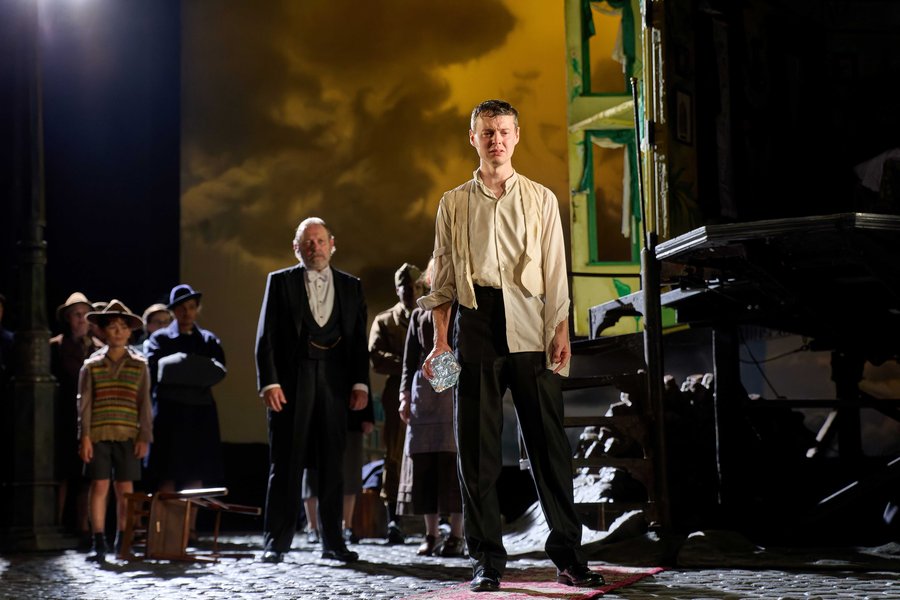
A scene from a 2024 stage production of "An Inspector Calls," depicting George Rowlands as Eric Birling amidst the company, capturing the play's dramatic tension.
The Shadow of Alcoholism
A significant aspect of Eric's initial characterization is his drinking problem, a vice that his parents seem either oblivious to or choose to ignore. Sheila is the first to allude to it, calling him "squiffy" and later exposing him as a "heavy-drinker." This dependency on alcohol is not just a personal failing but also a symptom of his inability to cope with the pressures of his life and his underlying unhappiness. It's a crutch that leads him into further moral compromises, most notably in his encounter with Eva Smith.
His drinking contributes to his recklessness and impaired judgment. He admits later in the play, "I was in that state when a chap easily turns nasty – and I threatened to make a row." This confession, referring to his coercive behavior towards Eva, links his alcoholism directly to his mistreatment of her.
The Weight of Actions: Eric's Entanglement with Eva Smith
Eric's involvement with Eva Smith (who he knew as Daisy Renton) is a critical turning point for his character and a central element of the play's moral drama. He recounts how he met her at the Palace Bar, a known haunt for prostitutes, and, fueled by alcohol, forced his way into her lodgings. Their relationship was "illicit" and exploitative from the outset, with Eric admitting he wasn't "in love with her or anything."
When Eva became pregnant with his child, Eric's irresponsibility deepened. He stole money from his father's business – fifty pounds – to try and support her. While his intent might have seemed to be to help, the act of theft itself underscores his desperation and flawed moral reasoning. He rationalized his actions, but the consequences for Eva were dire, especially when compounded by the actions of other members of his family.
The Crushing Realization of Guilt
Unlike his parents, who remain largely unrepentant, Eric is profoundly affected by the Inspector's revelations and the news of Eva's suicide. He is described as being "wracked by guilt." His reaction to learning about his mother's role in refusing Eva charity is particularly visceral. Upon hearing that Mrs. Birling turned Eva away from her committee despite knowing she was pregnant and desperate, Eric is aghast. His anguished outburst is one of the most powerful moments in the play:
"You killed her – and the child she was going to have too – my child – your own grandchild – you killed them both – damn you, damn you –"
The fragmented syntax and raw emotion in this quote, emphasized by the hyphens, convey the depth of his despair and his horror at his mother's callousness. He doesn't shy away from his own culpability either, stating, "The girl’s dead and we all helped to kill her. And that’s what matters." This contrasts sharply with Mr. and Mrs. Birling's attempts to deflect blame.
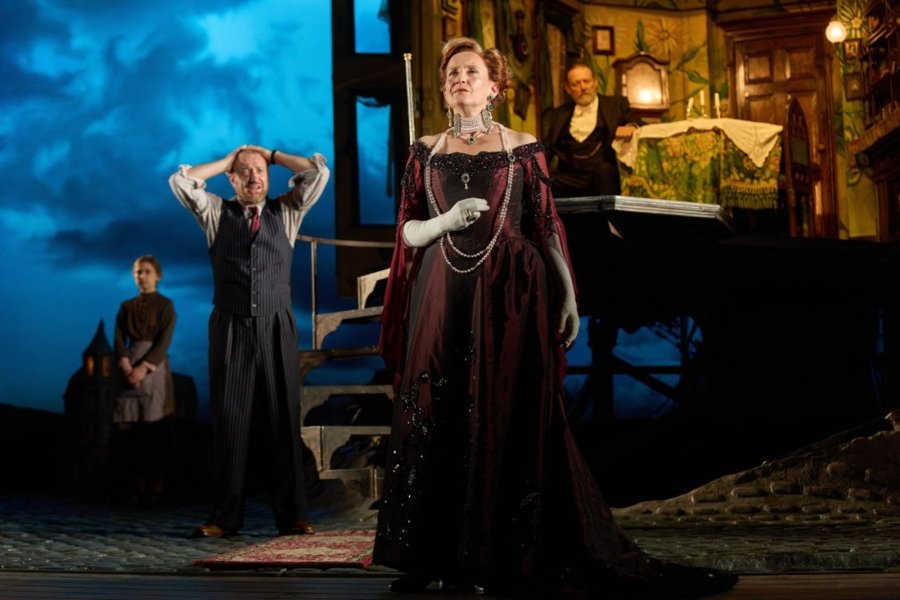
A scene from a 2024 production of "An Inspector Calls," highlighting Mrs. Birling (Jackie Morrison), whose actions critically impact Eric's understanding and emotional state.
Eric's Transformation: A Radar View
Eric Birling undergoes a significant transformation throughout "An Inspector Calls." Initially characterized by his immaturity and irresponsibility, the Inspector's interrogation forces him to confront his actions and their devastating consequences. The radar chart below visually represents key aspects of his character at the beginning of the play versus the end, illustrating his development. We see a marked increase in his sense of responsibility, guilt, and social awareness, while his initial assertiveness, often misdirected, evolves into a more morally grounded conviction.
This shift highlights Priestley's optimism in the younger generation's capacity for moral growth and their potential to break away from the destructive ideologies of their elders.
A Mind Unfolding: Eric's Character Dynamics
Eric Birling's character is a tapestry woven with threads of initial immaturity, personal failings, burgeoning social consciousness, and eventual, painful self-awareness. The mindmap below illustrates the interconnected aspects of his presentation in "An Inspector Calls," from his conflicted beginnings to his role as a voice challenging the established order. It highlights his relationships, his key actions, and the internal and external factors that shape his development throughout the play.
half shy, half assertive'"] id1b["Drinking Problem ('squiffy')"] id1c["Strained relationship with father"] id1d["Internal Conflict"] id2["Relationship with Eva Smith"] id2a["Met at Palace Bar"] id2b["Coercive behavior
('when a chap easily turns nasty')"] id2c["Eva's Pregnancy"] id2d["Stole money ('fifty pounds')"] id3["Moral Development & Guilt"] id3a["Acceptance of Responsibility
('I did what I did.')"] id3b["Confronts Parents
('You killed her... my child')"] id3c["Shame and Remorse
('the girl’s dead and we all helped to kill her')"] id3d["Contrasts with older generation"] id4["Voice of Younger Generation"] id4a["Challenges Capitalism
('Why shouldn't they try for higher wages?')"] id4b["Aligns with Sheila
('Eric’s absolutely right.')"] id4c["Represents hope for social change"] id4d["Embraces social responsibility"] id5["Priestley's Message"] id5a["Critique of upper class"] id5b["Consequences of irresponsibility"] id5c["Potential for redemption"] id5d["Advocacy for socialist values"]
This visualization helps to consolidate the multifaceted nature of Eric's character and his significance within Priestley's socio-political critique.
The Assertive Son: Finding a Voice
As the play progresses, particularly after the Inspector's departure and the subsequent debate about the Inspector's legitimacy, Eric becomes increasingly assertive in his convictions. He refuses to revert to the pre-inspection complacency that his parents eagerly embrace. He stands firm in his acceptance of guilt and his understanding of their collective responsibility.
Challenging Parental Hypocrisy
Eric openly challenges his parents' attempts to dismiss the evening's events. He is "ashamed of both them and what he has done." His earlier, hesitant questioning of his father's business practices ("Why shouldn't they try for higher wages? We try for the highest possible prices.") evolves into a more direct condemnation of their attitudes. He powerfully states: "I did what I did. And mother did what she did. And the rest of you did what you did to her." The repetition emphasizes his clarity and his refusal to let his parents off the hook. He recognizes that whether the Inspector was "real" or not, their actions remain unchanged, and their moral culpability is the same.
Alignment with Sheila: A New Generation's Perspective
Eric finds an ally in his sister, Sheila, who undergoes a similar transformation. They both represent Priestley's hope for the future – a younger generation willing to learn, to change, and to accept the principles of social responsibility. When Eric insists on their shared guilt, Sheila supports him, saying, "Eric’s absolutely right. And it’s the best thing any one of us has said tonight and it makes me feel a bit less ashamed of us." This alliance between the siblings highlights the generational divide that Priestley explores. Eric's journey, while fraught with serious misdeeds, ultimately positions him as a voice for a more compassionate and just society. He may have started as "spoilt and irresponsible," but he ends the play with a far greater understanding of the interconnectedness of human lives.
Eric Birling: A Deeper Dive Through Video Analysis
To further explore the nuances of Eric Birling's character, the following video offers a detailed analysis, focusing on his key moments, motivations, and thematic significance within "An Inspector Calls." It provides valuable insights into his development from a troubled youth to a figure who, alongside his sister Sheila, represents the potential for change in the younger generation.
This character analysis delves into Eric's alcoholism, his exploitative relationship with Eva Smith, his profound guilt, and his eventual confrontation with his parents' capitalist and morally bankrupt worldview. The video highlights how Priestley uses Eric to critique the irresponsibility of the Edwardian upper class and to champion the idea of collective social responsibility, a core tenet of his socialist beliefs.
Eric's Words: A Table of Key Quotes and Significance
Eric Birling's dialogue is crucial in understanding his character arc and Priestley's thematic concerns. The table below highlights some of his most significant quotes and explains their importance in the context of the play.
| Quote | Act | Significance |
|---|---|---|
| "Not quite at ease, half shy, half assertive." (Stage Direction) | One | Establishes Eric's initial internal conflict, discomfort within his family, and foreshadows his complex nature. |
| "Why shouldn't they try for higher wages? We try for the highest possible prices." | One | Shows an early, albeit tentative, questioning of his father's capitalist ethics and a flicker of empathy for the working class. |
| "I was in that state when a chap easily turns nasty – and I threatened to make a row." | Three | Admits to his coercive and irresponsible behaviour towards Eva Smith, linking it to his drunkenness and highlighting his capacity for cruelty. |
| "You killed her – and the child she was going to have too – my child – your own grandchild – you killed them both – damn you, damn you –" | Three | A powerful, emotional outburst directed at his mother, demonstrating his profound guilt, his acknowledgement of paternity, and his horror at his family's actions. The fragmented speech shows his distress. |
| "He was our police inspector all right." | Three | Indicates Eric's belief in the moral authority of the Inspector, regardless of his actual identity, showing he has learned the lesson of social responsibility. |
| "The girl’s dead and we all helped to kill her. And that’s what matters." | Three | Explicitly states his acceptance of collective responsibility, contrasting sharply with his parents' denial and attempts to evade blame. |
| "(shouting) And I say the girl's dead and we all helped to kill her - and that's what matters -" | Three | Reinforces his conviction and frustration with his parents' inability to accept their role. The stage direction "shouting" shows his passion and defiance. |
These quotes trace Eric's development from a somewhat passive and troubled individual to an assertive voice of conscience, embodying Priestley's hope for the younger generation's capacity for moral awakening and social change.
Frequently Asked Questions about Eric Birling
What are Eric Birling's main character flaws at the start of the play?
At the beginning of "An Inspector Calls," Eric Birling is portrayed with several significant flaws. He is shown to have a serious drinking problem, often described as "squiffy" or a "heavy-drinker." This leads to irresponsibility and poor judgment. He is also "half shy, half assertive," indicating a lack of confidence and an inability to effectively express himself or stand up to his father. Furthermore, he demonstrates a degree of immaturity and a tendency towards escapism, evidenced by his drinking and his initial cagey responses to the Inspector.
How does Eric's relationship with Eva Smith reveal his character?
Eric's relationship with Eva Smith (Daisy Renton) is exploitative and irresponsible. He meets her when he is drunk, forces himself upon her ("I threatened to make a row"), and gets her pregnant. This reveals his capacity for callousness and his abuse of power, likely stemming from his privileged upbringing and the societal norms of the time that allowed men to treat working-class women poorly. However, his subsequent actions of stealing money to try and help her, while misguided and illegal, also show a flicker of conscience and desperation, albeit poorly managed. His profound guilt upon learning of her death highlights his capacity for remorse, unlike his parents.
In what ways does Eric change by the end of the play?
By the end of the play, Eric undergoes a significant transformation. He moves from a state of denial and immaturity to one of acute guilt and acceptance of responsibility for his actions. He is openly ashamed of himself and his family, particularly his parents' refusal to acknowledge their part in Eva Smith's death. He becomes more assertive in voicing his newfound moral convictions, directly confronting his parents. Quotes like "The girl’s dead and we all helped to kill her. And that’s what matters" demonstrate his clear understanding of collective responsibility. He aligns with Sheila, representing the younger generation's hope for social change and a more compassionate society.
What is the significance of Eric's quote, "You killed her—and the child... my child"?
This quote is highly significant as it marks the peak of Eric's emotional distress and moral outrage, particularly directed at his mother. It shows his full acceptance of paternity ("my child") and his horror at the family's collective actions leading to the death of both Eva and their unborn grandchild. The raw emotion, emphasized by the fragmented speech ("damn you, damn you"), underscores his genuine remorse and his break from the callous indifference of his parents. It highlights his transformation and his understanding of the human cost of their irresponsibility, making him a key voice for Priestley's message about social accountability.
Recommended Further Exploration
- How does Sheila Birling's transformation compare to Eric's in "An Inspector Calls"?
- What is the role of Inspector Goole in revealing Eric Birling's character?
- Explore the theme of generational conflict as portrayed through Eric and his parents in "An Inspector Calls."
- How does J.B. Priestley use Eric Birling to convey his socialist ideas in "An Inspector Calls?"
References
 amysmithliterature.wordpress.com
 madameanglaise.wordpress.com
Last updated May 17, 2025