
Unlocking the World of 'A': A Comprehensive ESL Pre-K Lesson Plan Adventure!
Embark on a journey to introduce the foundational letter 'A' to young English learners with engaging, multisensory activities.
Teaching the alphabet is a cornerstone of early literacy, especially for ESL Pre-K students. This lesson plan provides a structured and engaging approach to introducing the letter "A"—its shape, sound, and connection to familiar words. By using a blend of interactive strategies and hands-on activities, young learners will build a strong foundation for their English language journey.
Lesson Highlights: Mastering the Letter 'A'
- Multisensory Engagement: Activities are designed to appeal to visual, auditory, and kinesthetic learners, ensuring all students can connect with the material.
- Gradual Skill Building: The "I Do, We Do, You Do" strategy provides scaffolding, moving from teacher-led instruction to independent practice, fostering confidence.
- Comprehensive Learning: Students will not only recognize the letter 'A' but also learn its sound, practice its formation, and associate it with key vocabulary words.
Core Components of the Lesson Plan
Learning Objectives
By the end of this lesson, ESL Pre-K students will be able to:
- Recognize and differentiate between the uppercase "A" and lowercase "a" in various visual contexts (e.g., flashcards, charts, books).
- Produce the short vowel sound /æ/ associated with the letter "A" (as in "apple") with increasing accuracy during verbal activities and repetition.
- Identify at least three common English words that begin with the letter "A" (e.g., apple, ant, alligator) when prompted with pictures or verbal cues.
- Practice forming the uppercase "A" and lowercase "a" through guided tracing, drawing, or sensory activities, developing pre-writing fine motor skills.
- Actively participate and engage in large group, teacher-led, and small group activities centered around the letter "A".
Teaching Strategy: The "I Do, We Do, You Do" Model
This lesson employs the "I Do, We Do, You Do" instructional framework, a powerful strategy for gradual release of responsibility, which is particularly effective for young ESL learners. This approach ensures that students receive adequate modeling and support before being expected to perform tasks independently.
I Do (Teacher Modeling)
In this phase, the teacher takes center stage, explicitly modeling the target skill or concept. For the letter "A," this involves demonstrating how to recognize the letter, articulate its sound, and form its shape. The teacher provides clear, step-by-step instructions and think-alouds to make the learning process transparent. For example, "This is the uppercase letter A. Watch how I write it: a slanted line down, another slanted line down, and a line across. It makes the /æ/ sound, like in 'apple'."
We Do (Guided Practice)
Following the teacher's demonstration, the "We Do" phase involves collaborative practice. The teacher and students work together on the skill. This could include choral repetition of the letter sound, tracing the letter in the air together, or collectively identifying "A" words from a set of pictures. This stage allows the teacher to provide immediate feedback, correct misconceptions, and offer support as students begin to internalize the new knowledge. It's a crucial bridge between passive reception and active application.
You Do (Independent Practice)
Once students have demonstrated understanding with guidance, they move to the "You Do" phase. Here, students apply the learned skill independently or in small groups. This could involve completing a worksheet, participating in a learning center activity, or using manipulatives to form the letter "A." The teacher's role shifts to that of a facilitator, observing students, providing differentiated support where needed, and assessing understanding. This phase fosters autonomy and allows students to consolidate their learning.
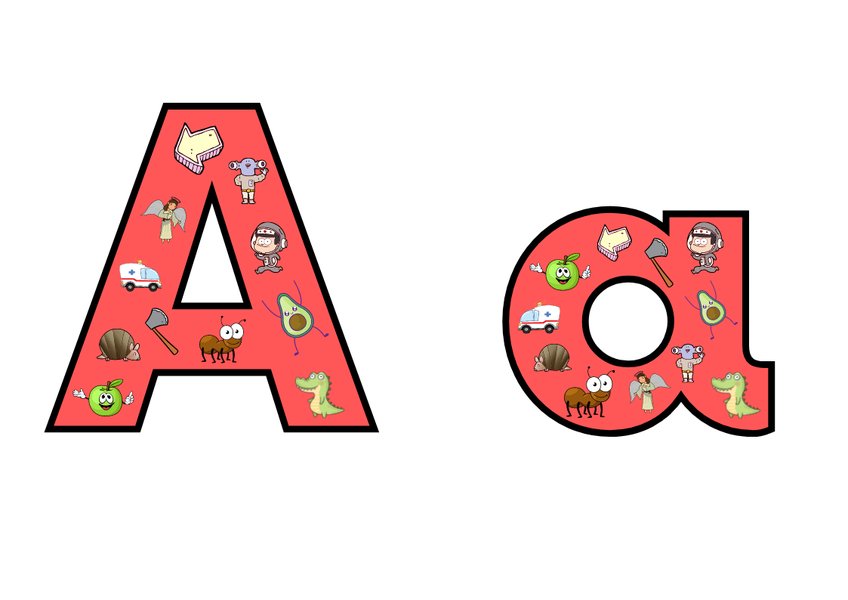
An example of an alphabet display poster useful for large group instruction.
Essential Resources for Teaching "A"
For the Large Group (Whole Class Instruction)
- Large alphabet chart clearly displaying uppercase "A" and lowercase "a".
- Oversized flashcards: one for "A", one for "a".
- Picture cards representing words starting with "A" (e.g., apple, ant, alligator, aeroplane, astronaut, arrow).
- Whiteboard, large paper, or interactive whiteboard for demonstrating letter formation.
- Markers or digital drawing tools.
- Audio player or device for an alphabet song focusing on or including the letter "A".
For the Teacher-Led Group (Small Group, Focused Instruction)
- Smaller set of letter "A" flashcards (uppercase and lowercase).
- Miniature objects or detailed toy figures representing "A" words (e.g., plastic apple, toy ant).
- Letter "A" tracing worksheets with clear starting points and directional arrows.
- Pencils, crayons, or washable markers suitable for small hands.
- Sensory writing materials: shallow trays filled with sand, salt, or rice; or resealable bags with a thin layer of paint or gel for finger tracing.
- Simple picture books prominently featuring the letter "A" and related vocabulary.
For Small Groups (Independent Learning Centers/Tables)
- **General Supplies for Centers:** Letter "A" manipulatives (magnetic letters, foam letters, letter blocks), playdough, construction paper, child-safe scissors (with supervision), glue sticks, stickers, various art supplies (buttons, yarn, googly eyes for crafts).
- **Table 1 (Sensory/Writing Focus):** Letter "A" tracing templates (laminated for reuse with dry-erase markers or for playdough mats), sand/salt trays, individual playdough portions.
- **Table 2 (Matching/Sorting Focus):** Sets of picture cards (some starting with "A", some with other letters for sorting), uppercase and lowercase "A" letter tiles or cutouts for matching.
- **Table 3 (Craft/Creative Focus):** Pre-cut letter "A" shapes (large), materials for decorating (e.g., red paper circles for apples, green paper for alligator skin), glue, crayons.
Key Vocabulary
Introduce and reinforce these words throughout the lesson:
- A, a (emphasizing uppercase and lowercase)
- Apple
- Ant
- Alligator
- Aeroplane (or Airplane)
- Astronaut
- Arrow
- Alphabet
Guiding Assessment: Key Questions
Use these open-ended questions throughout the activities to gauge understanding and encourage verbal participation:
- "Can you point to the uppercase 'A' on our chart? How about the lowercase 'a'?" (Assesses letter recognition)
- "What sound does the letter 'A' make? Can you say /æ/ like in 'apple'?" (Assesses phonemic awareness)
- "Look at these pictures (show apple, ant, ball). Which one starts with the /æ/ sound, the sound of 'A'?" (Assesses sound-object association)
- "Can you show me with your finger how to write the letter 'A' in the air/sand?" (Assesses recall of letter formation)
- "Can you tell me a word we learned today that starts with the letter 'A'?" (Assesses vocabulary recall)
- "When you were at the playdough table, how did you make the letter 'A'?" (Promotes reflection on process)
Engaging Activities to Explore the Letter "A"
Large Group Activity (Approx. 15-20 minutes)
This whole-class session introduces the letter "A" and sets the stage for more focused learning.
"Meet Letter A" (I Do & We Do)
Gather students. Hold up the large uppercase "A" flashcard. "Today, we're going to meet a special letter! This is uppercase 'A'." Show the lowercase "a". "And this is lowercase 'a'." Introduce the sound: "The letter 'A' makes the /æ/ sound, like in 'apple'." Exaggerate the mouth movement. Show the apple picture card. "A-a-apple. Apple starts with A." Have students repeat "A" and the /æ/ sound. Introduce other "A" vocabulary (ant, alligator, aeroplane) with picture cards, emphasizing the initial sound. Students repeat each word.
Alphabet Song & Action (We Do)
Sing an alphabet song that prominently features the letter "A". Create a simple action for "A" (e.g., hands making a triangle shape above the head for uppercase A). Pause at "A" and have students do the action and say the sound.
Sky Writing (I Do & We Do)
On the whiteboard or large paper, model writing uppercase "A" using simple, verbalized strokes ("Slant down, slant down, line across!"). Then model lowercase "a" ("Magic 'c' shape, up and down!"). Have students use their "magic fingers" to sky-write the letters with you, repeating the verbal cues.
This video provides a child-friendly introduction to the letter 'A', its formation, and phonic sound, which can be a great supplement to large group instruction or for individual reinforcement.
Teacher-Led Group Activity (Small Group, Approx. 15-20 minutes)
This focused session allows for more direct instruction and personalized feedback with a smaller group of students.
Letter "A" Deep Dive (I Do & We Do)
Show letter "A" flashcards (uppercase and lowercase). Ask students to identify the letter and make its /æ/ sound. Use miniature "A" word objects. Hold up a toy apple: "What's this? Yes, an apple! What sound does 'apple' start with?" Reinforce the /æ/ sound.
Guided Tracing and Formation (We Do & You Do with support)
Provide letter "A" tracing worksheets. Model the correct starting point and stroke order for both uppercase and lowercase "A". Guide students as they trace, offering hand-over-hand assistance if needed. Encourage them to say the /æ/ sound as they trace. For a tactile experience, have students trace the letter "A" in a sand tray or on a gel bag.
Simple "A" Book Exploration (We Do)
Read a simple picture book that highlights the letter "A" or features many "A" words. Pause to point out the letter "A" in the text and in illustrations.
Small Group Independent Rotations (Learning Centers/Tables - Approx. 20-25 minutes)
Students rotate through these hands-on activity stations, practicing skills independently or with minimal peer interaction. The teacher circulates to provide support and observe.

Encourage children to find or create the letter 'A' using everyday objects, enhancing letter recognition in their environment.
Table Activity Summary
The following table outlines the activities planned for each small group station, emphasizing diverse learning engagements:
| Table | Activity Focus | Materials Needed | Learning Emphasis |
|---|---|---|---|
| Table 1 | Sensory Writing & Tracing | Letter "A" tracing worksheets (laminated for dry-erase or plain paper), pencils/crayons, OR shallow trays with sand/salt/rice, playdough and letter 'A' cookie cutters/mats. | Fine motor skills, letter formation (uppercase & lowercase), tactile learning, letter-sound reinforcement (encourage saying /æ/ while tracing/forming). |
| Table 2 | Matching & Sorting Adventure | Picture cards (some starting with "A" like apple, ant, astronaut; others not, like ball, cat, dog), a designated "A" mat or container, uppercase "A" and lowercase "a" letter tiles or cutouts. | Letter recognition (A/a), sound association, critical thinking (sorting), vocabulary building. Students sort pictures onto the "A" mat if they start with "A," or match uppercase to lowercase letters. |
| Table 3 | "A" is for Awesome Alligator/Apple Craft | Large pre-cut construction paper letter "A"s (uppercase), green/red construction paper scraps, googly eyes, glue sticks, crayons, child-safe scissors (teacher may pre-cut some shapes). | Creativity, fine motor skills (cutting, gluing), letter shape reinforcement, vocabulary association (e.g., making an 'A' into an alligator or an apple tree with 'A' as the trunk). |
These small group activities are designed to reinforce the concepts introduced in the large and teacher-led groups, allowing for differentiated practice and exploration based on the "You Do" principle.
Visualizing Lesson Engagement & Skill Focus
The radar chart below offers an opinionated perspective on how different components of this lesson plan might contribute to various learning aspects. For instance, "Large Group" activities might be high on broad engagement but offer less individualized attention compared to "Teacher-Led" sessions. "Small Group" activities, particularly crafts, can excel in fine motor skill development.
Mapping the Lesson: A Conceptual Overview
This mindmap provides a visual summary of the interconnected components of the "Letter A" lesson plan for ESL Pre-K students. It highlights the core elements from objectives and strategies to specific activities and assessment, illustrating how each part contributes to a holistic learning experience.
Clear demonstration of letter, sound, formation"] id2_2["We Do: Guided Practice
Collaborative activities with teacher support"] id2_3["You Do: Independent Practice
Students apply skills at centers/tables"] id3["Resources & Vocabulary"] id3_1["Large Group: Charts, Big Flashcards, Song"] id3_2["Teacher-Led: Small Flashcards, Objects, Worksheets"] id3_3["Small Groups: Manipulatives, Craft Supplies, Sensory Trays"] id3_4["Key Vocabulary: Apple, Ant, Alligator,
Aeroplane, Astronaut, Arrow, Alphabet"] id4["Activities Structure"] id4_1["Large Group: Intro, Song, Sky Writing"] id4_2["Teacher-Led Group: Deep Dive, Guided Tracing, Book"] id4_3["Small Group Rotations (3 Tables)"] id4_3_1["Table 1: Sensory Writing/Tracing"] id4_3_2["Table 2: Matching/Sorting Games"] id4_3_3["Table 3: Creative 'A' Craft"] id5["Assessment & Reinforcement"] id5_1["Key Assessment Questions (Observational)"] id5_2["Review: Recap sound, words, song"] id5_3["Reinforcement: Printables, Praise"] id5_4["Ongoing Observation for understanding"]
Review, Reinforcement, and Assessment (Throughout & Concluding - Approx. 5-10 minutes)
Review (Large Group)
Gather students back together. Quickly review the letter "A," its sound, and some of the "A" words learned. "What letter did we learn today? What sound does it make? Can anyone name an 'A' word?" Sing the alphabet song again, emphasizing "A."
Reinforcement
Provide letter "A" printable activities (e.g., coloring pages with "A" words, simple dot-to-dot "A") for students to complete as follow-up work, during free play, or to take home. Offer positive verbal praise for participation and effort throughout the lesson.
Assessment (Ongoing & Summative)
Throughout all activities, observe student participation, their ability to identify the letter "A" and its sound, and their attempts at forming the letter. Use the key assessment questions informally with individual students or in small groups. Note any students who may need additional support or re-teaching. An informal check can be asking students to point to an "A" on a chart or find an object in the room (if applicable) that starts with /æ/.
Frequently Asked Questions (FAQ)
How long should this entire lesson take?
This lesson plan is designed for approximately 45 to 60 minutes. However, this can be flexible. You might spread the activities over two shorter sessions, especially for younger Pre-K students whose attention spans may vary. Large group: 15-20 min, Teacher-led: 15-20 min, Small groups: 20-25 min, Review: 5-10 min. Adjust timings based on your students' engagement and needs.
What if some students already know the letter "A"?
For students who already recognize the letter "A," you can provide extension activities. During small group time, they could try writing other "A" words they know, finding more "A" words in a picture book, or practicing the letter "A" sound in the middle or end of words (though this is more advanced). The focus can shift to deeper vocabulary or early reading of simple "A" words.
How can I adapt this for different ability levels within my ESL Pre-K class?
Differentiation is key. For students needing more support, provide more hand-over-hand guidance during tracing, simpler matching tasks (e.g., matching "A" to "A" rather than sorting "A" words), or focus primarily on verbal repetition and sound recognition. For more advanced learners, encourage them to name additional "A" words, attempt independent writing of the letter, or create sentences with "A" words (with teacher help). The small group rotations allow for naturally differentiated tasks.
What are common challenges when teaching letters to ESL Pre-K students?
Common challenges include distinguishing letter sounds that may not exist in their native language, connecting the abstract symbol of a letter to a sound, and developing the fine motor skills for writing. ESL learners might also be shy about verbal participation. Patience, repetition, multisensory approaches, and a supportive, playful environment are crucial to overcome these challenges.
Can I reuse these activity structures for other letters of the alphabet?
Absolutely! The structure of this lesson plan—including the "I Do, We Do, You Do" strategy, the types of group activities, and the learning center ideas—is highly adaptable for teaching other letters. Simply change the target letter, key vocabulary, and specific craft or sensory materials to suit the new letter.
Recommended Further Exploration
To deepen your understanding and find more resources for teaching ESL Pre-K students, consider exploring these related queries:
- Fun and engaging phonics games for ESL preschool children.
- Methods for assessing letter recognition skills in non-verbal Pre-K ESL students.
- Creative strategies for teaching English vocabulary to three and four-year-old ESL learners.
- How to effectively integrate technology into ESL Pre-K alphabet and literacy lessons.
References
This lesson plan was informed by concepts and activity ideas found in the following resources:
 thepreschoolplan.blogspot.com
Last updated May 9, 2025