
Unraveling the Christmas Eve Awakening of Mount Etna: A Detailed Look at the 2018 Flank Eruption
Explore the timeline, characteristics, and profound seismic impacts of Mount Etna's significant 2018 flank eruption.
Key Insights into Etna's 2018 Flank Eruption
- Commencement: The 2018 flank eruption of Mount Etna began on December 24, 2018, around 9:30 AM local time, marking the volcano's first significant flank activity in approximately a decade.
- Duration: The main eruptive phase, characterized by lava flows and ash emissions, lasted for approximately 3 to 4 days, concluding by December 27 or 28, 2018.
- Seismic Impact: The eruption was accompanied by an intense and unprecedented seismic crisis, including a swarm of over 130 earthquakes on December 24 and a powerful magnitude 4.9 earthquake on December 26, causing significant damage and displacement.
Mount Etna, Europe's most active volcano, unleashed a significant flank eruption in late 2018, a geological event that captured the attention of scientists and local residents alike. This eruption, which commenced on Christmas Eve, provided invaluable insights into the complex dynamics of the volcano's internal plumbing system, characterized by intense seismic activity and remarkable ground deformation.
The Genesis of the 2018 Flank Eruption: A Christmas Eve Event
A Decade-Long Hiatus Ends with a Seismic Awakening
The 2018 flank eruption of Mount Etna began on the morning of December 24, 2018, at approximately 9:30 AM local time. This event was particularly noteworthy as it represented the first significant flank eruption for Etna in roughly a decade, with the last comparable activity occurring in 2008-2009. The eruption was not an isolated incident but rather the culmination of considerable internal volcanic unrest.
Preceding the visible eruption, Mount Etna experienced an intense seismic swarm. On the morning of December 24, over 130 earthquakes were recorded within a span of just three hours. This seismic activity signaled a shallow dyke intrusion—a magma-filled crack—beneath the volcano's southeastern flank, indicating significant pressure buildup within the volcano's plumbing system. Geochemical studies further supported that Mount Etna was in a state of extreme overpressurization in the weeks leading up to this eruption, driven by deep magma recharge and storage within the upper crust.
The eruption commenced with the opening of a new eruptive fissure, approximately 2 kilometers long, on the southeastern flank of the volcano. This fissure rapidly propagated southeastward, reaching elevations down to 2400 meters above sea level. This initial phase was characterized by vigorous ash emissions and the immediate outpouring of lava flows.
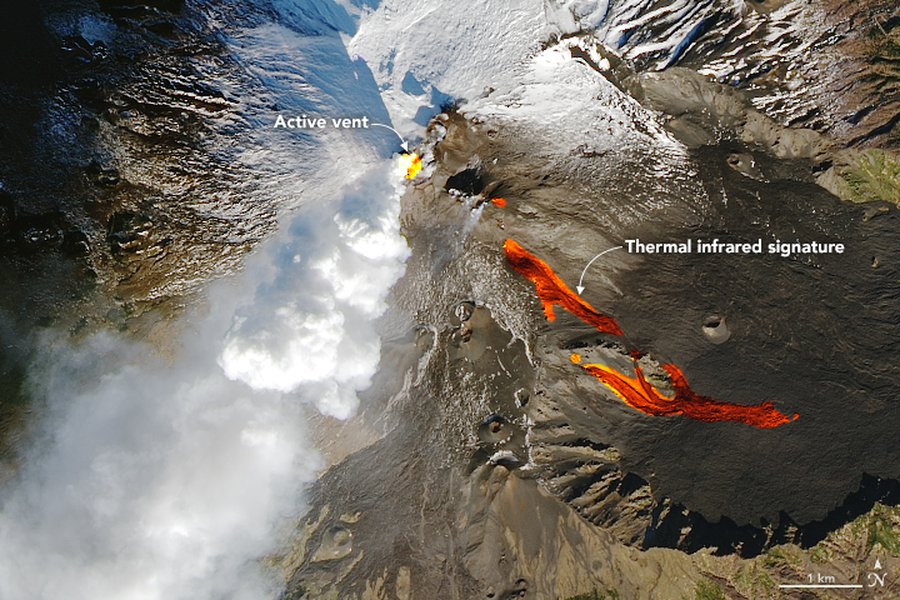
An aerial view of Mount Etna's flank eruption on December 24, 2018, captured by satellite, highlighting the new eruptive fissure and the associated ash plume.
Duration and Characteristics of the Eruptive Episode
A Short but Intense Volcanic Display
The primary eruptive phase of Mount Etna's 2018 flank eruption lasted for a concise but impactful period of approximately 3 to 4 days. Volcanic activity, including significant lava output and ash emissions, officially subsided by December 27 or 28, 2018. During this brief window, the eruption displayed several key characteristics:
- Lava Flows: Lava poured from the newly formed fissure on the southeastern flank, directing flows predominantly towards the vast Valle del Bove. While the total volume of lava was considered relatively small compared to some of Etna's historical eruptions, its rapid effusion underscored the intensity of the event.
- Ash Plumes: A vigorous column of ash rose to significant altitudes, reaching approximately 8 to 9.5 kilometers (26,200 to 31,000 feet) above sea level. This dense ash plume dispersed southeast of the volcano, significantly impacting air quality and visibility. As a result, airspace around Mount Etna, including Catania Airport, was temporarily closed due to aviation risks.
- Explosive Activity: The eruption involved Strombolian-style explosions and lava fountains, contributing to the dramatic visual spectacle and the generation of volcanic ash.
- VEI Rating: The event was classified with a Volcanic Explosivity Index (VEI) of 2, indicating a small but explosive episode capable of generating substantial ash clouds and lava flows.
While the main eruptive activity concluded within days, the broader impact on the volcano's internal dynamics and seismic behavior extended beyond this period. This rapid, short-lived event served as a critical case study for understanding how pressure imbalances within Etna's magma system can trigger both summit and flank eruptions.
The Unprecedented Seismic Crisis
Earthquakes as a Harbinger and Consequence
Perhaps one of the most distinctive features of the 2018 flank eruption was the accompanying seismic crisis, which was of an unprecedented magnitude for Mount Etna since geophysical monitoring networks were installed in 1970. This seismicity was both a precursor and a direct consequence of the eruptive activity.
- Initial Seismic Swarm: Hours before the visible eruption, on the morning of December 24, an intense swarm of over 130 earthquakes occurred within a three-hour window. This swarm was a direct indication of magma intrusion at shallow depths, forcing its way through the volcano's structure and causing the ground to fracture.
- Magnitude 4.9 Earthquake: Two days into the eruption, on December 26, 2018, a significant magnitude 4.9 (Mw) earthquake struck the southeastern flank of Mount Etna. This shallow earthquake, located approximately 5 kilometers northwest of Acireale, caused severe damage to nearby towns and villages. It resulted in at least 10 injuries and displaced over 1100 people, underscoring the direct and devastating impact of volcanic-tectonic activity on human populations.
- Extended Seismic Activity: The seismic activity outlasted the main eruptive phase. The magnitude 4.9 earthquake was followed by an intense swarm of about 250 events with magnitudes less than 3, which continued until the end of February 2019. This prolonged seismicity reflected the ongoing adjustments within the volcano's edifice as it responded to the changes in internal pressure and the emptying of shallow magma chambers.
This video captures the dramatic scenes of Mount Etna's flank eruption in 2018, highlighting the seismic activity and intense volcanic emissions. It visually contextualizes the reports of over 130 earthquakes that accompanied the eruption, offering a dynamic perspective on the scale of the event.
Scientific Insights and Impact
Revealing Etna's Magma Dynamics and Deformation
The 2018 flank eruption provided an extraordinary opportunity for volcanologists to study the complex interplay between magma intrusion, flank instability, and volcanic seismicity. Monitoring networks recorded unprecedented ground deformation and seismic patterns, offering critical data that contributed to a deeper understanding of Etna's plumbing system. The event demonstrated how the sudden intrusive event was linked to the extreme overpressurization of the volcano, which was eventually relieved through the eruptive release.
Analysis of erupted materials, including ash and lava samples, revealed the mixing of magmas from different depths, with crystal cores indicating storage pressures. This offered valuable insights into the volcano's internal factory and how pressure imbalances dictate eruptive styles, leading to both summit and flank eruptions. The insights gained from the 2018 event continue to inform improved hazard assessments and monitoring strategies for Mount Etna, a volcano that has a long and active history dating back to 1500 BCE.
Volcanic Processes at Play in the 2018 Etna Eruption
~9:30 AM Local Time"] id2["Duration: ~3-4 Days
Concluded: Dec 27-28, 2018"] id3["Key Characteristics"] id4["Flank Eruption: Southeastern Fissure"] id5["Lava Flows: Directed towards Valle del Bove"] id6["Ash Plumes: Up to 8-9.5 km high"] id7["Explosive Activity: Strombolian, Lava Fountains"] id8["VEI: 2 (Small but Explosive)"] id9["Associated Seismic Activity"] id10["Pre-Eruption Swarm: >130 Earthquakes (Dec 24)"] id11["Main Earthquake: Mw 4.9 (Dec 26)"] id12["Location: 5 km NW of Acireale"] id13["Impact: Damage, 10 Injuries, >1100 Displaced"] id14["Post-Eruption Swarm: ~250 Events (from Deep Magma Recharge"] id17["Dyke Intrusion at Shallow Depth"] id18["Significant Ground Deformation
Unprecedented since 1970"] id19["Impacts & Significance"] id20["Airspace Closures (Catania Airport)"] id21["Valuable Data for Volcano Monitoring"] id22["Insights into Etna's Plumbing System"] id23["Improved Hazard Assessments"]
This mindmap illustrates the interconnected events and characteristics of the 2018 Mount Etna flank eruption, from its precise timing and duration to the significant seismic activity and the underlying geological processes that drove it. It highlights how various factors contributed to this notable volcanic event.
Comparative Analysis of Eruption Features
A Look at the Magnitudes and Manifestations
To better understand the scale and nature of the 2018 flank eruption, it's useful to compare its various features. The following table summarizes key aspects discussed, providing a consolidated view of the event's intensity and impact.
| Feature | Description / Value | Significance |
|---|---|---|
| Start Date | December 24, 2018, ~9:30 AM local time | First significant flank eruption in a decade. |
| Main Eruptive Duration | ~3-4 days (concluding by Dec 27-28, 2018) | Relatively short-lived but intense lava and ash output. |
| Eruptive Fissure Length | ~2 kilometers | New crack on the southeastern flank, feeding lava into Valle del Bove. |
| Ash Plume Height | Up to 8-9.5 kilometers (26,200-31,000 feet) | Caused widespread ash dispersal and airspace closures. |
| Pre-Eruption Earthquake Swarm | >130 earthquakes in 3 hours (Dec 24) | Indicative of shallow dyke intrusion and magma movement. |
| Largest Associated Earthquake | Magnitude 4.9 (Mw) on December 26, 2018 | Caused significant damage, injuries, and displacement in nearby towns. |
| Post-Eruption Seismic Activity | ~250 events ( | Indicates ongoing structural adjustments within the volcano. |
| Volcanic Explosivity Index (VEI) | 2 | Classifies the eruption as small to moderate, with significant ash. |
| Ground Deformation | Unprecedented since 1970 | Reflects significant internal pressure changes and edifice response. |
Understanding Etna's Volcanic Profile: A Radar Chart Analysis
Assessing Key Volcanic Parameters and Impact Categories
To provide a holistic view of the 2018 flank eruption's characteristics and its significance relative to various volcanic parameters, a radar chart can effectively illustrate the interplay of different factors. This chart offers a qualitative assessment based on the intensity and impact observed during this particular event.
The radar chart visually compares the 2018 flank eruption of Mount Etna against a 'Typical Etna Eruption' baseline across several key parameters. It highlights that while the lava volume (4) was moderate, the seismic activity (9), ground deformation impact (9), and social impact (8) were exceptionally high for the 2018 event, signifying its unique intensity beyond just eruptive output. Eruptive intensity (7) and ash plume height (8) were also notably elevated.
Frequently Asked Questions (FAQ)
When did Mount Etna's 2018 flank eruption start?
How long did the main eruptive phase of the 2018 Etna eruption last?
What was the most significant seismic event during the 2018 Etna eruption?
Was the 2018 Etna eruption a summit or flank eruption?
Did the 2018 Etna eruption affect local aviation?
Conclusion
The 2018 flank eruption of Mount Etna, commencing on Christmas Eve, December 24, and lasting approximately 3 to 4 days, was a pivotal event in the volcano's recent history. Characterized by the opening of a new 2-kilometer fissure on its southeastern flank, moderate lava flows into the Valle del Bove, and a vigorous ash plume reaching up to 9.5 kilometers, it significantly impacted regional aviation and air quality. However, the true hallmark of this eruption was the unprecedented seismic crisis that accompanied it. From an initial swarm of over 130 earthquakes to a powerful magnitude 4.9 tremor that caused extensive damage and displacement, the seismic activity underscored the immense pressures within Etna's plumbing system. This event provided critical data for volcanologists, shedding light on the intricate relationship between magma intrusion, ground deformation, and volcanic seismicity, thereby enhancing hazard assessments and monitoring capabilities for this remarkably active stratovolcano.
Recommended Searches
- Explore the historical timeline of major Mount Etna eruptions and their characteristics.
- Understand the Volcanic Explosivity Index (VEI) and how it classifies volcanic eruptions.
- Investigate the role of seismic swarms and ground deformation in forecasting volcanic activity.
- Learn more about the specific dangers and operational challenges posed by volcanic ash to aircraft.