
EU Software Compliance Risk Management
A comprehensive guide to secure and compliant software development in the EU
Key Takeaways
- Establish a comprehensive risk management framework that embeds security and compliance throughout the software lifecycle.
- Adopt secure development practices with continuous vulnerability management, secure design, and regular testing to meet EU regulatory standards.
- Implement robust monitoring, documentation, and third-party oversight to ensure ongoing compliance with diverse EU directives and regulations.
Introduction
Software developers targeting the European Union market must navigate a regulatory landscape characterized by evolving cybersecurity standards and stringent compliance requirements. Achieving compliance not only minimizes legal risks but also strengthens a product’s resilience against cyber threats.
Modern risk management in the EU context demands an integrated approach that begins from the early stages of software development and extends throughout the product lifecycle. Developers must integrate risk assessment and mitigation strategies into the design, development, testing, deployment, and maintenance phases. In addition, compliance involves aligning with multiple regulatory frameworks including the Digital Operational Resilience Act (DORA), the Cyber Resilience Act (CRA), the Network and Information Security Directive 2 (NIS2), and the General Data Protection Regulation (GDPR).
Establishing a Comprehensive Risk Management Framework
Understanding Risk Management in the EU Context
A robust risk management framework is critical for developing software that meets EU compliance standards. This framework should encompass:
Risk Identification and Assessment
Developers must systematically identify risks throughout the software lifecycle. This includes:
- Mapping out potential vulnerabilities during the planning and design phases.
- Evaluating risks related to data breaches, cybersecurity threats, and compliance failures under GDPR.
- Utilizing methodologies such as Failure Modes and Effects Analysis (FMEA), threat modeling, or hazard analysis (HAZOP) to assess the probability and severity of identified risks.
Defining Roles and Responsibilities
It is critical to define clear roles and responsibilities within the risk management team. In multidisciplinary teams, experts in cybersecurity, legal, compliance, and operational areas should collaborate to shape an effective risk strategy. Establishing accountability ensures that responsibility for maintaining compliance and mitigating risks is integrated across the organization.
Implementing Secure-by-Design Strategies
Embedding Security in Every Phase
Secure-by-design is the cornerstone of building resilient software. This strategy advocates integrating security measures from the very beginning of the development process:
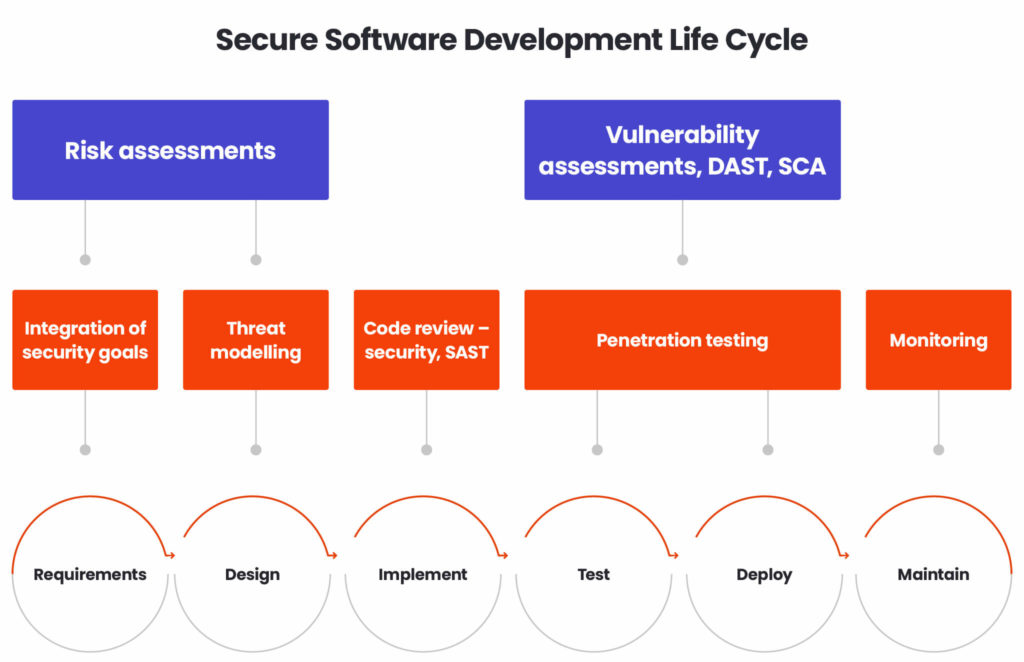
Secure Software Development Lifecycle (SDLC)
Integrating a Secure Software Development Lifecycle (SDLC) ensures that security is not an afterthought but a continuous process. Developers are encouraged to:
- Implement secure coding standards to minimize vulnerabilities.
- Conduct rigorous static and dynamic application security testing (SAST/DAST) so that security issues are identified early.
- Adopt automated tools for continuous security assessment to sustain code quality and detect emerging vulnerabilities.
Vulnerability Management and Patch Deployment
Ongoing vulnerability management is essential to mitigate risks post-deployment. Developers should establish a structured vulnerability management process that includes:
- Timely identification and classification of potential threats.
- A 24-hour reporting mechanism for actively exploited vulnerabilities.
- Maintaining a comprehensive Software Bill of Materials (SBOM) that provides transparency for all open-source and third-party components.
- Regular patching, updates, and remediation procedures to address discovered vulnerabilities promptly.
Adhering to EU Regulatory Compliance
Navigating the EU Regulatory Landscape
Compliance with EU regulations necessitates an alignment with various legislative frameworks that focus on both cybersecurity and privacy. Key regulations include:
Digital Operational Resilience Act (DORA)
DORA emphasizes the need for financial institutions and stakeholders to maintain operational resilience against ICT-related incidents. Relevant measures under DORA include:
- Integrating secure development practices into the core ICT risk management framework.
- Continuous monitoring and threat modeling that adapts to emerging cybersecurity risks.
- Implementing technical controls such as digital certificates lifecycle monitoring and vulnerability disclosures.
Cyber Resilience Act (CRA) and NIS2
The CRA and NIS2 directives focus on ensuring products and networks meet elevated cybersecurity standards. Developers must:
- Embed security by default configurations to minimize end-user intervention in maintaining security.
- Perform rigorous conformity assessments, requiring extensive testing and periodic recertification of software products.
- Implement secure authentication, encryption, and access control measures, ensuring comprehensive protection of user data and system integrity.
- Continuously monitor the supply chain to verify that third-party components meet these regulatory standards.
General Data Protection Regulation (GDPR)
Software that processes personal data must comply with GDPR by:
- Adopting privacy by design principles, which include data minimization, user consent management, and secure handling of sensitive data.
- Implementing robust data encryption, pseudonymization, and controlled access mechanisms.
- Maintaining transparent data processing records and comprehensive security documentation to facilitate audits and regulatory inspections.
Continuous Monitoring, Documentation, and Review
Ensuring Sustained Compliance and Security
Continuous monitoring and documentation are critical components of an effective risk management strategy. EU regulations require that developers not only implement robust security controls but also maintain documentation that details these measures for audits and inspections.
Documentation and Transparency
Detailed documentation should include:
- Technical documentation of security controls implemented.
- Records of risk assessments, incident reports, and post-market surveillance data.
- Logs of software updates, patch deployments, and remediation efforts.
Regular Audits and Third-Party Evaluations
Routine internal and external audits are crucial for:
- Verifying the effectiveness of risk management and cybersecurity measures.
- Identifying gaps in compliance with new EU standards and directives.
- Facilitating continuous improvement cycles based on real-time data and evolving threat landscapes.
Third-Party Risk Management and Supply Chain Security
Mitigating Risks from External Dependencies
Software development today often relies on a multitude of third-party components ranging from libraries to complete third-party platforms. Ensuring these external dependencies do not introduce vulnerabilities is a must for EU market compliance.
Vendor and Supply Chain Oversight
Organizations should:
- Perform due diligence on ICT providers and third-party vendors.
- Regularly audit and assess the security postures of external software components.
- Utilize contractual requirements and certifications to ensure that external partners adhere to the same rigorous security standards expected internally.
Integrating Third-Party Risk into the Overall Framework
Incorporate third-party risk management into the broader risk management strategy by:
- Mapping the supply chain and identifying critical external dependencies.
- Establishing ongoing monitoring and evaluation processes to identify and respond to vulnerabilities in external software components.
- Implementing contingency plans to manage disruptions caused by third-party failures.
Risk Assessment Methodologies and Secure Testing
Utilizing Comprehensive Risk Analysis Techniques
Selecting the right risk assessment methodology is vital to tailoring a risk management plan that accurately reflects the unique challenges of each software project. Developers may use several established techniques to evaluate and prioritize risks:
Risk Assessment Techniques
Common methodologies include:
- Failure Modes and Effects Analysis (FMEA): Evaluate potential points of failure and their impact on the system.
- Threat Modeling: Identify potential threats and adversary tactics to anticipate attack vectors.
- Hazard Analysis (HAZOP): Assess the process and design for possible deviations and unsafe conditions.
Static and Dynamic Application Security Testing (SAST/DAST)
Integrating both static (code-based) and dynamic (runtime) analyses into the SDLC allows for early detection of vulnerabilities. Automation tools help in continuously scanning the codebase, providing developers with immediate feedback about any inconsistencies or exposures that could compromise security.
Practical Implementation: A Summary Table
The table below provides an overview of key risk management measures that software developers should adopt for EU market compliance:
| Risk Management Measure | Description | Relevant EU Regulations / Standards |
|---|---|---|
| Comprehensive Risk Management Framework | Establish a systematic process for identifying, assessing, and mitigating risks throughout the software lifecycle. | DORA, CRA, GDPR |
| Secure-by-Design and SDLC Integration | Embed security measures at every development stage, including secure coding, regular testing, and automated vulnerability assessments. | CRA, NIS2 |
| Vulnerability Management & Patch Deployment | Implement continuous monitoring, vulnerability reporting, and timely patching processes. | CRA, DORA |
| Compliance with Specific EU Regulations | Adhere to directives such as GDPR for data protection, DORA for operational resilience, and NIS2 for secure network management. | GDPR, DORA, NIS2 |
| Documentation & Transparency | Maintain detailed records of risk assessments, security controls, audits, and compliance measures. | EU Software Liability Directive, GDPR |
| Third-Party Risk Management | Conduct regular assessments of external vendors and supply chain components, integrating these checks into the overall security strategy. | CRA, NIS2 |
Strategic Considerations for Long-Term Compliance
Integration into Organizational Cyber Strategies
Adapting to the EU compliance landscape requires long-term strategic planning that transcends initial application development. Organizations should embed risk management into their broader cyber strategies, which should encompass:
Continuous Improvement and Adaptation
As cyber threats evolve, the risk management framework must be adaptable:
- Regular reviews ensure that risk mitigation strategies remain aligned with emerging threats and regulatory changes.
- Post-market surveillance and continuous risk monitoring allow organizations to respond proactively to incidents and shifting risk landscapes.
- An agile approach to compliance involves periodic training for development teams and updates to security protocols as new vulnerabilities are discovered.
Collaboration and Information Sharing
Collaboration across departments and with regulatory bodies further strengthens cybersecurity capabilities:
- Participation in industry forums and regulatory consultations helps organizations keep abreast of best practices and regulatory updates.
- Establishing information sharing protocols with third-party vendors and within industry networks ensures a coordinated response to emerging threats.
- Cooperation with certification bodies and external auditors provides an independent evaluation of security measures and enhances credibility in the EU market.
Investment in Security Infrastructure
Achieving compliance is resource-intensive, requiring:
- Investment in advanced security tools such as automated vulnerability scanners, penetration testing software, and continuous integration/deployment (CI/CD) pipelines integrated with security checks.
- Allocation of resources for regular training and certification of development and security teams, ensuring that best practices are maintained.
- Budget planning that considers certification processes and the administrative costs associated with compliance audits and documentation.
Conclusion and Final Thoughts
Software developers aiming for the EU market must adopt a multifaceted risk management strategy that is both comprehensive and adaptive. By integrating a robust risk management framework from the inception of the software development process, incorporating secure-by-design principles, and continuously monitoring and testing vulnerabilities, developers can meet the high standards set by EU regulations such as DORA, CRA, NIS2, and GDPR.
This proactive approach not only minimizes cybersecurity risks but also builds a product’s resilience against ever-evolving threats. Moreover, clear documentation, transparency in the use of third-party components, and periodic audits ensure that the software remains compliant over its entire lifecycle. In today’s complex regulatory environment, investments in secure development practices and continuous improvement are not just necessary steps for compliance—they are essential components of building trust with users and safeguarding digital assets.
Embracing these comprehensive measures helps organizations navigate the challenges of an increasingly regulated digital landscape, fostering both operational resilience and organizational success in the competitive EU market.
References
- EU Regulatory Impact on Software - InfoSecurity Magazine
- Risk Management for SaMD - Oriel Stat
- Software Risk Management - Johner Institute
- EU Software Legislation Impact - GitHub
- Developers' Guide to GDPR - FusionAuth
- Digital Services Act - European Commission
- EU AI Act Compliance Checker - Artificial Intelligence Act
More
Last updated February 18, 2025