
Prioritizing Victory: Unpacking the "Europe First" Strategy of the Allies in World War II
A Grand Strategic Decision That Shaped the Course of Global Conflict
The "Europe First" policy, also known as the "Germany First" policy, was a pivotal grand strategy adopted by the United States and the United Kingdom during World War II. This strategy dictated that the overwhelming majority of Allied resources and military efforts would be concentrated on defeating Nazi Germany in Europe before turning full attention to the war in the Pacific against Japan. This approach was a cornerstone of Allied cooperation and profoundly influenced the allocation of manpower, weaponry, and strategic planning throughout the conflict.
Understanding this policy requires delving into the geopolitical landscape of the early 1940s, the perceived threats from the Axis powers, and the complex dynamics of coalition warfare. While the attack on Pearl Harbor by Japan on December 7, 1941, brought the United States formally into the war, it did not alter the fundamental commitment to Europe First. This strategic decision was solidified at the Arcadia Conference in December 1941, where President Franklin D. Roosevelt and Prime Minister Winston Churchill affirmed their shared conviction that Nazi Germany posed the most significant and immediate threat to global security.
Key Insights into the "Europe First" Strategy
- Primary Threat Assessment: The Allies, particularly the United States and the United Kingdom, viewed Nazi Germany as the most formidable and immediate threat due to its industrial capacity, technological advancements, and aggressive territorial expansion across Europe, which directly imperiled Allied interests and threatened to overwhelm key allies like the Soviet Union and Great Britain.
- Resource Allocation Priority: Under this doctrine, approximately 70% of Allied resources, including troops, equipment, and logistical support, were dedicated to the European theater. This allowed for a concerted and sustained offensive against Germany and Italy, while a more contained "holding action" was pursued in the Pacific against Japan.
- Coalition Unity and Geopolitical Stability: The strategy fostered stronger collaboration between the Western Allies and the Soviet Union, who were bearing the brunt of the German assault on the Eastern Front. A swift defeat of Germany was seen as crucial to preventing Hitler from consolidating power and potentially becoming an "unconquerable fortress" in Europe, which would have had devastating long-term geopolitical consequences.
The Genesis of a Grand Strategy
The Perceived Imminent Danger from Nazi Germany
The decision to prioritize Europe stemmed from a comprehensive assessment of the global threat posed by the Axis powers. While Japan's aggression in the Pacific was undeniable, Nazi Germany under Adolf Hitler presented a more immediate and existential danger to the Allied nations. Germany's rapid conquests across Europe, including the invasion of Poland in 1939 and subsequent occupations, demonstrated its military might and expansionist aims. The fear was that if Germany succeeded in defeating the Soviet Union and isolating Great Britain, it would gain control over vast industrial and natural resources, making it an unassailable force.
The British, already engaged in a desperate struggle against Germany, strongly advocated for this approach. They recognized that diverting significant American resources to the Pacific would weaken the European front, potentially leading to the collapse of their resistance and the Soviet Union's defeat. President Roosevelt, despite initial American public sentiment that favored retaliation against Japan after Pearl Harbor, ultimately agreed with Churchill's assessment. This consensus was vital for coordinating a unified Allied response.

A map illustrating the volatile geopolitical landscape of Europe in 1939, just before the outbreak of World War II, highlighting the expansionist ambitions of Nazi Germany.
The Arcadia Conference and Formalization
The "Europe First" strategy was formally solidified at the Arcadia Conference in Washington D.C., held from December 22, 1941, to January 14, 1942. This conference, occurring shortly after the United States' entry into the war, brought together President Roosevelt and Prime Minister Churchill, along with their top military advisors. Despite the shock and anger over Pearl Harbor, the leaders affirmed that Germany was the primary enemy and that the major effort would be made initially in Europe. This commitment was crucial for setting the strategic direction of the war for the Allied powers.
The logic behind this decision was multifaceted:
- Germany's Industrial and Scientific Capacity: Allied leaders feared Germany's advanced industrial base and potential to develop devastating new weapons, including atomic bombs, if given enough time.
- Threat to Key Allies: The UK and the Soviet Union were under direct and sustained assault from Germany. Their collapse would have left the U.S. facing a much more formidable and entrenched enemy.
- Geographic Proximity: Europe was geographically closer to Allied supply lines from North America, making it logistically more feasible to deploy and sustain large forces compared to the vast distances of the Pacific.
- Consolidating Power: A German victory in Europe would have given Hitler control over immense human and material resources, creating an almost unconquerable fortress.
Implementation and Resource Allocation
A Two-Front War with Asymmetrical Focus
While the "Europe First" policy dictated a primary focus on Germany, it did not mean abandoning the Pacific theater entirely. Instead, a strategy of "holding action" was implemented against Japan. This involved defensive measures and limited offensives to contain Japanese expansion while the bulk of Allied power was directed towards Europe. Approximately 70% of Allied resources were allocated to the European front, with 30% designated for the Pacific. This asymmetric allocation allowed the Allies to build overwhelming force in Europe while preventing Japan from posing an insurmountable threat.
This approach demanded significant coordination and strategic discipline from the Allied powers, particularly the United States, which faced strong public pressure to retaliate aggressively against Japan. However, the leadership recognized the strategic imperative of dismantling the core of the Axis power, which they believed resided in Nazi Germany.
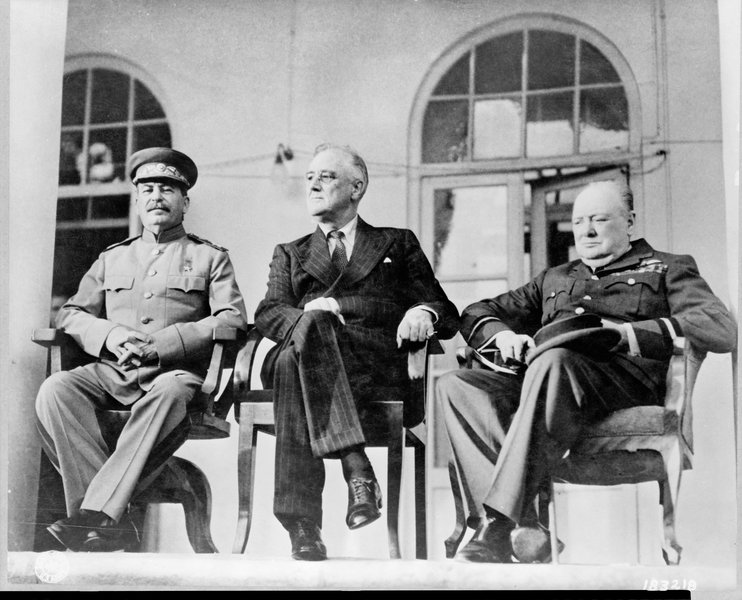
The 'Big Three' Allied leaders: Winston Churchill, Franklin D. Roosevelt, and Joseph Stalin, whose strategic decisions, including "Europe First," guided the Allied war effort.
The Allied Coalition: Strengths and Challenges
The "Europe First" strategy was a product of coalition warfare, involving the complex interplay of interests, capabilities, and challenges among the major Allied powers: Great Britain, the United States, and the Soviet Union. Often referred to as the "Grand Alliance" or "Big Three," these nations, despite their differing political aims and geographical separation, formed an effective military team.
| Allied Power | Primary Contribution to Europe First | Strategic Priorities & Concerns |
|---|---|---|
| United States | Provided immense industrial capacity, military manpower, and logistical support. Committed to the European theater despite Pearl Harbor. | Defeating Germany to secure the European continent and prevent further Axis consolidation. Building up forces for a decisive cross-channel invasion. |
| United Kingdom | Crucial in advocating for "Europe First" and providing a strategic base for Allied operations. Endured significant German assaults. | Survival against German aerial and naval attacks; protecting supply lines; opening a second front to relieve pressure on the Soviet Union. |
| Soviet Union | Absorbed the vast majority of German ground forces on the Eastern Front, inflicting heavy casualties and tying down critical resources. | Demanded a "second front" in Western Europe to alleviate the immense pressure and casualties on its own territory. |
| Other Allies (e.g., France, Canada) | Contributed troops, naval forces, and strategic positions. Provided support for liberation efforts. | Liberation of occupied territories; securing their sovereignty; contributing to the collective Allied effort. |
The coordination between these powers was facilitated through numerous conferences, though direct meetings between Roosevelt, Churchill, and Stalin were rare. Despite the geographical distances and differing perspectives (e.g., Stalin's persistent demand for an immediate second front), the shared understanding of the existential threat posed by Germany cemented their strategic alignment.
Strategic Considerations and Outcomes
The Logic of Overwhelm and Containment
The "Europe First" strategy embodied a clear logic: overwhelm the most dangerous enemy first. By concentrating resources, the Allies aimed to achieve decisive victories in Europe, thereby crippling Germany's ability to wage war on multiple fronts. This also allowed them to support the Soviet Union, which was bleeding the German Wehrmacht dry on the Eastern Front. The subsequent invasion of Sicily and Italy, followed by the monumental D-Day landings in Normandy, were direct consequences of this strategic prioritization, continuously diverting German resources and forcing speculation on the location of the next major assault.
The radar chart below illustrates a qualitative comparison of the perceived threats and strategic priorities guiding the "Europe First" policy. These are subjective assessments based on the historical context and the reasoning articulated by Allied leaders.
The radar chart visually represents how the Allies perceived Germany as a significantly greater threat across multiple dimensions, including military strength, industrial capacity, and geopolitical impact, justifying the "Europe First" prioritization. Japan, while a threat, was seen as comparatively less immediate in its global implications and more geographically contained.
A Crucial Strategic Decision
The "Europe First" policy was critical for the Allied victory in World War II. It allowed for the focused application of overwhelming force against the most dangerous Axis power, preventing a prolonged and potentially unwinnable two-front war with equally divided resources. While American resources were initially allocated more to the Pacific due to the immediate aftermath of Pearl Harbor, by 1944, a clear preponderance of U.S. resources was directed towards Europe, leading to the successful conclusion of the European theater by early 1945.
This strategic foresight and disciplined execution proved instrumental in achieving victory against the Axis powers. The interconnectedness of the European and Asian theaters was implicitly recognized, with the understanding that success in Europe would profoundly impact the Pacific. The policy, while sometimes controversial in public opinion, especially in the US following the attack on Pearl Harbor, ultimately proved to be a sound military and political decision.
Insights into Allied Wartime Strategy
The Broader Allied Approach to World War II
The "Europe First" policy was a cornerstone of the broader Allied strategy, which aimed to defeat the Axis powers (Germany, Italy, and Japan) through a coordinated and overwhelming military effort. This strategy was not merely about prioritizing one theater over another but also about achieving several key objectives:
- Defeating Germany First: As elaborated, this was the central tenet, aiming to eliminate the strongest Axis power and liberate occupied Europe.
- Maintaining Coalition Unity: Despite ideological differences between the Western democracies and the Soviet Union, maintaining a united front against the common enemy was paramount.
- Economic Mobilization: The Allies leveraged their vast industrial capabilities to outproduce the Axis powers in military equipment and supplies.
- Strategic Bombing: A sustained aerial bombing campaign against German industrial and military targets aimed to cripple their war-making capacity.
- Island-Hopping in the Pacific: Concurrently, in the Pacific, the U.S. adopted an "island-hopping" strategy to gradually advance towards the Japanese mainland, bypassing heavily fortified islands to conserve resources and speed up the offensive.
The strategic decisions made by the Allied leaders, particularly the "Big Three," were dynamic and adapted to the evolving war situation. The synergy between the different theaters, though prioritized, was critical for ultimate victory.
This video, "World War II: Military Strategy," provides an overview of the D-Day Invasion and other key Allied offensives, highlighting the implementation of the "Europe First" policy and its impact on the liberation of France from German occupation.
The D-Day invasion, prominently featured in the video, serves as a prime example of the "Europe First" strategy in action. This massive amphibious assault on June 6, 1944, was the culmination of years of planning and resource accumulation, directly aimed at opening a decisive second front in Western Europe. It underscored the Allies' commitment to direct engagement with German forces on the European continent and was a critical step towards the eventual defeat of Nazi Germany. The sheer scale and complexity of D-Day would not have been possible without the strategic prioritization of resources to the European theater, illustrating the profound impact of the "Europe First" policy on the ground.
Frequently Asked Questions (FAQ)
What was the primary reason for adopting the "Europe First" strategy?
Did the "Europe First" policy mean abandoning the war in the Pacific?
Which Allied leaders were instrumental in deciding on this strategy?
How were resources typically divided between the European and Pacific theaters?
Conclusion
The "Europe First" policy was a defining element of Allied grand strategy during World War II, a calculated decision rooted in the comprehensive assessment of global threats and the imperative of coalition unity. By concentrating the preponderance of their resources and military might against Nazi Germany, the Allies aimed to dismantle the most potent Axis power and secure the European continent. This strategic prioritization, agreed upon by the United States and the United Kingdom, allowed for a coordinated and decisive war effort that ultimately led to the defeat of the Axis powers. The policy underscored the critical importance of a unified vision and disciplined resource allocation in achieving victory in a global conflict of unprecedented scale.
Recommended Searches
- Explore the impact of the Europe First policy on the Pacific Theater during WWII.
- Learn more about the major Allied strategic conferences during World War II.
- Understand the comparison of industrial capacities between Axis and Allied powers in WWII.
- Discover the role of the Lend-Lease Act in supporting the Europe First strategy.