
Unlock Accurate Injection Mold Costing: Existing Tools & Building Your Own Excel Estimator
Discover readily available Excel cost calculators and learn a detailed methodology to create your own precise injection molding cost analysis.
Estimating the cost of plastic injection molds and the subsequent parts is a critical step in product development and manufacturing planning. Fortunately, you don't have to start from scratch. Several resources, including pre-built Excel spreadsheets, exist online. Additionally, understanding the core methodology allows you to build or adapt a tool tailored to your specific needs.
Essential Insights into Injection Molding Cost Estimation
- Existing Tools Available: Several downloadable Excel spreadsheets and online calculators already exist, offering varying levels of detail for estimating mold and part costs.
- Key Cost Components: Accurate estimation requires breaking down costs into distinct categories: tooling (mold making), materials, production (machine time, labor), and secondary operations.
- Volume is Crucial: The initial mold cost is a significant fixed investment; higher production volumes amortize this cost, drastically reducing the per-part price.
Finding Existing Injection Molding Cost Estimator Spreadsheets
Leveraging Pre-Built Resources
Several organizations and platforms offer Excel-based tools designed to streamline the cost estimation process for plastic injection molding. These calculators typically incorporate various crucial factors and provide a structured way to input project specifics and receive cost projections. Utilizing these can save significant time and provide a solid foundation based on established models.
Here are some examples of available resources:
- Engineers Edge Calculator: Provides an Excel spreadsheet considering material, part size/complexity, finish, volume, tolerances, and machine tools.
- Scribd Calculators: Documents often available containing tables for raw material, mold making, and production costs based on volume and cavity numbers.
- Slidesdocs Templates: Offers free, editable Excel/Google Sheets templates specifically for manufacturing cost estimation in injection molding.
- CustomPartNet Calculator: An online tool (potentially exportable or adaptable for Excel) allowing detailed input for mold and production variables to build a cost model.
- Micromolding Calculators: Provides resources explaining pricing principles and may offer simplified Excel models illustrating the impact of factors like cavity count.
- AI-Enhanced Estimators: Some platforms offer Excel tools integrated with AI for potentially more nuanced estimations of part cost, mold cost, and cycle times.
- Research & Training Files: Academic papers or training resources sometimes include downloadable Excel workbooks (like the "Quicksight Mold Estimator" or Polybridge Training files) demonstrating cost estimation methodologies.
These tools often break down costs into categories like raw materials, mold fabrication, and production operations, reflecting how costs scale differently (e.g., material cost scales with volume, while mold cost is largely fixed). They serve as excellent starting points or validation tools for your own analytical process.
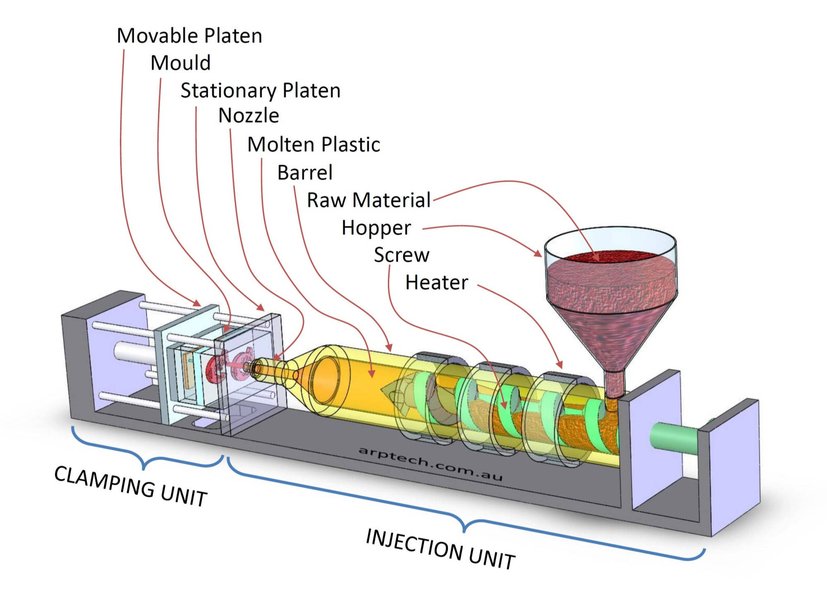
An injection molding machine, the core equipment in the production process.
Detailed Methodology for Building Your Excel Cost Estimator
A Step-by-Step Approach to Comprehensive Cost Analysis
If existing templates don't fully meet your requirements or you wish to build a deeper understanding, developing your own Excel-based estimator is feasible. A robust methodology involves systematically breaking down and quantifying all cost drivers involved in creating the mold and producing the parts.
1. Tooling (Mold) Cost Calculation
The mold is often the most significant upfront investment. Its cost is driven by complexity, size, material, and required lifespan.
- Mold Base Cost: This depends on the mold's overall dimensions (length, width, height), the material used (e.g., P20 steel, H13 steel, aluminum), and the number of cavities (how many parts are made per cycle). More cavities increase mold cost but decrease part cost at high volumes.
- Complexity & Features: Intricate part geometries necessitate complex mold features. Factors adding cost include:
- Slides and Lifters: Needed for parts with undercuts or complex shapes. Each mechanism adds design, machining, and fitting time.
- Side Actions/Cams: Similar to slides, used for external features.
- Cooling Channels: More complex or conformal cooling improves cycle time but increases mold machining cost.
- Surface Finish: Higher polish levels (e.g., SPI A-1) require significant hand labor and increase cost. Textured finishes also add process steps.
- Tolerances: Tighter tolerances require more precise machining and quality control.
- Mold Material & Lifespan: Hardened steel molds (like H13) are more expensive but last for high-volume production (millions of cycles). Aluminum molds are cheaper and faster to machine but suitable only for lower volumes (thousands to tens of thousands of cycles).
Excel Implementation: Use input fields for dimensions, cavity count, material type (linked to base cost factors), and checkboxes or counts for special features. Lookup tables or tiered pricing based on complexity can automate cost additions.

A complex injection mold installed within the molding machine.
2. Material Cost Calculation
The cost of the plastic resin is a major component of the per-part cost.
- Resin Selection: Different plastics (e.g., ABS, PP, PC, Nylon, PEEK) have vastly different costs per kilogram or pound. Commodity plastics are cheaper ($1-3/kg), while engineering or high-performance plastics can be significantly more expensive ($5-$50+/kg).
- Part Volume & Weight: Calculate the volume of the part (from CAD) and multiply by the material's density to get the weight per part. \[ \text{Part Weight (kg)} = \text{Part Volume (cm}^3\text{)} \times \text{Material Density (g/cm}^3\text{)} / 1000 \]
- Runner System & Scrap Rate: Include the material used in the runner system (channels delivering plastic to the cavities), which is often reground or discarded. Account for a typical scrap rate (e.g., 2-5%) for defects or process adjustments. \[ \text{Total Material Weight per Cycle} = (\text{Part Weight} \times \text{Number of Cavities} + \text{Runner Weight}) \times (1 + \text{Scrap Rate}) \] \[ \text{Material Cost per Part} = (\text{Total Material Weight per Cycle} / \text{Number of Cavities}) \times \text{Resin Cost per kg} \]
Excel Implementation: Create a database or lookup table for different resins with their densities and current market prices. Input part volume from CAD data. Calculate weight and apply scrap rate.
3. Production Cost Calculation
This covers the cost of running the injection molding machine and associated labor.
- Cycle Time: The total time to produce one set of parts (one shot). It comprises injection time, packing/holding time, cooling time (often the longest component), and mold open/part ejection time. Shorter cycle times mean higher output and lower cost per part. It's influenced by part thickness, material, mold cooling efficiency, and machine parameters. \[ \text{Cycle Time (seconds)} = \text{Injection Time} + \text{Packing Time} + \text{Cooling Time} + \text{Mold Movement Time} \]
- Machine Hourly Rate: This rate covers the cost of using the injection molding machine. It includes machine depreciation, energy consumption, maintenance, floor space (overhead), and potentially direct operator labor if not tracked separately. Rates vary significantly based on machine size (tonnage) and location ($50 - $150+/hour is common).
- Production Run Size: The total number of parts to be produced. This is crucial for amortizing the fixed mold cost.
- Labor Costs: If not fully included in the machine rate, add costs for operators, quality inspection, setup time, etc.
Excel Implementation: Input estimated cycle time (or calculate based on part thickness/material). Input the appropriate machine hourly rate. Calculate machine cost per part: \[ \text{Machine Cost per Part} = (\text{Cycle Time (seconds)} / 3600) \times \text{Machine Hourly Rate} / \text{Number of Cavities} \] Calculate total production cost and add amortized mold cost. \[ \text{Amortized Mold Cost per Part} = \text{Total Mold Cost} / \text{Total Production Volume} \]
4. Secondary Operations & Finishing Costs
Costs incurred after the part is molded.
- Assembly: If the molded part is part of a larger assembly.
- Painting, Plating, Printing: Surface treatments or decoration.
- Machining: Additional drilling, tapping, or milling if features cannot be molded directly.
- Inspection & Testing: Specific quality control requirements beyond standard checks.
- Packaging: Custom packaging requirements.
Excel Implementation: Add input fields for each potential secondary operation, allowing entry of cost per part or cost per batch for these processes.
Visualizing Cost Factors
A radar chart can help visualize the relative impact of different factors on the overall cost per part for a specific scenario. For example, for a complex part produced in low volume, mold complexity and amortization might dominate, while for a simple part in high volume, material cost might be the largest contributor.
This chart illustrates how different production scenarios shift the cost drivers. High complexity and low volume emphasize mold costs, while high volume shifts focus towards material efficiency and cycle time.
Structuring Your Excel Estimator
Organize your spreadsheet logically:
- Input Sheet: Collect all user-defined parameters (part dimensions, material choice, volume, machine rate, etc.). Use data validation (dropdown lists) for material selection.
- Calculation Sheet: Perform all the intermediate calculations (part weight, material cost, machine cost, mold cost components, amortized costs). Keep formulas transparent.
- Summary/Output Sheet: Present the final results clearly, showing cost breakdowns (mold, material, production, secondary ops) and the final cost per part. Include charts for visualization.
- Data Sheets: Store reference data like material properties (density, cost/kg) and machine rates.
Consider adding features for sensitivity analysis (e.g., using Excel's Data Tables) to see how changes in key inputs like production volume or material price affect the final cost.
Key Cost Components Summary
Consolidated Overview for Estimation
The following table summarizes the primary cost categories and the key factors influencing them, providing a quick reference for building your estimation model.
| Cost Category | Key Influencing Factors | Typical Calculation Approach / Considerations |
|---|---|---|
| Mold Tooling Cost | Mold Size, Mold Material (Steel vs. Aluminum), Number of Cavities, Part Complexity (Undercuts, Threads), Surface Finish Requirements, Required Lifespan, Tolerances | Base cost based on size/material + Additions for complexity features + Cavity scaling factor. Often requires quotes or experience-based estimates. Fixed cost amortized over production volume. |
| Material Cost | Part Volume, Material Density, Resin Type & Cost ($/kg), Runner System Volume, Scrap Rate | (Part Weight + Runner Weight) * (1 + Scrap Rate) * Resin Cost per kg. Calculated per part or per cycle. |
| Production Cost | Cycle Time (Injection, Cooling, Ejection), Machine Hourly Rate ($/hour), Number of Cavities, Operator Labor Cost (if separate) | (Cycle Time / 3600) * Machine Hourly Rate / Number of Cavities. Calculated per part. |
| Secondary Operations | Assembly Steps, Painting/Plating, Printing, Machining Needs, Special Packaging, Quality Control Procedures | Cost per part or cost per batch, added to the molded part cost. Varies widely based on specific requirements. |
This table highlights the multifaceted nature of injection molding costs. An effective Excel model needs input fields and calculation logic for each of these areas.
Understanding the Cost Estimation Hierarchy
Visualizing the Breakdown with a Mindmap
To better grasp how individual costs contribute to the final estimate, a mindmap can illustrate the hierarchical structure of the cost components.
(Size, Material)"] id1b["Number of Cavities"] id1c["Complexity Features
(Slides, Lifters, Cooling, Finish, Tolerances)"] id1d["Design & Engineering Time"] id2["Production Cost"] id2a["Material Cost"] id2a1["Resin Price ($/kg)"] id2a2["Part Weight + Runner"] id2a3["Scrap Rate"] id2b["Machine Cost"] id2b1["Machine Hourly Rate"] id2b2["Cycle Time"] id2b3["Number of Cavities"] id2c["Labor Cost
(Operator, Setup, QC)"] id2d["Overhead
(Energy, Maintenance, Floor Space)"] id3["Secondary Operations Cost"] id3a["Assembly"] id3b["Surface Treatment
(Painting, Plating)"] id3c["Printing / Decorating"] id3d["Post-Mold Machining"] id3e["Packaging"] id4["Amortization"] id4a["Total Production Volume"] id4b["(Mold Cost / Volume) = Mold Cost per Part"]
This mindmap shows how the total cost aggregates from major categories like Tooling and Production, which are further broken down into specific, quantifiable elements that your Excel spreadsheet should capture.
Insights from Industry Experts
Understanding Costing Secrets
Gaining insights into how manufacturers calculate costs can be invaluable. The following video discusses some 'secrets' behind plastic injection molding costing, offering perspectives on what drives pricing from a manufacturer's viewpoint. Understanding these factors can help refine your estimation model and negotiations.
Video discussing factors influencing injection molding pricing.
Key takeaways often include the importance of Design for Manufacturability (DFM) to simplify tooling, the impact of material choices beyond just the raw price (e.g., processing ease), and how operational efficiency (cycle time, automation) directly affects the bottom line.
Frequently Asked Questions (FAQ)
Common Queries on Injection Molding Cost Estimation
How accurate can an Excel cost estimator be?
What are the most significant cost drivers in injection molding?
Can I use these spreadsheets for different types of plastic materials?
How do I estimate mold complexity effectively in the spreadsheet?
Recommended Next Steps
Further Exploration
- How does Design for Manufacturability (DFM) reduce injection mold costs?
- Compare costs of aluminum vs steel injection molds for different production volumes.
- What are the key factors affecting cycle time in plastic injection molding and how can they be optimized?
- Explore a detailed cost comparison of common injection molding plastics like ABS, PP, PC, and Nylon.
References
Sources & Further Reading
Last updated April 28, 2025