
Exim Under Siege: Unpacking CVE-2025-30232 and Securing Your Mail Server
A deep dive into the critical use-after-free vulnerability affecting Exim, how attackers might exploit it, and essential steps to patch your systems.
A significant security vulnerability, identified as CVE-2025-30232, has been discovered in the Exim mail transfer agent (MTA). This flaw could allow local users to escalate their privileges, potentially leading to full system compromise. Understanding the nature of this vulnerability, its potential impact, and the available remedies is crucial for system administrators.
Key Highlights of CVE-2025-30232
- High Severity Vulnerability: CVE-2025-30232 is a use-after-free flaw in Exim versions 4.96 through 4.98.1, carrying a CVSS score of 8.1 (High), indicating a significant risk.
- Local Privilege Escalation: Successful exploitation requires command-line access to the affected system but can allow an attacker to gain elevated privileges, potentially up to root access.
- Patch Available: Exim version 4.98.2 and later versions address this vulnerability. System administrators are urged to update their installations immediately.
Understanding CVE-2025-30232: The Technical Lowdown
What is This Vulnerability?
CVE-2025-30232 is categorized as a use-after-free vulnerability. In essence, this type of memory corruption flaw occurs when a program attempts to use a piece of memory after it has been deallocated (freed). If an attacker can influence the data written into this prematurely freed memory location or control how it's subsequently used, they might be able to divert the program's execution flow, leading to arbitrary code execution or, in this specific case, privilege escalation.
The vulnerability was reportedly introduced after commit 19fdbfb4a2b6ca4a6a96ef52be848f0a23e2414f (which corresponds to Exim 4.96-RC0) and affects Exim versions from 4.96 up to and including 4.98.1. It was reported by security researchers at Trend Micro on March 13, 2025, and the CVE ID was assigned on March 19, 2025.
Affected Software and Versions:
- Software: Exim Mail Transfer Agent
- Affected Versions: 4.96 through 4.98.1
Severity and Impact:
The Common Vulnerability Scoring System (CVSS) assigns this vulnerability a score of 8.1 (High) with a vector of AV:L/AC:H/PR:N/UI:N/S:C/C:H/I:H/A:H. This score underscores the seriousness of the flaw, although it's important to note the "AV:L" (Attack Vector: Local) and "AC:H" (Attack Complexity: High) components, which mean an attacker needs prior local access to the system and the exploit might not be trivial to achieve.
The primary impact is local privilege escalation. An attacker who already has limited (e.g., unprivileged user) command-line access to a server running a vulnerable Exim version could exploit CVE-2025-30232 to gain higher privileges, potentially obtaining root or SYSTEM-level access. This would grant them full control over the affected server.
Exploitation Mechanics: How Could an Attacker Leverage This?
To exploit CVE-2025-30232, an attacker must first have command-line access to the target system. This is not a remote code execution vulnerability that can be triggered from across the internet without prior access.
The Attack Scenario
The specific mechanism involves Exim's handling of memory during certain operations. The flaw is reportedly linked to the processing of the dp command-line parameter. An attacker with local access could potentially craft specific inputs or execute commands that trigger the use-after-free condition. By carefully manipulating the state of the program and the contents of the freed memory, they could redirect Exim's execution flow to run arbitrary code with the privileges of the Exim process (which often runs as root or a highly privileged user).
Essentially, the vulnerability stems from Exim not properly validating an object's existence before performing operations on it, leading to the use of a pointer to memory that has already been deallocated.
Prerequisites for Exploitation
- Local Access: The attacker must have an existing foothold on the system, such as a shell account.
- Vulnerable Exim Version: The server must be running Exim 4.96 to 4.98.1.
- Exploit Crafting: The attacker needs to understand the specifics of the memory corruption to develop a working exploit, which can be complex.
While the Exploit Prediction Scoring System (EPSS) score for this CVE was reported as low initially, indicating a lower probability of widespread exploitation in the short term, the high CVSS score means that if an exploit is developed, its impact could be severe.
Proof of Concept (PoC) Status
Are There Publicly Available PoCs?
As of the current date, May 13, 2025, there are no widely published, publicly available Proof of Concept (PoC) exploit codes for CVE-2025-30232. Security researchers and vendors are aware of the vulnerability, and Exim has released patches, but detailed exploit scripts have not been shared on major public platforms.
The absence of a public PoC doesn't mean the vulnerability isn't exploitable; it could mean that exploit code is being held privately by researchers, security firms, or potentially malicious actors. System administrators should always assume a high-severity vulnerability can be exploited and act accordingly by patching.
General insights into how CVEs are handled and the role of Proof of Concepts in the cybersecurity landscape.
The video above discusses the general lifecycle and considerations around CVEs and PoCs, providing context to why PoCs might not always be immediately public even for known vulnerabilities. While not specific to CVE-2025-30232, it highlights the dynamic nature of vulnerability disclosure and exploit development.
Patching Your Server: Securing Exim Against CVE-2025-30232
The most effective way to protect your server from CVE-2025-30232 is to update Exim to a patched version. The Exim project released version 4.98.2 on March 26, 2025, which contains the fix for this vulnerability. The fix was introduced by commit be040d7df68a8cbb244aaabc37832984dafcbf55.
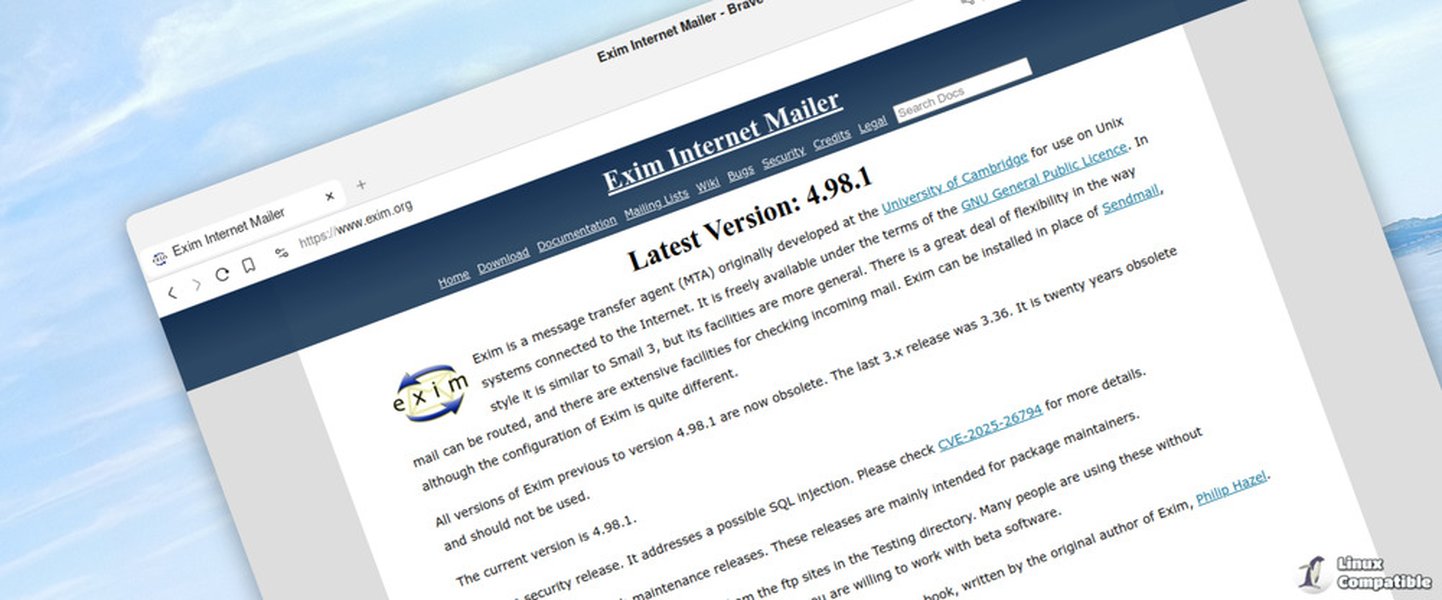
Screenshot indicating the release of Exim 4.98.2, which includes the patch for CVE-2025-30232.
Steps to Patch Your Server:
-
Verify Your Exim Version:
Determine the currently installed version of Exim on your server. You can typically do this by running a command like:
exim --versionIf the version is between 4.96 and 4.98.1 (inclusive), your system is vulnerable.
-
Update Exim:
- Using Package Managers (Recommended for most distributions):
If you installed Exim via your Linux distribution's package manager, this is the preferred update method.
For Debian/Ubuntu systems:
sudo apt update && sudo apt install exim4For Red Hat-based systems (CentOS, Fedora, RHEL):
sudo yum update eximor
sudo dnf update eximEnsure your distribution's repositories have been updated with the patched Exim version. For instance, Ubuntu has addressed this in USN-7373-1. Some distributions, like Debian `bullseye`, may indicate their packaged version was not affected because the vulnerable code path wasn't present or was patched differently.
- Building from Source:
If you compiled Exim from source, you will need to download the latest source code (version 4.98.2 or newer) from the official Exim website or its Git repository, compile it, and install it, replacing your existing vulnerable version.
- Using Package Managers (Recommended for most distributions):
-
Verify the Update:
After the update process, run
exim --versionagain to confirm that version 4.98.2 or a later version is now active. -
Restart Exim Service:
Ensure the Exim service is restarted for the changes to take effect:
sudo systemctl restart exim4 # (or exim, depending on your system)
Additional Mitigation Strategies:
- Limit Command-Line Access: Since exploitation requires command-line access, strictly limit who has shell access to your mail server. Apply the principle of least privilege.
- Monitor System Logs: Regularly monitor system and Exim logs for any suspicious activity or unauthorized access attempts.
- Intrusion Detection Systems (IDS): Consider using an IDS to detect unusual patterns that might indicate an attempted privilege escalation.
- Regular Security Audits: Perform regular security audits of your server configurations and installed software.
CVE-2025-30232 Vulnerability Profile
The radar chart below provides a visual summary of key characteristics of the CVE-2025-30232 vulnerability. The scores are qualitative assessments based on the available information, on a scale where higher values generally indicate greater concern or effectiveness (e.g., higher severity, higher patch availability).
This chart illustrates that while the vulnerability is severe and has high potential impact, the patch is readily available, and the current lack of public PoCs, combined with the need for local access and high exploit complexity, somewhat mitigates immediate widespread risk, provided systems are patched promptly.
Visualizing CVE-2025-30232: A Mindmap Overview
This mindmap offers a structured overview of the key aspects of CVE-2025-30232, summarizing its definition, impact, how it's exploited, its current PoC status, and the necessary remediation steps.
Exim Vulnerability"] id1["Definition"] id1a["Use-after-free flaw"] id1b["Memory corruption"] id1c["Affects Exim MTA"] id2["Affected Versions"] id2a["Exim 4.96 to 4.98.1"] id3["Exploitation"] id3a["Requires local command-line access"] id3b["Via `dp` parameter handling (potential)"] id3c["Leads to privilege escalation"] id4["Impact"] id4a["High Severity (CVSS 8.1)"] id4b["Potential root/SYSTEM access"] id4c["Full server compromise"] id5["Proof of Concept (PoC)"] id5a["No widespread public PoCs (as of May 2025)"] id6["Patching & Mitigation"] id6a["Update to Exim 4.98.2 or later"] id6b["Commit fix: `be040d7df...`"] id6c["Limit shell access"] id6d["Monitor logs"] id6e["Restart Exim service post-patch"]
The mindmap helps to quickly grasp the interconnected details of this security issue, from its technical nature to the practical steps for protection.
Quick Facts Table: CVE-2025-30232
This table provides a concise summary of the essential information regarding CVE-2025-30232.
| Attribute | Detail |
|---|---|
| CVE ID | CVE-2025-30232 |
| Vulnerability Type | Use-after-free |
| Affected Software | Exim Mail Transfer Agent |
| Affected Versions | 4.96 through 4.98.1 |
| CVSS v3.1 Score | 8.1 (High) |
| Attack Vector | Local (AV:L) |
| Attack Complexity | High (AC:H) |
| Privileges Required | None (PR:N, from perspective of triggering the flaw once local access is gained) / Low (for initial system access) |
| User Interaction | None (UI:N) |
| Impact | Local Privilege Escalation (leading to Confidentiality:High, Integrity:High, Availability:High) |
| Reported By | Trend Micro (March 13, 2025) |
| Patch Available | Yes |
| Patched Version(s) | Exim 4.98.2 and newer |
| Fixing Commit ID | be040d7df68a8cbb244aaabc37832984dafcbf55 |
| Public PoC Available | No (as of May 13, 2025) |
Administrators should use this information to prioritize patching and communicate the risk within their organizations.
Frequently Asked Questions (FAQ)
What exactly is CVE-2025-30232?
CVE-2025-30232 is a specific security vulnerability identified in the Exim mail server software, versions 4.96 through 4.98.1. It's a "use-after-free" type of flaw, meaning the software incorrectly tries to use memory that has already been released. This can be exploited by a local attacker to escalate their privileges on the system, potentially gaining administrative (root) control.
Can you explain "use-after-free" in simpler terms?
Imagine a program has a temporary note (a piece of memory) it's using. When it's done, it throws the note in the trash (frees the memory). A "use-after-free" error is like the program later trying to read or write on that same note it already trashed. If an attacker can influence what's on that "trashed" note or how it's used, they can cause unexpected behavior, like making the program do things it shouldn't, such as giving the attacker more permissions.
How severe is CVE-2025-30232?
It's rated as "High" severity, with a CVSS score of 8.1. This indicates a significant risk. While it requires local access (an attacker can't exploit it remotely over the internet without first gaining some access to the machine), if exploited, it can lead to a complete compromise of the server by allowing the attacker to gain the highest level of privileges.
If I don't give users command-line access, am I safe?
Restricting command-line access significantly reduces the risk from this specific vulnerability, as it's a primary prerequisite for exploitation. However, attackers might gain local access through other means (e.g., exploiting another vulnerability in a web application running on the same server, or through compromised credentials). Therefore, patching Exim is still the most robust defense, even if direct shell access is tightly controlled.
Is there a Proof of Concept (PoC) exploit available for CVE-2025-30232?
As of May 13, 2025, there are no widely known or publicly available Proof of Concept (PoC) exploit codes for CVE-2025-30232. However, this can change, and the absence of a public PoC does not mean the vulnerability is not exploitable. It's always best to patch critical vulnerabilities regardless of PoC availability.
How do I fix CVE-2025-30232 on my server?
The primary fix is to update your Exim installation to version 4.98.2 or any later version. This can usually be done through your Linux distribution's package manager (e.g., `apt` for Debian/Ubuntu, `yum` or `dnf` for Red Hat-based systems) or by compiling and installing the latest version from source if you manage Exim that way. After updating, ensure you restart the Exim service.
Recommended Further Exploration
To deepen your understanding of server security and vulnerability management, consider exploring these related topics:
- What are common types of memory corruption vulnerabilities besides use-after-free?
- Best practices for securing a mail server like Exim beyond just patching CVEs.
- How does the CVSS scoring system work in detail?
- Explain the principle of least privilege and how to implement it on Linux servers.
References
Last updated May 13, 2025