
Understanding the Intricacies of Black Holes
Unraveling the Mysteries of the Universe's Most Enigmatic Objects
Key Takeaways
- Black holes are regions of spacetime with gravitational pulls so strong that nothing, not even light, can escape.
- The formation of black holes typically results from the collapse of massive stars, leading to various types like stellar and supermassive black holes.
- Black holes interact with their environment through gravitational effects, accretion disks, and relativistic jets, and are observed indirectly via these phenomena.
Introduction to Black Holes
Black holes are among the most fascinating and mysterious objects in the universe. Defined by their incredibly strong gravitational pull, black holes are regions in spacetime where gravity is so intense that nothing—not even light—can escape once it crosses the event horizon. This immense gravitational force arises from the compression of a massive amount of matter into an extremely small volume, warping the fabric of spacetime itself.
Formation of Black Holes
Stellar Collapse
The primary mechanism for the formation of black holes is the gravitational collapse of massive stars. When a star exhausts its nuclear fuel, the outward pressure generated by nuclear fusion can no longer counteract the inward pull of gravity. If the star's mass is sufficient—typically more than 20 times the mass of our Sun—the core collapses under its own gravity, leading to a supernova explosion. The remaining core continues to condense, eventually forming a black hole.
Supermassive Black Holes
Supermassive black holes reside at the centers of galaxies, including our own Milky Way. These black holes contain millions to billions of times the mass of the Sun. Their formation is less straightforward and is believed to involve the accumulation of matter over cosmic time scales, possibly through the merging of smaller black holes and the accretion of gas and stars from their surroundings. The exact processes that lead to the formation of supermassive black holes are still an active area of research.
Primordial Black Holes
Primordial black holes are hypothetical black holes that may have formed in the early universe due to high-density fluctuations shortly after the Big Bang. Unlike stellar and supermassive black holes, primordial black holes could vary widely in mass and size, potentially providing insights into the conditions of the early universe and contributing to dark matter.
Structure of a Black Hole
Singularity
At the very core of a black hole lies the singularity, a point where matter is thought to be infinitely dense and spacetime curvature becomes infinite. In this region, the known laws of physics, including Einstein's General Relativity, cease to function predictably. The singularity represents a boundary where our current understanding of the universe breaks down, posing significant challenges for theoretical physics.
Event Horizon
The event horizon is the boundary surrounding a black hole beyond which nothing can escape. It marks the "point of no return." The size of the event horizon, known as the Schwarzschild radius, depends on the mass of the black hole. For instance, a black hole with ten times the mass of the Sun would have an event horizon with a radius of approximately 30 kilometers.
Accretion Disk
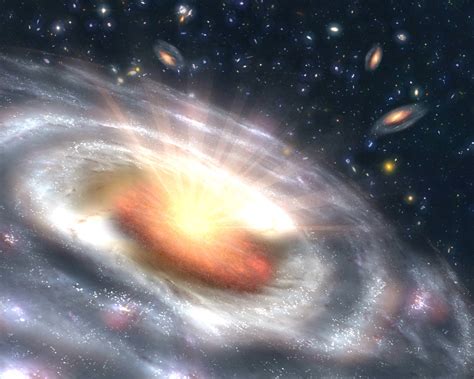
Many black holes are surrounded by an accretion disk—a swirling disk of gas, dust, and other matter spiraling inward toward the black hole. As matter in the accretion disk accelerates and heats up due to intense gravitational and frictional forces, it emits radiation, often in the form of X-rays. The accretion disk serves as a critical component for observing black holes, as it is one of the primary sources of detectable radiation.
Relativistic Jets
In some cases, black holes can emit powerful jets of charged particles moving at nearly the speed of light. These relativistic jets are launched perpendicular to the accretion disk and are believed to be driven by strong magnetic fields associated with the accreting material. Jets can extend vast distances into space, influencing their galactic environments and contributing to galaxy evolution.
Types of Black Holes
Stellar-Mass Black Holes
Stellar-mass black holes are the most common type and form from the gravitational collapse of massive stars. Their masses range from a few to tens of times that of the Sun. These black holes are typically found within binary systems, where they can interact with companion stars, accreting matter and emitting X-rays.
Supermassive Black Holes
Supermassive black holes, with masses ranging from millions to billions of solar masses, are located at the centers of galaxies. They play a significant role in the formation and evolution of their host galaxies. The mechanisms behind their formation involve early universe processes, mergers, and sustained accretion of matter over cosmic time.
Intermediate Black Holes
Intermediate black holes bridge the gap between stellar-mass and supermassive black holes, with masses ranging from hundreds to thousands of solar masses. Their existence has been suggested by certain astronomical observations, such as the dynamics of globular clusters, but they are less commonly observed and remain a subject of ongoing research.
Primordial Black Holes
Primordial black holes, if they exist, would have formed in the early universe before stars and galaxies. They could have a wide range of masses, potentially contributing to dark matter. However, their existence has not been confirmed, and they remain theoretical constructs within cosmology.
Gravitational Effects and Spacetime Warping
Gravitational Pull
The gravitational pull of a black hole is immensely strong due to its concentrated mass. This intense gravity affects the motion of nearby stars, gas clouds, and other celestial objects, often resulting in orbits that spiral toward the black hole. The gravitational influence extends beyond the event horizon, affecting the surrounding spacetime.
Gravitational Time Dilation
According to Einstein's General Relativity, time slows down in stronger gravitational fields. Near the event horizon of a black hole, time dilation becomes extreme, causing time to pass significantly slower compared to regions farther away. This phenomenon has profound implications for the behavior of objects and light near the black hole.
Gravitational Lensing
Black holes can bend and distort light from objects behind them, a phenomenon known as gravitational lensing. This effect can magnify and distort the appearance of background stars and galaxies, providing indirect evidence of the black hole's presence and allowing astronomers to study the properties of both the black hole and the lensed objects.
Accretion Disks and Energy Emission
Formation and Composition
Accretion disks form from the gas, dust, and other matter that spiral inward under the influence of the black hole's gravity. As matter accumulates in the disk, it becomes increasingly hot and dense, emitting energy across various electromagnetic wavelengths, particularly in X-rays. The composition of the accretion disk can include ionized hydrogen and helium, as well as heavier elements depending on the surrounding environment.
Energy Emission Mechanisms
The intense gravitational and frictional forces within the accretion disk convert gravitational potential energy into thermal energy, causing the disk to heat up. This super-heated material emits radiation, primarily in the X-ray spectrum, making the accretion disk one of the primary observable features of black holes. Additionally, instabilities and turbulence within the disk can lead to variable emission and flares.
Relativistic Jets
Relativistic jets are highly collimated streams of charged particles ejected from the regions surrounding a black hole at nearly the speed of light. These jets are powered by the rotational energy of the black hole and the magnetic fields generated in the accretion disk. Jets can extend thousands of light-years into space, influencing the intergalactic medium and contributing to the feedback mechanisms that regulate galaxy growth.
Hawking Radiation and Black Hole Evaporation
Quantum Effects Near the Event Horizon
Stephen Hawking proposed that black holes are not entirely black but emit radiation due to quantum effects near the event horizon. This radiation, now known as Hawking radiation, arises from particle-antiparticle pairs that spontaneously form near the event horizon. One particle falls into the black hole while the other escapes, resulting in a net loss of mass for the black hole over time.
Black Hole Evaporation
Over astronomical time scales, Hawking radiation can lead to the gradual evaporation of a black hole. Smaller black holes emit radiation more intensely and therefore lose mass more quickly than larger ones. However, for stellar and supermassive black holes, the evaporation process is exceedingly slow, making it insignificant for the current age of the universe.
Implications for Black Hole Thermodynamics
The concept of Hawking radiation bridges quantum mechanics and general relativity, suggesting that black holes have thermodynamic properties such as temperature and entropy. This has profound implications for our understanding of the fundamental laws of physics and the nature of spacetime.
Observing Black Holes
Indirect Detection Methods
Since black holes themselves do not emit light, astronomers rely on indirect methods to detect and study them:
- Stellar Motion: Observing the motion of stars and gas near the center of galaxies can indicate the presence of a black hole. For example, the rapid orbit of stars around the center of the Milky Way suggests a supermassive black hole.
- Accretion Disk Emissions: The radiation emitted from the accretion disk, especially in X-rays, provides evidence of matter being accreted by a black hole.
- Gravitational Waves: The collision and merging of black holes produce ripples in spacetime known as gravitational waves. Detectors like LIGO and Virgo have successfully observed these waves, confirming the existence of black holes and providing data on their properties.
- Gravitational Lensing: The bending of light around a black hole can produce observable lensing effects, allowing astronomers to infer the presence and mass of the black hole.
Direct Imaging
In April 2019, the Event Horizon Telescope (EHT) collaboration released the first-ever direct image of a black hole's event horizon in the galaxy M87. This groundbreaking achievement was made possible by synchronizing multiple radio telescopes around the world to function as a single, Earth-sized telescope, achieving the necessary resolution to observe the shadow of a black hole.
Gravitational Wave Astronomy
Gravitational wave observatories have opened a new window for studying black holes. The detection of gravitational waves from black hole mergers has provided direct evidence of their existence and has allowed scientists to measure their masses, spins, and the dynamics of their interactions.
Black Holes and Their Role in the Universe
Galaxy Formation and Evolution
Supermassive black holes play a crucial role in shaping their host galaxies. The energy and momentum carried by relativistic jets and accretion disk winds can influence star formation rates and the distribution of interstellar gas. This feedback mechanism is essential for regulating the growth of galaxies and preventing them from becoming too massive.
Testing Theories of Gravity and Quantum Mechanics
Black holes serve as natural laboratories for testing the limits of our understanding of physics. The extreme conditions near singularities challenge our theories of gravity and quantum mechanics, driving advancements in theoretical physics and prompting the search for a unified theory that can reconcile these fundamental forces.
Information Paradox
The information paradox arises from the question of what happens to information about the physical state of objects that fall into a black hole. According to quantum mechanics, information cannot be destroyed, but classical descriptions of black holes suggest that information is lost inside the singularity. Resolving this paradox is a key challenge in modern theoretical physics and has implications for the nature of reality and the laws governing the universe.
Mathematical Foundations: Schwarzschild Radius and General Relativity
Schwarzschild Radius
The Schwarzschild radius (\( r_s \)) defines the size of the event horizon of a non-rotating black hole. It is given by the formula:
\[ r_s = \frac{2GM}{c^2} \]
Where:
- \( G \) is the gravitational constant.
- \( M \) is the mass of the black hole.
- \( c \) is the speed of light in a vacuum.
This equation illustrates how the radius of the event horizon scales linearly with the mass of the black hole.
Einstein's General Relativity
Black holes are a direct prediction of Einstein's General Theory of Relativity, which describes gravity as the curvature of spacetime caused by mass and energy. The equations of General Relativity allow for solutions that include singularities and event horizons, providing a theoretical framework for understanding black holes. These solutions, such as the Schwarzschild and Kerr metrics, describe the spacetime geometry around non-rotating and rotating black holes, respectively.
Black Hole Thermodynamics
Hawking's Laws
Black hole thermodynamics is a field that studies the laws governing black holes, drawing analogies from classical thermodynamics. Stephen Hawking's discovery that black holes emit radiation due to quantum effects led to the formulation of the laws of black hole thermodynamics:
-
First Law: Relates the change in mass of a black hole to changes in area, angular momentum, and electric charge.
-
Second Law: States that the total area of the event horizons of black holes can never decrease, analogous to the second law of thermodynamics concerning entropy.
-
Third Law: Asserts that it is impossible to reduce the surface gravity of a black hole to zero through any physical process.
Entropy and Information
The entropy of a black hole is proportional to the area of its event horizon, not its volume, suggesting a deep connection between information and geometry. This relationship is a cornerstone of the holographic principle, which posits that all the information contained within a volume of space can be represented on its boundary.
Future Prospects and Research
Quantum Gravity and Black Holes
Understanding black holes is essential for the development of a theory of quantum gravity, which seeks to unify General Relativity with quantum mechanics. Research into the nature of singularities, the behavior of matter and energy at quantum scales near black holes, and the resolution of the information paradox are pivotal in this quest.
Event Horizon Telescope Enhancements
The Event Horizon Telescope continues to expand its capabilities, aiming to capture more detailed images of black holes and their immediate environments. Future observations may reveal the dynamics of accretion disks, the structure of relativistic jets, and provide further tests of General Relativity in the strong-field regime.
Gravitational Wave Astronomy
Advancements in gravitational wave detectors promise to enhance our understanding of black hole mergers, formation rates, and the population of black holes in the universe. The ability to detect and analyze gravitational waves in greater detail will provide invaluable data for testing theoretical models and uncovering new phenomena related to black holes.
Exploration of Intermediate and Primordial Black Holes
Identifying and studying intermediate-mass black holes could bridge the gap in our knowledge between stellar and supermassive black holes. Additionally, confirming the existence of primordial black holes would have profound implications for cosmology, potentially shedding light on the conditions of the early universe and the nature of dark matter.
Conclusion
Black holes remain one of the most captivating subjects in modern astrophysics, embodying the extreme limits of our understanding of gravity, spacetime, and quantum mechanics. Their formation, structure, and interactions with the cosmic environment provide critical insights into the fundamental laws governing the universe. Ongoing advancements in observational technology and theoretical research continue to unravel the complexities of black holes, promising to deepen our comprehension of these enigmatic cosmic entities and their role in the fabric of the cosmos.
References
Last updated January 17, 2025