
Demystifying the Black Box: A Comprehensive Guide to Explainable AI (XAI)
Understanding and Trusting the Decisions of Artificial Intelligence
As Artificial Intelligence (AI) and Machine Learning (ML) models become increasingly integrated into critical aspects of our lives, from healthcare diagnostics to financial decisions and autonomous vehicles, the need to understand how these systems arrive at their conclusions has become paramount. This is where Explainable AI, or XAI, plays a crucial role. XAI refers to the set of processes, methods, and techniques that aim to make the decisions and outputs of AI systems comprehensible to human users.
In essence, XAI seeks to pull back the curtain on the often opaque nature of complex AI models, frequently referred to as "black boxes." While traditional AI systems, particularly deep learning models, can achieve remarkable accuracy, their internal workings can be incredibly difficult to interpret, even for the developers who created them. XAI addresses this challenge by providing insights into the reasoning behind AI-driven decisions, fostering trust, enabling accountability, and facilitating responsible AI development and deployment.
Key Highlights of Explainable AI
- Transparency and Trust: XAI is fundamentally about increasing the transparency of AI systems, allowing users to understand the factors influencing a model's output and building trust in its reliability.
- Diverse Applications: XAI is crucial in high-stakes domains like healthcare, finance, and autonomous driving, where understanding the 'why' behind a decision is vital for safety, compliance, and ethical considerations.
- Methods and Techniques: Various techniques exist within XAI, including model-specific methods for simpler models and model-agnostic methods like LIME and SHAP for more complex 'black box' models.
Why is Explainable AI Important?
The growing complexity of AI models has highlighted the critical need for explainability. Without XAI, we face several significant challenges:
Lack of Trust and Adoption
If users cannot understand how an AI system works or why it made a particular recommendation or decision, they are less likely to trust and adopt it. This is especially true in sensitive applications where incorrect decisions can have severe consequences.
Difficulty in Debugging and Improvement
When a 'black box' model produces an erroneous or biased output, it can be incredibly challenging to identify the root cause. XAI provides insights that help developers understand where the model went wrong, enabling effective debugging and iterative improvement.
Ensuring Fairness and Mitigating Bias
AI models can inadvertently learn and perpetuate biases present in the data they are trained on. XAI techniques can help uncover these biases by revealing which features are most influencing a model's decisions, allowing for the identification and mitigation of unfair outcomes.
Meeting Regulatory and Compliance Requirements
In many industries, regulations are emerging that require transparency and explainability in algorithmic decision-making. For example, the European Union's General Data Protection Regulation (GDPR) includes a "right to explanation," giving individuals the right to understand how automated decisions affecting them are made. XAI is essential for meeting these legal and ethical obligations.
Enhancing Human-AI Collaboration
For humans to effectively collaborate with AI systems, they need to understand the AI's capabilities, limitations, and decision-making process. XAI facilitates this collaboration by providing the necessary context and explanations.
Understanding the 'Black Box' Problem
Many powerful machine learning models, such as deep neural networks, are considered "black boxes." This means that while they can produce highly accurate predictions or classifications, the complex interactions between layers of artificial neurons and the vast number of parameters make it nearly impossible for a human to follow the exact path of reasoning that led to a specific output.
Consider an AI system designed to diagnose a medical condition from an image. A black box model might provide a diagnosis with high confidence, but without XAI, a doctor wouldn't know which specific features or patterns in the image the AI focused on to reach that conclusion. This lack of insight can hinder the doctor's ability to trust the diagnosis, validate it with their own expertise, or explain it to the patient.
XAI attempts to provide various levels of insight into these black box models, making their decisions interpretable and understandable.
Key Principles of Explainable AI
While there is no single, universally agreed-upon definition of explainability, several core principles guide the development and implementation of XAI:
Transparency
The ability to understand the inner workings of an AI model. This can range from the inherent transparency of simple models like decision trees to techniques that shed light on the decision process of complex models.
Interpretability
The degree to which a human can understand the cause of a model's decision. This is often related to identifying the most important features or factors that contributed to a particular outcome.
Faithfulness
The explanation should accurately reflect how the model actually works and arrived at its decision.
Trustworthiness
Building confidence in the AI system's reliability and the validity of its explanations.
Actionability
The explanation should provide insights that allow users to take meaningful action, whether it's improving the model, addressing bias, or making informed decisions based on the AI's output.
Methods and Techniques in Explainable AI
XAI encompasses a variety of methods and techniques, which can broadly be categorized as model-specific or model-agnostic:
Model-Specific Methods
These techniques are designed to provide explanations for specific types of AI models. Simpler models, often referred to as "white-box" models, are inherently more interpretable. Examples include:
- Decision Trees: The decision-making process can be visualized as a tree structure, making it easy to follow the path to a prediction.
- Linear Regression: The coefficients associated with each feature indicate their influence on the outcome.
While these models are interpretable by design, they may not always achieve the same level of accuracy as more complex models for certain tasks.
Model-Agnostic Methods
These techniques can be applied to any machine learning model, regardless of its internal architecture. They work by analyzing the relationship between the model's inputs and outputs to infer the reasons for its decisions. Popular model-agnostic techniques include:
-
LIME (Local Interpretable Model-agnostic Explanations): LIME explains the predictions of any black-box model by approximating it locally with an interpretable model. It focuses on explaining individual predictions rather than the entire model.
-
SHAP (SHapley Additive exPlanations): SHAP values are based on game theory and attribute the contribution of each feature to the model's prediction. They provide a unified measure of feature importance and can be used to explain both individual predictions and the overall model behavior.
-
Partial Dependence Plots (PDPs): These plots show the marginal effect of one or two features on the predicted outcome of a machine learning model.
-
Individual Conditional Expectation (ICE) Plots: Similar to PDPs, but they show the relationship between a feature and the predicted outcome for each instance individually.
-
Saliency Maps: Used primarily in computer vision, saliency maps highlight the pixels or regions in an image that were most influential in the model's prediction.
These model-agnostic methods are crucial for making the decisions of complex deep learning models more understandable.
Real-World Applications of Explainable AI
XAI is being applied across a wide range of industries to enhance trust, transparency, and effectiveness of AI systems.
Healthcare
In healthcare, XAI is vital for AI-assisted diagnostics and treatment planning. For example, an AI model used for cancer detection can use XAI to highlight the specific areas in a medical image that led to its diagnosis, allowing radiologists to validate the AI's findings.
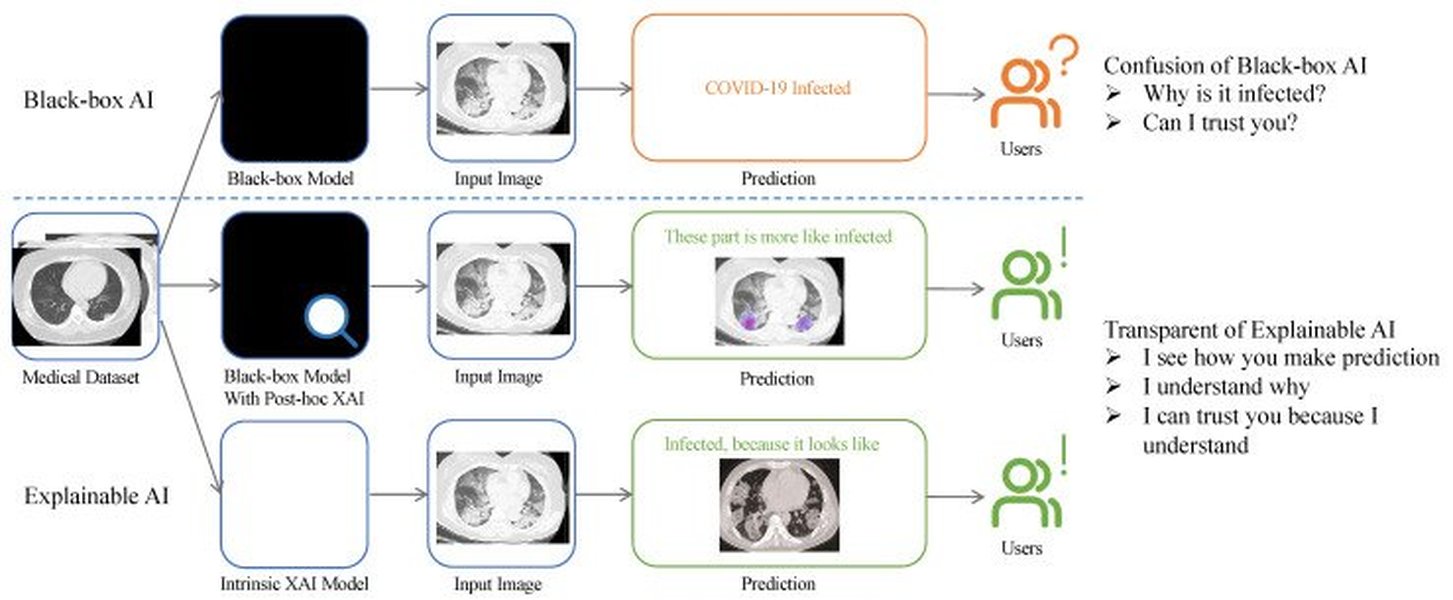
A visual representation of XAI applications in the healthcare sector.
Finance
Financial institutions use XAI for credit scoring, fraud detection, and investment analysis. XAI can explain why a loan application was denied (e.g., due to specific late payments or high credit utilization), helping customers understand and improve their financial standing. It also helps ensure compliance with financial regulations.
Autonomous Vehicles
Understanding the decision-making process of self-driving cars is critical for safety and liability. XAI can provide insights into why a vehicle made a particular maneuver, such as identifying the sensors and data that led to a decision to brake or swerve.
Legal and Compliance
XAI is increasingly important in legal contexts where AI is used for tasks like document review or predicting legal outcomes. Explainable AI ensures that these decisions can be justified and scrutinized.
Manufacturing
In manufacturing, XAI can help optimize production processes and improve quality control by explaining the factors that lead to defects or inefficiencies.
Retail and Marketing
XAI can explain product recommendations or marketing campaign targeting, helping businesses understand customer behavior and refine their strategies.
Comparing Interpretable and Explainable AI
While often used interchangeably, there is a subtle difference between interpretability and explainability in the context of AI. Interpretability refers to the ability to understand the inner workings of a model, typically in simpler models where the relationship between inputs and outputs is more transparent. Explainability, on the other hand, is a broader concept that focuses on providing a human-understandable explanation for a model's decision, particularly for complex black-box models. XAI often employs methods to make inherently non-interpretable models explainable.
Challenges and Future Directions
Despite the significant progress in XAI, several challenges remain. Developing explanations that are accurate, understandable to diverse users, and scalable to large and complex models is an ongoing area of research. There is also a need for standardized metrics to evaluate the quality of explanations. The field of XAI is continuously evolving, with new techniques and approaches being developed to address these challenges and further enhance the transparency and trustworthiness of AI systems.
Frequently Asked Questions about Explainable AI
What is the primary goal of Explainable AI?
The primary goal of Explainable AI is to make the decision-making processes of AI systems understandable to humans, fostering trust, enabling accountability, and facilitating debugging and improvement.
How does XAI differ from traditional AI?
Traditional AI, especially complex models, often acts as a "black box," where the reasons behind decisions are opaque. XAI provides methods and techniques to unveil these reasons and make the AI's workings transparent.
What are some common techniques used in XAI?
Common techniques include LIME, SHAP, Partial Dependence Plots, Individual Conditional Expectation Plots, and Saliency Maps. These techniques help explain the influence of different features on the model's output.
Why is XAI important in regulated industries?
In regulated industries like finance and healthcare, XAI is crucial for compliance with regulations that require transparency in algorithmic decision-making and for ensuring fairness and preventing bias.
Can XAI make any AI model fully transparent?
While XAI aims to increase transparency, achieving complete transparency for highly complex models can be challenging. XAI focuses on providing sufficient understanding for human users to trust and verify the AI's decisions in specific contexts.
References
Last updated May 7, 2025