
Comprehensive Guide to Explaining Your Data Collection Process
Master the art of articulating your data gathering methods with clarity and precision.
Key Takeaways
- Define Clear Objectives: Establish the purpose and goals of your data collection to provide context and direction.
- Detail Methodologies: Clearly describe the methods, tools, and procedures used to gather and manage data.
- Ensure Ethical Standards: Address ethical considerations to maintain data integrity and participant trust.
1. Define the Purpose of Data Collection
Begin by clearly articulating the objective of your data collection efforts. Understanding the purpose helps in selecting appropriate methods and ensures that the data gathered is relevant and actionable. For instance, if the goal is to assess customer satisfaction, your focus might be on qualitative insights through interviews or quantitative data via surveys.
2. Identify the Research Design
2.1 Quantitative, Qualitative, or Mixed Methods
Determine whether your study is quantitative, qualitative, or employs a mixed-methods approach.
- Quantitative: Focuses on numerical data and statistical analysis. Suitable for measuring variables and testing hypotheses.
- Qualitative: Emphasizes descriptive data and thematic analysis. Ideal for exploring concepts and understanding experiences.
- Mixed Methods: Combines both quantitative and qualitative approaches to provide a comprehensive understanding.
2.2 Overall Approach
Specify the overall approach of your research, such as experimental, survey-based, observational, or case study. Each approach has its strengths and is suited to different types of investigations.
3. Define Data Sources
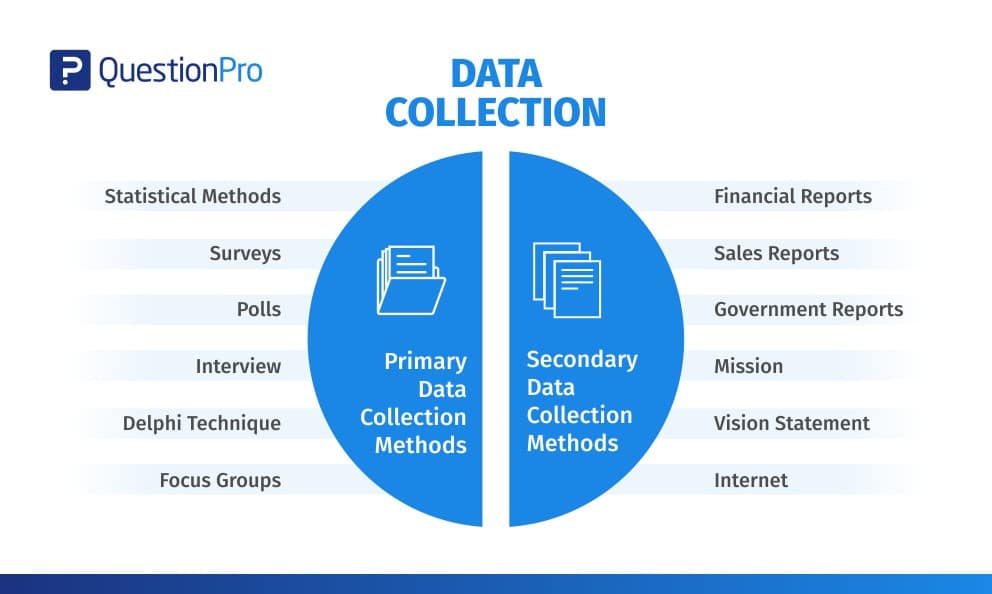
3.1 Primary Data
Primary data is collected firsthand for the specific purpose of your study. Methods include:
- Surveys: Can be administered online, via phone, or in person.
- Interviews: Structured, semi-structured, or unstructured formats to gather in-depth information.
- Observations: Participant or non-participant observations in natural or controlled settings.
- Experiments: Controlled procedures to test hypotheses and establish causality.
3.2 Secondary Data
Secondary data involves using pre-existing data from sources such as government records, published research, or public databases. It is cost-effective and useful for longitudinal studies or when primary data collection is impractical.
4. Data Collection Methods and Tools
4.1 Surveys and Questionnaires
Surveys are versatile tools for collecting large amounts of quantitative data. Design considerations include question types (open-ended vs. closed-ended), survey length, and distribution channels (online platforms like SurveyMonkey or in-person).
4.2 Interviews and Focus Groups
Interviews provide qualitative insights through direct interaction. Decide on the format (structured, semi-structured, unstructured) and the selection criteria for participants. Focus groups facilitate discussion among multiple participants to explore diverse perspectives.
4.3 Observations
Observational methods can be either participant or non-participant. Determine the setting (natural vs. controlled) and establish protocols to ensure consistency and minimize bias.
4.4 Experiments
In experimental research, outline the design, including independent and dependent variables, control groups, and the specific procedures followed to maintain validity and reliability.
4.5 Digital Tracking and Secondary Research
Utilize digital tools for tracking behaviors or trends online. Secondary research leverages existing data repositories and requires criteria for selecting reliable sources.
5. Sampling Strategy
5.1 Selecting Participants
Describe how participants are chosen, detailing the sampling method used:
-
Random Sampling: Each member of the population has an equal chance of selection.
-
Stratified Sampling: The population is divided into subgroups, and samples are taken from each.
-
Convenience Sampling: Selecting readily available participants.
-
Purposive Sampling: Selecting participants based on specific characteristics.
5.2 Sample Size and Justification
Explain the rationale behind the chosen sample size, considering factors like the study’s objectives, statistical power, and resource constraints.
6. Data Collection Procedures
6.1 Step-by-Step Process
Outline the sequential steps taken to collect data, ensuring clarity and replicability. This includes scheduling, administering tools, and monitoring data collection activities.
6.2 Tools and Technologies
Mention specific tools or platforms used, such as online survey tools (e.g., SurveyMonkey), data analysis software (e.g., SPSS, R), or specialized equipment for experiments.
7. Ethical Considerations
7.1 Informed Consent
Detail how informed consent was obtained from participants, ensuring they are aware of the study’s purpose, procedures, and their rights.
7.2 Confidentiality and Privacy
Describe measures taken to protect participant data, such as anonymization, secure storage, and restricted access.
7.3 Ethical Approval
If applicable, mention any approvals obtained from ethics committees or institutional review boards, demonstrating compliance with ethical standards.
8. Data Management and Storage
8.1 Organization and Storage
Explain how data was organized, stored, and backed up. Utilize secure databases, cloud storage solutions, or physical storage as appropriate.
8.2 Data Cleaning and Preparation
Describe the processes involved in cleaning the data, such as removing duplicates, handling missing values, and ensuring consistency.
9. Data Validation and Quality Assurance
9.1 Ensuring Accuracy
Implement validation techniques like cross-checking information, using multiple data sources, and conducting pilot tests to verify the accuracy and reliability of your data.
9.2 Addressing Challenges
Acknowledge any challenges encountered during data collection, such as low response rates or technical issues, and explain how they were mitigated.
10. Limitations of Data Collection
Discuss the limitations inherent in your data collection process, such as potential biases, sample size constraints, or methodological limitations, and how they may impact the study’s findings.
11. Data Analysis and Action
11.1 Analysis Plan
Outline the strategies and tools you plan to use for analyzing the collected data, whether through statistical methods, thematic analysis, or other appropriate techniques.
11.2 Actionable Insights
Explain how the analysis will inform decision-making or contribute to addressing the research questions or objectives.
Conclusion
Effectively explaining your data collection process involves a clear and structured presentation of your objectives, methodologies, tools, ethical considerations, and data management strategies. By meticulously detailing each component, you not only enhance the credibility of your research but also provide a transparent framework that others can replicate or build upon. Ensuring ethical standards and addressing potential limitations further solidifies the integrity of your data and the validity of your findings.
References
Last updated February 13, 2025