
Why Do Some Galaxies Glow Red Across the Cosmos?
Unveiling the secrets behind the crimson hues of distant star cities.
Galaxies, the vast islands of stars, gas, and dust that populate our universe, come in a variety of colors. Among the most intriguing are the red galaxies. Their distinct coloration isn't just a matter of aesthetics; it provides profound clues about their age, composition, distance, and evolutionary history. Understanding why some galaxies appear red helps astronomers piece together the grand narrative of cosmic evolution.
Key Insights into Red Galaxies
- Multiple Causes: A galaxy's redness often stems from a combination of factors, including the dominance of old, cool stars, the presence of interstellar dust that scatters blue light, and the cosmological redshift effect due to the expansion of the universe stretching light from distant objects.
- Evolutionary State: Many red galaxies, particularly massive ellipticals, are considered "red and dead," meaning they have largely ceased forming new stars. However, recent discoveries show some red galaxies, especially dusty ones in the early universe, are actively forming stars.
- Cosmic Probes: Studying red galaxies, especially those observed billions of light-years away by telescopes like the James Webb Space Telescope (JWST), provides critical information about how galaxies formed and evolved in the early universe, sometimes challenging existing models.
The Primary Drivers of Galactic Redness
Several distinct physical processes contribute to the observed red color of galaxies. Often, more than one mechanism is at play.
1. The Age of Stars: A Stellar Sunset
Dominance of Older Stellar Populations
One of the primary reasons galaxies appear red is the age of their constituent stars. Star formation doesn't go on forever. In many galaxies, especially large elliptical ones, the star formation process has significantly slowed down or stopped altogether. When this happens, the massive, hot, blue stars (which have short lifespans) die out first. What remains are the less massive, cooler, longer-lived stars, such as red giants and red dwarfs. These stars predominantly emit light in the red and infrared parts of the spectrum, giving the entire galaxy a reddish hue. These are often referred to as "red and dead" galaxies, signifying their quiescent state.
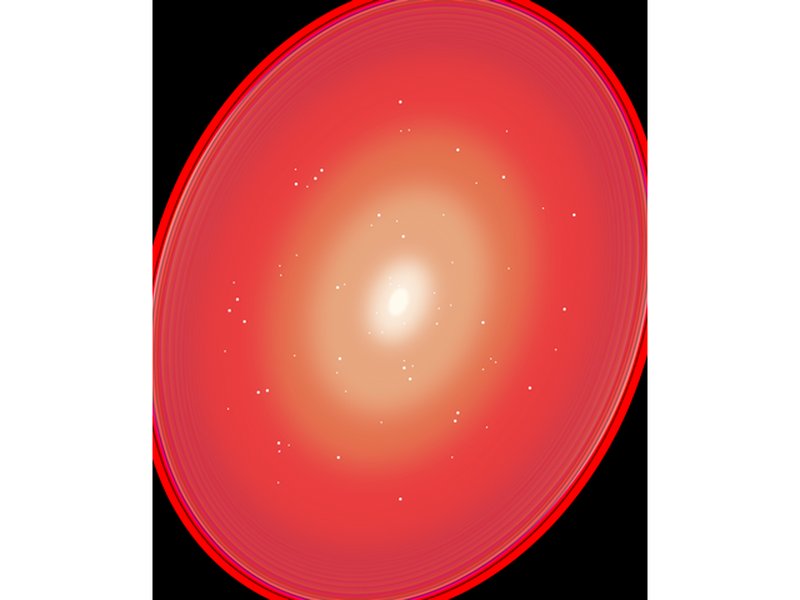
An example of an elliptical galaxy, often characterized by its reddish color due to older stars.
Suppressed Star Formation
Observations, for instance by NASA's Chandra X-ray Observatory, suggest that in some massive elliptical galaxies, feedback from the central supermassive black hole (jets of high-energy particles) can heat the surrounding gas, preventing it from cooling and collapsing to form new stars. This mechanism helps maintain the galaxy's "red and dead" status, preserving its population of old, red stars.
2. Interstellar Dust: A Cosmic Veil
Scattering Blue Light
Galaxies contain not just stars but also gas and dust. Interstellar dust particles are very effective at absorbing and scattering shorter-wavelength light, like blue and ultraviolet light. Longer-wavelength light, such as red and infrared, passes through the dust more easily. This phenomenon, known as dust extinction or reddening, means that even if a galaxy has young, blue stars, the presence of significant amounts of dust can make it appear redder than it intrinsically is, particularly when viewed in visible light.
Dusty Starbursts
Intriguingly, some very red galaxies are far from dead. Discoveries, especially from infrared telescopes like Spitzer and JWST, have revealed populations of galaxies, particularly in the early universe, that are extremely dusty but are also undergoing intense bursts of star formation. The dust shrouds the young blue stars, absorbing their light and re-radiating it in the infrared, while making the galaxy appear very red at visible and near-infrared wavelengths. Examples include the "Ultra-red Flattened Objects" (UFOs) and "Red Monster" galaxies.
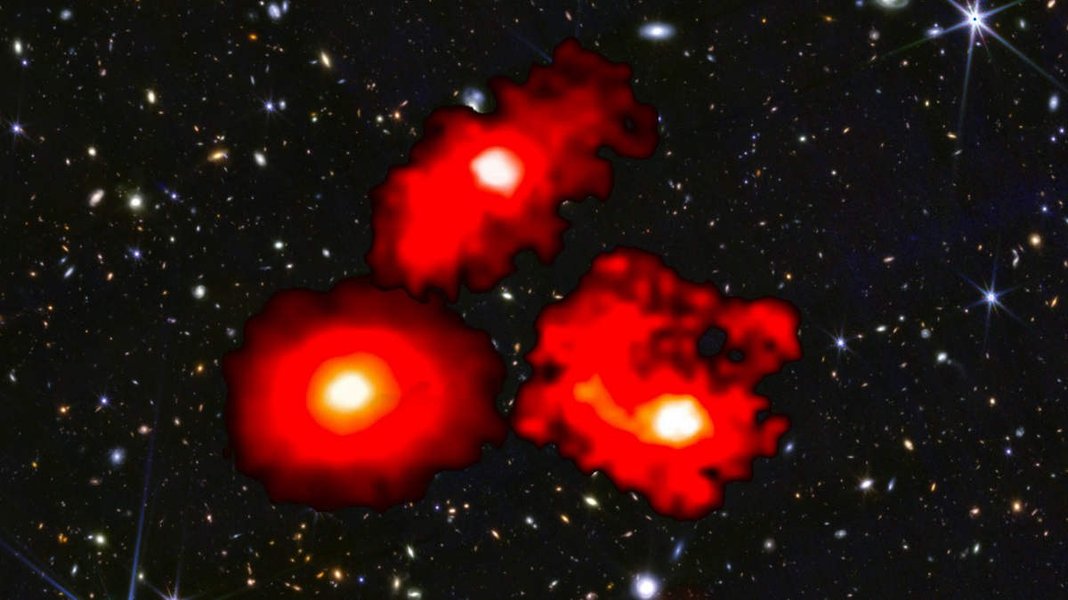
Artist's concept of a massive, dusty "red monster" galaxy in the early universe, observed by JWST.
3. Cosmological Redshift: The Expanding Universe
Stretching Light Waves
The universe has been expanding since the Big Bang. As space itself expands, it stretches the wavelengths of light traveling through it. Light emitted from distant galaxies has traveled for billions of years through this expanding space. Consequently, its wavelengths get stretched, shifting towards the red end of the electromagnetic spectrum. This effect is known as cosmological redshift. The farther away a galaxy is, the greater its redshift, and the redder it appears to us. This is a fundamental observation supporting the expanding universe model, first systematically observed by Edwin Hubble.
Observing the Early Universe
Extremely distant galaxies, whose light has traveled for over 12-13 billion years to reach us, are seen as they were in the early universe. Due to cosmological redshift, these ancient galaxies often appear very red. Telescopes like JWST are specifically designed to capture the infrared light from these highly redshifted objects, allowing us to study the first generations of galaxies.
Exploring the Diversity of Red Galaxies
Red galaxies are not a monolithic group. They encompass various types, each telling a different story about galactic evolution.
Classic Examples: Elliptical Galaxies
The most commonly cited red galaxies are massive elliptical galaxies. They typically possess smooth, featureless, ellipsoidal shapes and lack the prominent spiral arms seen in galaxies like our Milky Way. Their red color primarily reflects their advanced age and lack of significant ongoing star formation, dominated by old stellar populations. While historically considered devoid of the cold gas needed for star birth, observations by facilities like the Herschel Space Observatory have surprisingly detected large reservoirs of cold gas in some, indicating the reasons for their quiescence are complex and still under investigation.
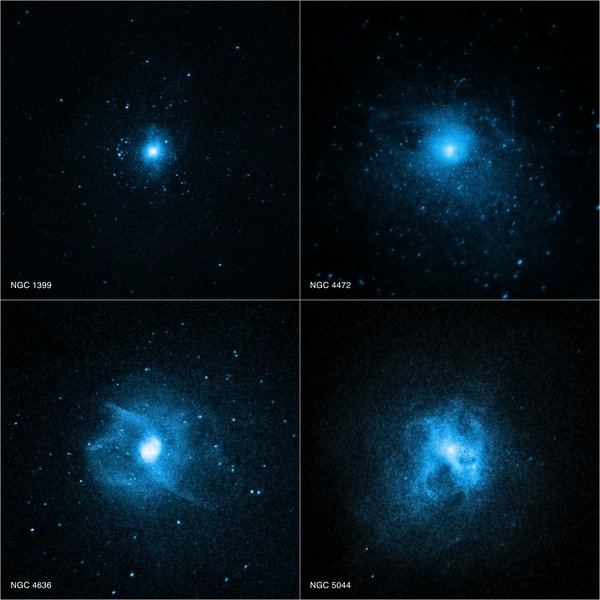
Composite image showing filaments of cold gas (red) within the elliptical galaxy NGC 4696, a "red and dead" galaxy where star formation is suppressed despite the presence of gas.
Surprising Discoveries: Red Spiral Galaxies
While spiral galaxies are typically blue due to active star formation in their arms, astronomers have discovered instances of red spiral galaxies. Some observed by JWST in the relatively early universe (8-10 billion years ago) show a uniform redness across their disk, unlike typical spirals with blue arms and redder centers. These discoveries challenge existing timelines for when galaxies might have quenched their star formation or accumulated significant dust, suggesting some spiral galaxies might have evolved differently or earlier than predicted.
Peering into the Past: Early Universe Red Galaxies (JWST Era)
The James Webb Space Telescope has revolutionized the study of the early universe, revealing several populations of intriguing red objects:
- "Ultra-red Flattened Objects" (UFOs): These are large, dusty, disk-like galaxies appearing extremely red. Primarily visible in infrared light, they were largely missed by previous telescopes like Hubble. They represent massive, potentially star-forming systems hidden by dust in the early cosmos.
- "Red Monster" Galaxies: These are exceptionally massive (containing hundreds of billions of solar masses in stars) and dusty galaxies found within the first billion years or so after the Big Bang. Their existence so early, and their apparent efficiency in forming stars despite their dustiness, pushes the boundaries of galaxy formation models.
- "Little Red Dots": These are numerous, compact red sources detected by JWST in the distant universe. While their exact nature is still being debated, leading explanations suggest they could be either very dusty young galaxies or early, rapidly growing supermassive black holes (quasars) obscured by dust.
This video discusses the discovery of "Red Monster" galaxies by the James Webb Space Telescope and why their size and existence in the early universe pose challenges to current cosmological models.
Comparing Factors Contributing to Redness
The perceived redness of different types of galaxies can be attributed to varying degrees of influence from stellar age, dust content, and cosmological redshift. The radar chart below provides a conceptual comparison of these factors for several representative types of red galaxies. Note that these are illustrative weightings rather than precise measurements.
Mapping the Concepts: Red Galaxy Characteristics
This mindmap visually summarizes the key factors contributing to the red appearance of galaxies and the different types observed.
Characteristics at a Glance
This table summarizes key features of different categories of red galaxies:
| Galaxy Type | Primary Reason for Redness | Typical Morphology | Star Formation Activity | Key Examples / Discoveries |
|---|---|---|---|---|
| Massive Elliptical Galaxy | Old stellar population, Lack of young blue stars | Smooth, Ellipsoidal | Very low or ceased ("Red and Dead") | Many nearby giant ellipticals (e.g., M87 core), NGC 4696 |
| Dusty Starburst Galaxy (DSFG) | Heavy dust obscuration | Often irregular or disk-like (sometimes mergers) | Very high, but obscured | Submillimeter Galaxies (SMGs), JWST's "UFOs" & "Red Monsters" |
| Red Spiral Galaxy | Dust, Older disk populations, Quenching? | Spiral / Disk | Low to moderate, or recently quenched | Rare nearby examples, JWST discoveries of early red spirals |
| Highly Redshifted Galaxy | Cosmological redshift (distance) | Varied (often compact or irregular in early universe) | Varied (can be actively forming stars) | Farthest galaxies observed by Hubble & JWST, "Little Red Dots" |
Frequently Asked Questions
Are all red galaxies "dead"?
No, not necessarily. While the term "red and dead" accurately describes many massive elliptical galaxies dominated by old stars with little to no ongoing star formation, it's not universally true for all red galaxies. Some galaxies appear red primarily due to heavy dust obscuration, even while they are vigorously forming new stars (like the "Red Monster" galaxies). Others might appear red mainly due to cosmological redshift because they are extremely distant. Therefore, a red color can indicate either old age/quiescence OR significant dust/distance.
What's the difference between reddening by dust and cosmological redshift?
Both processes make a galaxy appear redder, but they are physically distinct:
- Dust Reddening: This is an internal effect within or along the line of sight to the galaxy. Dust particles preferentially scatter or absorb shorter (bluer) wavelengths of light more than longer (redder) wavelengths. This changes the shape of the galaxy's spectrum, making it appear redder than its intrinsic emission. It's wavelength-dependent scattering.
- Cosmological Redshift: This is an external effect caused by the expansion of the universe. As space expands, it stretches the light waves traveling through it, uniformly shifting the entire spectrum of the galaxy towards longer (redder) wavelengths. The amount of shift is proportional to the distance. It affects all wavelengths equally in terms of stretching factor (z).
Astronomers use spectral analysis to distinguish between these effects and determine a galaxy's true properties.
How has the James Webb Space Telescope changed our understanding of red galaxies?
JWST's unprecedented sensitivity, particularly in infrared wavelengths, has significantly advanced our understanding of red galaxies, especially in the early universe:
- Revealing Hidden Populations: JWST has unveiled populations of extremely red galaxies (like UFOs and Red Monsters) that were too faint or too redshifted for previous telescopes. These massive, dusty systems challenge models of rapid galaxy formation.
- Characterizing Early Galaxies: It allows detailed study of highly redshifted galaxies, confirming their distances and properties, including the enigmatic "Little Red Dots."
- Finding Unexpected Types: JWST has identified types of galaxies, like massive red spiral galaxies, existing much earlier than anticipated, forcing revisions to galaxy evolution timelines.
- Probing Dust Content: Its infrared capabilities allow astronomers to peer through dust, better quantifying star formation rates in dusty red galaxies and understanding the role of dust in early cosmic evolution.
How is the redness of a galaxy measured?
Astronomers measure the redness of a galaxy by comparing its brightness in different wavelength filters, typically comparing a blue or ultraviolet filter measurement to a red or near-infrared one. A higher ratio of red light to blue light indicates a redder galaxy. More detailed information comes from spectroscopy, where the galaxy's light is spread out into its constituent wavelengths (a spectrum). By identifying specific atomic emission or absorption lines in the spectrum and comparing their observed wavelengths to their known laboratory wavelengths, astronomers can precisely measure the cosmological redshift. The overall shape of the continuum spectrum also reveals information about the stellar population and the amount of dust reddening.
Recommended Further Exploration
- How does cosmological redshift provide evidence for the expanding universe?
- What are the differences between elliptical and spiral galaxies?
- What has the James Webb Space Telescope discovered about early galaxy formation?
- How does interstellar dust affect observations of galaxies?
References
Last updated May 5, 2025