
Unraveling String Theory: A Journey into the Fabric of Reality
Exploring the Core Concepts, History, and Implications of String Theory
String theory is a theoretical framework in physics that attempts to reconcile quantum mechanics with Albert Einstein's theory of general relativity. It posits that the fundamental constituents of the universe are not point-like particles, but rather tiny, one-dimensional objects called strings. These strings, smaller than atoms, electrons, or quarks, vibrate at different frequencies, giving rise to the various particles and forces we observe. String theory is often described as a potential "theory of everything," aiming to unify all fundamental forces of nature into a single, consistent mathematical framework.
Key Highlights of String Theory
- Fundamental Constituents: String theory replaces point-like particles with one-dimensional strings as the fundamental building blocks of the universe.
- Unification of Forces: It aims to unify all four fundamental forces of nature: gravity, electromagnetism, the strong nuclear force, and the weak nuclear force.
- Extra Dimensions: String theory proposes the existence of extra spatial dimensions beyond the three we perceive, which are thought to be curled up at a subatomic level.
The Essence of String Theory
At its core, string theory suggests that what we perceive as particles are actually different vibrational modes of tiny strings. Imagine a guitar string vibrating at various frequencies; each frequency produces a different note. Similarly, each vibrational mode of a string corresponds to a different particle with specific properties like mass and charge.
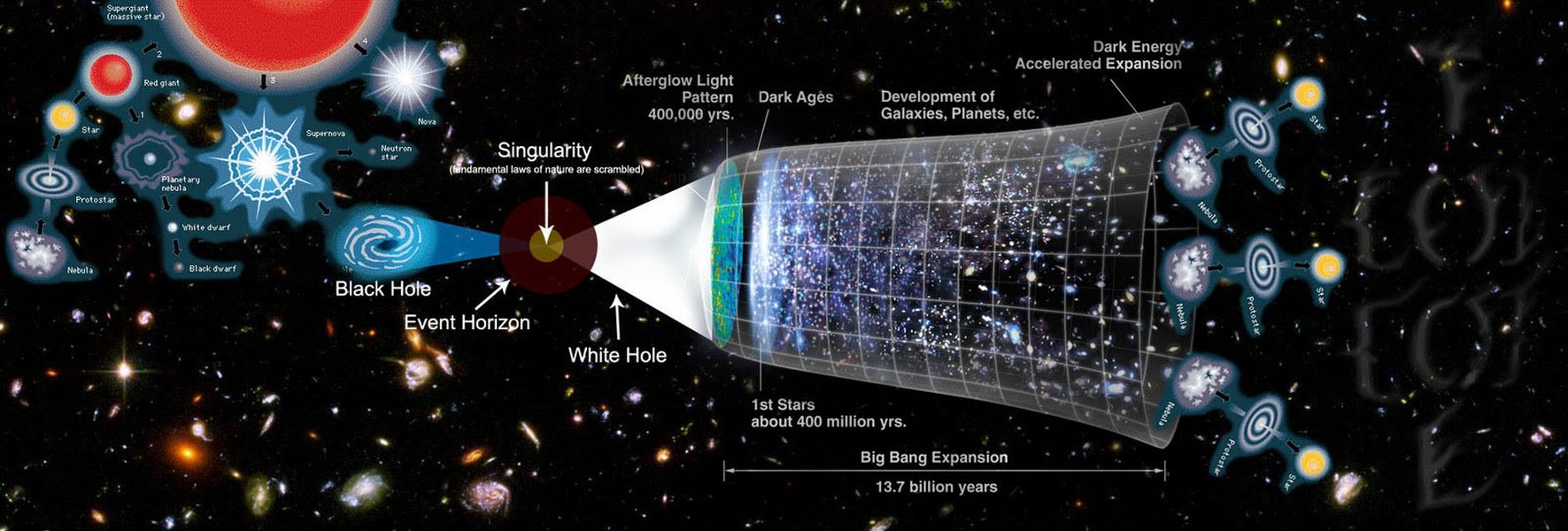
An illustration of how the multiverse might look.
String theory offers a potential solution to the conflict between quantum mechanics, which governs the behavior of particles at the subatomic level, and general relativity, which describes gravity as the curvature of spacetime. By replacing point-like particles with strings, string theory avoids the problematic infinities that arise when trying to reconcile these two theories.
Strings and Branes
In string theory, strings come in two primary forms:
- Open strings: These have ends that do not connect.
- Closed strings: These form closed loops.
Branes, short for membranes, are extended objects that strings can attach to. They can be of various dimensions, and strings are able to move through spacetime following the principles of quantum mechanics.
The Promise of a "Theory of Everything"
String theory is often referred to as a potential "theory of everything" because it seeks to provide a single, comprehensive framework for understanding all the fundamental forces and particles in the universe. The Standard Model of particle physics, while successful in describing many aspects of particle behavior, does not incorporate gravity. String theory, on the other hand, offers a way to include gravity in a quantum mechanical framework.
Unifying the Fundamental Forces
One of the central goals of string theory is to unify the four fundamental forces of nature:
-
Gravity
-
Electromagnetism
-
Strong nuclear force
-
Weak nuclear force
String theorists believe that by describing these forces as different manifestations of the same underlying entity (vibrating strings), they can create a unified theory that explains all physical phenomena.
Supersymmetry
Supersymmetry (SUSY) is a theoretical concept that posits a relationship between bosons (force-carrying particles) and fermions (matter particles). In a supersymmetric theory, every boson has a corresponding fermion partner, and vice versa. String theory often incorporates supersymmetry to address certain theoretical inconsistencies and to stabilize the theory.
While supersymmetry is an integral part of many string theory models, there is currently no experimental evidence to support its existence. Scientists are actively searching for supersymmetric particles at high-energy colliders like the Large Hadron Collider (LHC), but so far, no such particles have been found.
The Mathematical Underpinnings
String theory is deeply rooted in mathematics, relying on sophisticated concepts from various branches of mathematics, including topology, geometry, and algebra. The mathematical consistency of string theory imposes strong constraints on its structure, leading to some of its most intriguing predictions, such as the existence of extra spatial dimensions.
Extra Dimensions
One of the most remarkable features of string theory is its prediction of extra spatial dimensions beyond the three we experience in our everyday lives. According to string theory, the universe may have as many as ten or eleven dimensions, with the extra dimensions curled up at a subatomic level, making them imperceptible to us.

Illustration of spacetime.
The idea of extra dimensions is not new in physics; it was first proposed in the early 20th century by physicists like Theodor Kaluza and Oskar Klein in an attempt to unify gravity and electromagnetism. However, string theory gives the concept of extra dimensions a new twist, suggesting that they are necessary for the mathematical consistency of the theory.
Calabi-Yau Manifolds
In string theory, the extra spatial dimensions are often described as being curled up into complex geometrical shapes called Calabi-Yau manifolds. These manifolds are characterized by their special mathematical properties, which ensure that the laws of physics remain consistent in the presence of extra dimensions.
The specific shape of the Calabi-Yau manifold determines the properties of the particles and forces we observe in our three-dimensional world. This means that string theory predicts a vast landscape of possible universes, each with its own set of physical laws.
A Brief History of String Theory
The origins of string theory can be traced back to the late 1960s, when physicists were searching for a theory to describe the strong nuclear force, which binds quarks together inside protons and neutrons.
The Dual Resonance Model
In 1968, Gabriele Veneziano, a theoretical physicist working at CERN, discovered that the Euler beta function, a mathematical formula from the 18th century, could be used to describe the scattering of strongly interacting particles. This discovery led to the development of the dual resonance model, which was the precursor to string theory.
The Rise of String Theory
In the early 1970s, physicists realized that the dual resonance model could be interpreted as describing the vibrations of tiny strings. This realization marked the birth of string theory as a distinct field of research. However, initial versions of string theory had some serious problems, including the prediction of particles that travel faster than light (tachyons) and the requirement of 26 spatial dimensions.
The Superstring Revolution
In the 1980s, string theory underwent a major revival, known as the "superstring revolution." This revolution was sparked by the discovery of superstring theories, which incorporated supersymmetry and were free from the inconsistencies of earlier versions of string theory. Superstring theories also required only ten spatial dimensions, making them more realistic.
M-Theory
In the mid-1990s, physicists discovered that the five different superstring theories were actually different aspects of a single, underlying theory called M-theory. The precise nature of M-theory is still not fully understood, but it is believed to be an eleven-dimensional theory that encompasses strings, branes, and other extended objects.
Challenges and Criticisms
Despite its potential to unify the fundamental forces and provide a "theory of everything," string theory faces several challenges and criticisms.
Lack of Experimental Evidence
One of the biggest challenges facing string theory is the lack of direct experimental evidence to support its predictions. The strings and extra dimensions predicted by string theory are far too small to be directly observed with current technology.
The Landscape Problem
String theory predicts a vast "landscape" of possible universes, each with its own set of physical laws. This makes it difficult to make specific predictions about the properties of our universe, as there are too many possibilities to choose from.
Testability
A major criticism of string theory is that it is not testable. String theory is still a work in progress, and scientists have not yet been able to design experiments to test its predictions. Some physicists argue that string theory is not a science at all, but rather a form of mathematics or philosophy.
String theorists are actively working on ways to test their ideas, including searching for gravitational waves and scrutinizing the results from particle accelerators.
Applications and Implications
Despite the challenges, string theory has had a significant impact on various areas of physics and mathematics. It has led to new insights into black holes, quantum gravity, and the early universe. String theory has also inspired new mathematical techniques and concepts.
Quantum Gravity
String theory is one of the leading candidates for a theory of quantum gravity, which would reconcile general relativity with quantum mechanics. By replacing point-like particles with strings, string theory avoids the problematic infinities that arise when trying to quantize gravity using conventional methods.
Black Holes
String theory has provided new insights into the nature of black holes, including their entropy and Hawking radiation. String theory has also been used to construct models of black holes that are consistent with quantum mechanics.
Cosmology
String theory has been applied to the study of the early universe, including inflation and the origin of cosmic structure. String theory has also led to new ideas about the nature of dark energy and dark matter.
String Theory vs. Other Theories
String theory is not the only theoretical framework that attempts to unify the fundamental forces and explain the nature of the universe. Other approaches include loop quantum gravity, noncommutative geometry, and causal dynamical triangulations.
Loop Quantum Gravity
Loop quantum gravity is a competing theory of quantum gravity that is based on a different set of assumptions than string theory. Loop quantum gravity quantizes spacetime itself, rather than quantizing particles and fields propagating through spacetime.
While loop quantum gravity has some advantages over string theory, such as not requiring extra dimensions, it also faces its own challenges, including the lack of a clear connection to the Standard Model of particle physics.
Comparison Table
Here's a comparison of String Theory with other prominent theories:
| Feature | String Theory | Loop Quantum Gravity |
|---|---|---|
| Fundamental Objects | One-dimensional strings | Quantized spacetime |
| Extra Dimensions | Requires extra dimensions | Does not require extra dimensions |
| Unification | Aims to unify all forces | Focuses on quantum gravity |
| Experimental Evidence | No direct evidence | No direct evidence |
FAQ: Frequently Asked Questions About String Theory
What is the main idea behind string theory?
String theory proposes that the fundamental constituents of the universe are not point-like particles, but rather tiny, one-dimensional strings. Different vibrational modes of these strings correspond to different particles and forces.
Why is string theory called a "theory of everything"?
String theory aims to unify all four fundamental forces of nature (gravity, electromagnetism, strong nuclear force, and weak nuclear force) into a single, consistent mathematical framework. If successful, it would provide a complete description of all physical phenomena.
Does string theory have any experimental evidence?
Currently, there is no direct experimental evidence to support string theory. The strings and extra dimensions predicted by the theory are too small to be directly observed with current technology.
What are the main challenges facing string theory?
Some of the main challenges facing string theory include the lack of experimental evidence, the landscape problem (the vast number of possible universes predicted by the theory), and the difficulty of testing its predictions.
What are the potential applications of string theory?
String theory has potential applications in various areas of physics and mathematics, including quantum gravity, black hole physics, cosmology, and condensed matter physics.
References
 astrogeekz.wordpress.com

Last updated April 15, 2025