
Unlocking the Secrets of Salmon Heads: Your Guide to Collagen Extraction
Discover how to transform a fishery byproduct into valuable collagen using established scientific methods.
Salmon heads, often considered a byproduct of fish processing, are a surprisingly rich source of collagen. This protein, vital for skin, joint, and overall health, can be meticulously extracted for use in various applications, from cosmetics and food supplements to biomedical materials. This guide will walk you through the scientific processes involved in obtaining high-quality collagen from salmon heads.
Essential Insights: Key Takeaways
- Temperature is Crucial: Salmon collagen is heat-sensitive, denaturing at relatively low temperatures (around 19-37°C). All extraction steps must be conducted at low temperatures (typically 0-10°C, ideally 4°C) to preserve its triple helix structure and bioactivity.
- Multiple Extraction Strategies: The primary methods involve acid solubilization (yielding Acid-Soluble Collagen, ASC), enzymatic treatment with pepsin (yielding Pepsin-Soluble Collagen, PSC), or enzymatic hydrolysis to produce smaller collagen peptides. Each method offers different yields and collagen characteristics.
- Purity through Multi-Step Processing: Effective collagen extraction requires several stages, including thorough cleaning, defatting, removal of non-collagenous proteins, solubilization of collagen, precipitation, and purification, often concluding with freeze-drying to obtain a stable powder.
Understanding Collagen in Salmon Heads
Salmon heads are a valuable source of predominantly Type I collagen, the most abundant collagen in the human body, found in skin, bones, tendons, and connective tissues. Fish-derived collagen, like that from salmon, offers several advantages over mammalian sources, including a lower risk of zoonotic disease transmission, fewer religious or ethical restrictions, and often higher bioavailability. The collagen extracted from salmon heads can be used in its native form or hydrolyzed into smaller peptides, which may possess specific biological activities, such as anti-inflammatory or antioxidant properties.
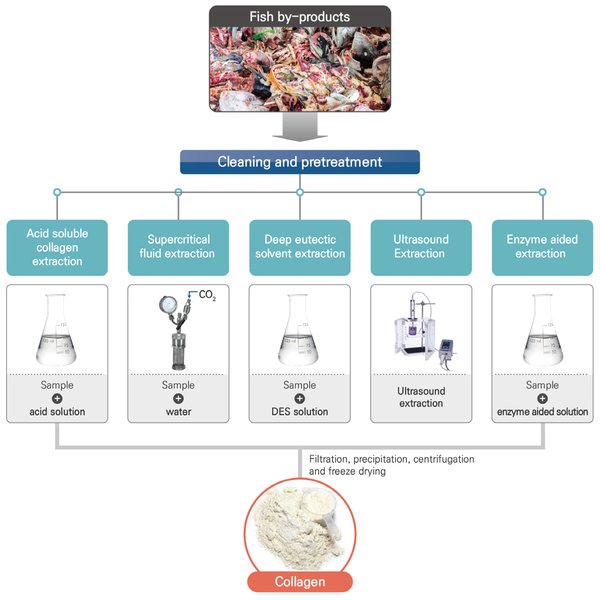
Overview of general fish by-product collagen extraction methods, applicable to salmon heads.
The Scientific Approach to Collagen Extraction
Extracting collagen from salmon heads is a meticulous process that can be broken down into several key stages. The goal is to isolate pure collagen while maintaining its structural integrity or, in some cases, to produce bioactive peptides.
Phase 1: Preparation and Pre-treatment
Proper preparation is foundational for a successful extraction, aiming to clean the raw material and remove substances that could interfere with collagen isolation or reduce its purity.
Cleaning and Size Reduction
The salmon heads must first be thoroughly cleaned to remove any blood, scales, residual flesh, and other visible impurities. Washing with cold distilled water is recommended. After cleaning, the heads are typically ground or chopped into smaller pieces (e.g., 0.5–1 cm). This increases the surface area, allowing for more efficient penetration of solvents and reagents in subsequent steps.
Defatting
Salmon heads can contain a significant amount of lipids (fats) which can hinder collagen extraction and affect the purity of the final product. A defatting step is often employed. This usually involves soaking the prepared salmon head material in an organic solvent such as butyl alcohol, ethanol, or isopropanol, or using an alkaline solution like dilute sodium hydroxide (NaOH). This step is typically carried out at low temperatures (e.g., 4°C) for several hours (e.g., 24 hours) with occasional stirring.
Alkaline Treatment (Removal of Non-Collagenous Proteins)
To remove non-collagenous proteins and other impurities, the defatted material may be treated with a dilute alkaline solution, commonly 0.1 M NaOH. This treatment, lasting several hours (e.g., 6-24 hours) at low temperature (4°C) with periodic solution changes, helps to swell the tissue matrix and solubilize unwanted proteins, making the collagen more accessible.
Phase 2: Collagen Solubilization
Once pre-treated, the collagen needs to be solubilized. The choice of method here determines the type of collagen obtained.
Acid-Soluble Collagen (ASC) Extraction
This is a widely used method. The pre-treated salmon head material is suspended in a dilute acid solution, most commonly 0.5 M acetic acid, at a solid-to-liquid ratio typically around 1:10 to 1:50 (w/v). The mixture is stirred continuously for 24-72 hours at a low temperature (around 4°C). The acidic environment helps to break down the intermolecular cross-links in the collagen, allowing it to dissolve into the solution. After the extraction period, the mixture is filtered or centrifuged to separate the acid-soluble collagen (ASC) solution (supernatant) from the insoluble residues.
Pepsin-Soluble Collagen (PSC) Extraction
To increase the collagen yield, especially for collagen that is more heavily cross-linked and less soluble in acid alone, an enzymatic treatment using pepsin can be employed. Pepsin is a proteolytic enzyme that specifically cleaves the telopeptide regions of the collagen molecule – the non-helical ends responsible for much of the cross-linking – without damaging the main triple-helical structure. The material (either the residue from ASC extraction or fresh pre-treated material) is suspended in an acidic solution (e.g., 0.5 M acetic acid) to which pepsin is added (e.g., at a ratio of 1:10 to 1:100 enzyme to substrate, w/w). This digestion is also carried out at low temperatures (4°C) for 24-48 hours with stirring. The resulting collagen is known as pepsin-soluble collagen (PSC).
Phase 3: Purification and Concentration
The crude collagen extract, whether ASC or PSC, contains impurities and needs to be purified and concentrated.
Salt Precipitation ("Salting Out")
Collagen is selectively precipitated from the acidic solution by adding sodium chloride (NaCl) to a final concentration typically ranging from 0.7 M to 2.6 M (depending on the type of collagen and solution pH). The increased salt concentration reduces the solubility of collagen, causing it to aggregate and precipitate out of the solution. The mixture is usually left to stand for several hours or overnight at 4°C, after which the precipitated collagen is collected by centrifugation (e.g., at 10,000-15,000 rpm).
Purification (Dialysis or Washing)
The collected collagen precipitate needs to be purified to remove residual salts, acid, and other small molecule impurities. Traditionally, this is done by dialysis. The collagen pellet is redissolved in a small amount of dilute acetic acid (e.g., 0.1 M or 0.5 M) and then dialyzed extensively against dilute acetic acid, followed by distilled water, using dialysis membranes with an appropriate molecular weight cutoff. This process is performed at 4°C and can take several days, with frequent changes of the dialysis solution. A simplified and quicker alternative involves repeatedly washing the collagen pellet with cold distilled water or dilute acid, followed by centrifugation to re-collect the collagen. This method can significantly reduce processing time and energy consumption.
Phase 4: Drying
Freeze-Drying (Lyophilization)
The final purified collagen solution or paste is typically freeze-dried (lyophilized). This process involves freezing the material and then reducing the surrounding pressure to allow the frozen water in the material to sublimate directly from the solid phase to the gas phase. Freeze-drying yields a porous, lightweight, and stable collagen powder or sponge, which preserves the protein's structure and is suitable for long-term storage and various applications.
Simplified Home Method: Collagen-Rich Broth
While the scientific methods above yield purified collagen, a simpler approach for home use is to make a collagen-rich broth or stock. This involves simmering cleaned salmon heads (often with aromatic vegetables like onions, carrots, and celery) in water for an extended period (several hours). The heat and water help to break down the connective tissues, releasing collagen into the liquid. While this method doesn't isolate pure collagen, the resulting broth will be rich in gelatin (denatured collagen) and other nutrients. It's a common way to access some of the benefits of fish collagen in a culinary context.
This video discusses the production of hydrolysed collagen from fishery products, providing insights into industrial-scale processes and the value of marine byproducts.
Visualizing the Extraction Process
The following mindmap provides a high-level overview of the key stages involved in extracting collagen from salmon heads using scientific methods.
Removes non-collagenous proteins"] id2["Phase 2: Collagen Solubilization"] id2a["Acid Solubilization (ASC)
e.g., 0.5M Acetic Acid, 4°C, 24-72h"] id2b["Enzymatic Treatment (PSC)
e.g., Pepsin in Acid, 4°C, 24-48h"] id2c["Enzymatic Hydrolysis (Peptides)
e.g., Papain/Pepsin, specific pH/temp"] id3["Phase 3: Purification & Concentration"] id3a["Filtration/Centrifugation
Separate soluble collagen"] id3b["Salt Precipitation (Salting Out)
e.g., NaCl to 0.7-2.6M"] id3c["Collection of Precipitate (Centrifugation)"] id3d["Purification
Dialysis (vs. dilute acid/water)
OR
Washing/Centrifugation Cycles"] id4["Phase 4: Drying"] id4a["Freeze-Drying (Lyophilization)
Yields stable collagen powder/sponge"] id5["Optional: Characterization"] id5a["Yield Analysis"] id5b["Purity (SDS-PAGE)"] id5c["Amino Acid Composition"] id5d["Thermal Stability (DSC)"]
This mindmap illustrates the journey from raw salmon heads to purified collagen, highlighting the critical steps and alternative pathways depending on the desired collagen product (ASC, PSC, or peptides).
Comparative Overview of Extracted Collagen Types
The choice of extraction method impacts the characteristics of the resulting collagen product. The radar chart below offers a comparative visualization of Acid-Soluble Collagen (ASC), Pepsin-Soluble Collagen (PSC), and Hydrolyzed Collagen Peptides based on several key attributes. These are generalized comparisons based on typical outcomes.
This chart highlights that PSC methods often yield more collagen than ASC due to the enzyme's action on cross-linked regions. Hydrolyzed peptides, while losing the triple helix structure, may offer enhanced specific bioactivities and solubility. The choice depends heavily on the intended application of the collagen.
Summary of Typical Extraction Parameters
The following table summarizes common conditions and materials used in the scientific extraction of collagen from fish byproducts, including salmon heads. These parameters can be adjusted to optimize yield and quality based on specific laboratory setups and objectives.
| Step | Conditions/Reagents | Typical Duration | Temperature | Purpose |
|---|---|---|---|---|
| Cleaning & Size Reduction | Cold water, grinding/mincing | As needed | Cold (e.g., <10°C) | Remove impurities, increase surface area |
| Defatting | Butyl alcohol, ethanol, or 0.1 M NaOH | 4-24 hours | 4°C | Remove lipids |
| Alkaline Pretreatment | 0.1 M NaOH | 6-24 hours | 4°C | Remove non-collagenous proteins, swell tissue |
| Acid Solubilization (ASC) | 0.5 M Acetic Acid (solid:liquid 1:10 to 1:50) | 24-72 hours | 4°C | Solubilize acid-labile collagen |
| Enzymatic Digestion (PSC) | Pepsin (e.g., 1% w/w of substrate) in 0.5 M Acetic Acid | 24-48 hours | 4°C | Solubilize pepsin-labile collagen, increase yield |
| Salt Precipitation | NaCl (0.7 M to 2.6 M final concentration) | 12-24 hours | 4°C | Precipitate and concentrate collagen |
| Purification | Dialysis against 0.1 M Acetic Acid then distilled water, OR repeated washing/centrifugation | Dialysis: 2-7 days; Washing: several hours | 4°C | Remove salts and impurities |
| Drying | Freeze-drying (Lyophilization) | 24-72 hours | Sub-zero temperatures | Obtain stable collagen powder |
It's important to note that these are general guidelines, and specific protocols may vary. Optimization of each step is often necessary for maximizing yield and maintaining the desired collagen characteristics.
Frequently Asked Questions (FAQ)
Why is temperature control so critical in salmon collagen extraction?
Salmon are cold-water fish, and their collagen has a lower denaturation temperature (typically between 19°C and 37°C, much lower than mammalian collagen which denatures around 40-45°C). If the temperature rises above this threshold during extraction, the collagen's triple-helical structure can unravel, leading to denaturation (formation of gelatin). This significantly alters its properties and reduces its biological activity and suitability for many applications, especially in biomedical fields. Therefore, maintaining low temperatures (ideally around 4°C) throughout the process is essential to preserve the native structure and functionality of the extracted collagen.
What is the difference between Acid-Soluble Collagen (ASC) and Pepsin-Soluble Collagen (PSC)?
Acid-Soluble Collagen (ASC) is extracted using dilute acids (like acetic acid) which break down the less stable, acid-labile cross-links in the collagen matrix. This method primarily extracts younger, less cross-linked collagen.
Pepsin-Soluble Collagen (PSC) is extracted with the aid of the enzyme pepsin in an acidic environment. Pepsin cleaves the telopeptide regions at the ends of the collagen molecules, which are involved in more extensive intermolecular cross-linking. This allows for the solubilization of more mature, highly cross-linked collagen that would not be extracted by acid alone. Consequently, PSC extraction typically results in a higher collagen yield than ASC extraction. Both ASC and PSC largely retain the native triple-helical structure of collagen.
Can I extract collagen from salmon heads at home without specialized lab equipment?
Extracting highly purified, native collagen as described in scientific protocols requires laboratory equipment such as centrifuges, freeze-dryers, and precise temperature control, which are not typically available at home. However, you can make a collagen-rich broth or stock by simmering salmon heads for a long period. This process extracts gelatin (denatured collagen) and other nutrients into the broth. While not pure collagen, this broth can provide some dietary collagen. For applications requiring pure, undenatured collagen, the more complex laboratory methods are necessary.
What are the main applications of collagen extracted from salmon heads?
Collagen from salmon heads has diverse applications. In the cosmetics industry, it's used in anti-aging creams, lotions, and masks for its moisturizing and skin-rejuvenating properties. In the food industry, it can be used as a supplement, gelling agent, or to enhance the nutritional value of products. In the biomedical and pharmaceutical fields, fish collagen is investigated for wound dressings, tissue engineering scaffolds, drug delivery systems, and as a component in joint health supplements due to its biocompatibility and low immunogenicity. Collagen peptides derived from salmon heads have also shown potential anti-inflammatory and antioxidant activities.
Recommended Further Exploration
- What are the differences in collagen types from various fish parts like skin, bones, and scales?
- How can the bioactivity of salmon collagen peptides be enhanced or tested?
- What are the regulatory considerations for using fish-derived collagen in food and cosmetic products?
- Compare the environmental impact of sourcing collagen from fish byproducts versus mammalian sources.
References
Last updated May 15, 2025