
Nature's Sweet Defense: The Strategic Timing of Extrafloral Nectary Production in Trees
Discover how deciduous trees maximize their protective nectar-producing glands precisely when they need them most
Key Insights About Extrafloral Nectary Density
- Peak Timing: Extrafloral nectary density reaches its highest point in spring and early summer, particularly just after bud break
- Evolutionary Strategy: Following optimal defense theory, trees allocate more defensive resources when most vulnerable to herbivore attacks
- Environmental Influence: Rainfall patterns, growth stages, and herbivore populations all influence when trees maximize their extrafloral nectary production
Understanding the Seasonal Patterns of Extrafloral Nectaries
Extrafloral nectaries (EFNs) are specialized structures on plants that secrete nectar but are not involved in pollination. Instead, they serve as part of a plant's defensive strategy by attracting beneficial insects like ants that protect the plant from herbivores. In deciduous trees, the density and activity of these nectaries follow distinct seasonal patterns aligned with the tree's vulnerability and resource allocation strategy.
Spring Emergence: The Peak Period
Research consistently shows that extrafloral nectary density reaches its highest point during spring and early summer, particularly during the period just after bud break. This timing is strategic as it coincides with when deciduous trees are most vulnerable to herbivore damage. Fresh, tender leaves and new growth have less structural defense (like toughness and lignin) and represent a significant investment of resources that trees must protect.
The highest number of ants visiting trees—indicating active EFNs—occurs just after bud break and gradually decreases as the season progresses. This pattern follows what ecologists call the "optimal defense theory," which predicts that plants will allocate more resources to defense when and where they are most vulnerable to attack.
Factors Influencing Extrafloral Nectary Density
Age-Related Patterns
Studies on aspen trees (Populus tremuloides) have revealed that younger trees tend to have higher EFN density than older ones. One-year-old trees showed 20% greater EFN density than 4-year-old trees and more than 50% greater density than trees older than 10 years. This age-related pattern further supports the optimal defense theory, as younger trees typically have fewer stored resources and face higher relative costs from herbivory.
Environmental Triggers
Environmental conditions strongly influence extrafloral nectary activity. In regions with distinct wet and dry seasons, the rainy season often corresponds with higher EFN activity on vegetative structures. The increased moisture enhances plant growth and nectar production, creating optimal conditions for EFN function. Temperature also plays a role, with warmer spring temperatures accelerating both leaf development and EFN production.
Herbivore Pressure
The presence and population levels of herbivores can directly influence EFN activity. Many tree species can increase nectar production in response to herbivore damage, suggesting a dynamic defense system that responds to current threats. The synchronization between peak EFN activity and herbivore populations demonstrates the adaptive nature of this defense mechanism.
Comparative Effectiveness of Extrafloral Nectaries Throughout the Growing Season
This radar chart illustrates the relationship between extrafloral nectary density, leaf vulnerability, ant activity, and herbivore pressure throughout the growing season. Notice how EFN density is highest during early spring at bud break, closely aligned with leaf vulnerability. Ant activity peaks slightly later in late spring when the nectaries are fully functional, while herbivore pressure reaches its maximum in early summer. The synchronization of these factors demonstrates the sophisticated timing of this defense mechanism.
Ecological Role of Extrafloral Nectaries in Different Growth Stages
Through Growth Stages"] Early Spring["Early Spring (Bud Break)"] Maximum EFN Density["Maximum EFN density"] New Leaf Protection["Critical protection for new leaves"] Nitrogen Mobilization["High nitrogen mobilization period"] Initial Ant Recruitment["Initial ant recruitment"] Late Spring["Late Spring"] High Ant Activity["Peak ant activity"] Established Mutualism["Established mutualistic relationships"] Reduced Herbivory["Measurable reduction in herbivory"] Early Summer["Early Summer"] Moderate EFN Density["Moderate EFN density"] Focus on Reproduction["Shifting resources to reproduction"] Protection of Fruits["Protection of developing fruits"] Mid to Late Summer["Mid to Late Summer"] Declining EFN Activity["Declining EFN activity"] Mature Leaf Defenses["Mature leaves with physical defenses"] Resource Conservation["Conservation of resources"] Fall["Fall"] Minimal EFN Activity["Minimal EFN activity"] Senescence["Preparation for senescence"] Reallocation["Reallocation of nutrients"]
The mindmap above illustrates how extrafloral nectary function evolves throughout the growing season of deciduous trees. The highest density and activity occur during early spring at bud break, when trees invest heavily in this defense strategy to protect vulnerable new growth. As the season progresses, trees gradually shift resources away from EFN production as leaves develop physical defenses and the tree's focus shifts toward reproduction and eventually preparation for dormancy.
Variations in Extrafloral Nectary Patterns Among Tree Species
| Tree Species | Peak EFN Density Period | EFN Location | Notable Characteristics |
|---|---|---|---|
| Populus tremuloides (Aspen) | Early spring (bud break) | Leaf margins, petioles | Younger trees show 20-50% higher EFN density than older trees |
| Prunus spp. (Cherry, Plum) | Early to mid-spring | Leaf bases, petioles | EFNs appear as small glands at the base of leaves |
| Catalpa spp. | Late spring | Leaf veins | Pronounced EFNs visible as dark spots along leaf veins |
| Ailanthus altissima (Tree of Heaven) | Spring to early summer | Leaf bases | EFNs clustered at the base of compound leaves |
| Inga spp. | Rainy season | Between leaflet pairs | Particularly large and productive EFNs |
While the general pattern of highest EFN density in spring holds true across most deciduous tree species, there are notable variations in timing, location, and characteristics of extrafloral nectaries. These variations reflect adaptations to specific environmental conditions, herbivore pressures, and mutualistic relationships that have evolved in different ecological contexts.
Visual Evidence: Extrafloral Nectaries in Action
The images below showcase extrafloral nectaries on various deciduous trees, illustrating their structure and function during the period of highest activity in spring and early summer.
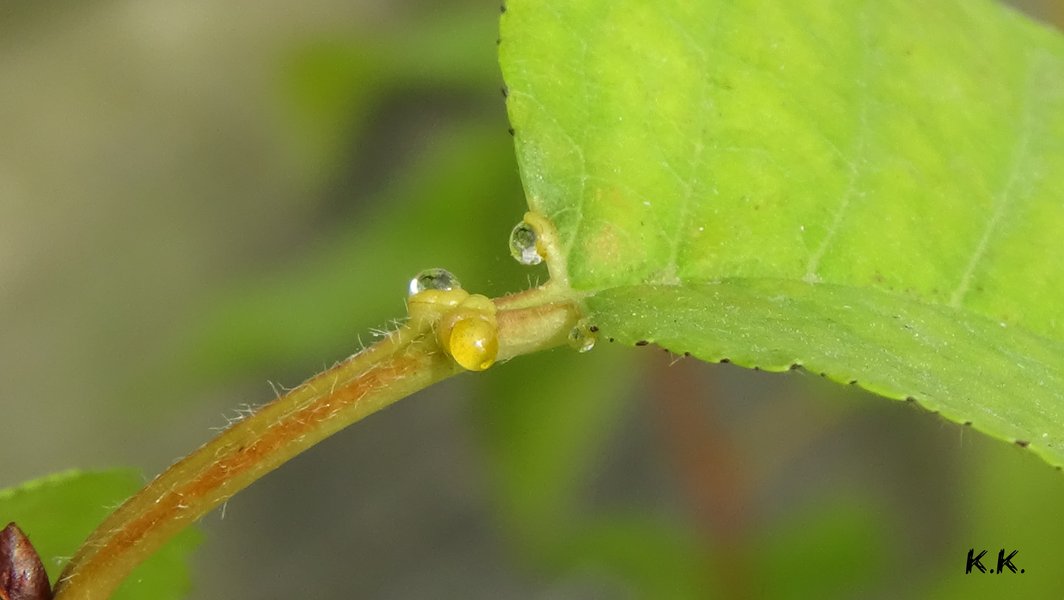


These images demonstrate the diverse morphologies of extrafloral nectaries across different tree species. Note how they are positioned strategically on vulnerable plant parts like leaf margins, petioles, and leaf bases. During spring, these structures actively secrete nectar to attract beneficial insects, forming a critical component of the tree's defense strategy when herbivore pressure is highest and new growth is most vulnerable.
Extrafloral Nectaries: Form and Function
This video provides an excellent overview of extrafloral nectaries, explaining their structure, development, and ecological role in plant defense. It illustrates how these specialized structures function during the peak of their activity in the spring growing season, attracting beneficial insects like ants that protect the plant from herbivores. The video highlights how extrafloral nectaries represent a fascinating example of plant adaptation and mutualistic relationships in ecosystems.
Frequently Asked Questions
Why do trees invest in extrafloral nectaries primarily in spring?
Trees invest heavily in extrafloral nectaries during spring for several strategic reasons. First, spring is when trees produce new leaves that are tender, nutritious, and lack physical defenses like toughness and high lignin content. Second, this coincides with the emergence of many herbivorous insects whose populations peak in spring and early summer. By allocating resources to extrafloral nectaries during this vulnerable period, trees effectively recruit defensive mutualists (like ants) when they need them most. This pattern follows the optimal defense theory, which predicts that plants will invest more in defense when and where they are most vulnerable to attack and when the tissue has the highest value to the plant.
Do all deciduous trees have extrafloral nectaries?
No, not all deciduous trees have extrafloral nectaries. Extrafloral nectaries have been documented in at least 66 plant families, but their presence varies significantly across genera and species. Common deciduous trees with prominent extrafloral nectaries include poplars (Populus), cherries and plums (Prunus), catalpa, and some maples. Many tree species have evolved alternative defense strategies instead, such as chemical defenses (producing tannins, alkaloids, etc.), structural defenses (thorns, trichomes), or rely primarily on induced defenses that activate after herbivore damage has occurred.
How do environmental factors affect extrafloral nectary activity?
Several environmental factors influence extrafloral nectary activity. Moisture availability is crucial—trees typically produce more nectar during periods with adequate rainfall, which is why EFN activity often peaks during the rainy season in tropical regions. Temperature also plays a significant role, with warmer temperatures generally increasing metabolic processes that support nectar production. Light intensity and duration affect photosynthesis rates, which in turn influence the availability of carbohydrates for nectar production. Additionally, soil fertility can impact nectar quality and quantity, as trees need sufficient nutrients to allocate to defense. Climate change may alter these patterns by shifting the timing of bud break, herbivore emergence, and precipitation patterns, potentially disrupting the synchronization of EFN activity with periods of peak vulnerability.
Can trees control or adjust their extrafloral nectary production?
Yes, trees demonstrate remarkable plasticity in their ability to adjust extrafloral nectary production. Many species can increase nectar production in response to herbivore damage, a phenomenon known as an induced defense. This response can be triggered by chemical signals released when plant tissues are damaged. Some trees can even modify the composition of their nectar, changing sugar concentrations or incorporating defensive compounds like alkaloids. Additionally, trees may adjust nectar production in response to the presence of beneficial insects, producing more when defensive mutualists are present to maximize the benefit of this relationship. This dynamic control system allows trees to optimize their resource allocation to defense based on current conditions and threats.
How does tree age affect extrafloral nectary density?
Research, particularly on aspen trees (Populus tremuloides), has shown that younger trees typically have higher extrafloral nectary density than older specimens. One-year-old trees can have up to 20% greater EFN density than 4-year-old trees and more than 50% greater density than trees older than 10 years. This age-related pattern aligns with the optimal defense theory since younger trees have fewer stored resources, less developed structural defenses, and face proportionally higher costs from herbivore damage. Additionally, younger trees are often in a more active growth phase, allocating more resources to new tissue production that needs protection. As trees mature, they typically develop more robust physical defenses and have greater resource reserves to recover from damage, potentially reducing their reliance on EFNs for protection.
References
- Extrafloral Nectaries and ETC - Ohio State University Extension
-
Morphological and Secretory Characterization of Extrafloral Nectaries - PMC
-
Extrafloral Nectaries in Aspen (Populus tremuloides) - PMC
- Functional Role of Extrafloral Nectar in Different Ecosystems - MDPI Forests Journal
- Extrafloral Nectaries in Temperate Regions - University of Nebraska Digital Commons
- Study on Extrafloral Nectaries in Aspen Trees - PubMed
- Plant Extrafloral Nectaries - Springer Reference
Recommended Topics
 nmsudesertblooms.blogspot.com
Last updated April 4, 2025