
Unlocking the Secrets of Factoring in Algebra: A Guide for Parents and Children
Simplifying Expressions and Discovering Common Bonds
Factoring in algebra is a fundamental concept, essentially the "reverse" process of expanding expressions. Just as you might break down a large number into its prime factors (e.g., 12 into 2 x 2 x 3), factoring an algebraic expression involves identifying simpler expressions that, when multiplied together, produce the original expression. This skill is crucial for simplifying complex equations, solving for unknown variables, and building a strong foundation for more advanced mathematical topics.
Key Insights into Factoring Algebraic Expressions
- Factoring is the Reverse of Expanding: Think of it like putting ingredients back into their original packages after you've mixed them. Expanding takes something like \(3(x + 4y)\) and makes it \(3x + 12y\), while factoring takes \(3x + 12y\) and returns it to \(3(x + 4y)\).
- Common Factors are Key: The most basic form of factoring involves identifying the greatest common factor (GCF) among the terms in an expression and "taking it out." This GCF acts like a shared ingredient that can be separated.
- Simplification and Problem-Solving: Factoring helps us simplify expressions, making them easier to work with. It's especially vital for solving quadratic equations and other polynomials, as it allows us to break down a complex problem into smaller, manageable parts.
Understanding the Core Concept: What is Factoring?
At its heart, factoring an algebraic expression means rewriting it as a product of its factors. Imagine you have a completed puzzle, and factoring is the process of breaking that puzzle back down into its individual pieces. These "pieces" are the factors. For numbers, a factor is any number that divides it evenly without a remainder. For example, the factors of 10 are 1, 2, 5, and 10 because they all divide 10 exactly.
In algebra, factors can be numbers, variables, or even other algebraic expressions. The goal is to express a complex expression as a multiplication of simpler ones, often enclosed in brackets. This process is often called "factorising" in the UK.
The Inverse Relationship: Factoring and Expanding
Factoring is often described as the "reverse" of expanding brackets. When you expand, you multiply a term outside the bracket by each term inside the bracket. For example, if you expand \(5(x + 2)\), you get \(5x + 10\). Factoring is the opposite: you start with \(5x + 10\) and aim to get back to \(5(x + 2)\). This inverse relationship is fundamental to understanding why factoring is done.
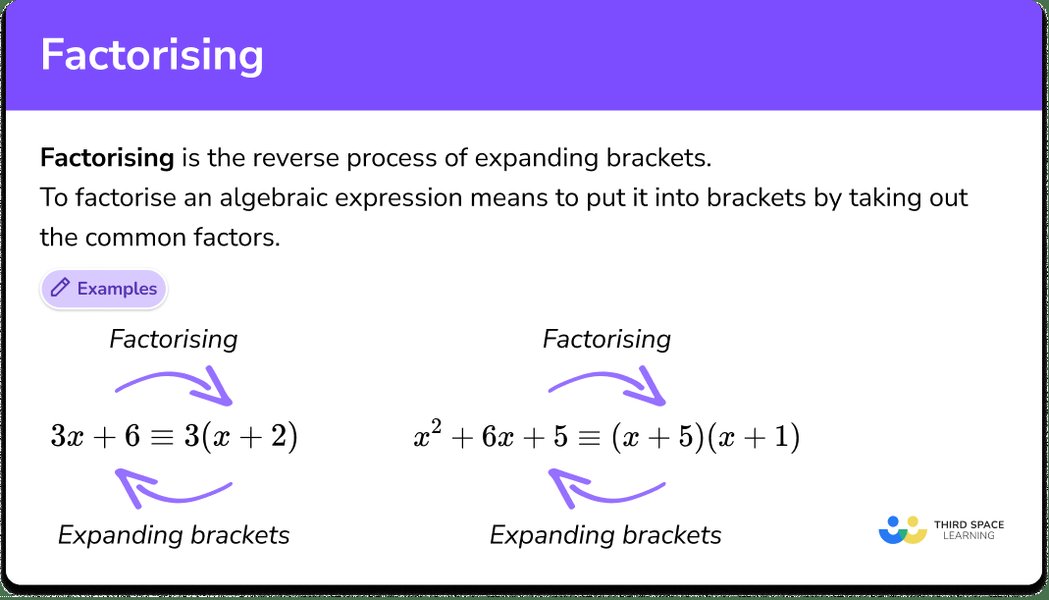
Visualizing the inverse operations of expanding and factoring.
Why is Factoring Important in Algebra?
Factoring isn't just a mathematical exercise; it's a powerful tool that simplifies problems and reveals underlying structures. Here's why it's so important:
- Simplification: Factoring allows us to simplify complex algebraic expressions, making them easier to understand and manipulate. A simplified expression is less prone to errors in further calculations.
- Solving Equations: One of the primary applications of factoring is solving polynomial equations, especially quadratic equations. If an equation can be factored into the form \(E \cdot F = 0\), then we know that either \(E = 0\) or \(F = 0\), which breaks down a single complex problem into two simpler ones.
- Understanding Roots and Intercepts: For graphical representations of functions, factoring helps identify the roots (x-intercepts) of a polynomial, which are the points where the function crosses the x-axis.
- Building Blocks for Higher Math: The principles of factoring extend into higher-level mathematics, including calculus and differential equations, where it's used for simplifying derivatives, integrals, and other advanced operations.
Common Methods for Factoring Algebraic Expressions
There are several methods for factoring, each suited for different types of expressions. We'll focus on the most common and fundamental ones.
Method 1: Factoring Out the Greatest Common Factor (GCF)
This is the simplest and often the first step in factoring any expression. The GCF is the largest number or algebraic term that divides evenly into all terms of the expression. Think of it as finding what all the terms "have in common" and then pulling that common part out.
How it Works:
- Identify all the terms in the expression.
- Find the greatest common factor (GCF) for the numerical coefficients.
- Find the greatest common factor for the variables (if any) by taking the lowest power of each common variable.
- Write the GCF outside a set of brackets.
- Divide each term in the original expression by the GCF and write the results inside the brackets.
Example: Factoring \(3x + 12y\)
Let's take the expression \(3x + 12y\).
- Terms are \(3x\) and \(12y\).
- The numbers are 3 and 12. The greatest common factor of 3 and 12 is 3.
- The variables are \(x\) and \(y\). They don't have common variables.
- So, the GCF of \(3x + 12y\) is 3.
- We write 3 outside the bracket: \(3(\ldots)\).
- Now, divide each term by 3: \(3x \div 3 = x\) and \(12y \div 3 = 4y\).
- Put these results inside the bracket: \(3(x + 4y)\).
Therefore, \(3x + 12y\) factored is \(3(x + 4y)\).
This video provides a basic introduction to factorising algebraic expressions.
Method 2: Factoring Quadratic Trinomials (when \(a=1\))
Quadratic trinomials are expressions of the form \(ax^2 + bx + c\). When \(a=1\), the expression is \(x^2 + bx + c\). To factor these, we look for two numbers that multiply to \(c\) and add up to \(b\).
Example: Factoring \(x^2 + 5x + 6\)
- We need two numbers that multiply to 6 (the \(c\) term) and add up to 5 (the \(b\) term).
- Let's list pairs of factors for 6:
- 1 and 6 (1 + 6 = 7, not 5)
- 2 and 3 (2 + 3 = 5, perfect!)
- So, the two numbers are 2 and 3.
- The factored form is \((x + 2)(x + 3)\).
Method 3: Factoring by Grouping
This method is often used for polynomials with four terms. It involves grouping terms that have common factors and then factoring out the GCF from each group.
Example: Factoring \(xy + 3x + 2y + 6\)
- Group the terms: \((xy + 3x) + (2y + 6)\).
- Factor out the GCF from each group:
- From \((xy + 3x)\), the GCF is \(x\), leaving \(x(y + 3)\).
- From \((2y + 6)\), the GCF is \(2\), leaving \(2(y + 3)\).
- Now we have \(x(y + 3) + 2(y + 3)\). Notice that \((y + 3)\) is a common factor to both terms.
- Factor out the common binomial \((y + 3)\): \((y + 3)(x + 2)\).
This method is highly versatile and can be applied in many factoring scenarios, including some trinomials when \(a \neq 1\).
Delving Deeper: Why 'a' is a Factor of \(a + ab\) but 'b' is Not
This is an excellent question that highlights the definition of a factor in algebraic expressions. Let's break down the expression \(a + ab\).
Understanding Terms and Factors
In an algebraic expression, "terms" are the parts separated by addition or subtraction signs. "Factors" are what you multiply together to get a term or an expression.
- In \(a + ab\), the terms are \(a\) and \(ab\).
- For the term \(a\), its factors are \(1\) and \(a\).
- For the term \(ab\), its factors are \(a\), \(b\), \(1\), and \(ab\).
Why 'a' is a Factor of \(a + ab\)
To determine if something is a factor of an entire expression, it must be a common factor to *all* terms in that expression. Let's look at \(a + ab\):
- The first term is \(a\). It clearly has \(a\) as a factor (\(a = a \cdot 1\)).
- The second term is \(ab\). It also has \(a\) as a factor (\(ab = a \cdot b\)).
Since \(a\) is a factor of both \(a\) and \(ab\), it is a common factor of the entire expression \(a + ab\). We can factor it out:
\[ \text{Expression: } a + ab \] \[ \text{Common factor is } a \] \[ a(1) + a(b) = a(1 + b) \]When you multiply \(a\) by \((1 + b)\), you get \(a \cdot 1 + a \cdot b\), which simplifies to \(a + ab\). This confirms that \(a\) is indeed a factor of the expression.
Why 'b' is Not a Factor of \(a + ab\)
Now, let's consider \(b\):
- The first term is \(a\). Can \(a\) be divided evenly by \(b\)? Not necessarily. If \(a\) does not contain \(b\) as part of its multiplicative components (e.g., if \(a\) is just a standalone variable or a number that isn't a multiple of \(b\)), then \(b\) is not a factor of \(a\). For example, if \(a=5\) and \(b=2\), then \(5\) cannot be divided evenly by \(2\).
- The second term is \(ab\). This term *does* have \(b\) as a factor (\(ab = a \cdot b\)).
For \(b\) to be a factor of the entire expression \(a + ab\), it must be a common factor to all terms. Since \(b\) is not a factor of the first term, \(a\), it cannot be factored out from the entire expression. Therefore, \(b\) is not a factor of \(a + ab\).
This illustrates a key principle: a factor of an expression must divide every single term within that expression without leaving a remainder. If even one term resists division by the proposed factor, then it is not a factor of the entire expression.
The radar chart above illustrates the importance of various aspects of factoring in algebra and the perceived ease of teaching these concepts to children. It highlights that while fundamental concepts like common factor identification are relatively easy to convey, their utility in solving complex equations and serving as a foundation for advanced mathematics emphasizes their high importance.
Common Factoring Techniques Summary
To further consolidate the understanding of different factoring techniques, the following table summarizes the key methods and their primary applications.
| Factoring Method | Description | Example | Typical Application |
|---|---|---|---|
| Greatest Common Factor (GCF) | Finding the largest common factor (number, variable, or both) shared by all terms in an expression and factoring it out. | \(4x + 8 = 4(x + 2)\) | Simplifying any polynomial; first step in most factoring problems. |
| Trinomials (a = 1) | Factoring expressions of the form \(x^2 + bx + c\) by finding two numbers that multiply to \(c\) and add to \(b\). | \(x^2 + 7x + 10 = (x + 2)(x + 5)\) | Solving quadratic equations where \(a=1\). |
| Difference of Two Squares | Factoring expressions of the form \(a^2 - b^2\) into \((a - b)(a + b)\). | \(x^2 - 9 = (x - 3)(x + 3)\) | Simplifying expressions, solving specific quadratic equations. |
| Factoring by Grouping | Used for polynomials with four terms by grouping pairs of terms, factoring out their GCF, and then factoring the common binomial. | \(ax + ay + bx + by = a(x+y) + b(x+y) = (x+y)(a+b)\) | Factoring polynomials with four terms, or complex trinomials (\(a \ne 1\)). |
This table offers a quick reference for identifying the appropriate factoring strategy based on the structure of the algebraic expression.
Frequently Asked Questions (FAQ)
What is a "term" in algebra?
What is the "Highest Common Factor" (HCF) or "Greatest Common Factor" (GCF)?
Is factoring only used for simple expressions?
How can I check my factoring work?
Conclusion
Factoring algebraic expressions is a cornerstone of algebra, transforming complex sums into understandable products. It's the inverse operation of expanding and serves as a vital tool for simplifying expressions, solving equations, and laying the groundwork for advanced mathematical concepts. By understanding common factors and applying systematic methods, one can effectively break down algebraic expressions, revealing their simpler components. This skill empowers students to tackle a wide array of algebraic challenges and is a testament to the beauty and utility of mathematical manipulation.
Recommended Further Exploration
- How to factor quadratic equations step by step?
- What are algebraic identities and how are they used for factoring?
- Where is factoring applied in real-life scenarios?
- Effective strategies for teaching algebraic concepts to children.
References
Last updated May 22, 2025