
FII Exit from Indian Stock Market
In-depth Analysis of FII Exits and Their Market Impact
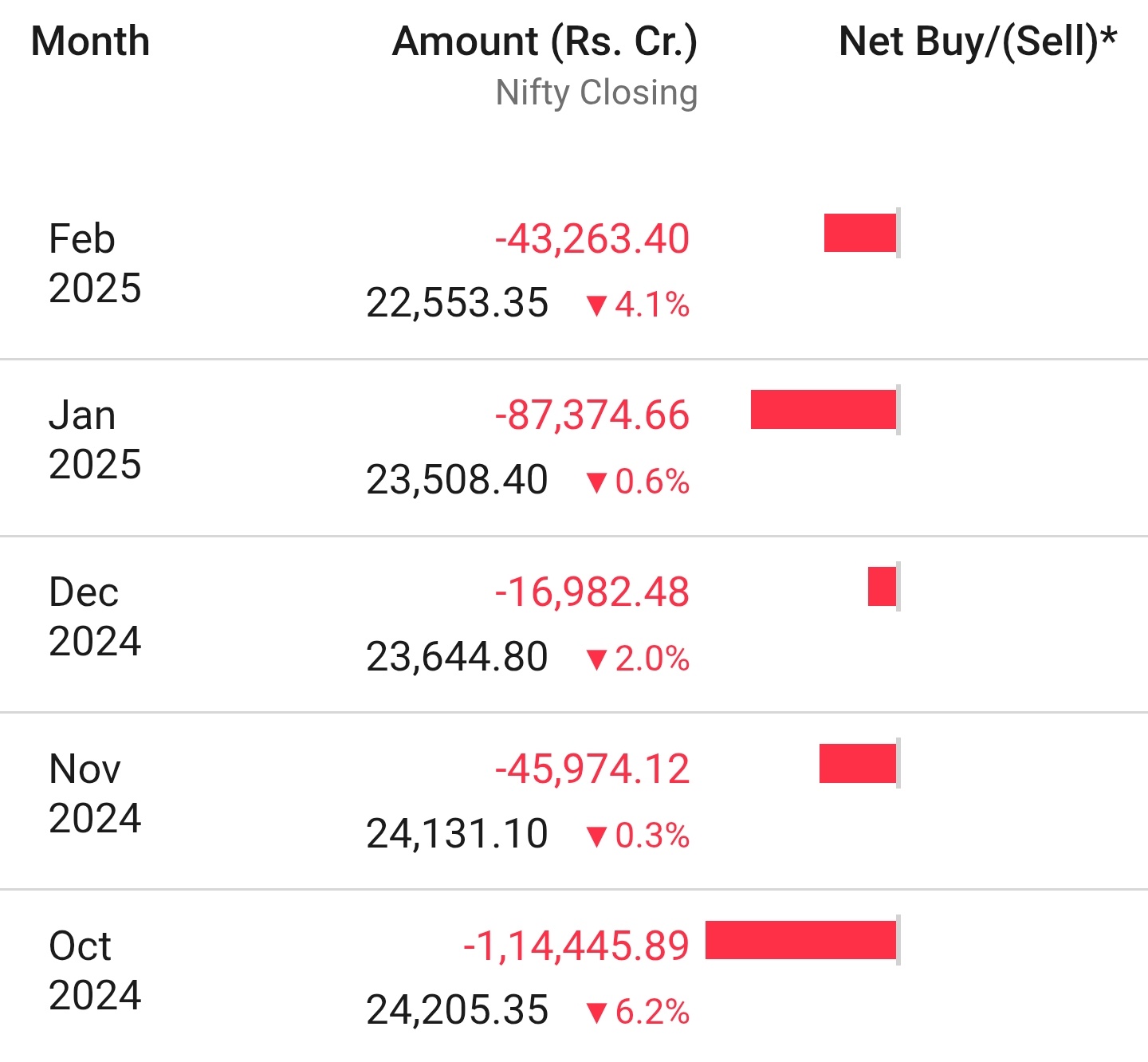
Highlights
- Market Scale: FIIs hold a significant portion of the market, yet their recent outflows represent only a fraction of total market capitalization.
- Exit Percentage: Despite large nominal values in rupees, the actual percentage of market capital exited is relatively low, around 0.2% of the entire equity market.
- Market Impact: The trend has implications for market volatility and sectoral shifts, even as overall market capitalization continues to grow.
Understanding FII Participation in the Indian Stock Market
Foreign Institutional Investors (FIIs) play an integral role in shaping the dynamics of the Indian stock market. Their investments often reflect global economic trends, risk appetite, and shifting sentiments regarding emerging markets. Traditionally, FIIs have invested heavily in Indian equities, contributing significantly to the market capitalization of numerous sectors and companies. However, recent trends show notable outflows, which have raised concerns among market participants regarding the potential impact on stock prices and overall market stability.
The Role and Scale of FII Investments
FIIs have long been viewed as a double-edged sword in emerging markets like India. On one hand, their investments boost liquidity, enhance price discovery, and help improve investor confidence. On the other, rapid inflows or outflows can exacerbate market volatility. In the context of the Indian stock market, FIIs have held approximately 17-18% of the total market capitalization. This significant stake highlights the scale at which these investors influence market trends. Even though their holdings amount to hundreds of billions in US dollars, the Indian equity market's explosive growth over the years means that the absolute figures need to be contextualized.
Current Trends in FII Outflows
During the early months of 2025, FIIs have been observed exiting from the market at an unprecedented pace. The total outflow has been reported to be around ₹1.1 to ₹1.12 lakh crore. While this figure might sound substantial on a nominal basis, when viewed as a fraction of the overall market capitalization, it represents only about 0.2% of the market. This relatively modest percentage indicates that although substantial capital has left the market in absolute terms, the size of the Indian stock market has grown substantially, mitigating the effect relative to the total valuation.
Quantitative Analysis of FII Exits
A numerical perspective offers clarity on the matter. As of late 2024, the total market capitalization of the Indian market stood at an estimated $5.3 to $5.5 trillion. With FIIs holding roughly 17-18% of this capital, the value of their portfolio was in the range of $900 billion to $1,000 billion. In such a scenario, even an outflow of about $11.5 to $12 billion from the FIIs translates into a minimal percentage when compared against the broader market capitalization.
To illustrate further, consider the following table which crisply summarizes the key quantitative aspects:
| Parameter | Value | Relevant Percentage/Impact |
|---|---|---|
| Total Market Capitalization | $5.3 - $5.5 trillion | 100% (Baseline) |
| FII Holdings | $900 - $1,000 billion | Approximately 17-18% |
| Reported FII Outflow (2025) | ₹1.1 - ₹1.12 lakh crore (~$11.5 - $12 billion) | ~1.2% of FII Holdings or ~0.2% of total market cap |
These figures underline that while the outflow may seem to be a significant loss in absolute terms, the overall percentage of the total market capitalization affected is relatively minor. This minimal percentage is primarily due to the large base of the Indian equity market, which has seen substantial growth over the years.
Factors Influencing the FII Exit
Market Sentiment and Global Economic Trends
The global economic scenario frequently influences FII behavior. Factors such as changes in global interest rates, shifts in economic growth prospects, and geopolitical uncertainties contribute to the decision-making process of these investors. During times of global economic uncertainty or when better investment opportunities arise in other parts of the world, FIIs might reduce their exposure to emerging markets like India.
Domestic Economic and Policy Factors
Within India, domestic economic performance, fiscal policies, and regulatory changes significantly impact FII decisions. Policy reforms aimed at boosting the economy, efforts to stabilize inflation, and measures to strengthen the financial sector all act as either attractors or dissuaders for foreign investments. During periods of favorable domestic policies, even with temporary outflows, FIIs might re-enter the market to capitalize on future growth.
Sectoral Impacts
The exits have not been uniform across all sectors. While FIIs have scaled back significantly in large-cap segments where liquidity and mature business models are present, there has been an observed incremental shift towards midcap and small-cap equities. This sectoral realignment could indicate a strategic repositioning, as FIIs search for undervalued opportunities that might offer higher growth potential in the long run.
Implications for the Market
Short-Term Volatility versus Long-Term Growth
One of the critical aspects of FII exits is their effect on short-term market volatility. The withdrawal of significant amounts of capital can temporarily depress stock prices, leading to increased market instability. This, in turn, may create concerns among domestic investors who become wary during episodes of high volatility. However, these short-term impacts are less indicative of the long-term strengths and growth trajectory of the Indian market.
In the long run, the Indian stock market has demonstrated a robust capacity to recover and grow. The overall increase in market capitalization, driven by improvements in corporate earnings, ongoing economic reforms, and supportive policy measures, reinforces the market's resilience. Hence, while the current exit percentage of FIIs might be cause for short-term apprehension, it is unlikely to disrupt the fundamental growth story of the market.
Market Liquidity and Investor Behavior
The liquidity provided by FIIs is instrumental for maintaining an efficient, liquid market. Although the recent outflows are noteworthy, the absolute percentage relative to the total market capitalization is small enough that liquidity remains largely intact. This means that while some sectors might feel the pinch in liquidity, the overall market continues to function with robust depth and resilience.
Behavioral Shifts and Strategic Repositioning
FIIs are known for their flexible investment strategies. In response to market turbulence or opportunities in other investments, their rebalancing efforts are not necessarily indicative of pessimism about the market’s future. Instead, these shifts can be part of a renewed focus on long-term value, where the temporary reduction in exposures is aimed at restructuring portfolios in anticipation of future market recovery and growth.
Integrating the Quantitative and Qualitative Perspectives
Balancing the Numbers with Market Fundamentals
While the quantitative assessment of the FII exits shows that only about 0.2% of the total market capitalization has been exited, understanding the qualitative factors is equally important. The fundamental strength of the market, reflected in growth in GDP, corporate earnings, and domestic investor participation, offsets the concerns raised by temporary capital flight. Despite the nominal value of the outflow, the Indian market continues to exhibit strong growth potential. It is essential to view these numbers against the backdrop of an expanding, dynamic market.
A Comparative Perspective on Investment Flows
A broader analytical perspective must also consider that FII exits represent only a slice of the overall international investment trends. While the exits are significant relative to the historical norms for emerging markets, many other global investors frequently shift their portfolios in response to evolving market conditions. In comparison with historical data of FII behavior, the current figures—though headline grabbing—are consistent with periodic rebalancing efforts driven by global capital reallocations.
Market Capitalization vs. FII Holdings: A Snapshot
The following table provides an overview of key metrics that help to compare the size of the market and FII holdings along with the impact of recent outflows:
| Metric | Value/Range | Insight |
|---|---|---|
| Total Market Capitalization | $5.3-$5.5 trillion | Represents the full value of the market |
| FII Share | 17-18% (~$900B-$1,000B) | Indicates the significance of foreign investments |
| FII Outflow (2025) | ₹1.1 - ₹1.12 lakh crore (~$11.5-$12B) | Approximately 0.2% of total market cap |
This structured analysis further substantiates that while the outflow values in absolute terms are considerable, their relative impact on the total market capitalization is minimal. Such insights reaffirm that investment decisions and market movements should always be contextualized within broader market trends.
Broader Implications and Future Considerations
Sectoral Rebalancing and Emerging Opportunities
The re-allocation of FII investments is often sector-specific. There is evidence to suggest that as FIIs reduce their exposure in large-caps, there is a gradual increase in allocations toward midcap and small-cap stocks. This sectoral rebalancing may usher in emerging opportunities for investors seeking growth in less mature segments of the market. Investors should carefully monitor these shifts as they might indicate future trends that could lead to an enhanced performance in targeted segments of the market.
Strategic Market Positioning Amid Global Currents
Considering the global investment landscape, the strategy of rebalancing and repositioning portfolios is a common practice among FIIs. They often move funds in response to macroeconomic signals, such as interest rate shifts, geopolitical risks, or emerging market opportunities elsewhere. Although these strategic exits temporarily reduce their exposure to Indian equities, it does not necessarily signal a long-term retreat. Instead, it reflects a dynamic approach in managing risk and optimizing returns in a volatile global environment.
The Path Forward for Domestic Investors
For domestic investors, understanding the implications of FII outflows is crucial. While large-scale exits might contribute to short-term market fluctuations, they also present attractive entry points for investors with a long-term horizon. The intrinsic principles of market growth, driven by India's economic fundamentals, suggest that any temporary disruptions caused by external capital movements can be capitalized upon with careful market research and strategic long-term planning.
Moreover, several market experts recommend that retail investors consider the cyclical nature of global investment flows. When foreign investments retract, there often follows a period during which domestic capital gets the opportunity to drive the market forward. Such cycles enable both domestic and institutional investors to recalibrate their strategies and leverage the ensuing market recovery phases.
Conclusion
In conclusion, while FIIs have executed substantial outflows amounting to approximately ₹1.1 to ₹1.12 lakh crore (roughly $11.5 to $12 billion) in early 2025, this figure represents only around 0.2% of the total market capitalization of the Indian stock market. Despite the dramatic headlines these outflows generate, the vast scale of the Indian market and the continued robust growth in its overall valuation help to cushion the impact of such exits.
It is essential to analyze these figures within both quantitative and qualitative contexts. The numerical data clearly indicate that the percentage of market capitalization affected is minimal. Simultaneously, understanding the underlying market dynamics, including global economic trends, domestic policy decisions, and sectoral shifts, provides a comprehensive picture of how these exits might influence overall market sentiment and future opportunities.
Ultimately, while FII withdrawals contribute to short-term market volatility and require careful monitoring, they do not represent a fundamental weakness in the market’s growth prospects. Instead, they are part of the normal rebalancing processes that characterize global investment strategies. Investors are thus encouraged to maintain a long-term perspective, capitalizing on the opportunities that arise from market re-adjustments, and to consider the inherent resilience of India’s equity market fueled by strong domestic fundamentals.
References
- FII Shareholding Hits a Decade Low - Livemint
- Rising FII Outflows - Value Research Online
- FIIs Outflows Touch Rs 1.1 Lakh Crore - The Times of India
- Foreign Investors Pull Out in 2025 - The Week
- Market Outlook 2025 - Business Standard
- Impact of FII Outflows - India Today
- FIIs Pull Over Rs 1.12 Lakh Crore - Economic Times
Recommended
Last updated February 28, 2025