
Unlock Your Productivity: The Definitive Guide to Conquering Procrastination for Good
Move beyond delay and unlock your potential with actionable strategies grounded in psychological insights.
Procrastination, the act of unnecessarily delaying decisions or actions, is a common human experience. It often feels like a battle against oneself, leading to stress, missed opportunities, and reduced performance. But it's not an insurmountable trait. By understanding its roots and implementing targeted strategies, you can break the cycle and cultivate lasting productivity.
Highlights: Key Insights to Stop Procrastinating
- Understand the 'Why': Procrastination isn't just laziness; it's often a coping mechanism for negative emotions like fear, anxiety, or overwhelm linked to a task. Recognizing your personal triggers is the first step.
- Break It Down & Start Small: Large, ambiguous tasks are paralyzing. Divide them into specific, manageable steps and use techniques like the "2-Minute Rule" to overcome initial resistance and build momentum.
- Cultivate Self-Compassion: Berating yourself for procrastinating is counterproductive. Practice self-kindness and mindfulness to manage the urge to delay without judgment, reducing fear of failure.
Decoding the Procrastination Puzzle
Why Do We Delay What We Know We Should Do?
Before diving into solutions, it's crucial to grasp why procrastination happens. It's rarely about poor time management alone. More often, it's an emotional regulation problem. We procrastinate to avoid uncomfortable feelings associated with a task:
- Fear of Failure or Judgment: Perfectionism can lead to paralysis, as the fear of not meeting high standards makes starting daunting.
- Task Aversion: The task might be boring, unpleasant, or difficult, leading us to seek more immediate gratification elsewhere.
- Feeling Overwhelmed: Large, complex, or poorly defined tasks can feel insurmountable, triggering avoidance.
- Decision Fatigue: Having too many choices or decisions to make can deplete mental energy, making it easier to put things off.
- Short-Term Mood Repair: Engaging in distractions provides temporary relief from the negative emotions tied to the task, reinforcing the procrastination habit.
Identifying which of these (or other factors like anxiety or ADHD) drives your procrastination allows you to choose the most effective counter-strategies.
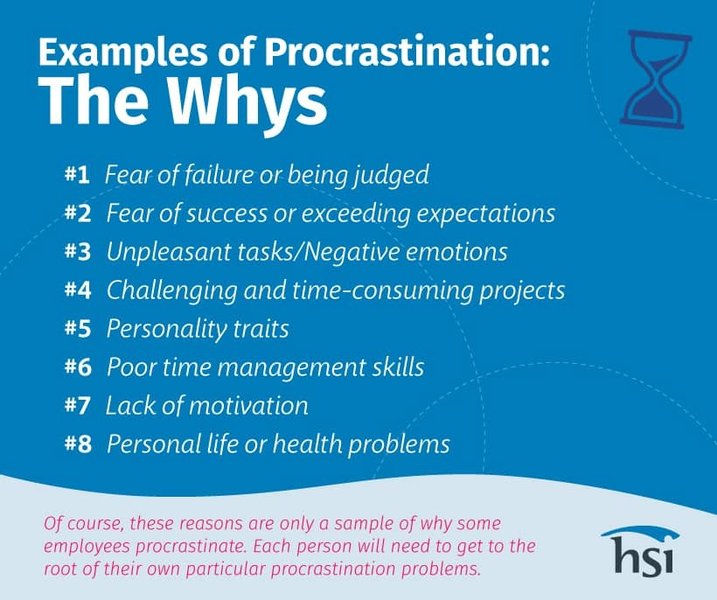
Understanding the underlying reasons for delay is key to finding effective solutions.
Actionable Strategies to Reclaim Your Time
Overcoming procrastination requires a multi-faceted approach combining mindset shifts, practical techniques, and habit building. Here’s a comprehensive toolkit:
1. Master Goal Setting and Task Breakdown
From Vague Intentions to Concrete Actions
Ambiguity fuels procrastination. Vague goals like "get organized" or "work on the report" are hard to start. Instead:
- Be Specific and Measurable: Define exactly what needs to be done and what success looks like. Change "study more" to "read Chapter 5 and summarize key points by 3 PM."
- Set Realistic Goals: Avoid overambition. Aim for achievable targets to build confidence and momentum. Factor in buffer time.
- Break Down Large Tasks: Divide daunting projects into the smallest possible steps. This makes the overall goal seem less overwhelming and provides clear starting points. Focus only on the very next action required.
2. Conquer Inertia: Just Get Started
Techniques to Overcome Initial Resistance
Often, the biggest hurdle is simply beginning. Use these methods to push past that initial block:
- The 2-Minute Rule: Commit to working on a task for just two minutes. If an action takes less than two minutes, do it immediately. Starting is often enough to break the resistance, and you'll likely continue for longer.
- Start with Easy/Enjoyable Tasks: Begin your work session with a small, manageable, or even interesting part of the task. This creates a feeling of accomplishment and builds momentum for tackling harder parts.
- Timeboxing: Allocate specific, fixed time slots (e.g., 25 minutes) for focused work on a particular task, followed by a short break (like the Pomodoro Technique). This creates structure and makes tasks feel less endless.
3. Cultivate a Proactive Mindset
Mindfulness, Self-Compassion, and Reframing
Your internal dialogue significantly impacts procrastination:
- Practice Mindfulness: Become aware of your thoughts and feelings when you feel the urge to procrastinate. Observe them without judgment. This awareness helps you consciously choose to act despite discomfort.
- Embrace Self-Compassion: Stop beating yourself up. Research shows self-criticism exacerbates procrastination. Acknowledge setbacks kindly and refocus on the next step. Treat yourself with the same understanding you'd offer a friend.
- Reframe Your Perspective: Shift from "I have to do this" to "I choose to do this" or "I want to see the outcome." Focus on the benefits of completion (relief, accomplishment, progress) rather than the difficulty of the task. Challenge perfectionist thoughts; aim for "good enough" instead of flawless.
- List the Costs: Sometimes, confronting the negative consequences of delay (increased stress, missed deadlines, regret) can provide the necessary motivation to act now.

A positive and compassionate mindset is crucial for overcoming procrastination.
4. Engineer Your Environment
Minimize Distractions, Maximize Focus
Your surroundings can either support or sabotage your efforts:
- Identify and Eliminate Distractions: Recognize your biggest time-wasters (social media, notifications, clutter, noise) and proactively reduce their presence during work periods. Turn off phone alerts, use website blockers, or find a quiet workspace.
- Create a Dedicated Workspace: If possible, designate a specific area solely for work or study. This helps create a mental association between the space and focused activity.
- Prepare in Advance: Gather all necessary materials before starting a task to avoid interruptions later.
5. Leverage Planning and Time Management
Structure Your Day for Success
Effective planning reduces overwhelm and prevents decision fatigue:
- Plan Your Day/Week: Decide ahead of time what you need to accomplish. Prioritize tasks (e.g., using the Eisenhower Matrix to distinguish urgent/important tasks). Knowing your plan reduces ambiguity.
- Schedule Tasks: Block out specific times in your calendar for important tasks, treating them like appointments.
- Reduce Daily Decisions: Make routine choices (like what to wear or eat) ahead of time to conserve mental energy for more demanding tasks.
- Build Routines: Establish consistent daily or weekly routines for work, study, and breaks to automate productive behaviors.
6. Harness Accountability and Support
Share Goals and Seek Encouragement
External factors can significantly boost motivation:
- Find an Accountability Partner: Share your goals and progress with a friend, family member, or colleague who can check in with you.
- Join Support Groups: Connect with others facing similar challenges, either online or in person, for shared strategies and encouragement.
- Connect to Purpose: Understand how your task contributes to larger personal, team, or company goals. Seeing the bigger picture can increase intrinsic motivation.
- Use Commitment Devices: Pre-commit to actions. This could involve setting deadlines with consequences, using apps that restrict distractions, or scheduling appointments you can't easily cancel.
Visualizing Your Path Forward: A Mindmap of Strategies
To help consolidate these techniques, here is a mindmap outlining the core pillars of overcoming procrastination. Visualizing the interconnectedness of these strategies can reinforce how they work together to build a more productive approach to tasks.
(Fear, Anxiety, Boredom)"] id1b["Task Characteristics
(Large, Vague, Difficult)"] id1c["Perfectionism"] id1d["Decision Fatigue"] id1e["Underlying Issues
(ADHD, Depression)"] id2["Core Strategies"] id2a["Goal Setting &
Task Breakdown"] id2a1["Specific & Measurable Goals"] id2a2["Realistic Targets"] id2a3["Break Into Small Steps"] id2a4["Identify Next Action"] id2b["Initiation Techniques"] id2b1["2-Minute Rule"] id2b2["Start Easy/Enjoyable"] id2b3["Timeboxing (Pomodoro)"] id2c["Mindset Shifts"] id2c1["Mindfulness"] id2c2["Self-Compassion"] id2c3["Reframe Perspective
(Want vs. Have To)"] id2c4["Challenge Perfectionism"] id2c5["Acknowledge Costs"] id2d["Environment Control"] id2d1["Minimize Distractions"] id2d2["Dedicated Workspace"] id2d3["Prepare Materials"] id2e["Planning & Time Mgt."] id2e1["Daily/Weekly Planning"] id2e2["Prioritization (Matrix)"] id2e3["Scheduling Tasks"] id2e4["Reduce Decisions"] id2e5["Establish Routines"] id2f["Accountability & Support"] id2f1["Accountability Partner"] id2f2["Support Groups"] id2f3["Connect to Purpose"] id2f4["Commitment Devices"] id3["Sustainable Habits"] id3a["Consistent Routines"] id3b["Adequate Sleep"] id3c["Regular Breaks"] id3d["Reflection (Journaling)"] id3e["Seek Professional Help
(If needed)"]
This mindmap serves as a quick reference, showing how understanding the roots of procrastination informs the various strategies you can employ across goal setting, task initiation, mindset, environment, planning, and seeking support.
Comparing Anti-Procrastination Techniques
Different strategies resonate differently with individuals and situations. This radar chart offers an illustrative comparison of the perceived effectiveness and ease of implementation for several key techniques discussed. The scores (ranging notionally from 3 to 10, where higher is better) reflect a synthesis of common experiences and expert advice, rather than precise empirical data. 'Effectiveness' refers to the potential impact on reducing procrastination, while 'Ease of Implementation' considers how simple the technique is to start using regularly.
As the chart illustrates, techniques like the '2-Minute Rule' are generally easy to implement, offering a quick way to overcome initial inertia, though their long-term effectiveness might depend on combining them with other strategies. Methods like 'Mindfulness & Self-Compassion' might require more practice (lower ease score) but can be highly effective for addressing the emotional roots of procrastination. Experiment to find the combination that works best for you.
Expert Insight: A Simple Strategy
Sometimes, a focused strategy can provide a breakthrough. Mel Robbins, a well-known speaker and author, offers practical advice on interrupting the hesitation loop that leads to procrastination. This video explains a simple technique you can use immediately to push yourself into action.
The core idea presented often involves recognizing the moment of hesitation and using a physical or mental trigger (like counting down) to interrupt the pattern and force yourself to start the desired action. This approach directly targets the gap between intention and action where procrastination often takes root.
Common Triggers and Tailored Solutions
Recognizing your specific procrastination triggers can help you apply the most relevant solutions. This table summarizes common scenarios and corresponding strategies discussed earlier:
| Procrastination Trigger | Description | Potential Solutions |
|---|---|---|
| Task Overwhelm | The project or task feels too large, complex, or long. | Break it down into small, manageable steps; Focus only on the 'next action'; Use timeboxing. |
| Perfectionism | Fear of not doing the task perfectly prevents starting. | Aim for 'good enough' not 'perfect'; Set realistic goals; Practice self-compassion; Focus on progress, not perfection. |
| Fear of Failure/Judgment | Anxiety about negative outcomes or what others might think. | Reframe the task as a learning opportunity; Focus on effort, not outcome; Seek supportive feedback; Practice mindfulness. |
| Task Aversion (Boring/Unpleasant) | Lack of interest or enjoyment in the task itself. | Pair the task with something enjoyable (e.g., music); Reward yourself upon completion; Connect the task to a larger, meaningful goal; Use the 2-minute rule to just start. |
| Lack of Clarity / Ambiguity | Unsure about what needs to be done or how to start. | Seek clarification; Define specific goals and steps; Break down the task until a clear starting point emerges. |
| Decision Fatigue | Mental exhaustion from making too many choices. | Plan ahead (e.g., the night before); Reduce non-essential decisions; Establish routines; Tackle important tasks when energy is highest. |
| Distractions | Easily sidetracked by phone, internet, environment, etc. | Minimize environmental distractions; Use apps/tools to block distracting sites/apps; Schedule specific focus time; Work in a dedicated space. |
Addressing Deeper Issues
When Procrastination Signals More
While the strategies above are effective for many, persistent and debilitating procrastination can sometimes be linked to underlying mental health conditions such as:
- Attention-Deficit/Hyperactivity Disorder (ADHD)
- Anxiety Disorders
- Depression
- Obsessive-Compulsive Disorder (OCD)
If procrastination significantly impacts your work, relationships, or well-being, and self-help strategies aren't sufficient, consider seeking professional help. A therapist or counselor can help identify potential underlying causes and develop tailored coping mechanisms, including cognitive behavioral therapy (CBT) techniques specifically designed to address procrastination and related emotional regulation difficulties. Online therapy options have also proven effective for many.
Building Sustainable Habits for Lasting Change
Consistency is Key
Overcoming procrastination isn't about a single fix but about building new, sustainable habits:
- Establish Consistent Routines: Regular schedules for work, breaks, meals, and sleep help automate productive behavior and reduce the mental effort needed to start tasks.
- Prioritize Sleep: Adequate sleep is crucial for focus, decision-making, and emotional regulation. Maintain a consistent sleep schedule and practice good sleep hygiene.
- Incorporate Regular Breaks: Working in focused bursts with short breaks prevents burnout and maintains concentration over longer periods.
- Practice Reflection: Regularly (e.g., daily or weekly) reflect on what you accomplished, what strategies worked, and where you struggled. Journaling can be a useful tool for identifying patterns and refining your approach.
- Be Patient and Persistent: Change takes time. There will be setbacks. The key is to learn from them, practice self-compassion, and consistently re-apply the strategies that work for you.

Creating sustainable habits and an inspiring environment supports long-term productivity.
Frequently Asked Questions (FAQ)
Is procrastination just laziness or poor willpower?
No, procrastination is typically more complex than simple laziness. While it involves a lack of action, the underlying reasons are often psychological. It's frequently linked to avoiding negative emotions (like fear, anxiety, boredom, or overwhelm) associated with a task, perfectionism, or difficulties with executive functions like planning and initiation. Viewing it solely as laziness or a willpower failure ignores these deeper factors and can lead to unhelpful self-criticism, which often worsens the problem.
Can procrastination ever be beneficial?
Some distinguish between passive procrastination (harmful delay) and "active procrastination" or strategic delay. Active procrastination might involve intentionally putting off a task to gather more information, allow ideas to incubate, or prioritize more urgent matters. Some people feel they work better under pressure. However, chronic, passive procrastination typically leads to negative consequences like increased stress, lower quality work, missed deadlines, and guilt. Relying on last-minute pressure is generally a less effective and more stressful strategy than planned, timely work.
What if I try these strategies and still procrastinate?
Overcoming procrastination is a process, not an overnight fix. Setbacks are normal. If you find yourself slipping back into old habits, practice self-compassion instead of harsh self-criticism. Re-evaluate which strategies you were using: Were your goals truly small and specific? Did you effectively manage distractions? Were you addressing the underlying emotions? Try different combinations of techniques. Reflect on what triggered the lapse. If procrastination remains a significant problem despite consistent effort, consider if an underlying issue like anxiety, depression, or ADHD might be contributing and whether seeking professional guidance from a therapist or counselor could be beneficial.
How long does it take to stop procrastinating?
There's no fixed timeline, as it depends on individual habits, the severity of the procrastination, the underlying causes, and the consistency with which new strategies are applied. It's about building new neural pathways and habits, which takes time and repetition. Focus on consistent progress rather than expecting immediate perfection. Celebrate small wins and view overcoming procrastination as an ongoing practice of self-awareness and strategic action, rather than a destination to be reached instantly.
Recommended Reading
Explore further insights into productivity and overcoming procrastination:
- What are the deep psychological reasons people procrastinate?
- How exactly can mindfulness techniques reduce the urge to procrastinate?
- Explore the complex link between perfectionism and putting tasks off.
- Discover specific time management techniques tailored for procrastinators.
References
Last updated May 4, 2025